





SWJ–El Centro Book Review – Out to Defend Ourselves: A History of Montreal’s First Haitian Street Gang
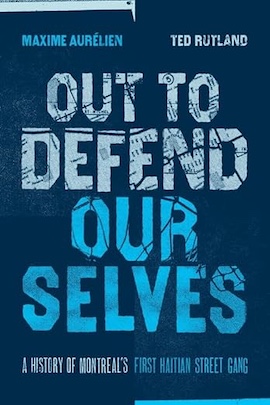

Maxime Aurélien and Ted Rutland, Out to Defend Ourselves: A History of Montreal’s First Haitian Street Gang. Halifax, Canada: Fernwood Publishing, 2023. [ISBN: 978-1773635965, Paperback, 192 pages]
Out to Defend Ourselves is a hybrid autobiography and critical history written by Maxime Aurélien with Ted Rutland who provided collaborative authorship and academic analysis. Aurélien is the former leader of les Bélangers, Montreal’s first Haitian street gang. He is also the owner of Cash Content, a pawn shop and barbershop in Montreal’s east end. Rutland is a professor at Concordia University. His research and activism focus on the racial politics of urban planning and policing in Canadian cities. Dr. Rutland is also the author of Displacing Blackness: Planning, Power, and Race in Twentieth-Century Halifax (University of Toronto Press, 2018).
The work follows the life of Maxime Aurélien as an immigrant child in the 1970’s to the formation of les Bélangers. The gang’s name was derived from a local park, Parc Bélanger, with the youths gathering at it known as “les gars de Bélanger” (the Bélanger boys). It documents the lives of the gang members, crimes committed by (and against) the members, and how the police response (it is argued) changed the gang into a violent organization:
The book also details the public response to the les Bélangers and other early Haitian gangs. Describing this response as a moral panic, we show how the police and the media exaggerated the crime and violence of the gangs, presenting them as a threat to the city as a whole. This response shaped public attitudes, as well as the composition and activities of the gangs themselves. All these developments, from the development of the Haitian Montreal community to the police and media responses to the gangs, were central to this period in Montreal’s history and the making of the city we know today (p. 11).
Structure of the Book
The book consists of an introduction, six chapters, an epilogue on the etymology and history of “gang,” and endnotes. Throughout the book, Aurélien recalls his life in various points of his life with most centered on his time in les Bélangers. Meanwhile, Rutland provides his background as an academic and university professor in urban politics, planning, and security. The two authors work together to provide a holistic picture of Montreal urban life in the 1970s and 80s along with the central focus on les Bélangers combined with research from archives and interviews with former police, community members, and other members of les Bélangers to enhance and strengthen Aurélien’s experience.
A Gang History, Otherwise – Introduction: The introduction summarizes the issues and experience of les Bélangers. It also explains what the book is and how it is different from other biographical accounts. Small tastes of issues that occur throughout the book such as police and media misuse, differences in what a “gang” represents, racial treatment and profiling, and economic hardships are offered to the reader. Finally, the story of how the authors met and came together to form the book is discussed.
Landscapes of Community, Racism, and Violence – Chapter 1: The beginnings of the life of Maxime Aurélien are laid bare. Aurélien reveals his life from birth in 1960’s Haiti and the life he experienced as a child under the Duvalier dictatorship during an out-migration wave. He then explains his new life in Montreal in the late 70’s, ending with “The Parc Bélanger Affair,” one of many-to-come police violence against the Haitian community which caused the spark for les Bélangers.
The Bélanger Boys – Chapter 2: Maxime recalls the formation of the gang: His friends he made as a youth, using basketball as a social gathering, and city traversal conduit centered on Parc Bélanger as the central location. The group traveled around Montreal and created their own identity, noting differences from their parents’ generation of Haitians, the rise of hip hop and clubbing, and racism.
Out to Defend Ourselves – Chapter 3: Maxime and his friends get fed up with the racism they are experiencing and take a stand. Notable battles in many neighborhoods between Haitians and whites occur, some approaching the thousands of people. Les Bélangers begin their defense by standing up to white racists in the subway and jumping them when Maxime is punched in the face. The defense of les Bélangers begins to snowball as the presence of racism lessens and other Haitians call on the group for defense. Maxime ends up in prison due to a confrontation gone wrong.
Paying the Rent – Chapter 4: This chapter explains the role of crime and its effect on Maxime and the Haitian community in Montreal. Maxime notes how petty crime helped people survive and stay afloat in a hostile and inequal environment. He also recalls the humiliation of looking for a legitimate job as a non-white person, with employers rejecting Maxime or making up an excuse when they saw the color of his skin. Maxime also details the differences in crimes and people who would later branch out to pursue higher level crimes such as drugs with the Montreal mafia or pimping.
New Gangs and a Moral Panic – Chapter 5: The success from les Bélangers inspires others in the Haitian community to form their own gangs, causing a “panic” amongst the white Montreal establishment. Maxime recounts the formation of other Haitian gangs such as “Master B” and “les Gwo Ponyéts.” This causes the media and police to begin reporting on the Haitians in an increasingly negative fashion. Unfairness between the lack of reporting and policing on white racists and criminals versus the Haitians are not lost on Maxime and Rutland. The recounting of these new gangs ends with encounters with Anglophone black gangs and then the eventual infighting between Haitian gangs.
The Death of les Bélangers – Chapter 6: The members of les Bélangers begin to split in different directions over a two-year period. Maxime ponders on what a gang is and its formation, such as when people come and go or when people change the nature and direction of the gang. He also laments on the effect of crack cocaine on the Black community. The police had many effects against the gang such as causing heightened conflicts between gangs, putting pressure on gangs to pursue profit-based criminality, and inter-gang disagreements, ending the chapter with the split between Maxime and one of the most notorious Montreal gangsters.
What is a Gang? – Epilogue: The term “gang” and its history through the lens of Montreal is explored in-depth. Rutland shows how “gang” is only applied to black people in Montreal’s historical record. Any white people engaged in similar crimes were entirely ignored by law enforcement due to pervasive racism and social inequality. The chapter ends by recounting the fates of members of les Bélangers.
Analysis and Critique
The book functions as a memoir enhanced with data-driven historical data that binds the first-person experience of a Haitian immigrant to the documented history of Montreal. The greatest strength of the book is the two-in-one teaming of the authors. The “bread and butter” of the memoir are laid bare by Maxime Aurélien, who gives his first-person account and insights into Haitian immigration, Montreal’s racism, and hardships as a result. Ted Rutland supplements Aurélien’s experience and insights with his knowledge and work of racial politics and urban policing. The book is supported by over two hundred endnotes made up of newspaper articles, interviews, academic journals, and related publications. They allow for further research if a better understanding of Aurélien’s life is desired. While the book achieves what it sets out to do in the introduction chapter, there is a missed opportunity from the authors on answering “Has any of the hardships or problems thrust upon Haitian immigrants in Montreal changed in the present day?” With a publication date of 2023, very little is said about the central themes from late 2010’s onwards making the work more historical than contemporary in nature.
Conclusion
Out to Defend Ourselves: A History of Montreal’s First Haitian Street Gang is an original and enhanced memoir that successfully blends first-person narrative account with critical urban scholarship on Montreal’s history. The book challenges the mainstream narrative about gangs, race, and public safety by exposing how media and law enforcement—especially the policy of pervasive harassment—played key roles in racializing and criminalizing Black communities during the 1970s-80s Montreal. At the same time, the work walks a fine line, as it may stray into apologist narratives concerning the criminality embraced by les Bélangers members. For this reason, it needs to be read with an open and evaluative mind.
El Centro readers can additionally draw upon the work “Third Generation Gangs Subject Bibliography No. 2: Haitian Gangs” for further resources and publications focusing on Haitian gangs.


