





Office of Strategic Services: Co-opting a Legacy or the Third Special Operations Revolution?


The United States needs forces that can help win a major war and compete effectively before one begins. Adversaries exploit political divisions, intimidate partners, cultivate proxies, and manipulate information to advance their interests. Military strength remains essential, but its strategic value depends on connecting it to political purpose.
Secretary Pete Hegseth’s November 2, 2026, memorandum elevating special operations leadership merits support. It can strengthen civilian oversight and protect capabilities suited to this competitive environment. Restoring the Office of Strategic Services (OSS) name offers an opportunity to connect institutional reform with a broader strategic tradition. The central question is whether stronger civilian leadership will enable special operations forces (SOF) to conduct sustained campaigns of strategic importance while remaining prepared to support the joint force in large scale combat operations.
An important caveat applies: the full institutional transformation assessed here depends on Congress enacting the necessary legislation, an outcome that remains uncertain. Friction between Congress and the Pentagon could prevent passage of the legislation required to establish the proposed under secretary and make the statutory changes enduring. Several administrative measures can proceed under existing authority, subject to applicable funding and personnel requirements. Congress remains essential to completing and sustaining the larger reform.
The Unfinished Third Revolution
In 2020, two SOF revolutions were described with a third proposed. The first was the establishment of OSS in 1942. The second followed the Nunn-Cohen reforms of 1986 and the activation of U.S. Special Operations Command (USSOCOM) in 1987. Congress created a distinctive organization combining combatant command responsibilities with service-like functions and dedicated resources.
The third revolution proposal called for empowered civilian leadership with the organization and institutional standing necessary to oversee SOF effectively. It also emphasized professional accountability, treating advocacy and rigorous oversight as complementary responsibilities.
The current memorandum does not adopt that proposal in full, including its provisions for a separate department and changes to military representation and command arrangements. It advances a central principle: responsibility must be accompanied by the capacity to exercise it. A May 2025 argument for SOF representation on the Joint Chiefs similarly addressed the importance of sustained influence in senior decisions. The memorandum’s civilian leadership provisions could advance that institutional objective.
What the Reforms Can Deliver
The memorandum authorizes the secondary title Assistant Secretary of War for the Office of Strategic Services for the official currently designated Assistant Secretary of War for Special Operations and Low-Intensity Conflict (ASW(SO/LIC)). It directs legislative proposals for a permanent Under Secretary of Strategic Services, elevates departmental precedence, and directs the integration of the office alongside the military department secretariats. Permanent statutory status remains subject to congressional action.
The memorandum directs at least $45 million annually for office operations, 75 additional civilian billets, including at least five Senior Executive Service positions, and 25 additional military billets. Civilian labor costs are separate from the specified operating funds. These resources support civilian institutional capacity rather than an equivalent expansion of operational forces.
Effective oversight requires personnel who can assess requirements, examine investment choices, and challenge assumptions. A civilian office cannot perform those functions through title or personal access alone. The Government Accountability Office (GAO) documented staffing shortfalls and unclear administrative arrangements, establishing an institutional basis for the reform.
The requirement to seek the office’s concurrence on budget matters affecting SOF could bring informed scrutiny to decisions made elsewhere in the department. A dedicated SOF portfolio within Cost Assessment and Program Evaluation could provide more focused analysis. Participation in senior leadership forums could give the civilian advocate an earlier opportunity to explain the consequences of competing choices.
These provisions build on congressional direction. Section 922 of the FY2017 National Defense Authorization Act strengthened SO/LIC’s service-like civilian role, and Section 907 of the FY2025 act directed further institutional implementation. The memorandum provides a framework for translating those responsibilities into routine departmental practice, combining informed scrutiny of the special operations enterprise with advocacy for appropriate support.
The proposed reforms build on a bipartisan institutional inheritance. Democratic administrations presided over the creation of the OSS, Army Special Forces, and Navy SEALs. A Republican administration and divided Congress established the modern special operations framework, while subsequent administrations and congressional majorities strengthened its authorities and civilian oversight. The present opportunity is to complete that unfinished work through durable legislation, adequate resources, and sustained accountability. The decisive question is whether the reforms will preserve and employ the full strategic value of SOF across competition, crisis, and war. Annex A documents the principal milestones and the party controlling the presidency, House, and Senate when each action occurred.
Directions concerning acquisition, service-common platforms, combat-loss replacement, and strategic guidance address practical readiness needs. SOF depends on support supplied by the military departments. Greater civilian influence can help resolve gaps while preserving the USSOCOM commander’s statutory responsibilities.
The provisions could improve America’s competitive position by sustaining preparation that immediate demands often displace. Language proficiency, regional expertise, and trusted partnerships develop over years, and their strategic value may become apparent only during a crisis. A stronger office could protect that preparation while assessing its contribution to national objectives.
The Political Warfare Test
RAND’s July 2018 study “An American Way of Political Warfare: A Proposal” examined why tactical success had too often failed to produce durable political outcomes. The authors proposed a capability integrating irregular warfare, expeditionary diplomacy, and covert political action, supported by a national center for research and education. They identified presidential leadership, congressional backing, and cooperation across government as essential conditions for success. The Congressional Research Service subsequently cited the proposal.
To what extent does the memorandum address these challenges?
It addresses an important military institutional weakness, but it does not establish the broader national capability envisioned in the RAND proposal. It strengthens the office’s administrative standing without granting a new mandate to direct diplomacy, intelligence, or economic statecraft. Realizing its strategic potential therefore requires connecting a better prepared military contribution to nationally directed campaigns.
Build Mastery Above the Tactical Level
Subsequent writings in The Hill examined the intellectual and organizational requirements for effective irregular warfare. A November 2022 article identified the Irregular Warfare Center as an opportunity to strengthen research and professional education. A December article emphasized the need for mastery above the tactical level.
A March 2023 essay examined the concepts and institutional responsibilities needed to realize irregular warfare’s potential in strategic competition. It considered empowering SO/LIC to address the human dimension of conflict.
The elevated office could connect these intellectual efforts to force development through cooperation with the Irregular Warfare Center, USSOCOM, military education institutions, universities, and civilian practitioners. Research should inform doctrine, exercises, personnel development, and assessment, while operational experience should test and refine concepts.
Additional staff capacity would improve strategic effectiveness only if accompanied by the expertise to distinguish among problems and prepare appropriate capabilities. Proficiency in raids does not automatically establish competence in campaigns involving legitimacy, resistance, governance, and competing political interests.
Protect the Full Special Warfare Contribution
The two Special Warfare trinities provide a framework for preserving this breadth, particularly for Special Forces, Psychological Operations, and Civil Affairs within the larger SOF enterprise.
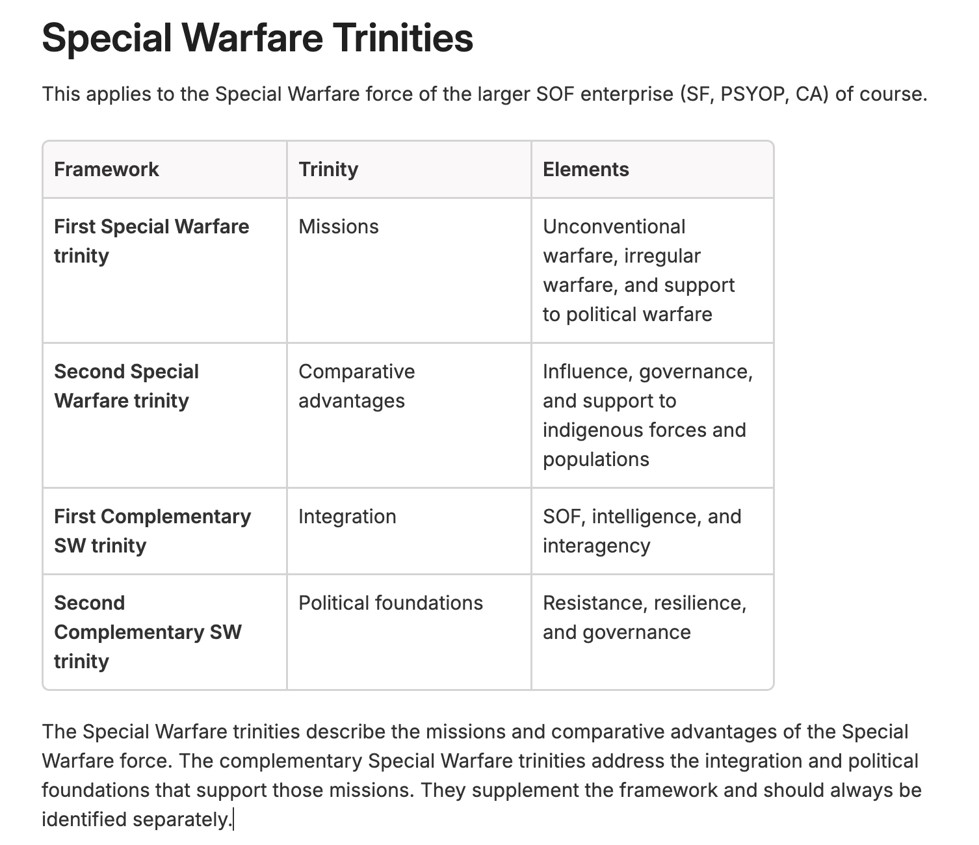
The first Special Warfare trinity concerns missions: unconventional warfare, irregular warfare, and support to political warfare. These overlapping concepts connect military action to political purpose. The second identifies comparative advantages: influence, governance, and support to indigenous forces and populations. These advantages require an understanding of whose choices matter and what shapes them.
Two complementary Special Warfare trinities support this framework. The first concerns the integration of SOF, intelligence, and interagency partners. The second concerns resistance, resilience, and governance, the political foundations that affect whether societies withstand pressure and whether gains endure.
The article “Unconventional Warfare: Solving Complex Political-Military Problems” emphasizes the political context of the problem being addressed. Institutional reform should preserve the ability to develop appropriate options rather than channel every problem toward familiar activities.
During competition, those options might strengthen partners, contest coercion, or support authorized resistance preparation. During war, Special Warfare can connect joint operations with indigenous knowledge, influence, and resistance. Following combat, it can support legitimate authorities and civil-military coordination. The appropriate contribution depends on policy, conditions, and authorities.
The essay “Do Not Jettison Low Intensity Conflict Unless You Replace It with Irregular Warfare” argues that changing a title must preserve responsibility for the missions it represents. The implementing charter and legislation should explicitly sustain the broader irregular warfare policy function alongside SOF administration.
Compete Persistently and Prepare to Fight
Strategic competition is the broader relationship among actors pursuing their interests. The gray zone describes ambiguous conditions and activities. Neither term supplies a strategy. National leaders must establish objectives, choose approaches, and organize sustained action.
A 2024 national strategy proposal and a modern national security decision directive proposal called for presidential guidance connecting objectives, responsibilities, resources, and assessment. A stronger secretariat could help the department implement such direction.
This logic applies in the Asia Pacific, where coercion against allies and partners can affect multiple regional contingencies. Persistent relationships and regional understanding can create options for competition and strengthen preparations for war.
SOF must also prepare for denied access, contested communications, sophisticated surveillance, and capable enemy forces. Contributions to reconnaissance, targeting, partner operations, and resistance support require realistic integration with joint plans. Readiness for those demands cannot be assumed.
The office should ensure that wartime preparation and sustained competition receive deliberate attention. Preserving language proficiency, political understanding, and indigenous relationships would strengthen capabilities useful in both settings. Modernization should develop human expertise alongside technology.
A hypothetical partner facing foreign disinformation, coercive economic pressure, and proxy intimidation illustrates the relationship between institutional capacity and strategic employment. A response could combine diplomatic engagement, exposure of hostile activity, assistance to legitimate institutions, and military support appropriate to the threat. Special Warfare could contribute regional understanding, advisory relationships, and authorized influence capabilities. A stronger secretariat could sustain the preparation required for that contribution, while national direction would align it with other instruments of power. The potential benefit is a more executable national strategy with clearly defined military and civilian responsibilities.
Earn the OSS Inheritance
The OSS name can encourage this broader perspective. Its wartime contributions included intelligence analysis, espionage, counterintelligence, psychological operations, innovation, and indigenous resistance support. Its inheritance is shared by SOF, the Central Intelligence Agency (CIA), and other intelligence community institutions.
The 1942 founding order placed OSS under the Joint Chiefs of Staff. The current memorandum does not establish an equivalent integrated intelligence and operational organization. Neustadt and May’s Thinking in Time provides a useful analytical discipline: examining the historical conditions that enabled effectiveness before assuming that adopting a historic name would reproduce it.
The “Office of Strategic Disruption” proposal and the “Political Warfare Service 2.0” argument envisioned a broader integrating capability. The elevated secretariat could become a stronger military participant in such an arrangement, but the memorandum does not itself establish that capability.
“The Missing Framework” summarizes a related political warfare argument: a national mechanism is needed to connect political objectives to coordinated actions and budgets. Clarifying that responsibility would help translate the memorandum’s institutional gains into strategic effectiveness.
Make the Opportunity Endure
Implementation should establish a durable charter preserving the full policy mission and clear relationships with USSOCOM and the services. Concurrence procedures need deadlines and dispute-resolution mechanisms to strengthen oversight without creating avoidable delay.
Consultation with the Department of State, CIA, the Office of the Director of National Intelligence (ODNI), and departmental intelligence leadership should clarify responsibilities, information sharing, and campaign support. The memorandum does not establish whether earlier consultation occurred. Implementation should make these arrangements explicit while respecting existing authorities.
Staffing should combine resource and acquisition expertise with Special Warfare knowledge, regional understanding, and campaign experience. The essay “Where Is Our JFK?” emphasizes the need for senior leaders to champion these capabilities. Such sponsorship is important, but institutional support must endure through leadership changes.
A significant counterargument is that additional staff resources could increase costs and delay decisions without improving outcomes. Evaluation should therefore examine readiness, timely support, professional accountability, and the quality of strategic options. Campaign assessments should measure progress toward political objectives and consider competing explanations for apparent gains.
Strategic effectiveness also requires legitimacy at home. A 2025 essay on domestic division and adversary exploitation emphasizes the importance of lawful boundaries. Foreign political warfare must not become a rationale for treating domestic political opponents as military enemies.
A Revolution Worth Completing
The reforms could improve America’s ability to compete and prepare SOF to contribute to major war by strengthening an institutional foundation that has too often depended on personal advocacy and incomplete implementation. Their value would lie in more effective stewardship of capabilities required by national strategy.
Congress should make the statutory changes enduring, while national leaders should connect the strengthened office to clear political objectives and integrated campaigns. Implementation should be judged by whether it produces better decisions, accountable leadership, and a force prepared for its full responsibilities.
The OSS name would acquire contemporary significance through those results. A third special operations revolution should give national leaders more credible options to contest coercion, strengthen allies, support indigenous partners, and prevail when war becomes necessary. The memorandum provides an opportunity to advance that transformation and warrants sustained congressional and departmental support.
Annex A
Political control at major SOF institutional milestones
Assessment through November 14, 2026. The record documents major institutional actions, operational authorities, and oversight reforms, rather than every SOF-related appropriation, equipment provision, or unit activation. Party control identifies the government in office; it does not establish authorship, advocacy, opposition, or exclusive credit.
D = Democratic; R = Republican. House and Senate entries identify the party exercising majority control on the relevant date. Dates refer to enactment or implementation, rather than the fiscal year in an NDAA title. Party-control data for all rows are drawn from source A1; action-specific sources appear in the final column. The 2026 elections do not change control of the sitting 119th Congress before the next Congress convenes. Column headings H and S denote the House and Senate, respectively.
Foundational institutions from 1942 through 1990
| Date | Action and significance | Administration | H | S | Sources |
| June 13, 1942 | OSS created by presidential military order under the Joint Chiefs of Staff. | Roosevelt D | D | D | A2 |
| Sept.–Oct. 1945 | OSS terminated by Executive Order 9621; functions transferred. Order signed September 20, effective October 1. | Truman D | D | D | A3 |
| June 1952 | 10th Special Forces Group established at Fort Bragg through Army organizational action. | Truman D | D | D | A4 |
| 1961–1962 | Kennedy champions Special Forces expansion and recognition of the green beret. | Kennedy D | D | D | A5 |
| January 1962 | Navy establishes SEAL Teams ONE and TWO. | Kennedy D | D | D | A6 |
| 1974 | Modern 1st and 2nd Ranger battalions activated across the Nixon–Ford transition. | Nixon/Ford R | D | D | A7 |
| Oct. 22, 1980 | Joint Special Operations Command established following the Iran hostage-rescue failure. | Carter D | D | D | A8 |
| October 1984 | Ranger regimental headquarters and 3rd Battalion activated. | Reagan R | D | R | A9 |
| Oct. 1, 1986 | Goldwater-Nichols Act, Public Law 99-433, strengthens joint defense arrangements. | Reagan R | D | R | A10 |
| Nov. 14, 1986 | Nunn-Cohen, FY1987 NDAA Section 1311, requires a unified SOF command and establishes SO/LIC and dedicated resource arrangements. | Reagan R | D | R | A11 |
| April 16, 1987 | USSOCOM and Naval Special Warfare Command activate. Senate control changed before implementation. | Reagan R | D | D | A8, A12 |
| Dec. 1, 1989 | U.S. Army Special Operations Command activates. | G. H. W. Bush R | D | D | A13 |
| May 22, 1990 | Air Force Special Operations Command activates. | G. H. W. Bush R | D | D | A14 |
Operational expansion and authorities from 2001 through 2018
| Date | Action and significance | Administration | H | S | Sources |
| Sept. 18, 2001 | AUMF, Public Law 107-40, supplies a central legal foundation for post-9/11 military operations, including SOF. Applies to the Armed Forces generally. | G. W. Bush R | R | D | A15 |
| 2004 | Unified Command Plan expands USSOCOM global counterterrorism planning and operational responsibilities. | G. W. Bush R | R | R | A8 |
| Oct. 28, 2004 | FY2005 NDAA Section 1208 authorizes partner support for ongoing U.S. SOF counterterrorism operations. | G. W. Bush R | R | R | A16 |
| Feb. 24, 2006 | Marine Forces Special Operations Command activates. | G. W. Bush R | R | R | A8 |
| Dec. 2008 | Initial DoD Directive 3000.07 establishes department-wide irregular warfare policy. | G. W. Bush R | D | D | A17 |
| 2013 | TSOCs assigned to USSOCOM for organizing, training, and equipping; geographic commanders retain operational employment arrangements. | Obama D | R | D | A8 |
| Aug. 2014 | DoD Directive 3000.07 reissued, continuing and updating irregular warfare policy. | Obama D | R | D | A17 |
| Nov. 25, 2015 | FY2016 NDAA Section 1097 requires a strategy to counter adversarial unconventional warfare. | Obama D | R | R | A18 |
| Dec. 23, 2016 | FY2017 NDAA Section 922 strengthens SO/LIC administrative responsibilities and its role in the SOF administrative chain of command. | Obama D | R | R | A19 |
| Dec. 23, 2016 | FY2017 NDAA Section 1203 codifies counterterrorism partner-support authority in 10 U.S.C. §127e, succeeding Section 1208. | Obama D | R | R | A19 |
| Dec. 12, 2017 | FY2018 NDAA Section 1202 establishes partner-support authority for ongoing and authorized U.S. SOF irregular warfare operations. | POTUS R | R | R | A20 |
| Aug. 13, 2018 | FY2019 NDAA Sections 914, 917, and 1066 require USSOCOM review, an oversight implementation deadline, and ethics and professionalism review. | POTUS R | R | R | A21 |
Oversight and irregular warfare institutionalization from 2020 through 2026
| Date | Action and significance | Administration | H | S | Sources |
| October 2020 | IW Annex summary to the 2018 National Defense Strategy released publicly; articulates an enduring IW requirement beyond counterterrorism and counterinsurgency. | POTUS R | D | R | A22 |
| Nov. 18, 2020 | Acting Secretary Miller directs SO/LIC elevation and direct reporting to the secretary, implementing congressional oversight reforms. | POTUS R | D | R | A23 |
| Jan. 1, 2021 | FY2021 NDAA Section 902 clarifies direct administrative reporting and establishes the Secretariat for Special Operations. Enacted over veto. | POTUS R | D | R | A24, A33 |
| Jan. 1, 2021 | FY2021 NDAA Section 1299L requires assessment and conditionally authorizes an irregular warfare functional center. Enacted over veto. | POTUS R | D | R | A24, A33 |
| May 5, 2021 | Austin returns SO/LIC to the policy organization while retaining direct reporting to the secretary for its SOF administrative chain-of-command role. | Biden D | D | D | A25 |
| July–Oct. 2022 | Irregular Warfare Center established; reaches initial operating capacity October 31. | Biden D | D | D | A26, A35 |
| Dec. 23, 2022 | FY2023 NDAA Section 1204 revises authorities to provide for the IW Center and Regional Defense Fellowship Program. | Biden D | D | D | A27 |
| Dec. 22, 2023 | FY2024 NDAA Section 1201 codifies SOF IW partner-support authority as 10 U.S.C. §127d, succeeding Section 1202. | Biden D | R | D | A28 |
| Dec. 23, 2024 | FY2025 NDAA Sections 907–908 direct further SO/LIC institutionalization, workforce planning, analytical support, and SOF force-development guidance. | Biden D | R | D | A29 |
| Dec. 18, 2025 | FY2026 NDAA Sections 1094 and 1204 authorize an IW Exercise Laboratory and revise the designated official in the IWC oversight provision to SO/LIC. | POTUS R | R | R | A30 |
| Nov. 2, 2026 | Hegseth memo directs SO/LIC elevation and use of the OSS secondary title; seeks legislation for a permanent under secretary. Announced November 12. | POTUS R | R | R | A31, A32 |
Notes:
Political control is context rather than a measure of exclusive partisan credit. The OSS was established under a Democratic president and led by Republican William Donovan. Nunn-Cohen brought together Democratic Senator Sam Nunn, Republican Senator William Cohen, and Democratic Representative Dan Daniel. Congress enacted the SOF-specific provision in the FY1987 NDAA in November 1986, separately from the Goldwater-Nichols Act; the change in Senate control occurred before USSOCOM activated in April 1987. [A1–A3, A10–A12, A36–A38]
The FY2021 NDAA became law during a Republican administration, with a Democratic House and Republican Senate, after Congress overrode the presidential veto. The Senate completed the override 81–13 on January 1, 2021. This was congressional enactment over a veto of the full NDAA; the veto alone does not establish opposition to its SOF provisions. Austin’s May 2021 decision subsequently changed organizational placement but retained SO/LIC’s direct administrative reporting relationship with the secretary. [A24–A25, A33]
The 2026 memorandum combines departmental implementation measures with proposals requiring legislation. Its proposed permanent under secretary should not be recorded as an enacted statutory office. The broader historical pattern supports bipartisan institution building, while repeated oversight reforms and GAO findings show that passage of legislation does not ensure complete implementation. [A19, A21, A24, A29, A31–A34]
Annex A source notes
Sources A1–A38 support the chronology and qualifications. These notes supplement the essay’s reference list. Online sources were consulted November 14, 2026. Official military and congressional histories are used for organizational milestones; public laws establish enactment dates and statutory provisions.
A1. U.S. House of Representatives, Office of the Historian. “Party Government Since 1857.” https://history.house.gov/Institution/Presidents-Coinciding/Party-Government/?lv=true
A2. National Archives. “Timeline,” OSS records. June 13, 1942, founding order. https://www.archives.gov/research/military/ww2/oss/timeline
A3. Truman, Harry S. Executive Order 9621, September 20, 1945. Effective October 1, 1945. https://www.presidency.ucsb.edu/documents/executive-order-9621-termination-the-office-strategic-services-and-disposition-its
A4. USASOC History Office. “A Timeline of U.S. Army Special Operations Forces.” https://arsof-history.org/arsof_timeline/index.html
A5. U.S. Army. “The Green Berets and Kennedy: Two Legacies Forever United.” 2019. https://www.army.mil/article/229902/the_green_berets_and_kennedy_two_legacies_forever_united
A6. Naval Special Warfare Command. “History.” SEAL Teams ONE and TWO, January 1962. https://www.nsw.navy.mil/ABOUT-US/History/
A7. U.S. Army. “U.S. Army Rangers,” heritage overview. https://www.army.mil/Ranger/heritage.html
A8. Feickert, Andrew. U.S. Special Operations Forces (SOF): Background and Issues for Congress. CRS RS21048, May 6, 2021 edition. Includes TSOC assignment, global roles, and component histories. https://www.everycrsreport.com/files/2021-05-06_RS21048_e71af6acb51edd517d94817d0154f4505cc81572.html
A9. U.S. Army. “75th Ranger Regiment Celebrates 30 Years of Service.” October 2014. https://www.army.mil/article/135693/75th_ranger_regiment_celebrates_30_years_of_service
A10. Reagan, Ronald. “Statement on Signing the Goldwater-Nichols Department of Defense Reorganization Act of 1986.” October 1, 1986. Public Law 99-433. https://www.reaganlibrary.gov/archives/speech/statement-signing-goldwater-nichols-department-defense-reorganization-act-1986
A11. United States. FY1987 NDAA, Public Law 99-661, Section 1311, November 14, 1986. Source and statutory notes to 10 U.S.C. §167. https://uscode.house.gov/us/usc/119-118/t10/s167/
A12. USSOCOM Public Affairs. “USSOCOM Celebrates Its 30th Anniversary.” April 19, 2017. Source
A13. U.S. Army. “The Upward Spiral Continues: U.S. Army Special Operations Command Celebrates 35 Years.” November 2024. https://www.socom.mil/Pages/USSOCOM-celebrates-its-30th-anniversary.aspx
A14. USSOCOM. “AFSOC.” Establishment date May 22, 1990. https://www.socom.mil/Pages/afsoc.aspx
A15. United States. Authorization for Use of Military Force, Public Law 107-40, September 18, 2001. https://www.govinfo.gov/content/pkg/PLAW-107publ40/html/PLAW-107publ40.htm
A16. United States. FY2005 NDAA, Public Law 108-375, Section 1208, October 28, 2004. https://www.govinfo.gov/content/pkg/PLAW-108publ375/html/PLAW-108publ375.htm
A17. U.S. Department of Defense. DoD Directive 3000.07, “Irregular Warfare,” August 28, 2014, incorporating Change 1, May 12, 2017. Reissues the December 1, 2008, directive. https://www.esd.whs.mil/Portals/54/Documents/DD/issuances/dodd/300007p.pdf
A18. United States. FY2016 NDAA, Public Law 114-92, Section 1097, November 25, 2015. https://www.govinfo.gov/content/pkg/PLAW-114publ92/html/PLAW-114publ92.htm
A19. United States. FY2017 NDAA, Public Law 114-328, Sections 922 and 1203, December 23, 2016. https://www.govinfo.gov/content/pkg/PLAW-114publ328/html/PLAW-114publ328.htm
A20. United States. FY2018 NDAA, Public Law 115-91, Section 1202, December 12, 2017. https://www.govinfo.gov/content/pkg/PLAW-115publ91/html/PLAW-115publ91.htm
A21. Feickert, Andrew. U.S. Special Operations Forces (SOF): Background and Issues for Congress. CRS RS21048, March 28, 2019 edition. Discusses FY2019 NDAA Sections 914, 917, and 1066. https://www.everycrsreport.com/files/20190328_RS21048_c1a317cdcc6dc57f25646d1e471f8ea77106f432.html
A22. U.S. Department of Defense. Irregular Warfare Annex to the National Defense Strategy, unclassified summary, 2020. https://media.defense.gov/2020/Oct/02/2002510472/-1/-1/0/Irregular-Warfare-Annex-to-the-National-Defense-Strategy-Summary.PDF
A23. Vergun, David. “Special Operations Leader to Report Directly to Acting Defense Secretary.” DoD News, November 18, 2020. https://www.war.gov/News/News-Stories/Article/article/2419154/special-operations-leader-to-report-directly-to-acting-defense-secretary/
A24. United States. FY2021 NDAA, Public Law 116-283, Sections 902 and 1299L, January 1, 2021. https://www.govinfo.gov/content/pkg/PLAW-116publ283/html/PLAW-116publ283.htm
A25. U.S. Department of Defense. “DOD Optimizes Organizational Role of the Assistant Secretary of Defense for Special Operations and Low-Intensity Conflict.” May 5, 2021. https://www.defense.gov/News/Releases/Release/Article/2596682/dod-optimizes-organizational-role-of-the-assistant-secretary-of-defense-for-spe/
A26. Irregular Warfare Center. “The Irregular Warfare Center Announces Initial Operational Capacity.” October 31, 2022. See also Senate Report 118-58 on the July 28, 2022, establishment memorandum. https://irregularwarfarecenter.org/news/the-irregular-warfare-center-announces-initial-operational-capacity/
A27. United States. FY2023 NDAA, Public Law 117-263, Section 1204, December 23, 2022. https://www.govinfo.gov/content/pkg/PLAW-117publ263/html/PLAW-117publ263.htm
A28. United States. 10 U.S.C. §127d, added by FY2024 NDAA, Public Law 118-31, Section 1201, December 22, 2023. https://uscode.house.gov/us/usc/119-120/t10/s127d/
A29. United States. FY2025 NDAA, Public Law 118-159, Sections 907 and 908, December 23, 2024. https://www.govinfo.gov/content/pkg/PLAW-118publ159/html/PLAW-118publ159.htm
A30. United States. FY2026 NDAA, Public Law 119-60, Sections 1094 and 1204, December 18, 2025. https://www.govinfo.gov/content/pkg/PLAW-119publ60/html/PLAW-119publ60.htm
A31. Hegseth, Pete. “Elevation of Assistant Secretary of War for Special Operations and Low-Intensity Conflict and Strengthening Departmental Support of the Special Operations Enterprise.” November 2, 2026. https://media.defense.gov/2026/Nov/06/2004024473/-1/-1/1/ELEVATION-OF-ASSISTANT-SECRETARY-OF-WAR-FOR-SPECIAL-OPERATIONS-AND-LOW-INTENSITY-CONFLICT.PDF
A32. Mehta, Aaron. “Hegseth Seeks to Elevate Top SOF Civilian to Service-Secretary Equivalent.” Breaking Defense, November 12, 2026. https://breakingdefense.com/2026/11/hegseth-seeks-to-elevate-top-sof-civilian-to-service-secretary-equivalent/
A33. U.S. Senate. Roll Call Vote 292, 116th Congress, second session, January 1, 2021. FY2021 NDAA veto override, 81–13. https://www.senate.gov/legislative/LIS/roll_call_votes/vote1162/vote_116_2_00292.htm
A34. U.S. Government Accountability Office. Special Operations Forces: Documented Policies and Workforce Planning Needed to Strengthen Civilian Oversight. GAO-24-106372, March 4, 2024. https://www.gao.gov/products/gao-24-106372
A35. U.S. Senate Committee on Armed Services. Senate Report 118-58, FY2024 NDAA. “Irregular Warfare Functional Center.” https://www.govinfo.gov/content/pkg/CRPT-118srpt58/html/CRPT-118srpt58.htm
A36. National Park Service. “William J. Donovan.” Documents Donovan’s Republican affiliation and Roosevelt’s selection of him. https://www.govinfo.gov/content/pkg/CRPT-118srpt58/html/CRPT-118srpt58.htm
A37. United States. Congressional Record, April 17, 1997. Tribute to USSOCOM identifies Republican William Cohen and Democrat Sam Nunn. https://www.congress.gov/105/crec/1997/04/17/CREC-1997-04-17.pdf
A38. U.S. House of Representatives, Office of the Historian. “Daniel, Wilbur Clarence (Dan).” https://history.house.gov/People/Detail/11876


Commenting is available to active SWJ members and staff.