




The Good Neighbor Initiative: Birth of a Pan-American Defense Service to Defend the Home Hemisphere by Air, Land, and Sea

Introduction
The United States enjoys a unique geographic advantage compared to other great powers: two oceans surround it, and it lacks powerful adversaries in its immediate orbit. Bismarck recognized this tremendous fortune, calling the US “very lucky” to be “bordered to the north and south by weak neighbors and to the east and west by fish.” The US must further leverage this advantage to create a regional coalition to advance its goals.
A stable and cooperative neighborhood creates conditions for a secure Homeland and Home Hemisphere. Still, to succeed, the United States must be a good neighbor through clear-eyed, pragmatic steps that empower its partners to pursue their own initiatives rather than prolong their dependence. The US can do this by leveraging both hard and soft power, military basing revival and economic preferences, for example, as tools of national influence to build valued relationships and a coherent hemispheric defense architecture.
Through the Good Neighbor Initiative, the US can build the core of this defense ecosystem by creating a new military service devoted to defending the neighborhood. This service would combine the National Guard and the United States Coast Guard into a new entity postured to defend the Home Hemisphere by Air, Land, and Sea. The Pan-American Defense Service (PADS) would leverage enduring relationships between the 54 States, Territories, and District of Columbia and the sovereign nations of the Western Hemisphere through the existing State Partnership Program. These partnerships must be the cornerstone of any coherent national strategy due to undeniable organizational ties, a shared history, and common geography. Additionally, the Pan-American Defense Service (members known as Defenders) will rebrand a portion of the current National Guard as the Home Guard to act as its reserve. The Home Guard will operate in both Title 32 and State Active Duty status and be wholly responsive to the needs of the Governors, unencumbered by requirements to provide the Army and Air Force with combat power.
The Good Neighbor Initiative will also unify disparate Service Component Commands and Combatant Commands into one holistic defense framework that is fully integrated with allies and partners throughout the Home Hemisphere. A military service dedicated to defending the Western Hemisphere provides purpose, clarity, and direction for both US regional and national security. Creating a Pan-American Defense Service will enable the US to defend in depth and increase its international engagement with the friends that matter most.
Geography, Realpolitik, and the Home Hemisphere
The United States occupies a unique geographic position; its geopolitical competitors lie outside the Western Hemisphere, giving the US a topographic buffer. This buffer, and the tyranny of distance, enabled the United States to consolidate gains in relative peace, free from great-power competition in the hemisphere. By contrast, Germany (and, before unification, Prussia) was surrounded by great powers, leading Bismarck, the leading 19th-century champion of Realpolitik, to characterize geography as the “anchor” of a nation’s destiny. He understood that though policies would shift with the prevailing winds, a nation’s physical location could not move and therefore would dictate its enduring strategic calculus. This physical distance forces competitors and potential adversaries to expend treasure and time developing power-projection capabilities to convey power, influence, and legitimacy. However, the United States can no longer hide behind its oceans. The Pan-American Defense Service must act as the ultimate guarantor of hemispheric stability.
A Military Service Designed for the 21st Century
The United States’ geography may be its greatest strategic advantage, but it is also its principal vulnerability. The maritime commons serve as autostrade for illicit logistics, acting as arteries for Transnational Criminal Organizations (TCOs). Given the reality of state capture by TCOs (Venezuela, for example) and increasing adversary access to advanced technology such as small submarines and autonomous water-borne vehicles, the threat to the homeland is expanding. A greater diversity of non-state actors with state-like capabilities may rapidly outpace the US’s ability to defend multiple entry points along an extensive coastline. For example, the Sinaloa Cartel partners with illicit vessel manufacturers in Colombia to build submersible vehicles and then transport drugs through the Caribbean towards ports in Mexico and the United States.
This threat demands a new capability: a force structure dedicated to defending the Home Hemisphere. The Pan-American Defense Service, or PADS, is the logical conclusion to the path President Monroe started the US on in 1823. What began as boundary-setting between the “Old” and “New” Worlds became a vehicle for regional interventionism to prevent a Reconquista of the Home Hemisphere. Further evolution targeted Transnational Criminal Organizations and the stability of US’ neighbors. The next step is a true unity of effort between Washington and its neighborhood for the common defense of the Home Hemisphere.
A Common Defense
The safest way to defend the homeland is at standoff range, best achieved through a common hemispheric approach. If the US and its allies and partners can secure the Western Hemisphere against external actors, it places half the world at its side and contains principal adversaries to the other side of the globe. Achieving this level of integration across a massive geographic area demands a unified Service tailored to hemispheric defense.
The Pan-American Defense Service provides a unique combination of multi-domain expertise, combat power, and interdiction capabilities. Long-standing international relationships established through the National Guard’s State Partnership Program and ongoing multinational collaboration between the US Coast Guard and other hemispheric coastal navies form a foundation for a hemispheric defense force. The National Guard maintains permanent relations with 37 partner nations in the Home Hemisphere; these partners represent nearly 95% of the region’s sovereign nations. The natural next step is progressing from permanent, part-time security relationships to full-time defense partnerships.
As the Pan-American Defense Service (PADS) continues the State Partnership Program (SPP) mission, it will yield two critical outcomes: 1) Hemispheric relationships will improve through increased availability of full-time PADS personnel to execute integrated training with partners, and 2) a transfer of funding for the SPP back to the 54 States, Territories, and District of Columbia for use by the Home Guard. Additionally, PADS will enable the Army, Navy, and Air Force to reposition formations from the Western Hemisphere, long an economy-of-force theatre, to Combatant Commands in the Eastern Hemisphere. This repositioning will provide much-needed reinforcement to EUCOM, CENTCOM, AFRICOM, and PACOM. With China as the pacing threat, demand for resources in the Pacific theatre will only grow as great-power competition continues.
The Home Guard
Combining the National Guard and the Coast Guard into a new military service will not only create a unified force focused on defending the homeland but also increase support to Governors and State Commanders (formerly Adjutant Generals) where they need it most. Liberated from the obligation to provide the Army and Air Force with many of its best formations at a time not of a state’s choosing, Governors and State Commanders will have total control of their respective Home Guards.
As the National Guard transforms into the Pan-American Defense Service, M-Day personnel would elect to either become full-time members (Active Component) or remain in a part-time role as members of the Home Guard. This choice would also include current Adjutant Generals who would either become senior leaders in PADS or commanders of their respective states’ Home Guards. Maintaining an effective Reserve Component for the Pan-American Defense Service is critical to building a defense-in-depth that provides coverage from Buenos Aires to Boise.
Defending Forward and In-Depth
For the United States, the Western Hemisphere is the rock from which regional stability and global power projection spring. It comprises half the world and hosts many of the United States’ most critical allies in terms of trade volume, Canada, Mexico, and strategic terrain in Panama and Greenland. From the Arctic to Antarctica, the Home Hemisphere contains trade corridors, key infrastructure, trusted allies, partners, and friends, as well as avenues of approach to the homeland. Trade routes between the South and North American continents date back to before the Age of Discovery. No example of key infrastructure is greater than the Panama Canal, nor is there a better archetype of a quintessential, reliable ally in the small but mighty isthmian nation. Given these conditions, strategic adversaries seek to expand influence while Transnational Criminal Organizations (TCOs) exploit gaps and seams in the common defense.
Only an interconnected, hemisphere-centric defense-in-depth gives Washington the best chance to detect, disrupt, and marginalize threats before they reach the homeland. Layered, connected defenses, buoyed by mutually supporting positions, have historically outperformed single-point protection. Detection, disruption, and response across the threat space will buy time for friendly forces, increase the effort required of an adversary, and reduce their options. A Pan-American Defense Service would be best equipped to develop and exploit a fully integrated hemispheric defense architecture, leveraging the State Partnership Program and the rich relationships throughout the Home Hemisphere.
Engaging the Friends That Matter Most
The current State Partnership Program supports 116 partnerships; however, many are based in economy-of-force theaters such as AFRICOM. Ruthless prioritization, as directed in strategic guidance such as the 2025 National Security Strategy and the 2026 National Defense Strategy, demands that the United States focus its energies on the friends that matter most. Those friends are its neighbors in the Home Hemisphere, with whom Washington has some of its longest-standing and most fruitful relationships. Beyond the dozens of bilateral relationships energized by the State Partnership Program, opportunities exist to expand US influence through preexisting but underutilized relationship vehicles.
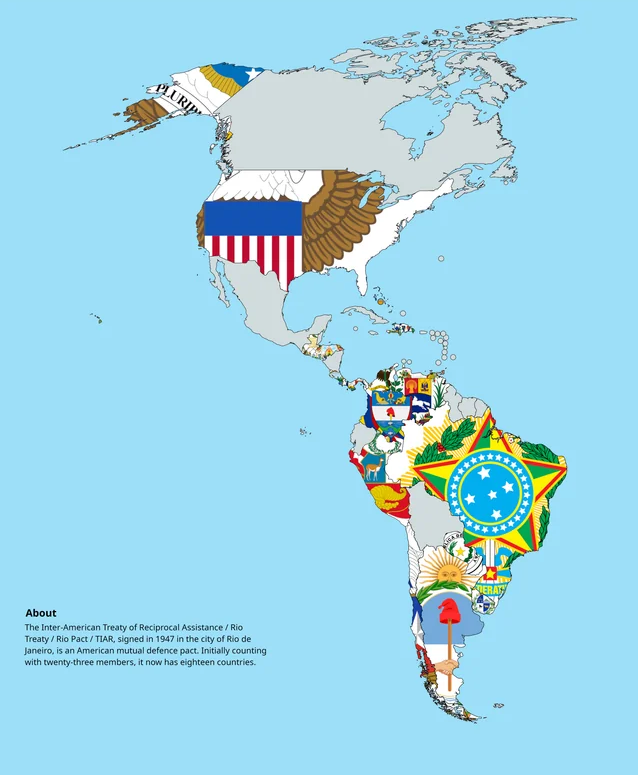
One of the most comprehensive (but underused) partnership networks in the Home Hemisphere is the Organization of American States (OAS), the world’s oldest regional organization. It was established to achieve an “order of peace and justice, to promote solidarity, strengthen collaboration and the sovereignty of member states.” Though the modern charter was signed in Bogotá in 1948, the idea of a hemispheric coalition dates to the “International Union of American Republics,” signed in Washington in 1889. The OAS serves as the primary diplomatic vehicle connecting most of the Americas, complementing simultaneous membership in the United Nations and other multilateral relationships. The OAS’s diplomatic function is balanced by the collective defense agreement known as the Inter-American Treaty of Reciprocal Assistance, or Rio Treaty. It is also expressed as Tratado Interamericano de Asistencia Recíproca, or TIAR. The Rio Treaty is historically significant as the world’s first treaty based on the principle of collective defense and for serving as the template for NATO’s Article Five.
Article Three of the Rio Treaty states “…an armed attack by any State against an American State shall be considered as an attack against all the American States…” This clause directly informed NATO’s “Article Five,” commonly expressed as “an attack against one is an attack on all.” The key difference between Rio and NATO is that Rio’s Article 20 retains specific language that “no State shall be required to use armed force without its consent.” Conversely, NATO’s integrated forces ensure a relatively rapid, interoperable, and standardized response by at least some members.
The practical value of the Rio Treaty is diminished by the ad hoc nature of member states’ expected responses and the fluctuating participation of several countries, including Mexico, Nicaragua, Bolivia, Ecuador, Venezuela, and Uruguay. Notably, Venezuela and Uruguay later rejoined the treaty. Competing geopolitical allegiances, such as the US supporting the UK during the Falkland Wars despite the invocation of Article Three, are also problematic. However, powerful bilateral relationships, specifically within the State Partnership Program, may be the key to reforging the blade that was broken and restoring the Inter-American Treaty of Reciprocal Assistance to its full vigor. To build an effective defense that features seamless connectivity and integration across sovereign nations, “Rio” must transform from a paper jaguar into a real animal.
Hemispheric Integration Through Education
To strengthen integration with US allies and partners in the Home Hemisphere, an expanded William J. Perry Center for Hemispheric Defense Studies will serve as the Pan-American Defense Service’s core college. The current center supports operational- and strategic-level leader development from partner nations within the Home Hemisphere. Spanish and English language requirements will ensure thoughtful dialogue and an accessible curriculum. The expanded Perry Center will include coursework curated to rank and responsibility focused on hemispheric defense and partner integration.
The Perry Center will work in tandem with the Western Hemisphere Institute for Security Cooperation (WHINSEC) located at Fort Benning. This combination will allow both US and international officers (principally from Latin America) to develop tactical, operational, and strategic skills. As Defenders complete foundational training at WHINSEC, they will flow unimpeded to the Perry Center for strategic education, as their career paths allow. This improved integration contributes to long-term relationships, interoperability, and professionalism. These intangibles add an invisible but important layer to the Home Hemisphere’s defense-in-depth.
The Good Neighbor Initiative
The Western Hemisphere is emerging as the decisive theater as US strategy completes a roughly 200-year circuit back to the days of a nascent Monroe Doctrine. Strategic guidance, beginning with the 2025 National Security Strategy, designates the Western Hemisphere as the principal region of interest. It is the number one priority of Homeland Defense and home to many of the United States’ top trading partners by volume. The Home Hemisphere is also the best place to build defense-in-depth through a comprehensive network of allies and partners that links strategic terrain with integrated forces. A hemispheric-focused service such as PADS will not only defend the homeland at standoff range but posture the US to identify and counter external threats through a “neighborhood watch.”
The Good Neighbor Initiative will capture opportunities the United States cannot afford to miss: chances to collaborate with its neighbors in ways consistent with strategic guidance, pursuing equal and eager partnerships. The initiative will also unify disparate Service Component Commands and Combatant Commands into one holistic defense framework that is fully integrated with allies and partners throughout the Home Hemisphere. By further tying into already strong allies in the Home Hemisphere, a well-supported United States can give developing partners a hand up rather than a handout. To meet the challenges of the current and future strategic environment, the neighbors of the Home Hemisphere must row and row together. The Pan-American Defense Service can be the vehicle to carry Washington and its closest friends to a place where everyone works, all are welcome, and the people have genuine cause for hope.
Disclaimer: The views and opinions expressed in this paper are those of the author alone and do not necessarily reflect the official policy, position, or endorsement of the Department of War, the National Guard Bureau, the U.S. Government, or any affiliated organization.


Commenting is available to active SWJ members and staff.