





Sarajevo and Vukovar to Kharkiv and Mariupol: The Evolution of Urbicide in Modern Warfare

Abstract:
Changes in how warfare is realized in the modern era are impossible to avoid. The advent of weaponized drones that are commercially available, AI-generated propaganda being disseminated on social media, and a large and seemingly ever-expanding kill-zone where combatants are being forced to disperse, as any movement could reveal one’s position. Despite these evolutions, the targeting of cities, their infrastructure, and inhabitants persist. This practice can bleed into wanton destruction of locales, leaving them unrecognizable and providing us with the term urbicide. Urbicide refers to the literal killing of the city or the deliberate targeting of urban spaces.
The term gained popularity during the Bosnian War from 1992-1995, where faith institutions were deliberately targeted, and ethnic enclaves repeatedly sought to be carved out; though, as this paper will present, this could arguably be predated by a year with the siege of Vukovar in an adjacent and interconnected conflict. It can also be applied retroactively to conflicts from the 20th century, including the bombings of Dresden, Stalingrad, and Warsaw, as well as the recent examples of Aleppo, Khartoum, and Gaza. For this paper, however, the focus will be on how the practice transpired in two of the cities most devastated by the Yugoslav conflicts, Sarajevo and Vukovar, and contrast those events with the Ukrainian cities Kharkiv and Mariupol, which have seen some of the most widespread destruction in the ongoing Russo-Ukrainian War.
This paper will, in part, track how urbicide has changed since those conflicts, specifically highlighting the transformation from torturous, drawn-out, ground-based sieges and heavy usage of artillery, mortars, and small arms between mismatched armies in Yugoslavia. It will contrast that with fighting in Ukraine involving rapid bombardment using a combination of ballistic/cruise missiles and drones, resulting in comprehensive urban annihilation. It will also make comparisons between the objective behind each practice of urbicide: ethnic cleansing, which featured the destruction of monuments or structures that were symbols of multi-ethnic coexistence, national identity, and religious affiliation during the Yugoslav wars, versus targeting statehood by erasing post-independence development that had occurred in Ukrainian cities, and making them unlivable via the razing of transport nodes, housing blocks, and critical infrastructure to prepare for reconstruction and Russification. The content discussed within this essay should not be taken as an attempt to determine guilt, attribute causation for violence that has occurred, or be used as an indicator for which of the various combatants holds the ‘moral high ground.’ Rather, it is intended to be used as a tool for comparison of how opposing sides apply the tactic of urbicide in pursuit of their wartime goals and the role of one-sided historical recollection.
Defining What Constitutes ‘Urbicide’
The term’s original meaning can be traced to urban redevelopment in the United States during the 1960s, whose aggressive nature left a heavy footprint on communities. Scholars, including Fernando Carrion Mena, have outlined it as the “liturgical murder of the city” and “actions that wipe out common life’s meaningful places.” Carrion Mena expands this by providing three categories: natural, anthropic, and symbolic. Within the latter, he contends that place naming holds immense value as an “urbicidal instrument” because it “kills the past and marks a new possession or domain.” American philosopher and Marxist writer Marshall Berman, who is cited by some as the individual who coined the term, situated it via the changes in his native community, the South Bronx, as part of the then New York Secretary of State Robert Moses’ redevelopment plan. Berman explains the pain of being forced to move in favor of a highway being built, trading in a park for a “storage dump,” and comparing what transpired in the South Bronx with unstable Biblical pagan cities.
In his book, Urbicide: The Politics of Urban Destruction, Martin Coward proposes that it be defined as a practice that destroys a city’s heterogeneity, a key component of urban spaces, by targeting the built-up environment. As an element that fosters shared spatiality, attacking structures helps to enable the ethnonationalist’s goals of homogenizing territory, and as he writes, “covering-over of a fundamental existential plurality.” Dr. Sebla Arin Ensarioğlu’s contribution could be said to advance on this line of inquiry by tying in how selective demolition of certain architectural styles helps to distort future historical narratives as pursued by the governing authority.
Coward lays out three “interpretative themes” for the assault on structures: military (also referred to as strategic in his PhD thesis), symbolic, and metaphorical, all of which he explains don’t quite address the act of urbicide as its own concept but attempt to contain it as a component or a secondary mention within one of these themes. This paper will briefly revisit the metaphorical theme during the discussion of the targeting of religious spaces or other structures that can be described as meaningful for a specific ethnic group. Later, in the introduction of a review of his book, Coward reaffirms his view that urbicide is a “distinct form of violence” but that we shouldn’t prioritize either violence against the built-up environment or violence against people because of their interconnected nature: “the assault on the urban fabric seemed … to be an assault on the communities of Bosnia.”
Usage During the Dissolution of Yugoslavia
Sarajevo
Following the secession of Yugoslavia’s two westernmost republics, Slovenia and Croatia, Bosnia & Herzegovina held an independence referendum where citizens overwhelmingly voted in favor of establishing a state, with Bosnian Serbs boycotting the process. Bosnian Serbs, supported by the Serbian government and the Yugoslav Army (JNA), had previously declared autonomous Serb regions (SAOs) in Bosnia and Croatia with the intent of unifying them into a larger Serbian state or Greater Serbia. What followed was a campaign undertaken by Bosnian Serb leaders Radovan Karadžić and the recently deceased Ratko Mladić, with support from the Yugoslav Federation’s President Slobodan Milošević, to terrorize diverse urban centers such as Sarajevo and ‘ethnically cleanse’ these self-proclaimed SAOs of their non-Serb population, mostly made up of Bosnian Muslims (referred to as ‘Bosniaks’), and predominantly Catholic Croats.
From 1992-1995, the besieged Bosnian capital presented some of the most well-known images of modern urban devastation, and offered relevant insight into identity erasure, attempts to maximize damage to the city’s infrastructure and inhabitants, and ‘ethnonationalist political movements of rural origin that were repulsed by the pluralist nature of Sarajevo.’ Pluralism of Sarajevans took shape through high rates of intermarriage among Muslims (sometimes referred to as Bosniaks), Croats, and Serbs, a vibrant cultural history, religious freedoms, and the adoption of a ‘Yugoslav’ identity. The latter, and pluralist tendencies broadly, are occasionally attributed as a product of Josip Broz Tito’s policy of “Brotherhood and Unity” and are instead more likely the result of a diverse history whose practices, including Bošnjaštvo, the idea of a shared national identity, predated any of the states that were said to have ‘unified’ the South Slavs.
Surrounded by the Bosnian Serb (Republika Srpska) and Yugoslav armies, Sarajevo’s residents were put through the arduous torture of what is Europe’s longest siege in modern history. It featured a campaign of encirclement, drawn-out shelling of landmarks, housing blocks, places of worship, and indiscriminate sniper attacks, which greatly reduced the daily movement of locals. At the beginning, the siege was very much one-sided because Bosnian forces didn’t yet have a unified army. The shelling of buildings included culturally significant sites such as the main office of the newspaper Oslobođenje, the Hotel Evropa, and the National Library, located at the time inside Vijećnica, Sarajevo’s city hall, where priceless manuscripts from the Ottoman period and 1.5 million books were lost. András Riedlmayer, a bibliographer who provided testimony before the International Criminal Tribunal for the former Yugoslavia (ICTY), reflected that the crime was an attempt to “eliminate material evidence … of a shared common heritage” and “to ensure themselves against future claims by the people they have driven out and dispossessed.” This ‘shared heritage’ was a key factor in the brutalization of the Bosnian capital’s architecture; as to destroy it was to tear down both coexistence and community.
Faith institutions were targeted by all the major constituents’ ethnic groups, and religion itself became a motivator in how urbicide was carried out. Carving out enclaves or reclaiming territory entailed the humiliation of the opponent — destroying the adversaries’ place of worship was tantamount to achieving total submission. It also served as a propaganda tool because, without the presence of these religious spaces and their congregations, it allowed the victor to claim the city had been returned to its rightful occupants, even if they had been slaughtered or driven out by force. This practice is closely connected to Martin Coward’s third interpretative theme, the metaphorical, where he alludes to ‘Balkanism’ and its relation to Edward Said’s theory of orientalism, which tells of the European hegemon’s construction of the ‘Orient,’ which characterizes the East as inferior and backwards. Coward points out the horrified reactions of international observers at the destruction of Stari Most by the Croatian Defense Council (HVO) as being part of a wider framing that the Balkans were both literally and figuratively a bridge between East and West, and of the overall barbarity of combatants. He writes that those differences can be observed in a localized context through Croats viewing their Roman Catholic beliefs as more modern than the Orthodoxy of the Serbs. Similarly, Serbian intellectuals, politicians, and religious leaders whipped up hatred that likened Bosnian Muslims to the Ottomans who had suppressed their revolts or defeated them in conflicts such as the 1389 Battle of Kosovo, an event they hadn’t forgotten, and later seemingly used to serve as a justification for the targeted destruction of 99% of the mosques in Banja Luka, and many in other cities.
Vukovar
In comparison to the other urban areas featured in this essay, Vukovar was considerably smaller, amassing a pre-war population of around 44,000. Despite its size, the siege of Vukovar provided the first example of a city in ruins on a scale not seen in Europe since the Second World War and signaled the beginning of large-scale combat in the Yugoslav Wars. Nicknamed the ‘Croatian Stalingrad‘ due to the scale of damage, at the siege’s most violent point, a conservative estimate of 5,000 shells a day were hitting the city, resulting in 85% or more of all buildings being destroyed. Nestled along the Danube on Croatia’s eastern border with Serbia, for 87 days the town was defended by approximately 1,800 lightly armed soldiers from the Croatian National Guard (ZNG) against 36,000 Yugoslav Army (JNA) members and Serb paramilitaries who were using comparatively advanced weaponry. Despite being hit by over 600 shells and being heavily damaged, Vukovar’s water tower became both a powerful national symbol of resistance and one that displayed the destruction of the urban milieu. Notwithstanding the numerical advantage, the JNA didn’t charge into the city or attempt to overwhelm the resistance by force. Instead, they gradually bombed it until there were practically no habitable dwellings left. The town is most well-known for the massacre that occurred once the Croat defenses fell and saw several hundred men taken from the hospital to Ovčara, a local pig farm, before being beaten, executed, and buried in mass graves.
It further served as a warning of the risks of the international community’s appeasement towards the Milošević regime, and as a precursor for the violence that was to follow in Mostar and Sarajevo. These risks were noted in the Spring of 1993 by architect and former mayor of Belgrade, Bogdan Bogdanović, who published an essay that criticized the attempt to rebuild Vukovar’s damaged Baroque architecture into a “Serbo-Byzantine style,” something that would inevitably change the city’s ‘face.’ Bogdanovic labeled the attack on the urban environment as the ‘murder of the city’ and those responsible for it as operating with “panic-ridden souls,” a characterization he reaffirmed in a letter the following year calling them “savage, bestial city destroyers.” His warning was not simply mourning the loss of a city’s physical structures as common meeting places or holding immense shared heritage, but also its ‘spiritual fall.’ In Vukovar, this could be said to be the history of multi-ethnic coexistence, of an “embracement of each other’s culture,” present since at least the Middle Ages, with later influence being dominated by Croatian and German inhabitants. Therefore, the process of urbicide may be said to be something which robs people not only of buildings they recognize or the squares they lingeringly drink coffee in, but also of the values as defined within them, and how these are passed down through generations and across ethnic groups.
The scale of the bombing in Vukovar made it nearly impossible for any structure to remain unscathed and left valuable sites such as Eltz Manor, the Church of St. Philip and Jacob, and the town’s central Baroque surroundings almost unrecognizable. In addition to these buildings, of 118 individual monuments, 94 were either partially damaged or destroyed, and numerous antiques and rare books were seized, all part of an effort to remove signs of Croatian cultural identity and objects that “transmitted the memory of Vukovar’s past.” One of those memories is Vučedol, an archeological site featuring handmade pottery from the Copper Age, notably the ceramic dove covered with white incrustations and used in ritual burial, which was heavily disturbed when it was used as an artillery position by the JNA.
Though many of Vukovar’s damaged structures have been rebuilt, the city remains deeply divided. The primary contributions it offers to the study of urbicide are how once conflict disturbs a city’s pluralism — structures can be rebuilt, but the social landscape has been permanently altered. That nationalistic actors pursue the redefining of the way a community’s history is understood by limiting the availability of archival or historical relics; and that urbicide’s usage is tied to the aggressor’s disdain for the values represented by the ‘city.’
Urbicide in the Russo-Ukrainian War
Kharkiv
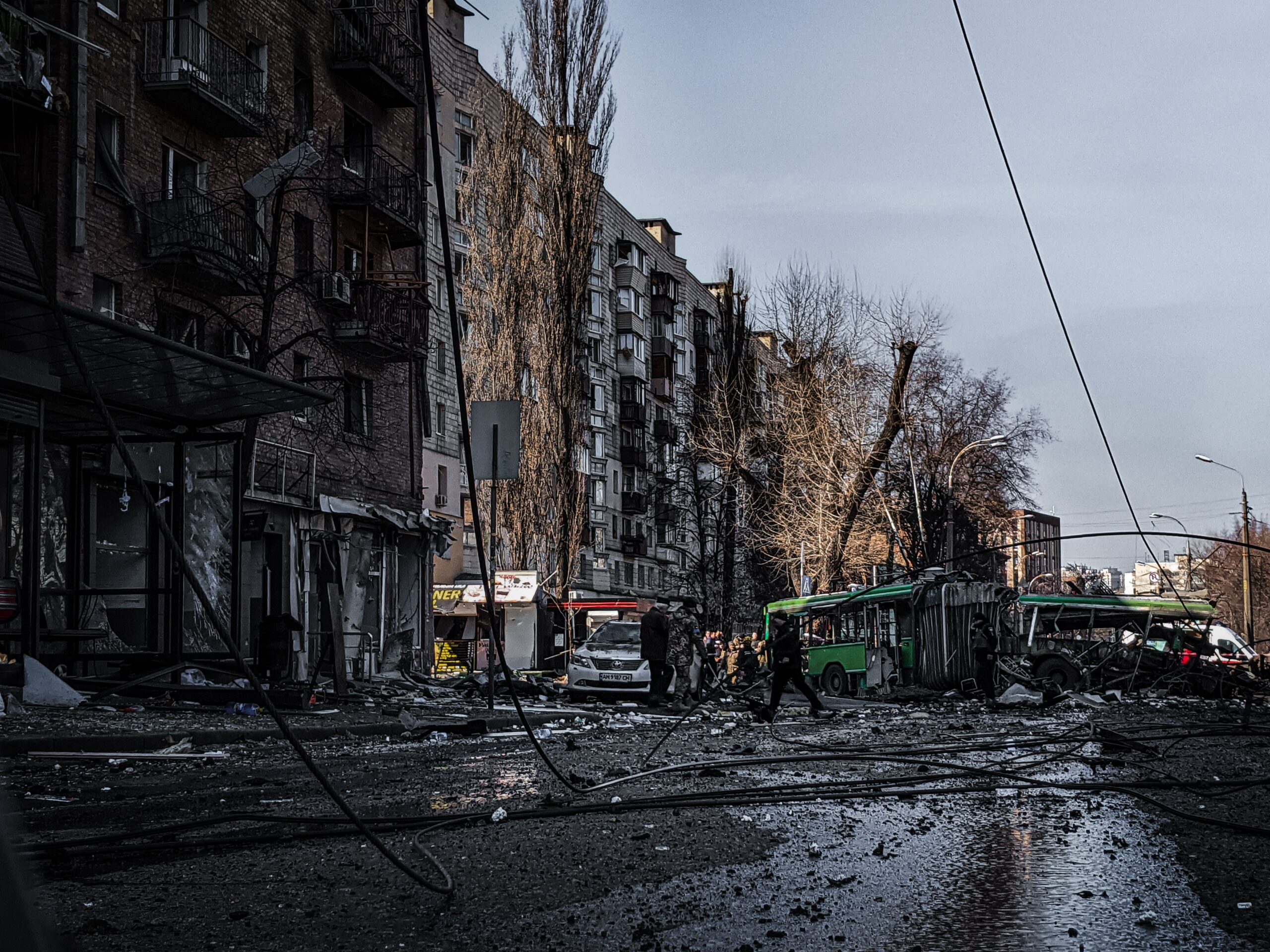
On February 22nd, 2022 when Russia began its invasion, Kharkiv was among the first cities to be engaged, and over several months saw over 600 residential buildings destroyed. In the past four years, that number has increased to 10,000 and has comprised everything from schools, shops, hospitals, and government administrative buildings. President Vladimir Putin initially referred to the conflict as a ‘special military operation,’ though later in 2022 admitted it was a war. Despite the stated aim of ‘denazifying’ Ukraine, the Kremlin’s long-term goals are to prevent NATO’s expansion, thus barring Ukraine from any future membership, and recovering what they consider to be historical Russian land. Novorossiya, meaning ‘New Russia’, refers to an area annexed from the Ottoman Empire by Catherine the Great stretching from the two eastern republics, down through Crimea, up past Dnipro, and all the way to the border with Moldova. Conquering that territory would essentially landlock Ukraine and remove much of the nation’s southern land. Putin’s own definition of the boundaries, brought into renewed focus by the 2014 annexation of Crimea, envisioned Novorossiya to include cities as far as Kharkiv, historically not part of the area.
Civilians have borne the brunt of this assault, with many losing limbs, becoming severely disabled, or having multiple members of their family killed. Though the attack on the city has since slowed compared to its initial pace, missile strikes still occur at random. A Human Rights Watch report documented numerous instances where cluster munitions were used by Russian forces, including an attack that killed one person and wounded three outside a children’s hospital. The same report noted Ukraine was accused of using cluster munitions in the past, including in Kharkiv oblast, and that they hadn’t made any recent effort towards joining the international treaty, the Convention on Cluster Munitions.
The assault on Kharkiv allowed observers to witness how urbicide can be broken down into stages, from bombings during an initial failed attempt to capture the city to attacks on civilian and energy infrastructure and sustained UAV/rocket attacks. This is where observations were made that the intensity of said onslaughts varied based on population density and sites of “historical and cultural significance to Ukrainian identity.” Some of these are the regional administration buildings, university facilities, and the Palace of Labor. Though Ukraine ultimately proved victorious in the battle, Kharkiv is undergoing a massive reconstruction effort, and the daily way of life for civilians continues to be heavily disrupted with sporadic but continuous strikes. According to Martin Coward’s research, these factors are commonplace within Russian military strategy, such as using the shelling of structures to interrupt interconnection within the city, done to produce the appearance that it is nonfunctioning. This is not limited to reducing the ability for an urban center to reproduce its plurality but also to “undermine and punish citizens and governments that resist domination.”
Urbicide in Ukraine is multifaceted and is not solely defined by military action, such as the examples focused upon in this essay. The concept of indirect urbicide focuses on how, when towns are under Russian occupation, they suffer from young people who leave to explore opportunities elsewhere, mismanagement, and a lack of economic development. They are rife with drab and dreary storefronts, or streets displaying visible signs of bureaucratic neglect, whereas Ukrainian cities that have been liberated are trending in the opposite direction: gradual modernization, a healthier social fabric, and new businesses popping up. Definitionally, although the community is not being disrupted by combat, the damage being done to how people interact and how they envision their homes is much the same.
Additionally, in contrast to the way urbicide developed in the Yugoslav conflicts — where differing ethnic groups each presented reasons for why territory was rightfully theirs, Ukrainians are in somewhat of a struggle to redefine their identity. Specifically, reacting to attacks on their territories by replacing monuments or homages to historical Russian figures and distancing themselves from the broader culture, viewed as separate and, in the opinion of some, inextricably linked to the Soviet idea of a sole culture within one country.
Mariupol
Due to its placement on the Sea of Azov and in between Crimea and the two eastern breakaway republics of Donetsk/Luhansk, Mariupol is of significant territorial importance for Russia. It’s for this reason that its bombardment was not only so intense but also carried with it a component of infrastructure-centered violence intent on intimidating those who had yet refused to leave. Up to 90% of the urban buildings have been destroyed, and there has been analysis that suggested that the city’s ruins are being used as a warning as to what Russia is capable of.
Following the strike on Maternity Hospital No. 3, Russia’s Foreign Minister Sergei Lavrov claimed the bombing was justified because the site was being used as a combat base for the far-right Azov battalion. This echoed the rationale offered nearly three decades ago by Slobodan Milošević after Serbian forces destroyed Sarajevo’s National Library and the Institute for Oriental Studies.
The most horrific attack on the city was against the Mariupol Drama Theatre, which the Associated Press reported in an investigation resulted in the deaths of 600 people sheltered inside. Russia has since rebuilt the theatre, complete with a large marble staircase and wholescale changes to its layout. Moreover, evidence of how the pace of urbicide has dramatically accelerated can be witnessed via tower cranes which were erected in a calculated rebuilding effort occurring only weeks after the city fell. The city has undergone a process of Russification, with transactions now being conducted in Rubles and the implementation of a Russian school curriculum. In 2023, Putin visited Mariupol to oversee how the process was going, inspecting the government-provided accommodations for those Kremlin loyalists that had their old homes destroyed by bombings.
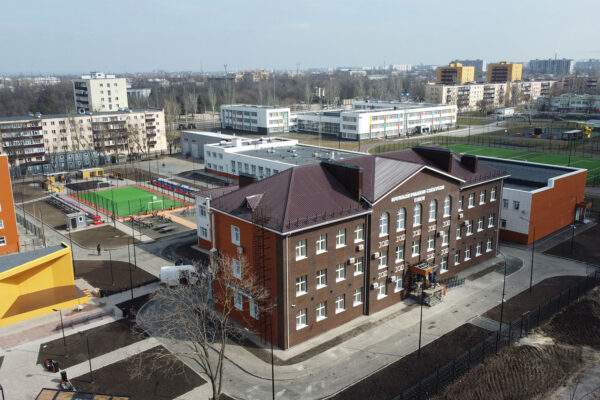
Photo disseminated by the Russian government showing a renovated part of Mariupol. Note: The futsal court (center left of photo) has had its bleachers painted in the colors of the Russian flag. Credit: Tularegion.ru. License: CC BY 4.0
Local leaders have also engaged in historical revisionism following the removal of a monument to Holodomor. The 1930s famine, which claimed several million Ukrainian lives, was dismissed by authorities and Russian academics, who asserted such displays were political disinformation. The razing of key parts of Mariupol needed to be carried out at speed, as did the removal of anything symbolizing Ukrainian identity for Moscow to solidify its occupation.
In somewhat of a full-circle moment, Russian authorities are not only rebuilding portions of the city, but also using underhanded means to seize property from former residents who fled as the violence grew fiercer. Unless those people return, the apartments will be “declared ownerless” and listed for sale by the housing ministry of the separatist Donetsk National Republic.
Conclusion
Changes in urbicide as a military tactic can thus be thought of as encompassing more than technological improvements, varying levels of cruelty, and how quickly cities are flattened. Though these three factors are almost always present in campaigns of urbicide, their deviations are meaningful and reveal that the practice is not monolithic. During the conflicts in the former Yugoslavia, antiurban violence contained a distinct ethnic component which tied buildings to groups, even outside religious doctrines. Pluralistic tendencies were seen by aggressor forces as key determinants for how cities were engaged, with a specific effort being made to permanently disrupt multiethnic spaces and reimagine them as being under the ownership of a sole nationality. As this ideology was not borne out in practice in metropolitan areas, nor within historical texts and artefacts, nationalists first sought to prevent communities from flourishing and then reinterpreted the history which they experienced.
Since Russia invaded Ukraine, urbicide has consisted of attempts to undo progress made since Ukraine gained independence, disrupt functioning cities, and then subsequently produce a one-sided retelling of history that not only misinterprets material facts but is also unable, or unwilling, to recognize the suffering of those with a Ukrainian identity. Russia’s practice of urban annihilation not only rests upon terrorizing Ukrainian civilians through rocket and drone attacks but also rebuilding those locales under a visual identity acceptable to the Kremlin.
To further develop this discipline, additional research is needed related to how those living in cities understand and contextualize their relationship with structures around them once they’re no longer under the threat of direct violence. For Sarajevo and Vukovar, this will be a much different observation as they’ve been removed from conflict for over three decades. Pertinent questions include what kind of differences in the levels of pluralism are present pre- and post-conflict, whether urbicide can truly be continued through non-conflict means, and whether buildings retain their value as spaces for intercommunity dialogue or if this has been limited to younger generations, which have shown a desire to engage in reconciliation.



Commenting is available to active SWJ members and staff.