The Force We Cannot Count
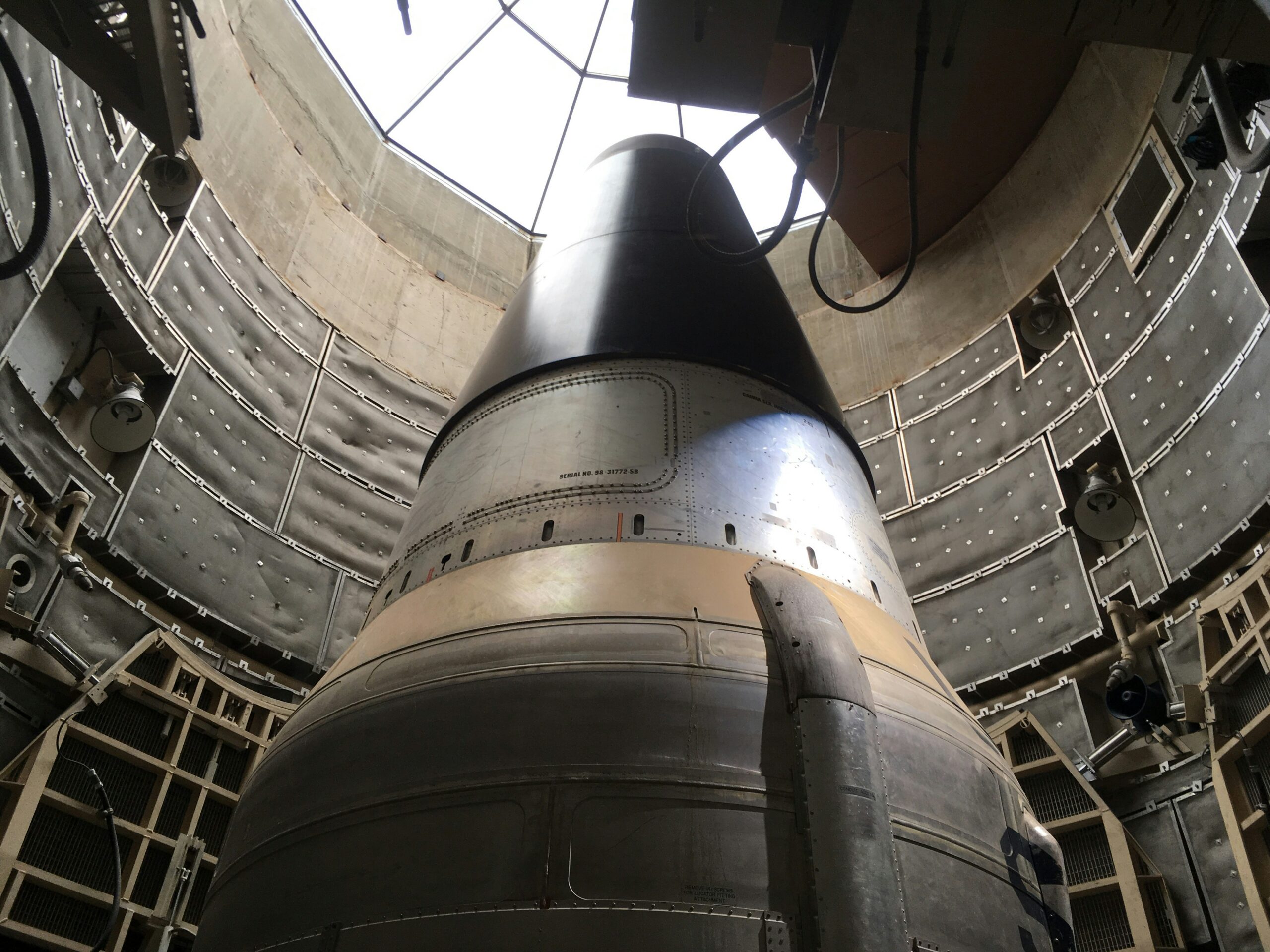

Structure, arsenal, and alert posture in China’s Rocket Force, and why the West keeps arriving at different answers.
Abstract
China’s People’s Liberation Army Rocket Force (PLARF) is one of the most important and least understood military organizations in the world today. It is not purely a nuclear force, and it is not purely a conventional one. It runs both kinds of missiles under a single command, and it increasingly places both kinds of warheads on the same launchers. This article describes what open-source intelligence can and cannot reveal about the branch: its size, the missiles it wields, the command structure, the effect of the 2023 to 2025 purges, and whether its warheads sit ready to fire. It argues that the force is built to be hard to read, that Western estimates differ where Beijing wants them to, and that the change that matters most is not the warhead count but the shift toward silo basing and a launch-on-warning posture that leaves every side less time to think.
A Force Built for Ambiguity
Western assessments of China’s Rocket Force rarely disagree about direction. They disagree about magnitude, readiness, and intent, and they do so consistently. The Stockholm International Peace Research Institute (SIPRI) now places China’s warhead inventory at roughly 620 as of January 2026, the fastest expansion of any nuclear-armed state. The United States Department of Defense (DoD), in its December 2025 report to Congress, assessed the stockpile as remaining in the low 600s through 2024, a slower rate of production than in earlier years. The Federation of American Scientists (FAS) reached a comparable figure while stressing that the overwhelming majority of these warheads sit in storage rather than on deployed missiles.
These are not contradictions so much as different readings of a force that reveals itself in fragments. The PLARF is the custodian of China’s land-based missiles, and it is unusual among the world’s strategic forces in that it operates the nation’s conventional and nuclear systems under one service, within a doctrine that has historically kept warheads separated from their launchers in peacetime. That structural choice is the origin of nearly every analytical dispute that follows. To ask what kind of force the PLARF is, how large it is, and whether it is ready to fire is to ask questions Beijing has deliberately left unanswered.
Neither Wholly Nuclear nor Conventional
The Rocket Force was elevated to a full service in 2015, inheriting the mission of the former Second Artillery. Its defining feature is the largest and most diverse arsenal of theater and intercontinental missiles in the world. A significant portion of this inventory is dual-capable and able to deliver either conventional or nuclear payloads. SIPRI notes that China, alongside Russia, India, Pakistan and North Korea, deploys dual-capable missiles and that this design choice introduces deliberate targeting and warning-assessment problems for an adversary. A launch detected in flight does not disclose the nature of its warhead. The decision window for a defender closes before the character of the strike is known.
This ambiguity is not a bug in the design of the PLARF. It is an intentional feature of a military bureaucracy that seeks to hide its capabilities. The DF-26 intermediate-range missile is the clearest example, a road-mobile system credited with a “hot-swappable” warhead that can be exchanged between conventional and nuclear configurations in the field. The newer DF-27, assessed by the Pentagon’s 2025 report as a fielded system with intercontinental reach, carries the same dual-capable uncertainty at far greater range. A force organized this way cannot be sorted cleanly into a nuclear column and a conventional one, and any count that tries to do so will produce a number bounded by assumption rather than observation.
The Arsenal: Quantity and Types
The question asked most often and answered least reliably concerns numbers. On warheads, the credible range for early 2026 clusters around 600 to 620, with the Pentagon projecting more than 1,000 operational warheads by 2030 and roughly 1,500 by 2035. The trajectory matters more than any single year’s figure, because the gap between the number of warheads and the number of launchers is now very wide. FAS estimates that China has built the silos and missiles for a far larger deployed force than it has warheads to fill, which is why the arsenal can appear both modest and alarming depending on which quantity is counted.
Figure 1. China’s estimated nuclear warhead stockpile, 2020 to 2035.
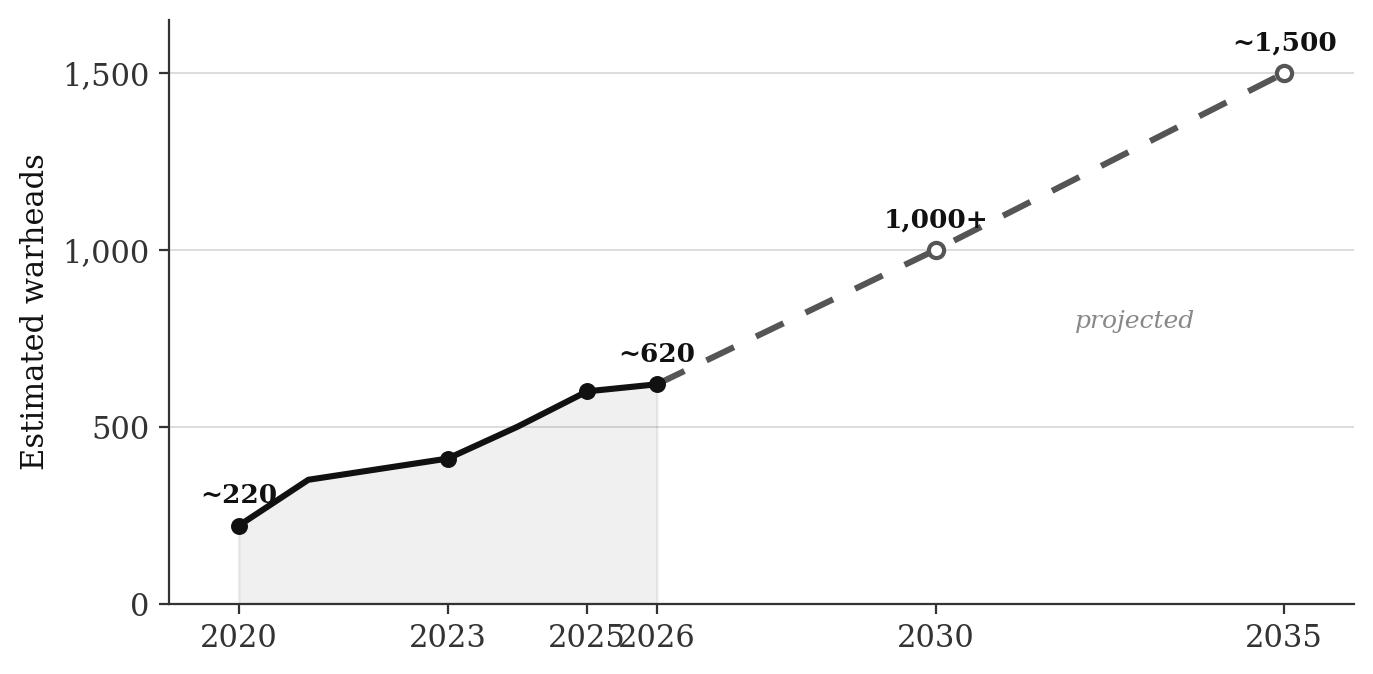
Figure 1: Solid line reflects assessed figures; dashed line reflects US Department of Defense projections. Figures are approximate and drawn from SIPRI, the FAS Nuclear Notebook, and successive DoD reports. The steepest growth lies ahead of, not behind, the present.
On systems, the picture is more stable, because launchers and transporter vehicles are visible to satellite imagery in a way that warheads are not. The PLARF fields a layered inventory running from short-range conventional missiles built for a Taiwan contingency to heavy intercontinental systems built to hold the American homeland at risk. The table below sets out the principal categories.
Table 1. Principal PLARF missile systems, by class and role. Ranges are Western open-source estimates and vary by variant and source.
| System | Class | Range (km) | Basing | Role / payload | MIRV / HGV | Notes |
| DF-15 / DF-16 | SRBM | 600–1,000 | Road-mobile | Conventional | – | Theater strike, Taiwan Strait |
| DF-21 (CSS-5) | MRBM | ~2,150 | Road-mobile | Conventional | – | DF-21D anti-ship “carrier killer”; nuclear variant assessed withdrawn |
| DF-17 (CSS-22) | MRBM | 1,800–2,500 | Road-mobile | Conventional | HGV | First operationally fielded hypersonic glide system |
| DF-26 (CSS-18) | IRBM | ~4,000 | Road-mobile | Dual-capable | – | “Guam killer”; anti-ship and land attack; hot-swappable warhead |
| DF-27 | IRBM / ICBM | 5,000–8,000 | Road-mobile | Dual-capable | HGV (assessed) | Longest-range conventional strike option; reaches Guam and Hawaii |
| DF-31A / AG (CSS-10) | ICBM | ~11,000 | Road-mobile | Nuclear | Single (assessed) | Backbone of the mobile ICBM force; now filling new silos |
| DF-41 (CSS-20) | ICBM | 12,000–15,000 | Mobile & silo | Nuclear | MIRV (up to 3) | Newest heavy ICBM; road-mobile and silo-based |
| DF-5B / DF-5C (CSS-4) | ICBM | 13,000–20,000 | Silo (liquid) | Nuclear | MIRV | The legacy heavy ICBM, DF-5C paraded 2025, assessed multi-megaton |
Classes: SRBM, MRBM, IRBM and ICBM denote short-, medium-, intermediate- and intercontinental-range ballistic missiles. HGV denotes a hypersonic glide vehicle; MIRV, a multiple independently targetable re-entry vehicle.
The sea and air legs sit outside the PLARF: the JL-3 submarine-launched missile equips the PLA Navy’s Type 094 boats, and the JL-1 air-launched ballistic missile arms the PLA Air Force’s H-6N. Together with the land-based force they constitute China’s emerging triad, first displayed in full at the September 2025 parade.
Reach, and What It Signals to Delhi and Tokyo
The strategic weight of the Rocket Force is best understood not as a warhead total but as a set of range rings. Because the majority of PLARF launchers are road-mobile, the relevant question is not where the missiles are based but how far they reach from anywhere inside China. Figure 2 sets the systems against the distances to three reference points that dominate regional anxiety.
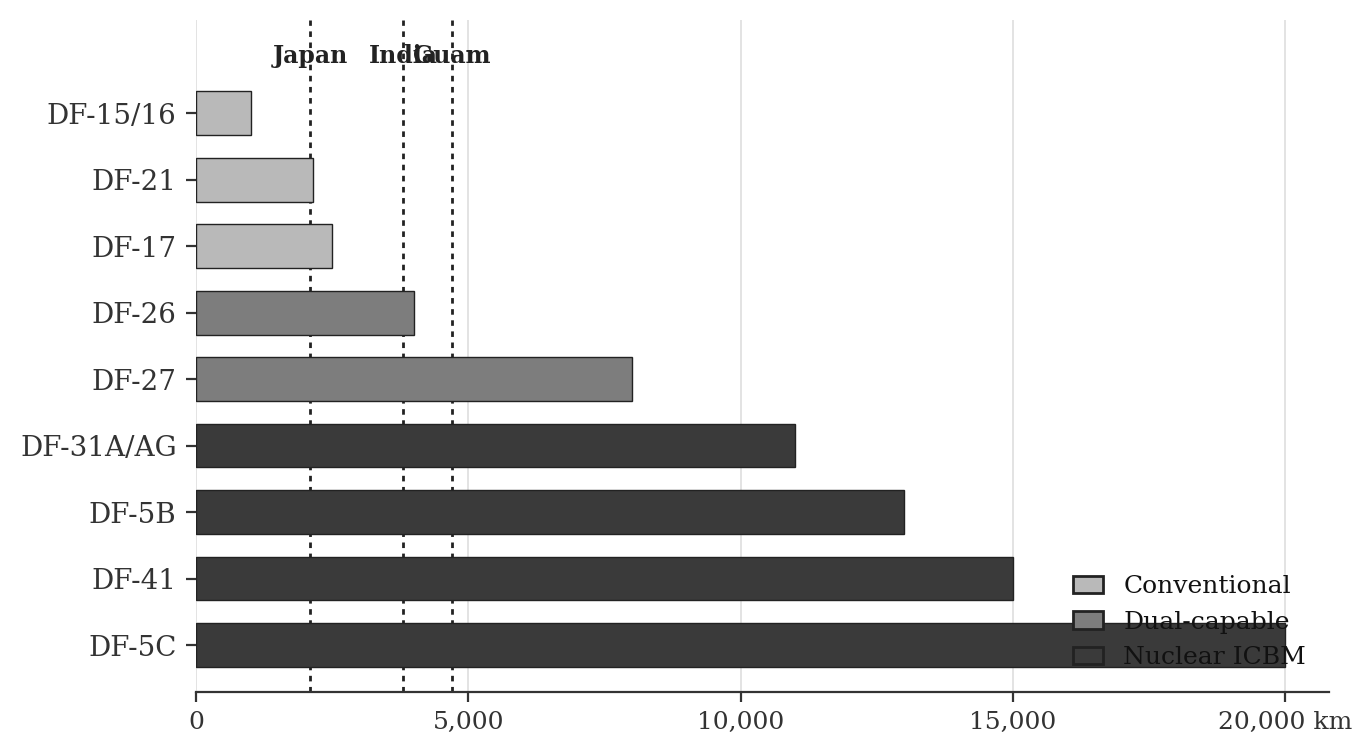
Figure 2. PLARF systems by maximum assessed range. With reference distances from mainland launch areas to Tokyo (~2,100 km), northern India (~3,800 km) and Guam (~4,700 km). Every category above the theater tier overreaches all three, which is the essence of the signaling problem.
For India, the relevant systems are the DF-26 and, increasingly, the DF-27. From western launch sites, the whole of the Indian landmass falls comfortably inside the DF-26 envelope, and the DF-27’s assessed reach brings even the Andaman and Nicobar approaches into a theoretical strike radius. What unsettles Indian planners is not the range of the ballistic missiles, but the dual-capable ambiguity each launcher carries. A conventional strike and a nuclear one look identical until impact, and India’s own posture, built on credible minimum deterrence and no first use, is not designed to absorb that uncertainty calmly.
For Japan, the pressure comes from the DF-17 hypersonic glide vehicle (HGV) and the DF-26, both of which hold Japanese bases and the surrounding operating areas at risk while degrading the value of the missile-defense architecture Tokyo has invested in, a buildup that commits ¥43 trillion (about $300 billion) to defense across 2023 to 2027, including some ¥1.25 trillion for integrated air and missile defense in a single year. The DF-17’s glide vehicle maneuvers through much of its flight, defeating interceptors optimized for predictable ballistic arcs. The reported DF-27A test of late 2025 extended this logic toward the Second Island Chain, placing Guam and allied rear-area logistics inside a hypersonic threat envelope. The signal to both capitals is coherent even where the count is not: China can now hold regional and rear bases at risk with systems that compress warning time and blur the line between a conventional and a nuclear event.
Command, Control, and the Shadow of the Purge
The PLARF ultimately answers to the Central Military Commission (CMC), chaired by Xi Jinping, and nuclear release authority in China is understood to be tightly centralized at the apex of the party-military structure. In principle this is a system built for control. In practice, the last three years have raised uncomfortable questions about the integrity of that structure, because the Rocket Force has been the epicenter of the most sweeping military purge of the Xi era.
The first wave, beginning in 2023, removed the PLARF’s entire senior leadership along with figures in the CMC’s equipment-development apparatus. It was followed by the ousting of two successive defense ministers, both previously associated with the Rocket Force and aerospace procurement, and later by the suspension of the CMC’s own political-work director, Admiral Miao Hua. Most striking, the officer installed to lead the Rocket Force in 2023, General Wang Houbin, himself fell under investigation within roughly two years. The Pentagon’s 2025 report documents the removal of dozens of flag officers across every service and theater.
These purges can be read in two ways. A campaign that reaches the custodians of the nuclear deterrent signals both Xi’s determination to root out graft and the depth of the problem he found. As the Observer Research Foundation has argued, and as other analysts have warned, publicly acknowledging corruption inside a force whose credibility depends on the appearance of reliability carries a cost to the deterrent force. It invites adversaries to wonder whether the arsenal is as ready as the order of battle implies and whether a leadership repeatedly surprised by its own appointees can command it with confidence in a crisis.
Safety, Security, and the Readiness Question
This is where the concern about launch status belongs. China’s traditional posture, described by the PLA itself as a “moderate” level of readiness, has kept most warheads in regional and central storage rather than mated to missiles in peacetime. FAS assesses that the great majority of Chinese warheads remain in storage, with only a small number deployed at any time. On this account, the force is not sitting at a hair trigger. A Chinese decision to fire would be preceded by a deliberate mating of warheads to missiles, a process that presupposes a period of rising tension rather than a bolt from the blue.
Two developments complicate that reassurance. The first is the corruption disclosure itself. US intelligence reporting surfaced in 2024 suggested graft had degraded readiness in concrete ways, including missiles maintained improperly and silo lids that would not function as intended. The Pentagon’s assessment that the ensuing investigation “likely resulted in the PLARF repairing the silos” is double-edged; it implies both that the force had real defects and that it is now being made more ready, not less. The second is doctrinal. The Pentagon judges that the construction of hundreds of quick-launch solid-fuel silos, paired with a nascent space-based early-warning system, indicates Chinese movement toward a launch-on-warning posture, what China terms “early warning counterstrike.” A force postured to launch on warning is, by definition, a force that intends to fire before incoming weapons arrive, which shortens the interval for human judgment and raises the salience of false alarms.
These two trends pull against the older picture of a relaxed, de-mated arsenal. The safety and security concern is therefore not that China maintains a Western-style alert posture today – the evidence does not support that – but that it is building the physical and doctrinal architecture that would permit one at the same moment that its command structure has been visibly disrupted. The combination of higher readiness ambitions and shaken confidence in the chain of custody is more worrying than either factor alone.
What Is Actually Transforming?
It is tempting to frame the PLARF’s transformation as a sprint toward numerical parity with the United States and Russia. That framing misleads. Even at more than 1,000 warheads by 2030, China would hold roughly a quarter of either superpower’s stockpile, or SIPRI states plainly that the warhead total is expected to remain far smaller than the launcher build-out might suggest. The genuine transformation is qualitative and structural. It runs along three axes: from a small assured-retaliation force toward a larger and more differentiated one; from road-mobile concealment toward a mixed posture that adds hundreds of fixed silos; and from a de-mated, launch-after-attack doctrine toward the option of launch on warning.
Each axis changes the strategic problem the force presents. Silos are countable, which paradoxically makes the arsenal more legible even as it grows, but they also create use-or-lose pressures in a crisis that mobile launchers do not. Multiple independently targetable re-entry vehicle (MIRV) systems such as the DF-41 and the modernized DF-5 multiply the warheads a single launcher can deliver, which decouples the warhead count from the launcher count still further. The dual-capable DF-26 and DF-27, which comprise the PLARF’s middle tier, deliberately fuse the conventional and nuclear domains that other powers keep apart. The result is a force whose posture is transforming faster than its inventory and whose most important changes are the ones least visible in a warhead tally.
Conclusion: The Limits of Certainty
The conclusion should be stated plainly. China has engineered a rocket force that holds its strategic ambiguity until the instant a warhead detonates, and for any future conflict in the Pacific the significance of that is difficult to overstate. This is a designed feature of the force, not a failure of Western intelligence. The credible warhead estimate for 2026 sits near 620 and is rising; the launcher inventory now outnumbers the warheads to arm them; the systems are increasingly dual-capable and hypersonic; the command structure is centralized but recently convulsed; and the alert posture is officially moderate but doctrinally drifting toward launch on warning. Every one of these statements carries a confidence interval, and Beijing benefits from each interval remaining wide.
For analysts and policymakers, the appropriate response is not to resolve the ambiguity by picking a number but to plan against the range and to attend to the trends that matter most: the silo fields, the mating practices, the early-warning satellites, and the health of the command chain. The question that opened this analysis, whether China’s missiles are in a launch position and ready to fire, has no single answer today. The more urgent question is whether China is building a force in which that answer could change in minutes rather than days, and on present evidence it is.