Enabling Maneuver – Imagining the Next Chapter in Armored Warfare

The recent essay by Amos Fox, Maneuvering to Obsolescence: The Death Ride of the Armor Branch, is the latest in a long line of writings on what is wrong with the US Army’s Armored force and its associated fighting vehicles. The article goes so far as to assert that the branch will be dead by 2035. Despite outlining some nebulous goals for the branch and a futuristic capability wish list for a new tank, the piece fails to provide concrete march objectives to prevent the asserted demise. The essay is another misdiagnosis of the interwar period and the enduring fundamentals of warfare. An interwar period that has seen the battlefield become transparent as drones and missiles bring cheap parity to the battlefield. Given an aggressive China in the Pacific, the US Army does not have time to learn the wrong lessons. False alarms like “Death Ride” are dangerous distractions that fail to account for the current operating environment or provide novel insight into how the Army should operate in the future.
The future battlefield will arguably be the toughest the US Army has ever faced, with periods of very high-intensity combat. Drones and sensors will proliferate across the Air Ground Littoral (AGL), denying sanctuary up to 40 km behind the contact line. The entire US Army must learn how to operate, survive, and win in the new and ever-changing environment. Rather than signaling the demise of the Armored Corps, this article argues the opposite. Indeed, a modern battlefield, in terms of size, scope, and cognitive load, is where Armor leaders at echelon are uniquely positioned to excel as maneuver professionals. As a potential conflict with China over Taiwan looms on the horizon, there is no doubt that the one region the Armor branch could have an effect in the next 10 years is the Pacific. The timing and condition of the arrival of that force are up to professionals to decide today. The refinement of Armor formations, mission sets, and support to the joint force for this potential conflict is critical.
Zero Growth
There is no arguing that the current formation design of an Armored Brigade Combat Team (ABCT) is too large and needs to evolve. An ABCT in its current configuration, especially its enablers and support elements, would be systematically destroyed by drones and missiles on the modern battlefield. However, this logic could be applied across both Mobile and Stryker Brigade formations. Anything at rest, not able to quickly obfuscate or rapidly displace, will not survive along the line of contact. Additionally, the issues and goals of a future ABCT that Fox recommends are common concerns to all brigades. They are just exacerbated by the size and scope of an ABCT. Combat Training Center After Action Reviews repeatedly show that all types of brigades struggle to manipulate data, maintain tempo, and extend operational reach. Armor leaders and associated formations, like the rest of the Army, are testing new structures, systems, and designs. The rearranging and rightsizing of legacy vehicles like the Bradley or Abrams is not as exciting as new equipment like the new Infantry Squad Vehicle (ISV). The definition of the Army Transformation Initiative is in its name; what formations experiment and look like today is not guaranteed to be the same in the future. This logic applies across all brigade types.
The time to argue for large armor formations in Europe or new armored vehicles has passed for now. The current state and capability of Russian ground forces shows a limited armor or maneuver force threat to greater Europe as they remain bogged down in Ukraine with yet to be reconstituted losses. Applying the adage “Do what your boss tells you to do first,” Armor, as a branch and fighting organization, needs to show what it can bring to the Pacific. No tanks in a future Pacific conflict will translate into Marines and Soldiers attempting to fight in a hellish and degraded first island chain with no armor support.
War Department policy direction and the fiscal realities of new vehicle acquisitions signal that Abrams and Bradley combat vehicles will remain for the foreseeable future. Advocates for heavy armored vehicles are not comparable, as Fox suggests, to staunch supporters of horse cavalry. Horse cavalry could no longer deliver an effect on the battlefield. Armored warfare has continued to evolve since World War I. Leaders continuously applied lessons learned and new concepts to ensure that armored maneuver could be successful. Maneuver warfare offered a feasible option to positional stalemates. Although conditions have changed again, tanks can still provide decisive action. This is especially possible as vehicle improvements and protection systems allow them to survive longer in the current environment. As an Army, we must learn to adapt to the current inventory. Using SpaceX’s continuous refinement of the rocket motor as inspiration and leveraging the Department of War’s (DOW’s) acquisition reform, efficiencies could be found for the Bradley and Abrams. These improvements could reduce weight and improve mobility and reliability. Future advancements in autonomous wingmen and ground robotics will dictate the requirements for the next future armored vehicle. That decision remains in the future; procurement and production timelines mean an intermediate armored platform will likely be overcome by events or crushed under the weight of its own incremental upgrades. Should the next fighting vehicle be simple, yes? However, the Army of today is not the one from the 1940s and thousands of simple Sherman tanks. The nation’s technological edge is a major advantage. Barring some technological leap forward, armored vehicles will remain complex at the cost of maintaining the lethality and survivability edge.
What can be debated now is the right mix of robotics, infantry, and armor to ensure mission success at the time of need. As mentioned in the article “Pacific Iron,” armored warfare will continue to have a place in combined arms formations. The quantity of robotics as part of maneuver warfare will continue to increase, but there will still be a requirement for manned armor, infantry, and other enablers such as artillery and engineers. Force composition will vary based on the mission and theater. Drones have reached a level of capability where they are not additive, but transformative. Brigade Command Teams, especially armor brigades, must radically transform to stay relevant and leverage this capability. Maybe it’s not a change in size but an adjustment in fighting force organization, operating concept, and doctrinal template (DOCTEMP) diagram to account for the new depth of the battlefield. Smaller units with specific tasks to shape the enemy and the environment to allow follow-on forces to maneuver.
Enabling Maneuver
Simply put, maneuver is the most efficient way to win, dislocating the enemy through mobile warfare is preferential to battles of attrition. Fox’s primary argument is that the US Armor community is too focused on maneuver, but ultimately, the enablement of maneuver is the primary mission of Armor. The modern battlefield does everything it can to draw combatants into positional and attritional fighting to prevent the lethality and shock of combined arms warfare. Maneuver to exploitation ultimately wins wars and despite enemy combatants’ actions, that must remain the primary goal. As the DOW looks to deter and defend in the Pacific, it does not mean a static defense. Early lessons from the recent Iran conflict show that static positions are early and easier targets. The Multi-domain Task Forces (MDTF) in the Pacific Theater is not the complete answer. Maneuver forces are a powerful enabler to the MDTFs as they provide all-weather sensors, survivability, and lower cost magazine depth. Again, the Iran conflict has shown that fiscal limitations and the military-industrial base will never provide a complete decisive answer through magazine depth. Eventually, ground units will go forward to impose the nation’s will and they will need armor integrated into the team to ensure success. The US Army does not deploy to fight positional or attritional wars; it goes forward with the end state of maneuver, bringing a decisive end.
Diverging from anything that does not set conditions for the US Army and Joint Force to win quickly and decisively is a loss from the tactical to the political level. All other actions or shaping by the joint force should be focused on breaking stalemates, setting conditions, and enabling maneuver. The protection and firepower provided by ABCTs are critical to maintaining maneuver. A simple example: as a ground force commander would you rather have your support by fire provided by an M240 gunner and the ammo they carry, or a coax supported by the thousands of rounds in the bustle rack of a tank? This answer doesn’t even consider the main gun or a Bradley’s 25mm gun. An armored vehicle may not start a direct fire engagement or be the first to fight, but it has the capability to end it very quickly; the same cannot be said for all maneuver forces or even drones. That capability saves lives and provides options.
Fox does highlight a critical vulnerability, the loss of the majority of the reconnaissance and security (R&S) squadrons across the force. However, the Army as a force must understand how to operate in smaller units on the battlefield and also integrate into the joint force kill web. The unfortunate closure of these squadrons brought the importance of the R&S mission to every battalion headquarters. As an Army, we must ensure we make contact with the smallest possible element, aggregate when conditions are set to attack, disaggregate, and continue to move.
Troop transport in Mobile and Stryker brigades moves Soldiers to the last covered and concealed position, and armor gets them across the objective. The contribution to the joint force is the Army’s ability to seize and control terrain, which takes a combined arms effort. As highlighted in “Transition Period Warfare,” maneuver is only possible and survivability is only maximized once friendly robots, and disaggregated forces have set conditions for follow-on operations. A key task for first-contact units will be the establishment of areas of opportunity where enemy drone activity is suppressed. These areas—call them RDOAs (Reduced enemy Drone activity/Opportunity Area) —will allow larger, traditional, and manned formations to operate, exploit, and survive within. Figure 1 illustrates the concept of the RDOAs, human and machine teaming works to set localized conditions favorable for maneuver operations. Drone operators in armored vehicles, albeit in fewer numbers, would be critical in establishing RDOAs to enable maneuver. The counter-UAS and protection systems that armor vehicles carry could very well help establish and reinforce the RDOAs. Armored platforms could be equivalent to a ground version of the F-35, providing a mobile and protective platform that enables commanders to fuse sensor data and coordinate all domain operations. Army Secretary Driscoll described a similar concept in his ideas on how tanks will, not should, operate in the future.
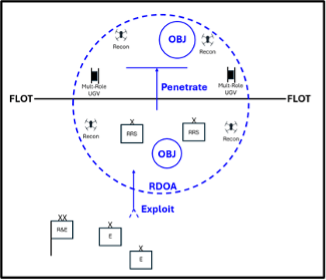
Figure 1. RDOA concept sketch
As noted in “Pacific Iron,” one way to reduce mass, maintain lethality, and increase deployability is by reducing the overall number of armored vehicles in an ABCT and leveraging air and ground robotics. These recommendations reduce risk to both the force and the mission with the goal of maintaining and enabling maneuver. The RDOA is one way to ensure that maneuver becomes possible again on the modern battlefield. In general, armor vehicles, especially US vehicles, have the capability to survive longer in these conditions as the RDOA is shaped for friendly forces. The pairing of the joint force and armor enablement increases the likelihood that US ground forces can once again take the initiative. As the Army wrestles with how to maintain maneuver, the shape and composition of the ABCT will naturally change to support. Ultimately, the Taiwan conflict will be decided by who controls the terrain. The Army is the foundation of the joint force, and armor must be part of any credible deterrence or conflict solution.
Wrong Lessons
A tired trope of the Ukraine-Russian War is learning the wrong lessons, and this is evident in the assertion of the demise of armor. First, the ongoing air campaign in Iran and numerous past historical bombing vignettes, from World War I to today, continue to prove that ground forces will always be needed for decisive victory. The joint force is not currently interested in ABCTs because it has not been tasked in seizing a highly contested area, destroying another mechanized force, nor are joint forces currently in direct fire contact. When those missions are assigned, the joint force will need support from armored formations to enable penetration through enemy defenses and operate forward and independently. Innovation and experimentation now will set the conditions for this operating concept.
Second, “Death Ride” highlights the substantial losses of Abrams tanks with the Iraqi and Ukrainian Armies, but these are not the most advanced US variants operated by US service members. Combined arms maneuver is incredibly difficult to execute, and that was before the rise of drones in the AGL. Variations in equipment and especially highly trained personnel have made a difference in many historical battles. The education and training of US Armor leaders and crewmen ensure they are ready for the large and complex battlefield, mastering transitions to maintain tempo and lethality.
However, the most serious error or admission by critics of the tank is that combat eventually dictates an increase in armor protection. The current battlefield losses by Ukraine and Russia as they struggle to employ armor would be unacceptable to the American public. Despite significant tank losses and a lack of maneuver in Ukraine, the People’s Liberation Army still maintains a sizable tank force and is working to augment it with drones.
The most recent and applicable example for the US Army is the Global War on Terrorism (GWOT). The invasion of Iraq was conducted in “soft-skinned” HMMWVs, and the insurgency bore the evolution of bolt-on armor to the MaxxPro, and other mine-resistant and armored vehicles. The same story will play out when the Infantry Squad Vehicle (ISV) makes its combat debut. An ISV and a Bradley swarmed by one-way attack drones will have vastly different outcomes for the crews based on the levels of protection. The ISV mobility will be effective in the opening engagements of the next conflict, but what happens when the conflict is prolonged? The best way to mitigate the weaknesses of the light and heavy platforms is through combined arms teaming. As during the GWOT, the American public will expect armor protection for its Soldiers. Then, ironically, ISVs weighed down with bolt-on armor and protection systems will struggle like their HMMWV predecessor. The rapid mobility and protection provided by an armored vehicle remain critical on the modern battlefield. Paired with onboard counter drone devices, it gives the crew a higher chance of survival. Armor and armored vehicles will continue to have a place on the battlefield as long as man participates as a combatant. True movement and maneuver in the future will take a mix of dirt bikes to tanks to maintain conditions favorable for maneuver. As an Army, we must maintain a mix of vehicle types to provide options for commanders.
The Future
This interwar period has made the tank and armored formations the target of criticism, some of it well deserved. However, the apparent weakness of the tank is a symptom of a greater issue. Warfare is evolving at such a quick pace that it causes professionals to either protect equities, make rash decisions about future force design, or abandon fundamentals. There is no arguing that the ABCT needs to adapt; however, the wrong lessons cannot be used to question fundamentals like mobility, force projection, and firepower. A critic of the tank can provide a litany of issues (many justified) until that vehicle is the only thing keeping them or their unit alive.
What does success look like for armor as a warfighting function and formation evolves over the next ten to twenty years? First, armor as a key maneuver enabler is a strong point in the holistic defense of the Pacific, fully incorporated into the operating concept. Planners familiar with the employment of armor help shape what this looks like. Armor and required sustainment forces are embedded forward to reduce reaction time to PLA indicators and warnings. Deterrence and offensive operations depend on the armored force being a credible threat to the enemy ground force commander. Vehicles like the Bradley fighting vehicle could serve as a mobile post for drone operators, a drone mothership, and a link to the great kill web through its human operators. Linked to filtered data and decision points, they remain hidden until conditions are set to move. Paired with ISV-equipped infantry, the teams can shape with joint fires to set conditions for maneuver and mutually support as a combined-arms team. Continued drone improvements and integration will help provide a clear picture of the true form and function of the next armored vehicle. Finally, the objectives mentioned above and continuous testing will refine the armor operating concept. The great difference between warfare in the air or on the sea is that it will ultimately be decided by who occupies the ground. Some fundamentals of warfare will not change. Mounted maneuver, from horse to tank, has enabled successful combined arms maneuver throughout history, and that will not change in the near future.
(The views expressed are those of the author and do not reflect the official position of the Department of the Army or Department of War)