





Nickel and DIMEd: Trading DIME’s “Participation Awards” for Mutually Reinforcing Capabilities

Editor’s note: An expanded version of this essay is available at https://mountainrunner.substack.com/p/nickel-and-dimed.
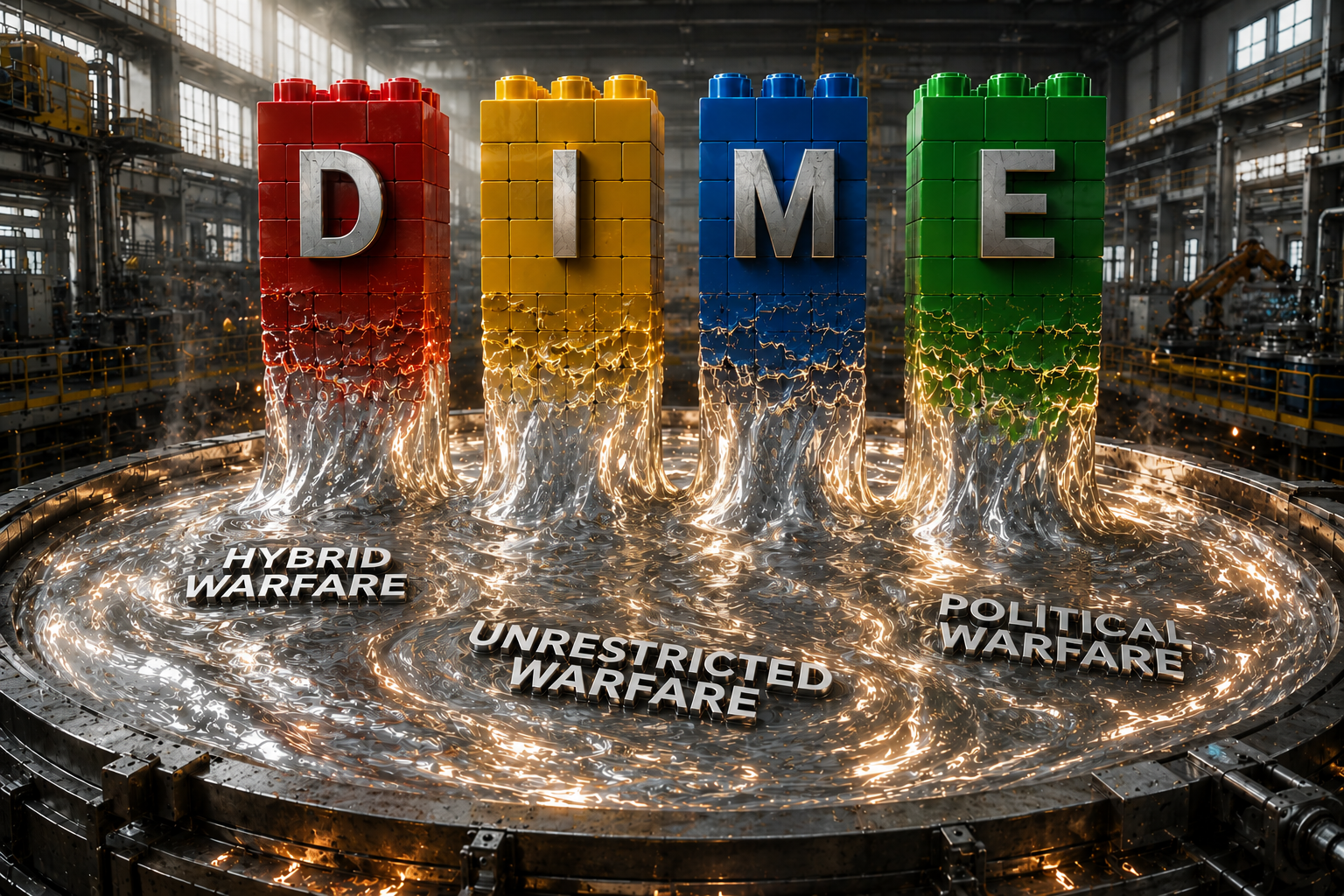
How a government conceptualizes national security inevitably dictates how it organizes its apparatus. If our foundational mental map is fractured, our execution will be, too. For decades, the dominant cognitive model for American statecraft has been DIME (Diplomacy, Information, Military, and Economics). But as the complexity of global challenges has grown, so did the bureaucracy’s fear of being left out. DIME soon bloated into DIMEFIL, bolting on Finance, Intelligence, and Law Enforcement. This expansion was not driven by strategic clarity; rather, it functioned as the ultimate interagency “participation award,” ensuring departments had a letter and a designated seat at the table.
The unintended consequence of this model is severe: DIME (or DIMEFIL) does not clarify national power; it fractures it. By categorizing national capabilities by agency zip code, the model locks our national security thinkers into artificial silos. It trains planners to ask, “Is this a diplomatic problem or a military problem?” instead of integrating the two.
To build a national security enterprise capable of achieving its strategic objectives, we must trade our bureaucratic participation awards for a framework built entirely on capabilities that do not stay within lanes but are fundamentally mutually reinforcing.
The Lexical and Philosophical Divide: Admixture versus Addition
To understand how we arrived at such a fractured mental model, we must first look backward. The historical progression of this strategic theory is rooted in a profound conceptual divide regarding architecture: do the instruments of statecraft operate as an integrated, comprehensive fusion—an admixture—or do they function as isolated, self-contained pillars that are merely added together?
The translation of Carl von Clausewitz’s foundational text, On War, mirrors this conceptual fault line The distinction rests on Clausewitz’s original German phrase using the word Beimischung. In 1873, Col. J.J. Graham rendered Beimischung as “a mixture of other means,” a phrasing cemented in American military thought by Col. F.N. Maude’s widely read 1908 republished edition. In 1943, translator O.J. Matthijs Jolles sharpened this to “admixture,” rendering Clausewitz’s famous dictum as, “We maintain, on the contrary, that war is nothing but a continuation of political intercourse with an admixture of other means.” The concept of admixture suggests a deep, almost metallurgical fusion. In an admixture, one cannot surgically extract military action from political consequence, nor isolate psychological shock from economic sanction. They flow through one another seamlessly, creating a synthesized reality.
The influential 1976 translation by Michael Howard and Peter Paret renders the same passage as, “War is simply a continuation of political intercourse, with the addition of other means.” The term addition introduces a modular mathematical relationship. This implies that war does not fundamentally alter the nature of political intercourse, but merely stacks a new, separate block of violent means alongside it.
If a strategic establishment subscribes to the Howard/Paret “addition” theory, it rationalizes a government built on separate cylinders. This allows for the creation of a diplomatic corps, an economic treasury, and a military apparatus that operate independently. The resulting isolation violates the architecture of successful statecraft. As George Kennan showed in his memos on political warfare and the psychological dynamics of the European Recovery Plan, countering grand-strategic threats requires a total admixture of national power.
The Antiquity of Admixture versus The Science of Isolation
The depth of a strategic theory is intrinsically tied to its willingness to embrace the chaotic admixture of human conflict. History’s greatest theorists demanded the comprehensive integration of state power. Sun Tzu recommended seamlessly synchronizing political, psychological, and economic coercion into a unified force. Clausewitz codified this inherent complexity within his “paradoxical trinity.” John Boyd validated this tradition by proving that conflict occurs simultaneously across interrelated physical, mental, and moral domains.
In contrast, Antoine-Henri Jomini represents the idea of addition. Seeking to distill the chaos of war into a rational science governed by geometric principles, Jomini built a firm structural boundary between the statesman and the general. By severing the concept of politics from the conduct of campaigns, he provided a blueprint for the modern bureaucratic silo. His framework became a foundational text for generations of American officers, establishing the justification for “objective civilian control.” This is the American idea that politicians should set a goal and then step aside to allow the military to execute war in a clean, sanitized, professional cylinder.
Scholars often debate how institutional structures dictate strategic execution. In his analysis of Clausewitz, Antulio J. Echevarria II, U.S. Army War College professor of strategic competition, notes that the concept of Politik encompasses both rational policy and the messy reality of institutional politics. Echevarria points out that because military institutions are shaped by internal realities, “a purely military perspective cannot exist at all.” Yet, this is exactly the false premise upon which the DIME framework relies. By artificially isolating the Military from Diplomacy and Economics into distinct silos, the model treats national power as a collection of static, inanimate instruments rather than dynamic, mutually reinforcing capabilities.
Bureaucratic Capture and the Polygon Fallacy
This mindset of addition continues to trap contemporary strategic theorists. Recognizing the traditional DIME model omits vital realities, defense scholars attempt to modernize it by bolting on new components. Defense strategist Frank Hoffman recently argued that Clausewitz’s trinity is incomplete because it neglects technology and economics and proposes a five-element “Pentagonian” framework. David Maxwell, an irregular and political warfare scholar, subsequently expanded on this impulse, suggesting the model requires an eight-sided “octagon” to properly include political warfare.
While Hoffman correctly diagnoses a historical blind spot regarding industrial capacity, and Maxwell rightly emphasizes the necessity of political warfare, their proposed solutions exemplify the ultimate strategic dysfunction, which I label the Polygon Fallacy. Adding more geometric nodes to a conceptual chart is the ultimate expression of the addition mindset that mirrors the bureaucratic reflex that bloated DIME into DIMEFIL (and, later, MIDFIELD to add Development). Strategy does not require a pentagon or an octagon any more than it requires a seven-letter acronym; it requires an admixture. By adding new sides to a shape, we perpetuate the illusion that capabilities exist as separate variables to be sequentially synchronized.
This additive fallacy breeds strategic paralysis. As Henry Kissinger warned in 1955, exclusive reliance on an isolated cylinder of power creates a “Maginot mentality,” the false security of a massive, static defense that an agile adversary may, and is in fact encouraged to, bypass. This rigidity leaves the nation vulnerable in the periphery, including low-intensity conflict and political warfare. Adversaries exploit this vulnerability by fusing economic coercion, psychological manipulation, and localized violence to subvert partner nations, fracture alliances, and hollow out American influence. When Western planners, blinded by the segregated DIME construct, observe this integration, they invent buzzwords like “hybrid warfare,” “lawfare,” and “cognitive warfare” to describe it. To an admixture thinker, “hybrid warfare” does not exist; it is simply the natural, integrated application of statecraft.
The Devolution of DIME and the Orphaned “I”
The US government replicates this architectural error in its administrative structure. A genealogical investigation reveals that DIME appeared in the 1980s without theoretical foundation. Driven by administrative mandates like the Goldwater-Nichols Act of 1986 and the 1988 National Security Strategy, DIME was initially introduced to force agencies to communicate. However, by the mid-1990s, DIME rapidly devolved into a de-confliction tool to establish boundaries and keep agencies safely in their respective lanes.
Crucially, when formalized, DIME mapped directly to the organizational chart of the era. The “D” mapped to the State Department, the “M” to the Department of Defense, the “E” to Treasury and Commerce, and the “I” mapped to the United States Information Agency (USIA). The inherent intellectual bankruptcy of this map was exposed when the USIA was abolished in 1999. The “I” was abruptly orphaned, sparking a period of bureaucratic grasping as agencies scrambled to point fingers as to who owned the “Information” domain.
If DIME had been a true strategic framework, the function of information—the shaping of minds and wills, which differs substantively from a battle for hearts and minds—would have remained conceptually secure regardless of which agency housed it. Instead, planners hunted for new organizational boxes to check. The subsequent addition of Finance, Intelligence, and Law Enforcement to create DIMEFIL (and later MIDFIELD) invited more departments to interagency de-confliction meetings, representing the triumph of Jominian isolation applied to the administrative state.
Revising the Framework: The PPCE Baseline
An older, theoretically superior conceptual baseline stands in stark contrast. A series of 1918 U.S. Army General Staff reports recognized that the strategic equation encompasses four coequal factors: combat, economic, political, and “psychologic.” Operating retrospectively, I apply the label “PPCE” to describe this framework. Unlike DIME, PPCE maps power to functional effects rather than organizational charts, operating on three interlocking layers.
Layer 1: The Core Elements
- Political: Generating the grand idea, consolidating domestic political will, marshaling coalitions of the willing and unwilling, and imposing dilemmas on adversaries form the guiding logic for all subsequent action.
- Psychological: The moral and mental domains, defined by the continuous struggle for minds and wills to shape action, sustain or fracture societal or political cohesion, and subvert adversarial decision-making.
- Combat: The application, or credible threat of physical violence to impose physical realities that alter the strategic calculus, serving as a direct expression of political will.
- Economic: The mobilization or restriction of capital, resources, and markets, alongside the application of targeted financial influence, to secure logistical endurance, induce foreign dependency, compel behavior, and project power.
Layer 2: The Binding Matrix
These core elements do not exist in isolation; they suspend within a Binding Matrix of Information and Time—the environment through which strategic force is transmitted, perceived, and regulated.
- Information: Instead of the legacy status as a separate DIME-style pillar, this recognizes information as a pervasive medium and operational accelerant. Information is both the medium through which target audiences perceive physical and psychological actions and the accelerant that determines the velocity with which the effects take hold. Because information operates as an environmental reality rather than a discrete munition, attempting to isolate it within a singular bureaucratic silo is akin to trying to contain gravity in a box.
- Time: Serves as the regulator of the admixture. Time operates along two critical vectors: operational velocity (compressing adversary decision cycles relative to one’s own) and strategic horizon (governing whether short-term operational gains aggregate into a sustainable, long-term “better peace”).
Layer 3: Institutional Culture and Integrated Planning
The first two layers remain conceptually inert without an operational apparatus driven by willful leadership direction. The natural state of the peacetime bureaucracy is addition. Historically, when early Cold War coordination boards failed, it was because cabinet secretaries like John Foster Dulles embraced Jominian silos. Dulles deliberately ejected the informational function (public diplomacy and psychological operations) from the State Department to create the isolated USIA because he viewed statecraft as modular blocks rather than a synthesized whole. This historical failure proves that moving boxes on an organizational chart achieves nothing. Resurrecting agencies like the USIA is a nostalgic exercise that treats the symptom rather than the disease. True strategic depth requires a systemic transformation executed across three distinct lines of effort:
- The Admixture Mandate for Leadership: The President must condition Cabinet appointments on a commitment to the PPCE framework. Executive agencies must be led by individuals who require their teams to look instinctively within, across, and outside traditional boundaries, with Jominian lane-protection actively penalized and corrected.
- Interdependent Agency Planning: Agency planning parameters must mandate functional interdependence from inception, ensuring departmental actions inherently reinforce overarching strategic intent rather than generating strategic and operational plans in isolation to be merely “de-conflicted” later.
- Educating Interdependent Practitioners: The nation’s national security professional schoolhouses, including the War Colleges, National Defense University, and the Defense Information School, alongside civilian foreign policy and national security graduate programs, must integrate this capability-driven model into their curricula. The goal is to cultivate practitioners of synthesis rather than silo-bound specialists.
The Admixture Litmus Test
Statecraft demands that this PPCE framework govern offensive campaigns, immediate crisis management, and the waging of peace. The core test for any strategy must evaluate action against the holistic reality captured by the U.S. Army General Staff in 1918:
It is necessary to remember, in the first place, that this war is not one that is being fought by the military forces alone. There are economic, psychologic, social, political and even literary forces engaged, and it is necessary for us in order to defeat the enemy, to understand fully the strength of each. Nor can the investigation stop with the forces of the enemy: it must extend to each country in the world and to every people. The question of winning the war is far too complicated and far too delicate to be answered by a study of only the powers and resources of the nations in arms.
Guided by this logic, the PPCE framework ensures that if leadership chooses a narrow strategy, they do so with eyes wide open. Planners evaluate options through two distinct lenses:
- Proactive Synthesis: Planners analyze how national capabilities fuse simultaneously rather than sequentially, evaluating how physical posture (Combat)—an inherently political act—instantly shapes the cognitive landscape (Psychological) and alters material conditions (Economic) to achieve overarching political ends and secure legitimacy (Political). If a strategy treats these dimensions as parallel phases or relies on mere optimism—remembering that hope is not a strategy—that plan remains a fragmented choice to accept strategic risk.
- Reactive Integration: When responding to an adversarial move, planners must reject the bureaucratic reflex of routing a crisis to a single agency based on its organizational zip code. The response must be a fluid, multi-dimensional admixture where targeted economic leverage (Economic) and combat posture (Combat) are synchronized to fracture the adversary’s narrative (Psychological) while securing overarching political ends and legitimacy (Political).
Conclusion
The debate over DIME’s effectiveness is fundamentally a debate over the nature of conflict. Those who view strategic competition through a rigid, mechanical lens believe national power divides into neat, manageable pillars. Such narrow application consistently yields grand strategic failures.
DIME’s fundamental structural flaw explains why contemporary efforts to expand strategic models fall short. The insights of Frank Hoffman regarding technological adaptation and David Maxwell regarding political warfare are currently strangled by the very apparatus meant to execute them. Hoffman and Maxwell correctly diagnose the deficiencies of our strategic depth, yet their solutions are forced to compete within a DIME-configured bureaucracy that treats their insights as minor additions to be merely de-conflicted at a lower level. The PPCE framework creates the institutional home that their diagnoses require.
Moving beyond DIME requires far more than a structural redesign of the national security apparatus demands a fundamental paradigm shift in how we conceptualize, lead, and execute national security statecraft. Power must be understood through integrated, cross-domain actions rather than static agency lanes. True power lives in an admixture—where the application of economic weight, the shaping of psychological will, and the posture of combat forces do not simply support one another, but fuse into a singular, indivisible expression of political consequence. These are unified capabilities, not separate letters acting in parallel.
However, even the most meticulously designed framework is a dead letter without relentless executive enforcement. A state ultimately gets the national security apparatus its top leadership demands and has the discipline to maintain. While a President will lack the daily bandwidth to personally enforce the mechanics of this synthesis, they must remain uncompromising in demanding it from their Cabinet. If the Commander-in-Chief does not actively penalize silo-bound lane-protection, the bureaucracy will inevitably default to its institutional comfort zones. Left to their own devices, agencies will prioritize institutional self-preservation, budgetary survival, and comfortable lanes over the operational friction required for true cross-agency synthesis.
National security is not an acronym-building exercise, and we can no longer afford a framework designed around handing out interagency participation awards. It is time to stop being nickel and DIMEd by our own silos and instead organize national security around the mutually reinforcing capabilities required yesterday and today.


