As US works to end reliance on China for critical minerals, mining companies see opportunity

WASHINGTON – The federal government sees America’s lack of domestic critical mineral production as a growing national security threat. For the companies involved, it’s a cash cow.
Critical minerals – a broad category of metals and other materials ranging from aluminum to zirconium – propel the defense industry. They’re used in guidance systems for Tomahawk missiles and stealth coating for aircraft, to keep warships from corroding and much more.
They’re indispensable for U.S. military technology, but China has disproportionate control over the flow of these materials.
“Every weapon system and platform we have, from submarines to fighters to missiles, carries anywhere from tens to thousands of pounds of critical minerals and rare earths,” said Mike Kuiken, the vice chair of the U.S.-China Economic and Security Review Commission. “Whether it’s the mining or the processing, the United States and our allies cannot afford to depend on our primary adversary for any of it.”
Fearful that China could use its supplies of critical minerals as a cudgel, the Trump administration has been building out a domestic supply chain. On July 20, Trump signed an executive order further restricting defense contractors from sourcing materials from U.S. adversaries and requiring the Pentagon to mitigate national security risks in supply chains.
The newfound demand has left the domestic industry confident.
“I am very bullish on the demand signal being strong,” Barbara Humpton, the CEO of USA Rare Earth, said in a May earnings call. “The only question we have to our team is, ‘How fast can we move?’”
It’s a common view in boardrooms across the country. Critical minerals companies are touting impending payoffs thanks to massive federal investment and stock purchases that have given taxpayers part-ownership of numerous mining companies.
From January 2025 to June 30, 2026, the federal government has invested $10 billion in the critical minerals sector, according to the Council on Foreign Relations U.S. Government Deal Tracker.
“We are actively seeking new opportunities to invest in everything from antimony and tungsten to manganese and beryllium, addressing vulnerabilities across the entire spectrum of the department’s needs,” the assistant secretary of defense for industrial base policy, Michael Cadenazzi, testified in February before the Senate Armed Services Committee.
Chinese domination
Using massive subsidies to develop its domestic mining and refining capacities, China eclipsed the U.S. in 1986 to become the top producer of rare earths, a class of 17 elements used in advanced technologies.
Today, China refines 91% of the world’s rare earths and dominates production of other critical minerals, including lithium, cobalt and manganese, according to the International Energy Agency.
China has put that leverage to use, particularly as it fights with the U.S. over trade policy.
In 2023, China imposed export controls on gallium and germanium, which are mainly used in semiconductors, in retaliation for President Joe Biden’s crackdown on the Chinese semiconductor industry. The next year, China began requiring licenses to export antimony, a mineral used in armor-piercing ammunition and explosives.
China ramped up the restrictions with an outright ban on all gallium, germanium and antimony exports to the U.S. in late 2024 after further semiconductor restrictions.
In April 2025, in response to a threat by President Donald Trump to impose 54% tariffs on most of its products, China announced export controls on seven categories of medium and heavy rare earths: samarium, gadolinium, terbium, dysprosium, lutetium, scandium and yttrium. Shortages hit automakers around the world hard.
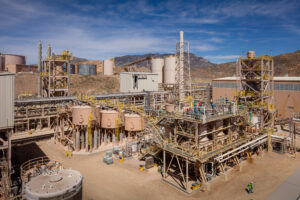
This 2024 photo shows the leach circuit at MP Materials’ Mountain Pass, Calif., mine and processing facility, which extracts rare earths from concentrate. (MP Materials photo by Michael Tesslerthe)
The U.S. and China struck a 90-day truce a month later, relieving both nations’ tariffs and requiring China to remove non-tariff countermeasures, including the export controls. But China slow-walked export licenses, drawing Trump’s ire and threatening to derail the deal.
The truce was extended by another 90 days in August, but China expanded the controls in October to apply to all rare earths and lithium battery materials.
Both sides agreed to a year-long extension of the truce in late October, which included rolling back the Chinese export controls.
During the Senate hearing in February, Cadenazzi testified that China’s control of the supply chains represented a serious risk to military preparedness.
“We cannot, and we will not, allow the operational readiness of the United States Armed Forces to be held hostage by the strategic calculus of an adversary,” he said.
Public policy experts agreed that China’s dominance of these materials poses a threat to U.S. security.
“We are one strong breeze away from not having the rare earths we need en masse for our supply chains,” said David Kelm, a senior policy analyst at Silverado Policy Accelerator.
Gabe Collins, a research fellow at Rice University’s Baker Institute for Public Policy, said the threat of critical mineral scarcity for defense manufacturers is a “gigantic military problem,” and the risks facing the overall economy could make it harder to build crucial weapons during a conflict.
“Making sure that your civilian economy and industrial base are able to underpin and sustain that effort is absolutely an existential and critical issue,” he said.
A wave of cash
The Trump administration has dedicated significant funding to critical mineral production, including through a novel strategy of buying stakes in mining companies.
Shoring up domestic critical mineral supply chains is a “generational undertaking” that requires sustained focus from the federal government, Cadenazzi told senators.
The Trump administration has announced around $3 billion in conditional investments to obtain stakes in seven critical mineral companies.
Korea Zinc, the world’s largest zinc smelting company, sold stock worth $1.9 billion to a joint venture controlled by the Pentagon and private investors in December. The purchase would give the Defense Department a 40% stake in the venture.
The joint venture will finance construction of the first large-scale zinc refinery built in the U.S. since the 1970s.
The U.S. government and financial institutions would supply an additional $4.7 billion in loans to finance the project, and the Commerce Department would provide $210 million in subsidies from the CHIPS and Science Act.
The government and associated investors would own roughly 10% of Korea Zinc.
Korea Zinc, based in Seoul, is publicly traded on the Korea Exchange.
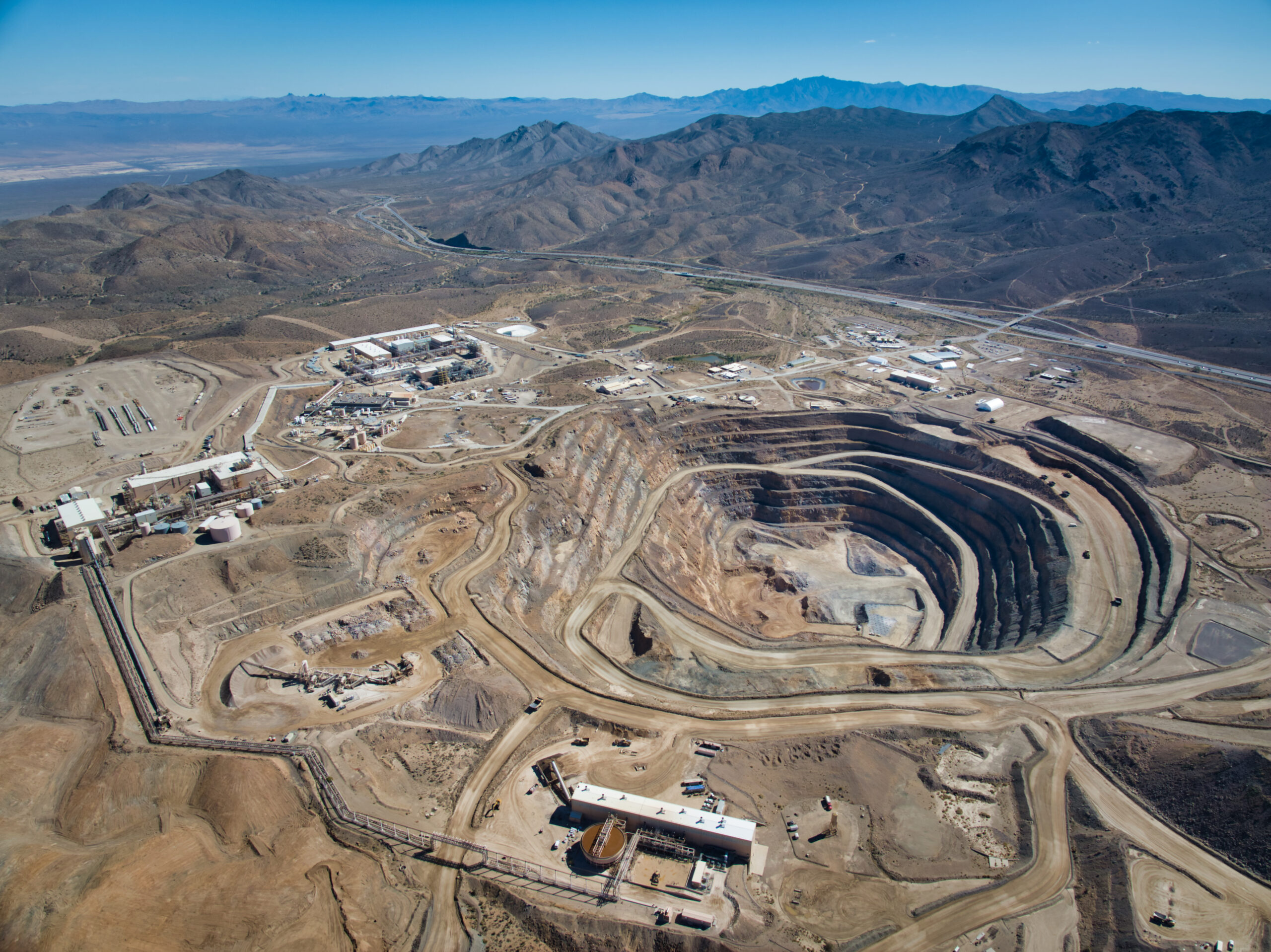
In July 2025, the Pentagon bought a $400 million stake in MP Materials, which operates the Mountain Pass mine in California, about 50 miles from Las Vegas – the only commercially viable rare earth mining and processing site in the U.S.
The move made the U.S. government the company’s largest shareholder as it seeks to build a new rare earth magnet manufacturing facility.
The deal also included a $150 million loan from the Defense Department, a guaranteed minimum price for its main products and a promise that all magnets produced at the facility would be bought by defense or commercial customers.
MP Materials’s products include neodymium-praseodymium oxide and metal, which are used to create the exceptionally strong neodymium-iron-boron magnets used in aerospace and defense manufacturing, in particular motors and generators.
James Litinsky, the founder and CEO of MP Materials, said in a May earnings call that construction on the new magnet manufacturing facility was moving rapidly – thanks to federal investment.
“With proven partners and full Department of War support, we expect construction activities to accelerate throughout the year,” he said.
Litinsky pointed to “policy tailwinds and continued urgency around onshoring and supply chain security” supporting the company’s financial performance and growth.
The Pentagon has awarded United States Antimony Corporation, a publicly traded firm operating North America’s only primary antimony smelter, a $245 million contract to supply the defense stockpile with antimony and a $27 million grant to boost production.
USAC has a mine in Alaska and refinement facilities in Montana and Mexico.
The company is “perfectly positioned” to take advantage of the capital the government has placed on the table, CEO Gary Evans said in a May earnings call.
“We’ve heard it loud and clear from the representatives of the government we deal with that they want more antimony like yesterday,” he said. “We’re working very, very hard in trying to meet that demand and that goal.”
He told investors the war in Iran and other conflicts around the world have boosted government demand for antimony.
At the government’s request, USAC also got involved in tungsten and cobalt production, he said. That marks the first time tungsten has been mined in North America in nearly two decades.
“They want more antimony, they want more tungsten, and we’re working on cobalt feverishly,” he said.
The Department of Commerce took an 8% stake in USA Rare Earth and pledged up to $1.3 billion in loans and $277 million in direct support if the company meets key milestones, with an option to double that stake later.
The publicly traded company, which operates in Oklahoma, Texas, Colorado and the U.K., owns a deposit that is expected to yield 15 of the 17 rare earth metals. It also produces neodymium-iron-boron magnets.
Dollar signs
Humpton, the USA Rare Earth CEO, told investors the company is focused on reaching a broad set of customers, including defense contractors in need of domestic suppliers.
“We recognize that the situation is dire,” she said. “Should China choose to withhold materials at any time, it’s critical for manufacturers in the U.S. and with our allies to be able to get access to materials.”
Kelm, the analyst, said the federal investments have spurred a boom.
“There’s a market signal saying, ‘There’s a vulnerability here, maybe we should focus on that,’” he said.
Moving forward, Kelm said government investments to improve mining and processing could allow more yttrium and scandium to be recovered without new mines, by ensuring those critical minerals aren’t dumped as byproducts in the production of other materials.
“We’re finally seeing where our leverage is and where China’s leverage is, as well,” he said. “It’s a good time to be in it.”