Trump’s widespread use of military goes far beyond Iran: ‘Death by a thousand cuts’ in terms of readiness

WASHINGTON – Iran is not the only country where the U.S. military engaged in conflict in the last few months.
Just since the first strike on Tehran on Feb. 28, the U.S. has conducted 10 strikes in Somalia against militant groups, four strikes against vessels in Latin America and a bombing in Ecuador.
And that doesn’t count ongoing missions and deployments, including a training mission in Nigeria, planning for two more bases in Greenland and a fuel quarantine in Cuba.
It’s not unusual for the U.S. to have simultaneous operations worldwide, though experts say the Iran war has taken up enough resources to erode readiness for another major conflict.
“It’s overstretched, but I don’t think the problem is the military being too small or not having enough money,” said Jennifer Kavanagh, a senior fellow and director of military analysis at Defense Priorities. “The problem is the military trying to do too much.”
Western Hemisphere
In the Western Hemisphere, strikes during Trump’s second term reflect the administration’s counterterrorism objectives, said Stephanie Savell, executive director of the Costs of War project at Brown University.
The strikes target drug cartels that Trump designated as terrorist groups by executive order the day he started his second term.
“Instead of calling it a war on drugs, it becomes an expansion of U.S. counterterror operations,” Savell said.
That’s how the Trump administration justifed the capture of former Venezuelan President Nicolás Maduro on Jan. 3, and the 50 strikes on boats in the Caribbean and eastern Pacific since September. The last such strike was on April 13, according to U.S. Southern Command.
U.S. officials asserted the boats and the 159 people killed in those strikes were involved in drug trafficking, though the government has presented no evidence, and doubts are widespread.
An E-2D Hawkeye, attached to Airborne Command & Control Squadron (VAW) 117, launches from the flight deck of Nimitz-class aircraft carrier USS Abraham Lincoln (CVN 72) during Operation Epic Fury, March 31, 2026. (U.S. Navy photo)
On March 3, the U.S. expanded its reach against narco-terrorists by launching operations with Ecuador.
On March 6, Ecuador bombed a site that officials there and in the U.S. described as a training camp for drug traffickers, using intelligence supplied by the U.S. Nearby residents later said the site was nothing more than a civilian farm. Secretary of Defense Pete Hegseth has said more such strikes are coming as part of the new anti-cartel U.S.-Ecuador effort.
In the Caribbean, the U.S. Coast Guard began a blockade around Cuba in February called Operation Southern Spear. With most oil deliveries halted, residents have endured frequent blackouts. The U.S. allowed a Russian tanker with about 730,000 barrels of crude oil into the country in late March.
Five U.S. warships were in the Caribbean Sea to institute the quarantine as of April 13, according to the U.S. Naval Institute.
Sebastián Arcos, the interim director of the Cuban Research Institute at Florida International University, said the fuel quarantine and Trump’s executive order against cartels shows a fresh emphasis on Latin America and a willingness to intervene militarily that presidents largely abandoned after the Bay of Pigs. The muscular use of U.S. forces sends a message to China that “the U.S. will be there if they take over Taiwan,” he added.
“The United States was falling behind in regards to other competing superpowers, China and Russia in particular, regarding military capability,” Arcos said. “It was a way to show the world that the United States has the spine to do what it needed to do in order to enforce U.S. foreign policy goals.”
The U.S. will likely continue its quarantine of Cuba for some time, Arcos said.
“Cuba is a long unfinished homework that the United States has to finish,” Arcos said.
The U.S. blockade of Iran’s ports, which CENTCOM declared was fully in place as of April 14, is meant to pressure Iran to drop its own efforts to control and toll shipping through the Strait of Hormuz.
Kavanagh said Trump has grown increasingly comfortable with force as his “best tool” for coercion in foreign policy.
“After the Venezuela operation, he was very emboldened and thought that he had cracked the code” that eluded other presidents who “had gotten us into long wars. They had messed up, but he had the key and that he felt that he could do anything,” she said.
Africa
According to New America, a left of center think tank, the U.S. conducted more than 170 strikes in Somalia in 2025 that killed at least 172 militants and civilians. The U.S. has justified these strikes as deterrence and self-defense against terrorist organizations like Al Shabaad and the Islamic State-Somalia.
Trump, in both of his terms, has conducted more strikes in Somalia than all presidents since President George W. Bush combined.
“There’s hardly any media attention to what’s going on in Somalia, but it’s a definite intensification,” Savell said.
The lack of media attention tracks the under-the-radar approach from the Trump administration.
The president, taking a poke at Rep. Ilhan Omar, D-Minn., a Somalian-born member of Congress, posted an article Feb. 3 detailing a U.S. strike a year earlier that targeted ISIS-Somalia leaders.
That was the first time in a year that he had referred publicly to the ongoing U.S. strikes.
At a news conference Jan. 20, at the height of protests in Minnesota about an immigration enforcement surge that led to the shooting deaths of two Americans by federal agents, Trump went out of his way to criticize Somalia.
Noting that Somalian immigrants were allegedly involved in a massive fraud scheme in Minnesota, he told reporters at the White House:
“Somalia is not even a country,” Trump said. “They don’t have anything that resembles a country. And if it is a country, it’s considered just about the worst in the world.”
The most recent U.S. airstrike in Somalia took place on April 9 near Qalay. U.S. Africa Command reported no additional details.
“The lesson we can draw there is that there is less regard for protecting civilians – a more belligerent, more aggressive military posture, and a sense in which the war on terror must continue through force,” Savell said.
On the other side of Africa, the U.S. sent 200 troops to Nigeria to assist with counterterrorism in February.
That followed a Christmas Day strike on ISIS in the northwest region of Nigeria called Sokoto.
Trump later called that strike a warning against jihadist who have attacked Christians. “If they continue to kill Christians it would be a many-time strike,” he told The New York Times.
Is the military spread too thin?
While the U.S. war with Iran – currently under ceasefire – has reduced the stockpile of munitions, these many smaller conflicts and commitments also sap resources, said Carlton Haelig, a fellow with the Defense Program at the Center for a New American Security.
Military operations around Venezuela alone cost $31 million a day, according to an analysis issued in December by the Center for Strategic and International Studies.
“You have this death by a thousand cuts situation going on,” Haelig said.
By itself, each commitment doesn’t “really put too much stress on the force,” he added. “But when you combine them all together, and then add to that a major war, you start to see cracks in the readiness and the capability of the force.”
The U.S. military has also been conducting exercises to maintain its readiness.
On Feb. 26, the U.S. and 29 other countries had 8,000 personnel conduct training and humanitarian assistance in Thailand in what is considered the largest joint exercise in Asia, according to the Navy.
The U.S. and South Korea conducted a 10-day exercise starting on March 9 – at the height of the Iran war – named “Freedom Shield 26.”
“Freedom Shield 26 demonstrates the strength of our alliance and our ability to train, build readiness, and operate seamlessly as one force,” said Gen. Xavier T. Brunson, commander of United Nations Command, Combined Forces Command and U.S. Forces Korea, in a press release. “There is no substitute for training, there is no excuse for not being ready.”
The annual Balikatan exercise in the Philippines is planned for April 20 to May 8, according to Stars and Stripes.
That will involve more than 10,000 U.S. troops and 7,000 from six other nations.
As of Jan. 31, the U.S. had 1.35 million active duty personnel, according to the Defense Manpower Data Center. That’s up about 43,000 from a year earlier.
More than 50,000 of those are in the Middle East. At the peak of the War on Terror in 2011, there were about 98,000 U.S. troops in Afghanistan.
Some of Trump’s moves have undermined other priorities, including Europe and the Indo-Pacific.
Deployments for the Iran war include about 2,000 troops on March 24 from the 82nd Airborne Division’s Immediate Response Force out of Fort Bragg. That force deployed to the Middle East in 2020 and to Eastern Europe to support NATO in 2022.
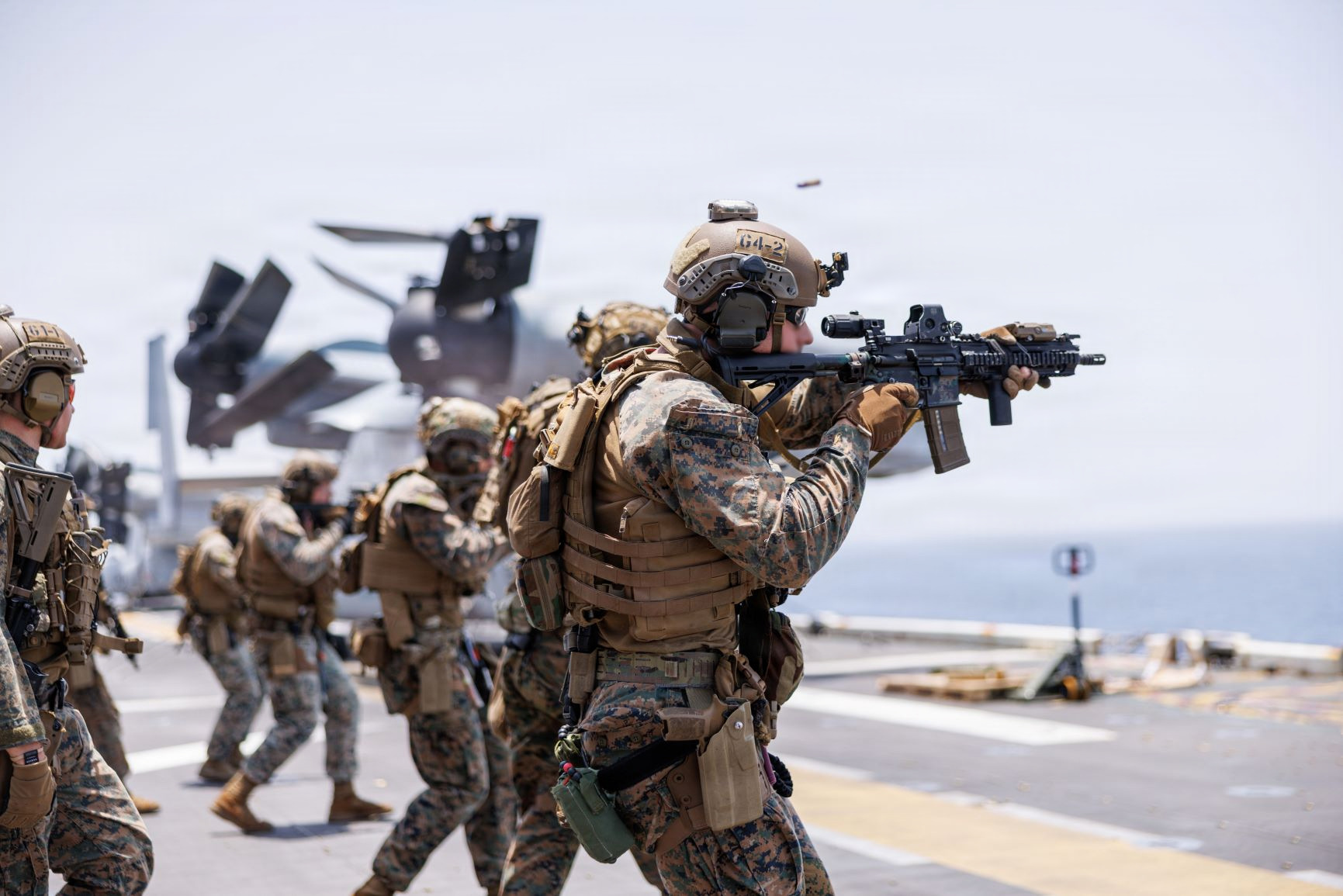
On March 28, the Pentagon also sent at least 2,000 Marines from the 31st Marine Expeditionary Unit to Iran. That unit, based in Okinawa, Japan, had been conducting exercises in the Indo-Pacific.
“The loss of a forward-deployed MEU in the Indo-Pacific is critical,” Haelig said. “It’s a significant capability for the Indo-Pacific that’s being taken away from that theater.”