SWJ–El Centro Book Review — Cárteles Inc.: La “nueva generación” que controla las redes criminales
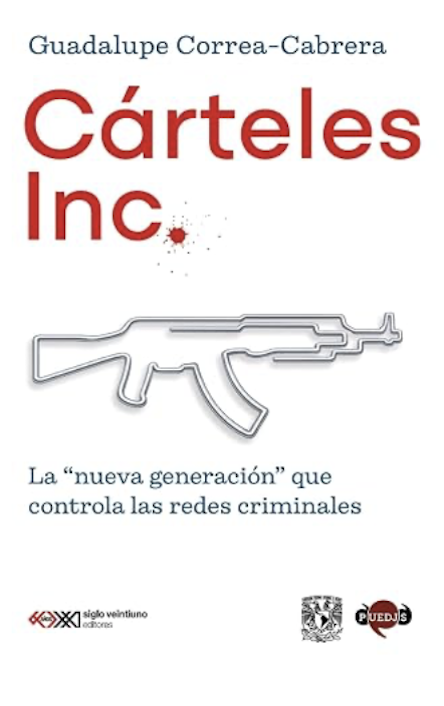

Guadalupe Correa-Cabrera, Cárteles Inc.: La “nueva generación” que controla las redes criminales. Ciudad México: Siglo XXI, 2026. [Spanish Edition; ISBN: 9786070315657, Softcover, 9786070315664, eBook, 304 pages]
Organized crime in Latin America is a growing concern due to its implications for national security and its ability to adapt and evolve. Over the last few decades, we have seen organized crime expand in its diversification, complexity, and reach. In Cárteles Inc. Guadalupe Correa-Cabrera masterfully expands on her last book, Zetas, Inc.: Criminal Corporations, Energy, and Civil Wars in Mexico, by updating the country’s security and criminal landscape after the restructuring of the Sinaloa Cartel and the rise of the Cártel Jalisco Nueva Generación (CJNG). She then builds on a new criminal model she refers to as criminal paramilitary that emerges from within the state’s structures. She finally proposes the analysis of social networks and systems theory as possible alternative methodologies to better understand the dynamics of criminality and violence in the country. Guadalupe Correa-Cabrera (Ph.D. in Political Science, The New School for Social Research) is a Professor and co-director of the Corruption, Networks, and Transnational Crime Research Center (CONTRA) at the Schar School of Policy and Government, George Mason University.
The Structure of the Inquiry
This book has a map and tables section, a prologue, an introduction, twelve chapters, a conclusion, notes, an epilogue, references, and an index. The chapters develop through four main sections that explore the Zetas’ business, paramilitarism, and a modern civil war; criminal corporations and their relationship to militarization and the energy industry; and, finally, the evolution of these criminal organizations.
The first chapter, The Origin (El Origen) provides background and context critical to understanding the Zetas cartel and why their business model was unique. The author first goes through the history of crime in Tamaulipas, linking it to ties to powerful businesspeople and politicians. She then explains the rise of the Gulf Cartel and explains that their links to the de Gortari family led to the establishment of large-scale narcopolitics in Mexico. When the leadership of the cartel changed to Osiel Cárdenas, he began to use violence as a means to consolidate his power as he lacked the political protection of his predecessors. He formed an armed group composed of ex-security forces that would become los Zetas. Nuevo Laredo has always had geostrategic importance for smuggling due to its location on the border, making it a contested area. The Zetas consolidated power in Nuevo Laredo and began to expand and diversify into other criminal enterprises like human trafficking. At this time, though, two major blocks of organized crime emerged. One was called the company and included the Zetas and the Gulf cartel, as well as other smaller organizations trying to maintain control of the Northeast of Mexico.
On the other hand, there was the Federation, controlled mainly by the Sinaloa Cartel and their allies at the time. The Federation tried to control the Western side of Mexico, and both groups battled over control of key strategic cities and drug routes across Mexico. What is most important is that the military structure and command that the Zetas formed began to reproduce across Mexico, creating what the author refers to as a generalized criminal paramilitarization of Mexico. Los Zetas would also use the media as a tool for their battle against the federation, which would open a new form of information operations into the fold. Their adversaries would exploit the Zetas’ extreme violence to portray them as the number one threat to Mexico.
The second chapter, the Zetas “War” (La “Guerra” de los Zetas) traces the break between the Gulf Cartel and the Zetas. The chapter examines the militarization of Mexico as a security strategy and its violent consequences. As the Zetas saw an opportunity to become independent, a fight over Tamaulipas erupted. The violence expanded and started to affect other states like Nuevo León as both organizations tried to extort money from the industries in Nuevo León. Violence also expanded to Veracruz as the Sinaloa Cartel fought the Zetas by forming an alliance with the Milenio Cartel, which would eventually become the CJNG. Coahuila would also see an expansion of violence and massacres, and the Zetas would become one of the most powerful criminal organizations in Mexico. The Zetas would also expand their reach into Central América and would even establish an extortion model in places like Michoacán that would expand across Mexico. She finishes the chapter by describing the fall of the Zetas and their leaders, explaining that their lack of familial ties within the leadership led to their quick demise.
The third chapter A Criminal Transnational Corporation (Una Corporación Criminal Transnacional) analyses the structure of the Zetas Cartel. The author exposes how previous analyses of the Zetas overlooked the important connections they had with politicians in Mexico, as well as the significance of their diversification into crime. Another issue with others’ analysis of the Zetas has to do with the assumption that they worked in a strict hierarchy, when in reality they used autonomous cells within their criminal network. As the trial of the leader of los Zetas exposed, los Zetas evolved from a military structure to a corporate structure with franchises across Mexico. The author expands, saying the franchise model is too basic; one must understand that the Zetas were the first to incorporate other criminals into their ranks to gain monopolies over different criminal sectors. This, along with their transnational network, made the Zetas a unique criminal organization at the time. The author continues by breaking down the Zetas’ structure, exposing how they were the country’s first transnational criminal corporation.
The fourth chapter Monopoly of Violence? (¿Monopolio de Violencia?) explores the real causes of violence in Mexico by exposing the myth that violence is mainly caused by these criminals and their fight over territory to control drug-trafficking. The author points to the economic problems many Mexicans face and the growing symbiosis between the government and organized crime as the real roots of the issues of violence Mexico faces. The author explores how the fall of the PRI’s political power in Mexico led to the loss of politicians’ control over the criminal sector. This is why Correa understands the PRI’s decentralization of power, the loss of control over organized crime, and the rise of economic problems as the variables behind the expansion of violence in Mexico. The rise in violence can also be understood as a battle over the Monopoly of violence between the state and criminal groups. The author finished the chapter by analyzing how the US does not seek to eradicate illicit drugs but instead seeks to explain the economy of illicit drugs to finance security agendas linked with transnational capital.
The fifth chapter, Paramilitarism: The Mexican State’s Secret Policy (Paramilitarismo: Política Secreta del Estado Mexicano) describes how the Mexican state has been using an ilícita táctica (illicit tactic) known as criminal paramilitarism to maintain its monopoly of violence and tax citizens. The author expands on the history of paramilitarism in Mexico and compares it to paramilitary cases in Colombia. The author then exposes how the paramilitarization of crime is used in Mexico for three main reasons. It can be used to eliminate enemies of the state; it can be used by community leaders or businesspeople to protect against extortion by criminals; and, finally, it can be used to resist social pressures against big capitalist projects. She then presents case studies for each scenario to expand on their use in Mexico.
The sixth chapter, Modern Civil War in Mexico (Guerra Civil Moderna en México) explains that Mexico is not simply fighting a war on drugs but a new type of civil war. The author expands on the definitions of irregular warfare and applies them to the conflict in Mexico to explain how the government began using paramilitary organizations in areas where it had lost its monopoly on violence in an attempt to regain control. Violence also has an economic function, as Correa explains how drug cartels work together with business interests to remove communities from areas they want to exploit. She finishes the chapter by explaining how cyberspace has also become a battlefield for these groups and the State to conduct information operations against one another.
The seventh chapter, the Extractivist War (La Guerra Extractivista) expands on how these modern civil wars exploit natural resources as new forms of financing. In this context, paramilitary groups aim to seize these resources to sustain warfare. Paramilitarism in Mexico has close links to the political class in places like Coahuila and targets petrol and gas pipelines. In Michoacán, they focused on illegally shipping Iron to Asia. The author exposes how these paramilitaries are clearing the way, both now and in the future, for the capitalist extraction of these natural resources.
The eighth chapter, Energy and Security in Tamaulipas (Energía y Seguridad en Tamaulipas) explains the economic importance of Tamaulipas and how extreme levels of violence accompanied the opening of its energy sector. The paramilitaries have been able to transfer very valuable land from public to private hands, facilitating its future exploitation.
The ninth chapter, To Whose Benefit? (¿Cui Bono?) expands on the idea that these crusades against drugs have really been used to transform the economies of the countries in which they are fought. These organizations do not seek to eliminate the drug trade but seek to create chaos by using the media coverage of these drug wars to cover up extractivist projects, which are the real goal. The forced movement of people in Mexico has had severe consequences. In each state, the areas of forced movement coincide with the locations of megaprojects and natural resources. The result is that areas of economic interest for the United States are now clear and ready to be exploited in the future.
The tenth chapter, A New Generation of Criminal Networks? (¿Una Nueva Generación de Redes Criminales?) delves into how the CJNG has adopted the model established by los Zetas, incorporating new criminal elements. The author describes the new criminal linkages and networks being formed, linking them to Mexico’s energy sector and the US’s economic interests. The author traces the origins of the CJNG and their connection to the fall of the Zetas. She then traces the major reconfigurations of criminal organizations since 2018. She also notes that Andres Manuel Lopez Obrador’s administration tried to recreate criminal monopolies by area to better control them, as the PRI did in the past. She finishes the chapter by exposing how the DEA has constructed a vision of criminal organizations in Mexico that does not fit its current reality.
The eleventh chapter, New Paramiltary Violence in Mexico (Nueva Violencia Paramilitar en Mexico) focuses on the new generation of criminal organizations that are violently fighting one another. She discusses the Sinaloa case and the failed kingpin strategy, questioning its real objectives. Zacatecas and Guanajuato have also had linkages between the government and criminal organizations. Still, the most important variable to explain the increase in violence in these states is the presence of natural resources. She also analyzes the use of paramilitary tactics in Sonora and concludes the chapter by saying that paramilitary strategies seem to prevail in areas of economic interest.
The twelfth chapter, Paramilitarization and Energy under Morena’s Administration (Paramilitarización y Energía en tempos de la 4T) focuses on the evolution of the criminal paramilitary model. The author points out that the regions with the most important energy-sector resources in Mexico are becoming epicenters of violence. The thing is that these criminal organizations have evolved beyond drug trafficking and take on the diversified opportunities presented when controlling a territory. The author expands by saying that these paramilitary criminal organizations are financed by Mexican businessmen coordinating with the Mexican government to advance capitalist development and projects. She provides several case studies to show how this works. She concludes that the areas with the most forced displacement in Mexico are also the ones with the greatest economic potential for capitalist interests.
Conclusion
I recommend Cárteles Inc. to anyone interested in criminology and studies of violence. Correa-Cabrera masterfully expands on her research on the Zetas by updating the current security situation in Mexico. She traces the evolution of these cartels since 2018, highlighting how they have adapted the Zetas’ model through criminal paramilitarism. She also makes interesting and eye-opening connections between paramilitarism and the capitalist economic interests in Mexico and the US that may be driving violence in these areas for their own interests. She also brilliantly exposes how these new generations of organized crime are not simply more fragmented, resilient, and flexible but have transformed into networks of power that encompass the state, criminal organizations, businesspeople, and the military. In the end, Correa-Cabrera traces the evolution of these criminal organizations while exposing the logic of paramilitary tactics used under the guise of the war on drugs that benefit transnational capitalist interests. Readers may also find Third Generation Gangs and Transnational Cartels, edited by John P. Sullivan and Robert J. Bunker, as a complementary volume that includes a piece, “Drugs, Elites and Impunity: The Paradoxes of Money Laundering and the ‘Too-Big-To-Fail’ Concept” by Correa-Cabrera et al.