





Part 1: The U.S. Munitions Problem
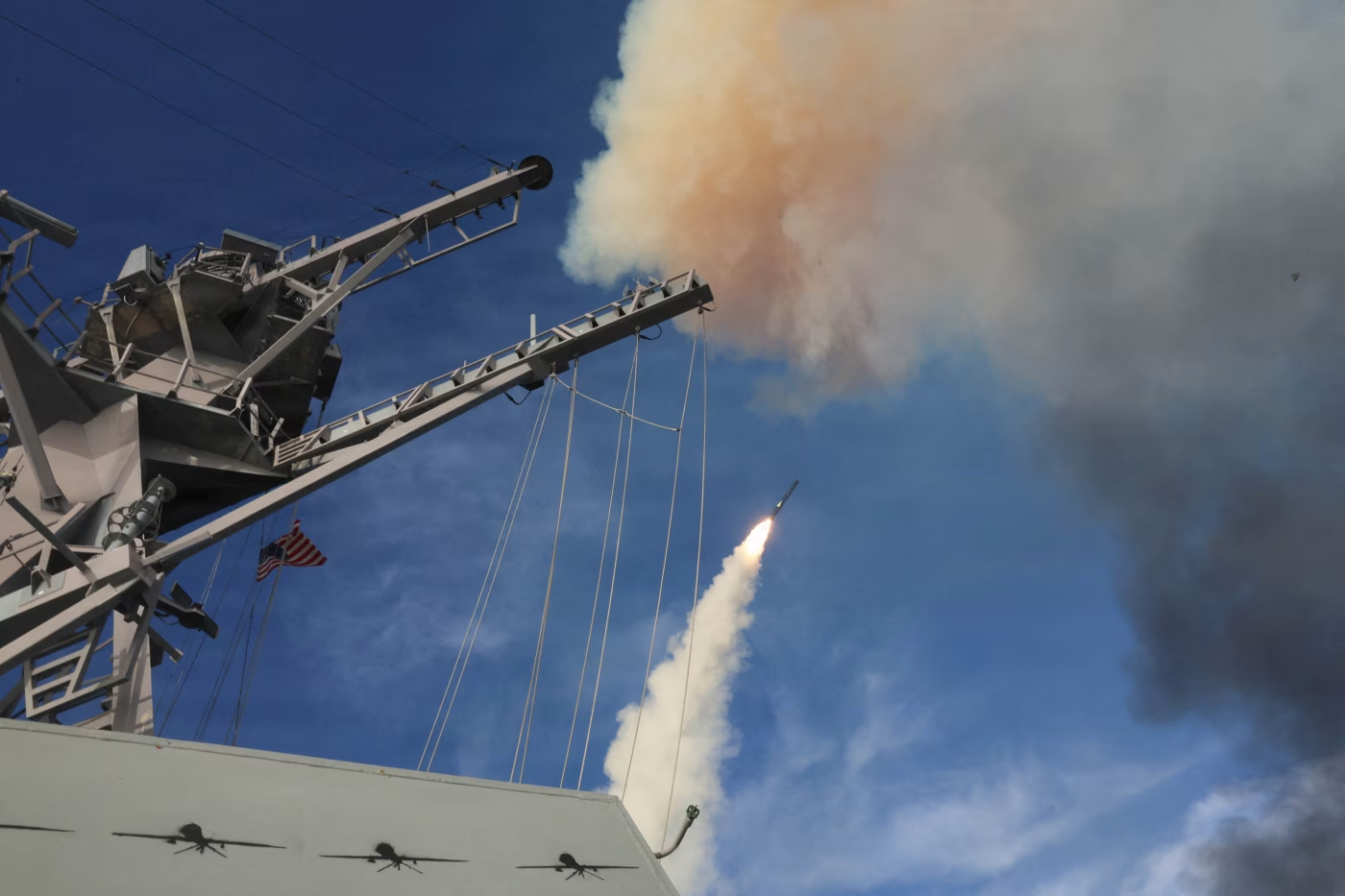

The Center for Strategic and International Studies (CSIS) published a report in late April analyzing the status of U.S. munitions inventories following the 39-day air campaign against Iran. “Last Rounds? Status of Key Munitions at the Iran War Ceasefire” concludes that U.S. missile expenditure won’t constrain current operations, but significantly weakens preparedness for future wars. The New York Times and Wall Street Journal reported similar findings when the ceasefire began. In this four-part Discourse series, we comb through these reports for key numbers, themes and takeaways.
In the 39-day air campaign against Iran, the U.S. depleted seven types of critical missile stockpiles– “critical” because of the time it will take to rebuild their stocks and their centrality to a potential future conflict in the Pacific. Even before the Iran War, stockpiles of these weapons were deemed insufficient for a near-peer war. Now, this gap is more acute.
Here are the seven missiles in question:
Long-Range Precision Fire Against Ground Targets:
Tomahawk Land Attack Missile (TLAM): Long-range sea-to-ground missile; allows U.S. Navy to fire from international waters. Proven and extensive use since Operation Desert Storm.
Joint Air-to-Surface Standoff Missile (JASSM): Air-launched stealth missile; first used in Trump’s 2018 strikes against the Assad regime’s chemical weapons.
Precision Strike Missile (PrSM): Ground-launched by field artillery units; succeeds Army Tactical Missile System (ATACMS). Requires access to territory relatively close to target (~500km).
Air and Missile Defense:
Standard Missile 3 (SM-3): Ship-launched ballistic missile interceptor; first used against Iranian missiles targeting Israel in 2024 and proven again in 2025 12-day war.
Standard Missile 6 (SM-6): Ship-launched aircraft and cruise, ship, and ballistic missile interceptor; improvement on SM-2.
Terminal High Altitude Area Defense (THAAD): Ground-launched ballistic missile interceptor; used extensively and depleted in 12-day war.
Patriot Advanced Capability-3 (PAC-3) Missile Segment Enhancement (MSE), aka PAC-3 MSE: Ground-launched aircraft and ballistic and cruise missile interceptor; half of annual production goes to allies, Ukraine in particular.
~~~
Not all stockpiles are in critical condition. CSIS notes several key munitions that allow the U.S. to continue the war should one or more critical inventories run out. They are:
Ground Attack munitions:
Joint Direct Attack Munition (JDAM): Guidance accessory that upgrades cheaper bomb precision capability.
Joint Air-to-Ground Missile (JAGM): Air-to-ground munition for launch from helicopters and large drones.
Small Diameter Bomb (SDB) I and II: Air-to-ground precision glide bombs.
For countering drones and cruise missiles:
AIM-120 Advanced Medium-Range Air-to-Air Missile (AMRAAM): Air-launched, radar-guided missile.
AIM-9X Sidewinder: Like AMRAAM but with shorter range; upgraded extensively since 1950s.
~~~
Looking ahead:
In the next discourse in this series, we’ll look at the numbers for Long-Range Precision Fire: how many we have and how many have been used.
Find the complete CSIS report by Mark F. Cancian and Chris H. Park here: “Last Rounds? Status of Key Munitions at the Iran War Ceasefire.”
Find the New York Times report by Eric Schmitt and Jonathan Swan here: “Iran War Has Drained U.S. Supplies of Critical, Costly Weapons.”
Find the Wall Street Journal report by Alexander Ward, Shelby Holliday, and Yoko Kubota here: “Iran War Complicates Contingency Plans to Defend Taiwan, Some U.S. Officials Say.”
This is the first of a four-part series on U.S. munitions inventories following the 39-day air campaign against Iran. The second is available here.

