





Managing the Strategic Gradient: Governance, Doctrine, and the Logic of Irregular War
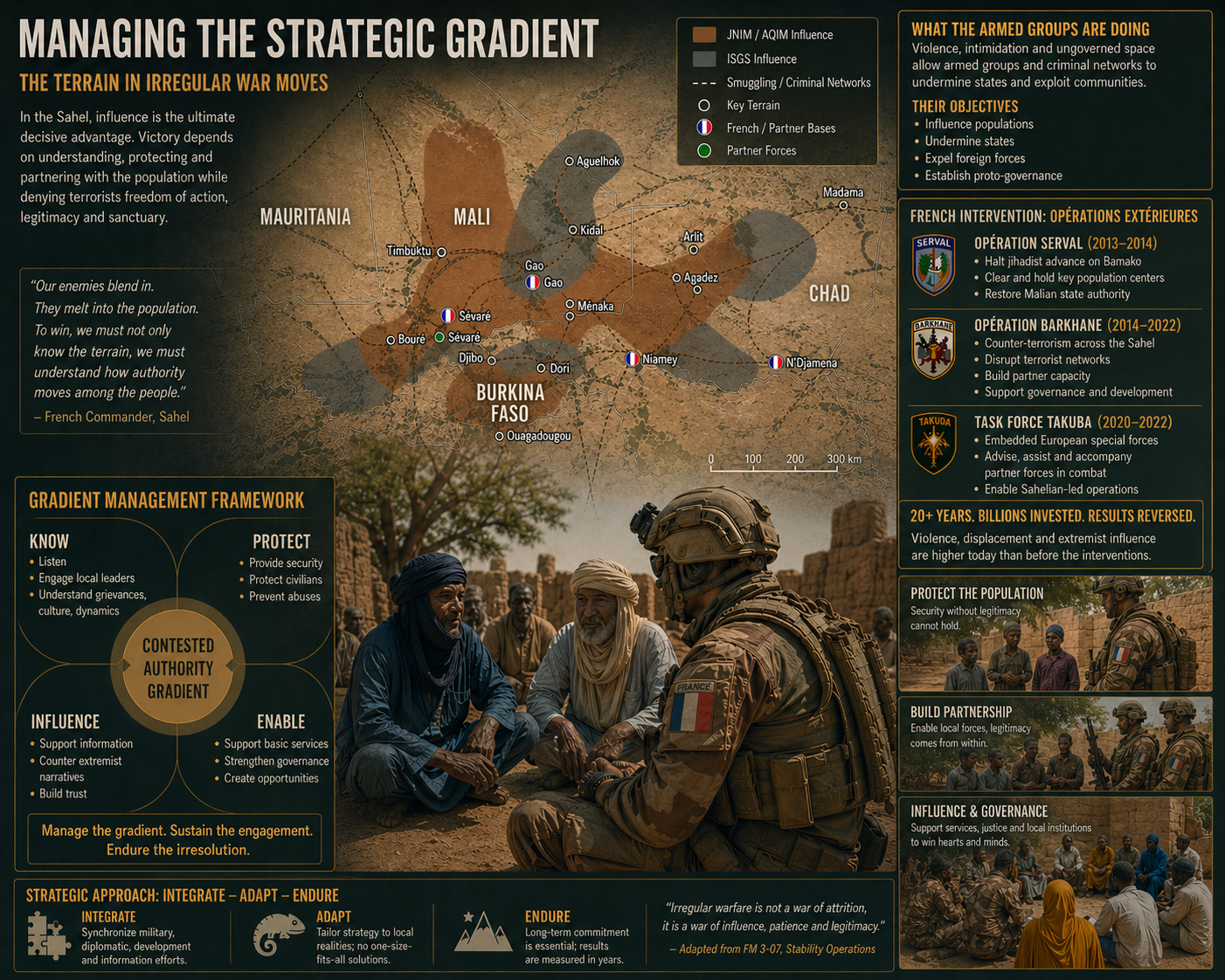

The Pattern That Never Changes
In January 2013, French forces entered Mali to conduct Operation Serval and did what Western militaries do well: they moved fast, hit hard, and pushed jihadist fighters out of the northern cities seized the previous year. By conventional measures, it was a successful operation. Yet within two years those same fighters had returned, were dispersed across a wider area, better networked, and harder to find. By 2019, after years of the follow-on Operation Barkhane, the Sahel was measurably less stable than before the intervention. By 2022, French forces had been expelled entirely. Today the region is among the world’s fastest-growing conflict zones. This is not a story about French incompetence; on the contrary, French forces were skilled and well-led. It is however a story about a recurring pattern that has appeared in the Philippines, Somalia, Iraq, and dozens of campaigns across the last century: the gap between what military intervention can accomplish and what irregular conflict requires.
Irregular warfare doctrine continues to fail for the same reason it has always failed: it trains practitioners to fight the wrong kind of war. Conventional doctrine and irregular warfare are not points on a single spectrum of intensity. They differ in perception, in objective, and in methodology. Conventional doctrine perceives a battlespace organized by enemy formations, key terrain, and decisive points. Irregular warfare unfolds in spaces where authority itself is contested and where the most consequential signals are economic, social, and legitimacy-based rather than military. Conventional doctrine pursues defined end states: the defeat of an adversary, holding key terrain, the transition to a stable peace. Irregular warfare manages ongoing political processes that do not easily resolve and require enormous amounts of time and effort. Conventional doctrine applies graduated force toward decision. Irregular warfare shapes conditions over time and operates substantially below the threshold of traditional armed conflict through political subversion, economic coercion, lawfare, information operations, and proxy activity that may never produce open fighting at all.
What irregular warfare is fought over, even when the fighting appears to be about something else, is the governance gradient: the direction and velocity of a population’s movement between competing systems of authority, formal state, customary, religious, criminal, and insurgent, that overlap and compete in any transitional political space. The governance gradient is the empirical condition on the ground it exists whether anyone is measuring it or not. The strategic gradient is the deliberate choice to treat that condition as the primary object of strategic focus rather than treating territory, enemy formations, or population allegiance as primary. The vocabulary is borrowed deliberately. Transitional political environments are the space where no single system of authority holds uncontested legitimacy, and a population’s allegiance is actively moving or is up for grabs between multiple competing systems (formal state, customary or tribal, religious, criminal, and insurgent). These systems often overlap meaning that territory and population behave less like battlefields and more like the gradient systems studied in physics and ecology. For example, pressure gradients that redistribute when compressed, ecotones that shift and reinforce themselves under disturbance. The tools built for one kind of system rarely work on the other.
The pattern of failure in Mali is not a failure of effort, resources, or tactical skill. It is a failure to recognize the governance gradient as the object being fought over and to adopt the strategic gradient as the frame for engaging it. What follows examines why doctrine misclassifies the problem at three levels—classification, perception, and familiarity—and what the formation of practitioners capable of managing the strategic gradient would require. The terrain in irregular warfare moves. The practitioner who keeps trying to hold it still will always lose it.
The Sahel is not an environment where territorial control produces stability. It is defined by ethnic fractures between Tuareg and Fulani communities, by governments whose authority is contested not just militarily but culturally, and by loyalties that shift with economic pressure, kinship obligation, and the credible presence of whomever can provide protection this season. None of these conditions responded to the French deployment. They predated it by decades and continued beneath it, undisturbed. France had not failed in its execution. It had succeeded in a task that the environment had already made insufficient.
What Irregular Warfare Actually Is
Irregular warfare is not insurgency with a broader label. It is a spectrum of conflict that includes not just guerrilla warfare, but also political warfare, sabotage, subversion, proxy operations, economic coercion, lawfare, information operations, and gray zone activity that never produces armed insurgency at all. Much of the most consequential irregular warfare in the contemporary period happens entirely below the threshold of armed conflict.
Russia’s operations in Ukraine between 2014 and 2022 demonstrate this clearly. Before the conventional invasion, they combined proxy support, political subversion, information operations, and economic pressure into a sustained irregular campaign that reshaped the political landscape without openly fielding a single attributable known uniformed Russian soldier. China’s approach in the South China Sea operates similarly, using legal claims, economic dependency, and gray zone maritime activity to advance its strategic position without triggering a conventional military response. Doctrine that centers on insurgency and counterinsurgency has little to say about either case.
In Mali, this pattern played out in plain sight. The political conditions that made the 2012 Tuareg rebellion and the subsequent jihadist seizure of the north possible had been developing for decades: a Bamako government that treated the north as extractable territory rather than governable space, economic exclusion that made young Sahelian men available for recruitment, and a regional arms flow from Libya that gave those men something to fight with. None of this was invisible. All of it was documented. And none of it was the primary object of French or international strategic attention until the crisis was already acute. Definitional narrowing produces a doctrinal blind spot that sophisticated adversaries exploit deliberately.
Why the Environment Resists the Tools Brought to It
To understand why doctrine fails though, one must begin to understand the environments where irregular conflict occurs. They are not simply difficult terrain. They are a specific kind of environment with distinct properties that conventional military institutions are structurally unprepared to navigate. Think about the difference between a forest and the edge where a forest meets a grassland. The forest has internal logic: canopy, understory, ground cover, established species relationships, and predictable resource flows. So does the grassland. The boundary between them, the ecotone in ecological terms, has different properties entirely. Species from both systems overlap there. New species exist only in that transitional zone. Resources concentrate at the boundary. The edge is more densely populated, more diverse, and more dynamic than either adjacent environment. It also responds to disturbance differently: apply pressure and it does not simply compress. It shifts, adapts, and often reinforces itself.
Transitional political spaces work the same way. They are not failed states or ungoverned spaces in the sense of absence. They are zones where multiple governance systems overlap and compete: formal state authority, customary or tribal authority, religious authority, criminal authority, and insurgent authority all present simultaneously, with different communities navigating different combinations depending on context. The Sahel’s central belt, stretching across Mali, Burkina Faso, and Niger, is not ungoverned. It is over governed, with each layer of authority operating according to different rules, legitimacy claims, and enforcement mechanisms.
Into this environment, conventional military doctrine brings tools built for different terrain. It assumes an enemy that’s a discrete organization with identifiable leadership, supply lines, and territorial holdings that can be disrupted and destroyed. It assumes a population that is a passive mass whose allegiance can be secured through protection and services. And, it treats the operating environment as a problem to be solved, a set of conditions to be assessed, planned against, and managed toward a defined end state.
None of these models fit. The enemy in a transitional political space is not a discrete organization. It is a set of relationships and conditions that produce fighters continuously, replacing those who are killed or captured faster than they can be removed. The population is not passive. It is making continuous, high stakes decisions about which authority system to engage with under conditions of radical uncertainty, not because it lacks information, but because the environment itself is genuinely ambiguous about which authority will be present and consequential tomorrow. The operating environment is not a problem to be solved. It is a gradient, a continuous spectrum of conditions that shifts in response to pressure and continues to shift as long as the underlying conditions that produce it remain in place.
This is why military pressure in irregular environments so often produces the opposite of its intended effect. In Mali, Operation Barkhane’s sustained targeting of jihadist leadership disrupted specific organizations but accelerated the fragmentation of the movement into smaller, more autonomous cells that were harder to track and no less capable of violence. Each successful strike on a leader produced successor factions rather than one weakened organization. The pressure did not compress the problem; it disaggregated and dispersed it.
The same dynamic appears in gray zone and proxy contests. When the United States sanctioned Russian entities involved in political subversion operations, Russia adapted by routing operations through more insulated cutouts and by distributing its information operations across a wider network of semi-autonomous actors. When European Union pressure raised the cost of overt economic coercion, China adapted by embedding dependency through commercial relationships that were harder to characterize as coercive. Pressure applied at the surface of an irregular campaign rarely reaches the gradient conditions beneath it. Those conditions reconstitute the campaign in adapted form.
Three Levels of Failure
The Classification Failure
At the broadest level, doctrine misclassifies what irregular warfare is. By treating it as a variant of conventional conflict, doctrine imports assumptions that actively distort understanding. It looks for enemies where there are networks of conditions. It looks for terrain to hold where instead there are strategic gradients to manage. It looks for end states where there are ongoing processes of political negotiation and resource competition. In the Sahel, the classification failure meant that international efforts, the G5 Sahel force, European training missions, and American and French intelligence support, were all structured to address the symptom rather than the condition. The governance gap in northern Mali that made the 2012 crisis possible remained unaddressed through a decade of intervention. It is still unaddressed today.
The Perception Failure
At the practitioner level, doctrine trains people to see the wrong things. Every military institution trains its personnel to notice specific signals: enemy formations, supply lines, key terrain, protected populations. These trained perceptual habits are appropriate for conventional environments and actively misleading in transitional ones. The signals that matter most in a transitional political space are not military. They are the direction of economic flows, the pattern of community leaders’ public versus private behavior, and the texture of local authority, specifically which disputes get brought to the formal state system and which are resolved through other mechanisms. These signals reveal where the governance gradient is moving. They are invisible to a perceptual system trained to read order of battle, and cultural briefings do not fix this. What practitioners need is not cognitive information about an environment but perceptual reorientation, a different set of trained instincts about what to notice and what questions to ask.
The Familiarity Failure
At the deepest level, there is a gap that no amount of doctrine or training fully closes: the difference between someone who grew up navigating a transitional environment and someone who arrived in it. Jihadist recruiters in the Sahel understood the social terrain of Tuareg and Fulani communities in ways that French intelligence officers, Malian army commanders from Bamako, and American planners did not and could not. Not because those officers lacked intelligence or commitment, but because the recruiters had grown up in the environment they were navigating. They knew which grievances were active and which were dormant, which community leaders could be co-opted, and which families were economically desperate enough to let a son join. This knowledge was not in any database. It was embodied, carried in relationships, language, and years of social navigation. Acknowledging the familiarity gap is not defeatist. It clarifies what capabilities matter most: long-term, deeply embedded human relationships with populations in transitional spaces, cultivated before crises develop rather than scrambled together after.
What the Gradient Actually Requires
Gradient management is a specific analytical and operational orientation that asks different questions than conventional or counterinsurgency approaches. Instead of asking where the enemy is and how to destroy it, it asks: where is the governance boundary, what conditions are maintaining it there, and what would shift it? Instead of measuring enemy casualties and territory controlled, it measures the direction and velocity of population movement across the governance gradient: which communities are moving toward engagement with legitimate authority, which are moving away, and why.
In Mali, a gradient management approach would have identified the specific communities in the Mopti region, the zone that became the epicenter of jihadist expansion after 2015, where intercommunal conflict between Dogon farmers and Fulani herders was creating the conditions for jihadist insertion. It would have invested in the local mechanisms for managing land and water disputes that had broken down under economic and climate pressure, treating fragile local authority structures as strategic assets requiring protection rather than as irrelevant to a campaign focused further north.
Most of what gradient management requires, sustained diplomatic engagement with community-level actors, economic integration of excluded populations, and patient investment in local institutional capacity, falls outside military authority. This points to a structural problem: the United States national security architecture is systematically biased toward military response. The State Department has a fraction of the budget, staff, and operational capacity of the defense establishment, and it is systematically excluded from early-phase engagement in transitional environments where its tools would be most effective. The result is a system that consistently reaches for the one instrument least suited to gradient management.
What the Practitioner Actually Requires
The answer to the doctrinal problem is not a new doctrine. It is a different kind of practitioner. Three qualities define someone who can navigate transitional political spaces effectively, and none of them are primarily cognitive.
Comfort with Irresolution
Conventional military culture rewards decisiveness: clear assessment, clear decision, clear action. Transitional environments punish premature decisiveness. The practitioner who forces a situation into familiar categories to act confidently will consistently misread the environment and take actions that worsen it. What these environments require is the ability to sustain uncertainty, to hold multiple competing interpretations simultaneously, act on partial information, and revise assessments continuously without experiencing that revision as failure. This is a disposition, not a skill. It can be cultivated, but not through doctrine or training courses. It develops through repeated exposure to environments that refuse to resolve into clarity, combined with mentorship from practitioners who model productive uncertainty rather than performed confidence. Military institutions that select and promote primarily on decisiveness systematically select against this disposition.
Gradient Literacy
The practitioner who can read a governance gradient, who can walk into a community and sense the direction and velocity of its political movement without relying on formal assessments, is worth more in an irregular environment than any weapons system. Gradient literacy requires long-term assignment patterns that conventional military institutions resist, language proficiency at genuine functional levels rather than the tourist-level competence most military language programs produce. Structured relationships with local interlocutors who have no institutional incentive to tell practitioners what they want or need to hear is not a mode of discourse that will lead to success. In the Sahel, the absence of this literacy was not an intelligence failure in the conventional sense. It was an institutional failure: a system that rotated personnel through twelve-month deployments and measured success in enemy contacts rather than in the quality of relationships built over years.
The Discipline of Restraint
Perhaps the most counterintuitive quality required of practitioners in irregular environments is the discipline not to act, or more precisely, to distinguish between actions that shift the gradient and actions that merely create the appearance of progress while leaving underlying conditions unchanged. Kinetic operations against insurgent networks, information operations targeting adversary narratives, and governance programs that build structures without building legitimacy can all be executed at a high professional standard and leave the gradient completely unchanged. The practitioner who can identify this distinction and walk away from an action that feels productive because it will not reach the gradient is rare. Developing this discipline requires institutional cultures that reward accurate assessment over optimistic reporting and that treat the honest acknowledgment of failure as more valuable than the performance of success.
The Honest Reckoning
Mali is still burning. The Sahel is less stable today than it was before a decade of intervention. Jihadist presence has expanded geographically, deepened socially, and diversified organizationally despite, and in some ways because of, sustained military pressure. This is not a verdict on the courage or competence of the soldiers, diplomats, and aid workers who spent years trying to stabilize the region. Many of them understood the problem clearly and said so. It is a verdict on a system, a doctrinal, institutional, and political system, that keeps reaching for the tools it knows how to use in environments that require something else entirely.
Irregular warfare will not become less common. The conditions that produce it, governance gaps, identity competition, economic exclusion, the availability of arms, and the willingness of outside powers to exploit all the above, are structural features of the international system. Navigating them successfully requires seeing transitional political spaces as they are, treating the governance gradient as the primary strategic object across the full spectrum from gray zone competition through armed insurgency, building the human relationships and gradient literacy that this navigation demands, and forming practitioners with the disposition to hold ambiguity, read gradients, and exercise the discipline of restraint.
None of this is easy. The point is not that the path forward is simple. It is that the current path is demonstrably not working, and that the reason is not a lack of effort, resources, or tactical skill. It is a way of seeing and doing that was built for a different kind of war. The terrain in irregular warfare moves. The practitioner who keeps trying to hold it still will always lose it.


