





Afghanistan, A History Already Forgotten: Counterinsurgency Lessons U.S. Senior Military Leaders Must Not Ignore

The United States fought a counterinsurgency in Afghanistan for almost 20 years, resulting in the loss of 2,448 U.S. military, 3,846 U.S. contractor, and over 100,000 Afghan lives and costing trillions of dollars. Bookended by al-Qaeda’s attacks on the U.S. homeland and Afghans clinging desperately to the tires of an Air Force C-17 during the evacuation of Kabul while Marines were slaughtered at Abbey Gate, the war in Afghanistan will be remembered as one of the greatest strategic losses in American history. Worse than the collapse of the South Vietnamese government, which persisted for two years after U.S. troop withdrawals, Ashraf Ghani’s Afghan government fell even before the U.S. military frantically departed the Hamid Karzai International Airport. Even the Soviet-backed Afghan government remained in power for three years after the Red Army left, highlighting the ineptitude of U.S. conduct in this conflict. This article identifies clear strategic failures throughout this counterinsurgency that the United States must learn from and endeavor never to repeat. An inability for U.S. senior military leaders to understand them and effectively apply appropriate lessons in a future counterinsurgency or hybrid war, in which counterinsurgent and irregular warfare tactics will indeed manifest, will result in more lives lost unnecessarily and another U.S. strategic failure.
Scope
The task of postmortem on America’s longest war is, no doubt, a massive undertaking. One that scholars, politicians, and military experts will debate for years to come. Many intellectuals will delve deeply into the failures in Afghanistan, such as the congressionally mandated Afghanistan War Commission. There will be no shortage of analyses and opinions on why the most powerful nation in the world lost a counterinsurgency war against a financially, technologically, and tactically inferior group of insurgents. This article seeks to add to the body of knowledge in a small way by identifying clear counterinsurgency failures in the campaign to root out the Taliban. It focuses on the counterinsurgency against the Taliban, not on counterterrorism targeting al-Qaeda, though the latter is used to explain failures of the former. It also does not attempt to address the counterinsurgency in Iraq, which no doubt limited resources into Afghanistan. Finally, it will not describe the interplay between other sources of instability, such as the Haqqani Network in eastern Afghanistan. Though not comprehensive, this article identifies six strategic failures largely based on David Galula’s Counterinsurgency Warfare: Theory and Practice, recognizing that there are other counterinsurgency frameworks with which to conduct analysis. David Galula, a veteran of World War II and the Algerian War, observed and experienced several insurgencies before codifying a simple framework of complex principles to counter seditious activities.
Failure 1: Counterterrorism vs. Counterinsurgency, Lacking an Enduring Cause
An insurgency is a protracted struggle designed to overthrow an existing power, which is measured in years and decades rather than months. The longer the struggle, the better it is generally for an insurgency as it takes root within the populace. Mao Zedong’s establishment of the People’s Republic of China in 1949, for example, was preceded by 22 years of guerrilla warfare against Chiang Kai-shek’s Nationalists and Japanese invaders. Mao’s theory of insurgency allows for an insurgency to move back and forth between phases – latent and incipient organization, guerrilla warfare, and conventional “war of movement”– as conditions require to ensure survival. Additionally, there can be synchronized efforts between conventional and insurgent forces, or hybrid warfare, based on the need as was the case of North Vietnamese Army regulars and Viet Cong insurgents operating in different areas in South Vietnam against U.S. and South Vietnamese forces. Throughout this protracted struggle and its shifting phases, an insurgency needs a galvanizing cause that helps drive a wedge between the people and the established government.
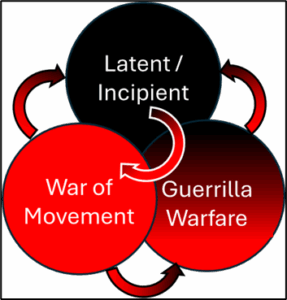
Figure 1: Maoist Phases of Insurgency (author contribution)
The counterinsurgent must have an equally compelling cause. Though the United States had the political will to fight a counterinsurgency in Afghanistan for almost 20 years, spanning four presidencies – no small feat – it lacked a coherent and enduring cause or overarching goal to unify the Afghans, and by extension, the American people, against the Taliban. From the heights of optimism following the ouster of the Taliban in late 2001, Afghan popular support for the subsequent governments of Hamid Karzai and Ashraf Ghani saw a consistent downward spin in approval amid widespread incompetence, corruption, and tribal cronyism – all issues that the Taliban had popularly positioned themselves against in their initial rise in 1994.
The United States’ justifiable cause in the early days after the terrorist attacks on September 11, 2001, was counterterrorism focused: punish and defeat al-Qaeda for perpetuating the largest terrorist attack on America. The Taliban regime was merely a stumbling block to get to this terrorist organization. Their refusal to hand over Osama bin Laden, al-Qaeda’s leader, to the United States put them in the crosshairs of military action beginning on October 7, 2001.
Aside from installing the rag-tag Northern Alliance and providing humanitarian aid, there was no holistic U.S. counterinsurgent strategy to consolidate gains after toppling the Taliban regime, let alone a unifying cause around which to rally the Afghan people. In fact, the U.S. National Security Strategies (NSS) throughout this conflict highlighted the counterterrorism efforts in Afghanistan with little to no mention of counterinsurgent activity, often lumping the Taliban in with al-Qaeda as a terrorist organization instead of an insurgent group. This gave the remnants of the Taliban regime time to morph back into an insurgency and codify their own cause (and legitimacy) against a foreign “infidel” power. Though a stated cause becomes less important as the conflict drags on and the people pine for a clear winner, in the latent or incipient stages of an insurgency, it is the driving force behind the movement. Unfortunately, the failure of the United States to help provide an indigenous-led cause to the Afghan people gave the Taliban an open door to exploit for their own purposes.

Figure 2: Enduring Cause of an Insurgency. This is most critical in the Latent / Incipient Phase and then becomes less important as the conflict continues. (author contribution)
Eight years later, the U.S. government remained engrossed in disrupting, dismantling, and defeating the al-Qaeda terrorist group, not on fighting the counterinsurgency against the Taliban. This cause was so ingrained in the U.S. collective psyche that even after Osama bin Laden was killed in the infamous Special Operations Force (SOF) raid in Abbottabad, Pakistan on May 2, 2011 there was serious debate amongst government officials on ending the war in Afghanistan. This clearly demonstrated the overall lack of counterinsurgency emphasis. Years later while U.S. forces were still embroiled in conflict in Afghanistan, the 2017 NSS makes only one mention of counterinsurgency but in a regional context, while the focus in Afghanistan remained on counterterrorism, an idea mirrored in the 2021 Interim NSS Guidance.
Following the successful raid on al-Qaeda’s chief, then Vice President Joe Biden stated that “the Taliban per se is not our enemy,” illustrating the United States’ bifurcated posture on destroying al-Qaeda versus defeating an insurgency led by the Taliban who were instrumental in facilitating the 9/11 attack. Never did a consistent, comprehensive counterinsurgent strategy undergird U.S. decisions in Afghanistan. Rather, it was an afterthought that frequently changed with every new political administration and rotation of military leadership. The maxim that typified this wavering counterinsurgency approach in Afghanistan and spread amongst military service members was “we didn’t fight one 20-year war; we fought 20 one-year wars.” Counterinsurgency, instead of being its own line of effort, was subservient to, rather than being in tandem with, counterterrorism efforts. Without a clear, enduring cause and supporting counterinsurgent strategy, the default U.S. policy in Afghanistan became the amorphous goal of spreading democracy.
Failure 2: A Battle for Democracy, Not the Afghan People
The U.S. efforts to counter the Taliban insurgency lacked strategic focus on the clear center of gravity required to win: the Afghan people. Insurgencies are won and lost based on the active and passive support they receive from the population it seeks to influence; so too are counterinsurgencies. Famed 19th century Prussian military theorist Carl von Clausewitz postulated that the nature of war is a constant tension between the policies of the government, the violence and passions of the people, and the currents of chance and probability that influence the outcome of military operations.
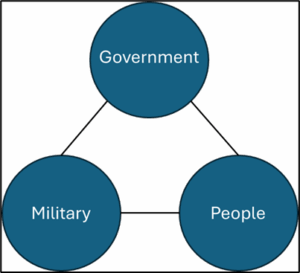
Figure 3: Clausewitzian Paradoxical Trinity (author contribution)
This simple, yet profound imagery, known as the Paradoxical Trinity, has influenced and informed the Western way of warfare for almost 200 years. It reflects the pressure that exists within a nation that goes to war with another nation. Though all three elements exist in an insurgency conflict, the protracted struggle is for influence over the people within a nation. The conflict is within itself. Dueling paradoxical trinities fight over the population for support. One trinity is the legitimate government with its military and the people that support both. The other is the insurgent’s shadow government, dutiful guerrillas, and the people it seeks to win over. The more the people support an insurgency, the more legitimate it becomes until it usurps the authority of the counterinsurgent government.

Figure 4: Dueling Paradoxical Trinities in an Insurgency (author contribution)
The counterinsurgent’s support from the population must be built at the grassroots level and scaled methodically, chiefly centered on security. Not only was the United States not primarily focused on the population, it also suffered from an ill-fated delusion that it could force the Afghan people from a Deobani Islamic theocracy into a democracy, counter to their religion, culture, and values. U.S. strategic documents speak to this fallacy. The NSS of 2006, for example, mentions that Afghanistan (and Iraq) “replaced tyrannies with democracies,” but made no mention of counterinsurgency efforts. By 2010, the NSS mentioned counterinsurgency in Afghanistan once, but failed to develop an effective framework other than “working to secure key population centers,” an ill-advised method that will be explained later. Rather, the focus was to spread “democracy abroad” by “supporting the human rights of all of Afghanistan’s people.”
The spread of liberal democracy as a means to stave off future wars and increase U.S. interests abroad is theoretically feasible, but it should not be considered a blanket solution to all international problems. Such a change for an agrarian, rural-based society, like in Afghanistan, could take generations. This is certainly not feasible during an ongoing conflict with insurgents where the local population could not receive the most basic government service: security. This says nothing for the lack of food, water, and power in the hinterlands of the country.
It was this basic concept of security that catapulted Mullah Omar, the Taliban’s leader into prominence during the transition period following the collapse of the Soviet-backed Afghan government in 1992 at the hands of the mujahideen. To undermine the transitional mujahideen government, Pakistan first supported Gulbuddin Hekmatyar, known as the “Butcher of Kabul” for his indiscriminate bombardments of Afghanistan’s capital during this period. The resulting civil war between guerrilla factions produced lawlessness, rape, and murder. When Hekmatyar failed to capture Kabul and was driven off by the mujahideen led by the famed Ahmad Shah Massoud, the “Lion of Panjshir,” Pakistan was forced to find alternate proxies through which to assert its influence over Afghanistan.
The Pakistanis then elected to support Mullah Omar’s group of students or “talib,” turned fighters, allowing them to first operate out of the Pakistani city of Quetta. Projecting from this safe haven, Omar’s Taliban provided security and administered harsh justice across the border into the southern provincial capital of Kandahar, which the local population desperately wanted. His strict adherence to Islam spread until taking over the country in 1996. Unfortunately, five years later, the U.S. focus on development over security ensured misplaced efforts and wasted funds after overthrowing the Taliban’s regime. For example, newly constructed schools in Afghan villages often went unoccupied as prospective students were not safe enough from threatened Taliban reprisals to attend class. Rather, Afghans used the buildings as open bays for human excrement. They became expensive outhouses paid for by the U.S. taxpayer, an unfortunate metaphor of U.S. strategic efforts.
U.S. security, governance, and development efforts were akin to those of the Soviet’s occupation of Afghanistan, concentrating on the larger, more secure key urban areas, such as Kabul and Kandahar, which were interconnected by the “Ring Road” within the interior of the country. Unfortunately, there was little to no security efforts in the rural areas during the first half of the conflict, areas from which the Taliban recruited the majority of its supporters. General William Westmoreland, the Commander of Military Assistance Command, Vietnam, eventually recognized the importance of security at the local level when faced with a similar counterinsurgency in South Vietnam. “There is no doubt whatsoever that the insurgency in South Vietnam must eventually be defeated among the people in the hamlets and towns,” he stated, “However, in order to defeat the insurgency among the people, they must be provided security.”
It wasn’t until 2010 that the U.S. military’s SOF initiated grassroots, local security programs dubbed Village Stability Operations (VSO) and Afghan Local Police (ALP). A modernization of the Vietnam-era Strategic Hamlet Program, and a similar program used during the Philippine Insurrection, SOF used VSO to set the conditions in a targeted local area for ALP to establish security in specific Afghan districts. VSO and ALP programs were methodically built based on thoughtful, conditions-based analysis. Despite its initial success, the programs were started too late in the conflict, causing them to be hastened to produce greater results. Unfortunately, quantity was prized over quality, resulting in a rush to failure. Proper vetting could not be adhered to as many ALP recruits were secretly Taliban insurgents, corrupt thugs who brutalized the locals, or nonexistent and counted solely so ALP commanders could pocket the appropriated salaries.
Additionally, U.S. and NATO’s support to the newly established Afghan government was often tied to Western ideology, such as women’s rights, freedom of religion, and universal elections. Though noble ideals and rightly to be pursued in incremental phases, these democratic values were foreign to the population that the United States was trying to influence. Unfortunately, this had the opposite impact, alienating the patriarchal-minded, Pashtun-led and deeply Islamic population base. The appeal to democratization came largely from those in the capital, Kabul, but it did little to impress the locals who had lived under tribal authority for centuries amid countless government changes. To pursue such a lofty goal was ill-conceived, forgetting the United States’ own founding and incremental progress. The constitutional republic that is the United States was not formed until 1787, 11 years after the signing of the Declaration of Independence. The newly established nation had four years of peace after the Treaty of Paris ended the war with Great Britain with which to develop its government. Even then it did not end the institution of slavery until 1865 or gain women’s suffrage until 1920. The United States expected the Afghan people to adopt radical social changes all while still fighting a counterinsurgency. For all its efforts, what did U.S. democratization accomplish? The women of Afghanistan are, unfortunately, no better off today than before the U.S. invasion of the country after 9/11.
Failure 3: Not Isolating the People from the Insurgency
Inherent in building a security apparatus at the local level is the need to isolate the people from insurgents, thereby cutting off the center of gravity and their source of recruitment and power. This requires the difficult reality of developing mechanisms that monitor and regulate the population. The use of a census, curfews, and passes to leave a village are just a few methods that local security and government officials must implement and strictly enforce to be effective. In the 21st century, such approaches seem overly harsh and authoritarian, and clash with the naïve perspective that the U.S. military were the “liberators” of the Afghan people. However, not all Afghans welcomed the United States as such or supported its “logical” approach to bringing freedom to Afghanistan.
An early 20th century counterinsurgency example provides much more effective methods of isolating the people from an insurgency. The hamlet program during the Philippine Insurrection from 1899-1902, grew from 50 to over 500 local garrisons and was marked with harsh punishments for failure to abide by control measures. Collective punishments involved families and communities. Municipal leaders were held responsible for issues in their villages; prisoners were detained until they or their families and friends gave intelligence on insurgents; and crops, buildings, and other property could be destroyed or confiscated. Captured insurgents were executed in accordance with anti-insurgent regulations. Also, U.S. military and Filipino law enforcement rewarded those who proved their loyalty to the cause, such as willingly giving information on insurgents. Though brutal, this was an extremely successful program that ended the Filipino insurgency in three years. However, 100 years later the United States forgot these methods, failing to ensure the Afghan people were effectively isolated from Taliban insurgents.
The infamous PowerPoint slide showing the interconnection between the Taliban, the Afghan people, and the U.S.-backed government described by General McChrystal’s staff was complex. It was characteristic of how insurgents blend into the population, rooting themselves within the people and creating confusion for the counterinsurgents. However, that same staff failed to provide a solution to cut off the Taliban from the people through strict implementation of harsh anti-insurgent rules and laws at the local level. Rather, modern sensibilities on the perceived abuse of the law resulted in injustice as insurgents were sent to westernized, central Afghan judiciaries where they were often set free shortly after being arrested due to unreasonable evidentiary procedures and intimidated witnesses. Insurgents were empowered, while local tribal leaders and law enforcement were rendered impotent, forcing them to broker deals with those they sought to displace. U.S. counterinsurgent efforts failed to produce a metaphorical shield for the people against the insurgents.
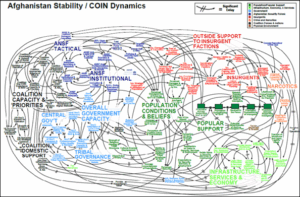
Figure 5: PowerPoint slide of the Afghanistan COIN dynamics under General Stanley McChrystal
Failure 4: Difficult Terrain, but Little Denial of Safe Havens, Outside Support
The type of terrain within a nation engulfed in an insurgency can either help or hurt the insurgent’s cause. As an archipelago with over 7,600 islands, the Philippines, for example, offered a difficult environment for the Filipino insurgency of the late 1800s to flourish. Fortunately for the Taliban, Afghanistan’s mostly rough, mountainous terrain, extensive international borders, and underdeveloped, dispersed population all significantly benefitted them. A land historically renowned as a crossroads for traders and invaders alike, U.S. and Afghan counterinsurgent forces could never realistically monitor or control the country’s porous border crossings. As a result, the Pashtun-dominant Taliban insurgency found a quick and easy safe haven across Pakistan’s extensive border amongst a sympathetic Pashtun population. Throughout the war, the Taliban maintained its senior leadership, recruitment centers, and training camps inside Pakistan, sending new insurgents across the border each spring at the start of the “Fighting Season.”
After being ousted from Afghanistan in December 2001, the Taliban found unabated support in Pakistan, to include the freedom to recruit, train, finance, and plan operations. For example, Quetta, the provincial capital of Baluchistan, was the notorious location for Taliban senior leaders to plan and issue guidance on attacks into Afghanistan; this was known as the Quetta Shura. Despite decades of U.S. aid and military support, the Pakistani government not only willfully ignored U.S. entreaties to stop the Taliban in its country, it directly supported the efforts of its historic puppet from the Afghan civil war, believing that a revived Taliban government would ultimately benefit Pakistan.
Unfortunately, U.S. sanctions on the Taliban and a few Pakistani firms did little to stop the Taliban’s lucrative underground fundraising. Money was filtered using the virtually undetectable “hawala,” or Islamic-compliant money transfer system. For instance, extortion, drug trafficking, and other illicit activities accounted for up to $400 million from 2011 to 2012 alone. The lack of local security allowed the Taliban to enforce religious taxes on the Afghan people and continue poppy cultivation in a country producing 80% of the world’s opium. Instead of targeting opium production directly as a major source of Taliban income, the United States viewed poppy as a European drug problem, not a counterinsurgent one. Moreover, widespread allegations persisted that Afghan President Hamid Karzai’s half-brother, Ahmed Wali Karzai, exploited his power as the “Kingpin of Kandahar” to profit from protection and trafficking networks in the opium economy. As a result, no full-scale efforts were ever made to destroy poppy cultivation once local security was established in a specific area and the Taliban continued to rake in their own profits to fund the insurgency.
Additionally, save from a few examples, there was little attempt to cut the Taliban off from their safe havens in Pakistan. Viewing the international and political fallout too great, the United States only used its proverbial sword in the form of SOF raids and drone strikes sparingly to disrupt Taliban efforts across Afghanistan’s southern border. The first known use of precision raids and strikes wasn’t until 2008, almost seven years after the United States overthrew the Taliban with the aid of the Northern Alliance. Their use ebbed and flowed throughout the counterinsurgency. However, like the ebb and flow of the bombing campaigns during the Vietnam War, there was no consistency in precision strikes, limiting their effectiveness against the Taliban over the course of the conflict. Often, these special operations were carried out as counterterrorism actions against al-Qaeda, such as the Osama bin Laden raid, not counterinsurgent operations against the Taliban.
Failure 5: Right Training for the Wrong War
Effective counterinsurgents must have specialized education. Conventional warfare training in the form of large force-on-force battles with tanks, fighter jets, and the latest technology hold little relevance against an insurgency who do not wear uniforms and rarely mass their forces. Rather, large numbers of light infantry with some indirect support, such as robust intelligence collection, mortars and artillery, and mobile transportation are more apropos. This allows for quick, flexible responses to insurgent activity. Additionally, as counterinsurgent forces move into local areas to increase security and establish local law enforcement, they will require a variety of skills to bolster governance and development of that area. Understanding politics, culture, language, history, law, and religion are critical for counterinsurgents as they help the local people rid themselves of insurgent influence. Counterinsurgents must be integrated into the populace, living amongst them to assist the people and using them to identify, arrest, and prosecute insurgents. To reiterate, governance and development cannot be enacted without security as the primary effort.
The U.S. military spent no effort on developing an Afghan security apparatus in the early years of the Afghan War, relying instead on unilateral strikes and raids throughout the country to defeat the Taliban. Once it finally realized the need for indigenous security personnel, the U.S. poured billions of dollars into building an Afghan National Army and Afghan National Police upwards of 350,000 personnel through the remainder of the conflict. Even if this number is to be believed and known corruption in counting “ghost soldiers” is discarded, the reality is that Afghan National Security Forces (ANSF) were not usually stationed at the local level. These national assets, though necessary for conventional fights, were not trained or equipped to counter an insurgency at the community level. ANSF often stayed on protected bases for fear of breaking or losing U.S.-acquired materials on operations so often ceding the hinterland to the Taliban, a tremendous advantage for an insurgent. They were also not trained in how to instill local security, governance, and development.
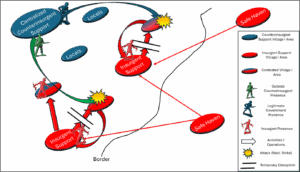
Figure 6: Raids and strikes only temporarily displace and disrupt insurgents in an area, but do not ultimately change their level of influence over a local population. (author contribution)
Even the highly trained strike force, the Afghan Commandos, did not remain in a local area long enough to provide consistent security. As amongst the most competent and capable of the ANSF, the limited number of available Commandos constantly deployed from one hot zone to another like a proverbial fire brigade. While comprising an exceedingly small portion of the overall ANSF, Afghan Commandos accounted for an outsized percentage of operational effects against the Taliban. Though a necessary Afghan government “sword” against insurgents, they did not provide the “shield” needed to protect the local populace. Raids as a “sword,” though they may kill some insurgents, will at best only disrupt insurgent activity for a short time. If used effectively, it can allow the necessary time and space needed to develop the “shield” of a consistent security presence with the local people. Also, advisors are a critical aspect to the counterinsurgent cause when an outside entity or nation is helping develop the legitimate government, much like the U.S. military support to local security forces in the Philippines in 1899.
It wasn’t until the establishment of the U.S. SOF’s VSO and ALP programs that local security started to flourish. Eventually, the Afghan National Army Special Operations Command, which housed the Afghan Commandos, built Afghan Specials Forces units with many of the skills necessary to establish local security. These units, formed after their U.S. counterpart, worked with U.S. Special Forces in local areas to enable the VSO and ALP programs. Unfortunately, there were too few of them to make a lasting impact. Additionally, the ALP program dwindled after control was taken away from U.S. SOF advisors in 2013 due to, yet another changing political strategy involving troop withdrawals. The program crawled along under the Afghan’s Ministry of Interior, but by 2020, the funding for ALP dried up and its doors were shuttered. This ended the best chance for counterinsurgents to defeat the Taliban insurgency.
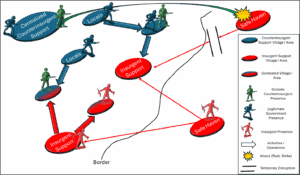
Figure 7: Local security establishments, combined with disruption raids, can permanently displace insurgents in an area, causing their level of influence over a local population to be reversed. (author contribution)
Failure 6: Undercutting the Government Made in the U.S. Image
Military action in any conflict is the extension of political aims. If this is the case in conventional warfare, how much more is it in counterinsurgency where conventional battles do not matter as much as the political ones? In 1975, Colonel Summers, a Vietnam War veteran, visited the country that he had been twice wounded in and spoke to Vietnamese Colonel Tu. During their conversation, Colonel Summers said “You know, you never defeated us on the battlefield.” To which Colonel Tu replied, “That may be so. But it is also irrelevant.” Colonel Tu rightly inferred that the political end to the Vietnam War was the only victory that mattered. An insurgency does not have to win battles; it just cannot lose the war. As a result, there must be intense political pressure, enabled by military action, to force an insurgent to capitulate.
An insurgency must be cut off from the population – the center of gravity – and its safe havens through military and law enforcement activities as previously described. Additionally, there needs to be an opportunity for the insurgent to reconcile with the government it was trying to overthrow. This, of course, must be done from a position of strength over the insurgent, and with strict safeguards to ensure the reconciled party does not resume seditious activities against the legitimate power. This is only feasible when an insurgent is so defeated and demoralized that he sees no other option but to make amends with the government. This brings a quicker end to an insurgency, allowing guerrillas to come out of their proverbial foxholes instead of fighting to the bitter end.
Unfortunately, after almost 20 years of counterinsurgency, U.S. political will came to a grinding halt. Instead of negotiating from a position of power, the United States sought to quickly make a peace deal with the Taliban, to the detriment of the Afghan government it had created. In 2020, the U.S. government signed a peace treaty with the Taliban, which did not include the internationally recognized Afghan government. Though the specifics of the treaty required the Taliban to begin negotiations with Ashraf Ghani’s administration, the insurgent group had no intention of doing so. The Taliban viewed the government as a puppet regime of foreigners; one they refused to recognize. Rightly discerning that the United States was more interested in ending the war than they were, the Taliban waited out its foreign adversary to the point where it would be unwilling or unable to protect the Afghan government from collapse. Instead of ensuring the Taliban recognized and integrated under the Afghan government, the United States undercut and sidelined the very institution it strove to build up and legitimize since late 2001. Even when it became obvious that the Taliban would not abide by the treaty’s negotiation clause, the United States could not or would not reinitiate military action against the insurgents. As deposed President Ghani flew to the United Arab Emirates on August 15, 2021, the newly established Taliban regime could easily say of the U.S. tactical victories, “it is also irrelevant.”
Conclusion
Much like after its failure in Vietnam, the U.S. military has quickly shifted focus from counterinsurgency to large scale combat operations, assuming that they are mutually exclusive, as it eyes China as its pacing challenge. Though claiming to not forget the lessons from 20 years in Afghanistan, the Army, as the chief of the land domain, has made no concerted effort to integrate recent counterinsurgency lessons into training. Rather, its focus is on a conventional mindset for large scale combat operations akin to the Cold War, albeit with the speed, precision, and technology currently unfolding in the Russo-Ukrainian War. Currently, counterinsurgent knowledge only resides within U.S. SOF, which should maintain this primacy. However, conventional forces must understand these lessons as well given that U.S. SOF will need additional support to effectively manage all counterinsurgency functions. Failure to incorporate counterinsurgency lessons into professional military education and other training venues will undoubtedly result in future strategic losses as U.S. senior military leaders will fail to provide sound advice to civilian leadership and policy makers on how to win the next war, which will be a hybrid one. This article identified six clear strategic failures in America’s longest war, which the United States can ill-afford to repeat. Hybrid warfare is coming, combining irregular units or insurgents with conventional military forces for a common purpose, and is already manifested in conflicts around the globe. More blood will be spilled, and treasure will be lost, if U.S. senior military leaders ignore these counterinsurgent failures before the next conflict.
Author’s Note: A special thanks to Mrs. Jamie Rix and fellow Green Berets, LTCs Todd Angstman, Marshall McGurk, and Andy Pfeiffer, for their contributions to this article.
Check out all the other great things Small Wars Journal has to offer.




… [Trackback]
[…] Read More: smallwarsjournal.com/2025/12/31/afghanistan-a-history-already-forgotten-counterinsurgency-lessons-u-s-senior-military-leaders-must-not-ignore/ […]