How Civilian Are Pakistan’s and India’s “Civilian” Nuclear Programs?

The phrase “civilian nuclear program” implies a clean line: reactors that generate electricity, isotopes for medicine, and research neutrons on one side, and the enrichment plants and plutonium reactors that feed a weapons stockpile on the other. Across most of the world, the International Atomic Energy Agency (IAEA) polices that line through comprehensive safeguards. In South Asia, the line barely exists. India and Pakistan both operate power reactors under IAEA inspection while running weapons complexes a short distance away, drawing on shared expertise, shared institutions, and, in important respects, a shared fuel cycle. The “civilian” label survives less as a technical description than as a diplomatic and commercial instrument. Asking how civil these programs are exposes how porous the boundary is and why that porousness matters for the wider non-proliferation order.
The ambiguity is not a recent complication; it is foundational. India’s first nuclear detonation in 1974 was carried out with plutonium produced in the Canadian-supplied CIRUS reactor, material provided on the understanding that it would be used only for peaceful purposes. New Delhi described the test as a “peaceful nuclear explosion,” a phrase that captured, perhaps unintentionally, just how indistinct the civil and military categories already were. Pakistan’s program was similarly ambiguous at birth. The Pakistan Atomic Energy Commission (PAEC), nominally a civilian body for peaceful development that functioned directly under the President and Prime Minister, became the institutional vehicle for the weapons effort pursued under Zulfiqar Ali Bhutto in the early 1970s. In both countries, the civilian institution and the weapons ambition grew from a single root, and the fuel cycle was never engineered to keep them apart.
The Non-NPT Starting Point
Both states belong to the small group that never joined the Treaty on the Non-Proliferation of Nuclear Weapons (NPT). That single fact shapes everything that follows. Under the NPT bargain, a non-nuclear-weapon state accepts comprehensive, or full-scope, safeguards covering all nuclear material on its territory. India and Pakistan accepted neither the treaty nor comprehensive safeguards. Instead, each place only names installations under inspection through item-specific safeguards agreements, the category the IAEA reserves for states outside the NPT, and leaves the remainder, including everything of direct weapons significance, entirely outside the Agency’s reach. Safeguards in South Asia are therefore an opt-in list rather than a wall. As the Arms Control Association has observed of India, facility-specific inspection at a handful of reactors leaves the unsafeguarded military sector free to produce fissile material and to design and build warheads. The same logic applies, with local variations, to Pakistan. The label “civilian” thus attaches to whichever facilities a state chooses to declare, not to a category the inspectorate can independently define.
India: A Civilian Umbrella Over a Weapons Core
India’s nuclear enterprise is administered by the Department of Atomic Energy (DAE), created in 1954 and placed, unusually, directly under the Prime Minister rather than any line ministry. A single umbrella covers the Nuclear Power Corporation of India Limited (NPCIL), which runs the grid-connected reactors; the Bhabha Atomic Research Centre (BARC), which conducts weapons research and reprocessing; and the fast-reactor establishment at Kalpakkam. Power generation, weapons-grade material, and basic research sit inside one department, answering to one office. The civil and military programs are not neighboring enterprises with a fence between them; they are branches of the same institution.
The 2005 joint statement by Prime Minister Manmohan Singh and President George W. Bush, alongside the arrangements that followed it, required India to draw a line it had never drawn before. In 2006, India adopted a Civil-Military Separation Plan, and the United States amended its domestic law to permit cooperation. In 2008, the IAEA Board of Governors approved an India-specific safeguards agreement, and in September of that year the Nuclear Suppliers Group granted India a waiver. Yet India drew the line itself and drew it generously. Of the 22 power reactors then operating or under construction, only 14 were designated for safeguards; the remaining eight stayed outside. The Prototype Fast Breeder Reactor (PFBR) at Kalpakkam, together with the CIRUS and Dhruva plutonium reactors and the reprocessing lines at BARC, was kept firmly on the military side of the ledger.
India’s own atomic managers made the entanglement explicit. Anil Kakodkar, then chairman of the Atomic Energy Commission, resisted placing the breeder program under safeguards on the ground that the fuel cycle serves “the same infrastructure which also feeds the strategic program,” describing the civil and military fuel cycles as intimately intertwined. The deal’s practical effect reinforced that point. By allowing India to import uranium for its safeguarded reactors, the arrangement freed scarce domestic uranium for plutonium production on the military side. According to the Carnegie Endowment for International Peace, custody of the warheads themselves rests with two nominally civilian scientific agencies, BARC and the Defence Research and Development Organisation (DRDO), which hold the fissile cores and the non-nuclear firing assemblies, respectively. Since 2003, command has rested with the Nuclear Command Authority, whose Political Council is chaired by the Prime Minister and remains the sole body able to authorize use.
The most consequential recent development sits squarely on the unsafeguarded side. On April 6, 2026, the 500-megawatt PFBR at Kalpakkam reached first criticality after more than two decades of construction. According to the government’s own account, the reactor is fueled with plutonium recovered by reprocessing spent fuel from India’s pressurized heavy-water reactors, and its uranium blanket breeds more plutonium than the reactor consumes. India presents the plant, accurately, as the entry point to the second stage of its three-stage energy program. Yet because the reactor was excluded from the 2006 civilian list, the plutonium it breeds falls entirely outside international accounting. A flagship of civil energy policy is, by design, also an unmonitored source of fissile material.
In December 2025, Parliament also enacted the SHANTI Act, which repealed the Atomic Energy Act of 1962 and the Civil Liability for Nuclear Damage Act of 2010. The new law opens power generation to licensed private operators and gives the Atomic Energy Regulatory Board (AERB) statutory standing for the first time. It is equally notable for what it withholds, since enrichment beyond a notified threshold, reprocessing and other spent-fuel management, and heavy-water production remain reserved for the central government and its wholly owned entities. The reform therefore liberalizes the reactor layer while keeping state control over precisely the fuel-cycle nodes that connect civil and military activity. The Indian model can be summarized in a sentence: the civilian energy establishment is the weapons establishment, gathered under one civilian umbrella and topped by civilian political control.
Pakistan: A Military Hand on the Civilian Lever
Pakistan’s civil power program is, if anything, more thoroughly safeguarded than India’s in proportional terms, because almost all of it was foreign-supplied and came with inspection attached. The Chashma reactors, the Karachi units, and the two research reactors at the PINSTECH laboratory near Islamabad all operate under item-specific IAEA safeguards. That pattern continues to the present. In September 2026, on the sidelines of the IAEA General Conference, Pakistan signed a safeguards agreement for Chashma Unit-5, its largest planned reactor. The program also carries real civilian weight. According to the PAEC, its six operating plants, with a combined capacity of 3,530 megawatts, supplied about 18.5 percent of national grid generation in 2025, compared with India’s nuclear share of 3.1 percent in 2024–25.
The weapons complex, however, sits entirely outside that fleet. The four heavy-water reactors at Khushab, dedicated to weapons-grade plutonium; the reprocessing plant known as New Labs at PINSTECH; and the uranium-enrichment facilities at Kahuta are not subject to IAEA inspection. The institutional entanglement is sharper than India’s in one respect. The same PAEC that operates the safeguarded power reactors is also reported to operate the Khushab production complex, so a single body straddles both sides of the declared boundary.
More striking still is who administers that body. The PAEC, together with Khan Research Laboratories (KRL), the National Engineering and Scientific Commission (NESCOM), and the National Development Complex (NDC), is administered by the Strategic Plans Division (SPD), the secretariat of the National Command Authority (NCA), which is headed by a serving three-star Army general. The ostensibly civilian atomic establishment thus operates under military administration, an arrangement without real parallel in India, where the corresponding institutions answer to the Prime Minister’s Office.
Recent constitutional changes have deepened this pattern. The 27th Amendment, passed in November 2025, abolished the post of Chairman Joint Chiefs of Staff Committee (CJCSC), made the Army chief concurrently Chief of Defence Forces, and created a four-star Commander of the National Strategic Command. In August 2026, Parliament passed the National Command Authority (Amendment) Act, which substitutes the Army chief, as Chief of Defence Forces, for the CJCSC throughout the 2010 NCA Act and adds the Commander of the National Strategic Command as a member of the Authority. Analysts disagree about what these changes mean in practice. Researchers at the Observer Research Foundation argue that they reduce civilian oversight and make the command structure more Army-dominant, while a commentary in Asia Times stresses that the Prime Minister still chairs the NCA and that nuclear-use authority has not formally shifted. For the purposes of this analysis, the relevant point is narrower but firm: the institutional ladder above Pakistan’s civil program has become more Army-centric, not less. Where India’s program is a civilian umbrella containing a weapons core, Pakistan’s is a civilian establishment with a military hand permanently on the lever.
The Fleets and Their Safeguards
Set side by side, the two power fleets show the paradox plainly. Pakistan’s smaller, entirely foreign-supplied fleet is fully safeguarded, while India’s larger and predominantly indigenous fleet is only partly so, with the units most useful to the weapons program left outside. Table 1 summarizes the two fleets. The figures for India reflect 24 operable power reactors and roughly 10 more under construction or in commissioning, including the PFBR, while those for Pakistan reflect six operable reactors, with Chashma-5 under construction.
Table 1. Nuclear power fleets and safeguards status.
| India | Pakistan | |
|---|---|---|
| Operable power reactors | 24 | 6 |
| Installed capacity | ~8.8 GWe | ~3.5 GWe |
| Under construction | ~10 units (~8 GWe) | Chashma-5 (~1.2 GWe) |
| Power reactors under IAEA safeguards | Foreign-supplied units and those designated in the 2006 Separation Plan | All six (item-specific) |
| Power reactors outside safeguards | Indigenous PHWRs (Madras, Kaiga, Tarapur 3&4) and the fast-breeder reactor | None |
| Operator | NPCIL; BHAVINI (fast reactor) | PAEC |
| Regulator | AERB | PNRA |
The facilities that matter most for weapons are, in both countries, precisely the ones the IAEA never visits. Table 2 lists the principal unsafeguarded, weapons-related sites. These are the plants that produce and separate the plutonium and highly enriched uranium at the heart of each arsenal, and none of them appears on any safeguards list.
Table 2. Principal unsafeguarded, weapons relevant facilities
| Country | Facility | Location | Function |
|---|---|---|---|
| India | Dhruva reactor (BARC) | Trombay, Mumbai | Weapon-grade plutonium |
| India | Reprocessing plants | Trombay; Tarapur; Kalpakkam | Plutonium separation |
| India | Rare Materials Plant | Rattehalli, Karnataka | HEU (naval propulsion) |
| India | Prototype Fast Breeder Reactor (critical since April 2026) | Kalpakkam, Tamil Nadu | Plutonium breeding |
| Pakistan | Khushab I–IV (heavy-water production reactors) | Khushab, Punjab | Weapon-grade plutonium |
| Pakistan | New Labs reprocessing | PINSTECH, Nilore | Plutonium separation |
| Pakistan | Enrichment plants (KRL) | Kahuta; Gadwal | HEU production |
The Fissile-Material Problem
Beneath the institutional detail lies a physical fact that no separation plan can alter: fissile material is fungible. Plutonium and highly enriched uranium (HEU) are chemically and physically identical whether the reactor that produced them carries a civil or a military label. Safeguards attach to facilities and to declared material flows, not to the atoms themselves once they leave inspection. Because neither state partitions its fuel cycle, and because neither has accepted a fissile material cutoff, the “civilian” designation determines which inspector visits a given site, not where the material ultimately goes.
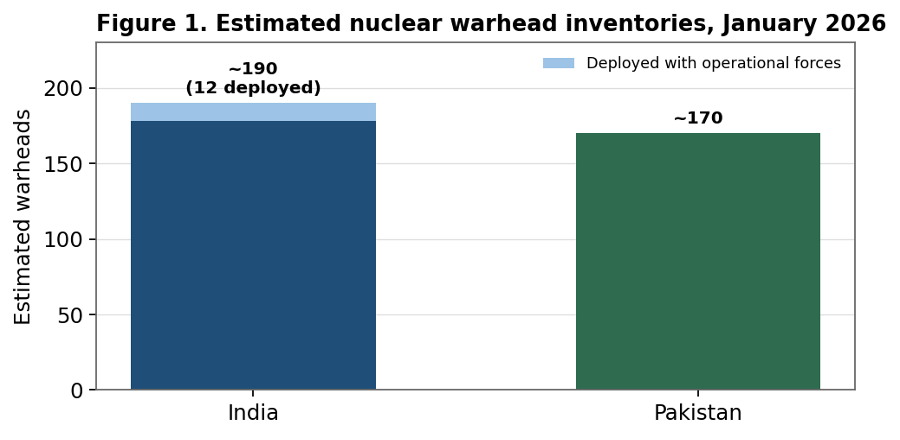
Source: International Panel on Fissile Materials (estimates as of early 2025).
The Stockholm International Peace Research Institute (SIPRI) estimates that, as of January 2026, India held about 190 warheads, including an estimated 12 deployed with operational forces, and Pakistan about 170. SIPRI also reports that both continue to accumulate fissile material and develop new delivery systems. The underlying stocks tell the same story. At the start of 2025, according to the International Panel on Fissile Materials (IPFM), India held about 6.1 metric tons of HEU and 0.73 metric tons of weapon-grade plutonium, while Pakistan held about 5.5 metric tons of HEU and 0.62 metric tons of weapon-grade plutonium. Table 3 and Figure 2 set these estimates out, with the wide uncertainty bands that inevitably attach to unsafeguarded programs.
Table 3. Estimated fissile-material stockpiles and warheads
| Estimated stock (early 2025) | India | Pakistan |
|---|---|---|
| Highly enriched uranium (HEU) | ~6.1 ± 2.4 metric tons (~30% U-235, mainly naval) | ~5.5 ± 1.6 metric tons (~90%, weapons) |
| Weapon-grade plutonium | ~0.73 ± 0.17 metric tons | ~0.62 ± 0.21 metric tons |
| Separated reactor-grade plutonium (civil) | ~11 ± 6 metric tons | None declared |
| Estimated warheads (SIPRI, January 2026) | ~190 (about 12 deployed) | ~170 |
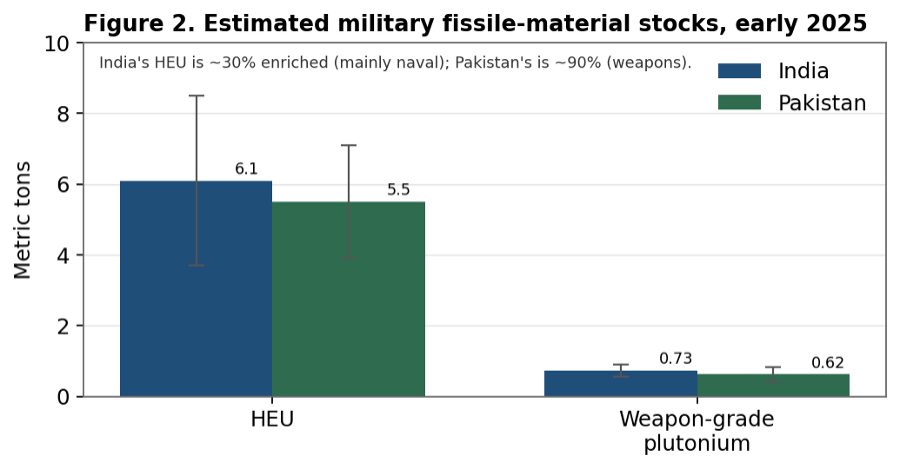
Source: International Panel on Fissile Materials (estimates as of early 2025).
The materials also differ in character, and that difference is itself revealing. India’s HEU is enriched only to around 30 percent and is oriented mainly toward naval propulsion, so India’s warheads are predominantly plutonium devices. Pakistan’s HEU is weapon-grade and its arsenal historically uranium-based, with plutonium a growing second track. Yet the civil-military distinction blurs even where the material is nominally peaceful. India holds an estimated 11 metric tons of separated reactor-grade plutonium outside weapons use, a civil stock that dwarfs its military one, is not under safeguards, and is chemically the same element. It is also the feedstock for the newly critical PFBR. Figure 3 shows the contrast in scale.
Comprehensive safeguards, of the kind non-nuclear-weapon states accept under the NPT, would require each state to account for all of its nuclear material and to open the whole fuel cycle to inspection, closing precisely the gaps that item-specific arrangements leave open. India has concluded an Additional Protocol, one that applies only to its declared civilian facilities; Pakistan has none. In both countries, material accountancy stops at exactly the point where the weapons program begins.
The stakes of this ambiguity are practical rather than theoretical. In May 2025, the two states fought a brief armed conflict in which, according to SIPRI, Indian strikes reached Pakistani air and missile bases likely to have nuclear-related roles, though both sides took steps to avoid escalation. When the facilities that blur the civil-military line also sit within reach of conventional exchanges, the analytical question of how civilian a program is becomes an operational question about escalation.
Institutional Control and the Chain of Command
The starkest contrast between the two programs is not technical but institutional, and it runs in opposite directions. In India, the entire complex, civil and military alike, sits under a civilian department reporting to the Prime Minister, and custody of fissile cores passes to the military only when weapons are assembled during an alert. In Pakistan, the ostensibly civilian establishment is administered by a military secretariat, and the reforms of 2025 and 2026 have added a four-star Army command for the strategic forces. Figures 4 and 5 trace the two chains of command, distinguishing safeguarded civil facilities from those outside safeguards, and Table 4 sets the structures side by side. In both cases, the point is the same: the civil and military strands are held together, not apart, by the institutions that control them.
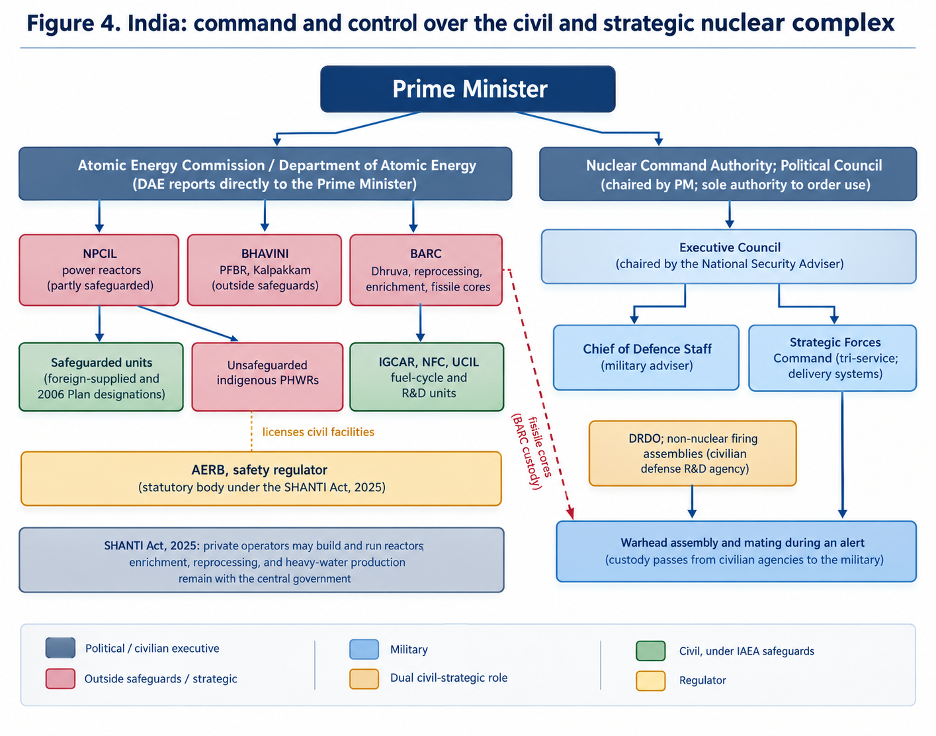
Sources: Carnegie Endowment for International Peace; Arms Control Association; Press Information Bureau, Government of India; World Nuclear Association. The chart is simplified, and some reporting lines are not public.
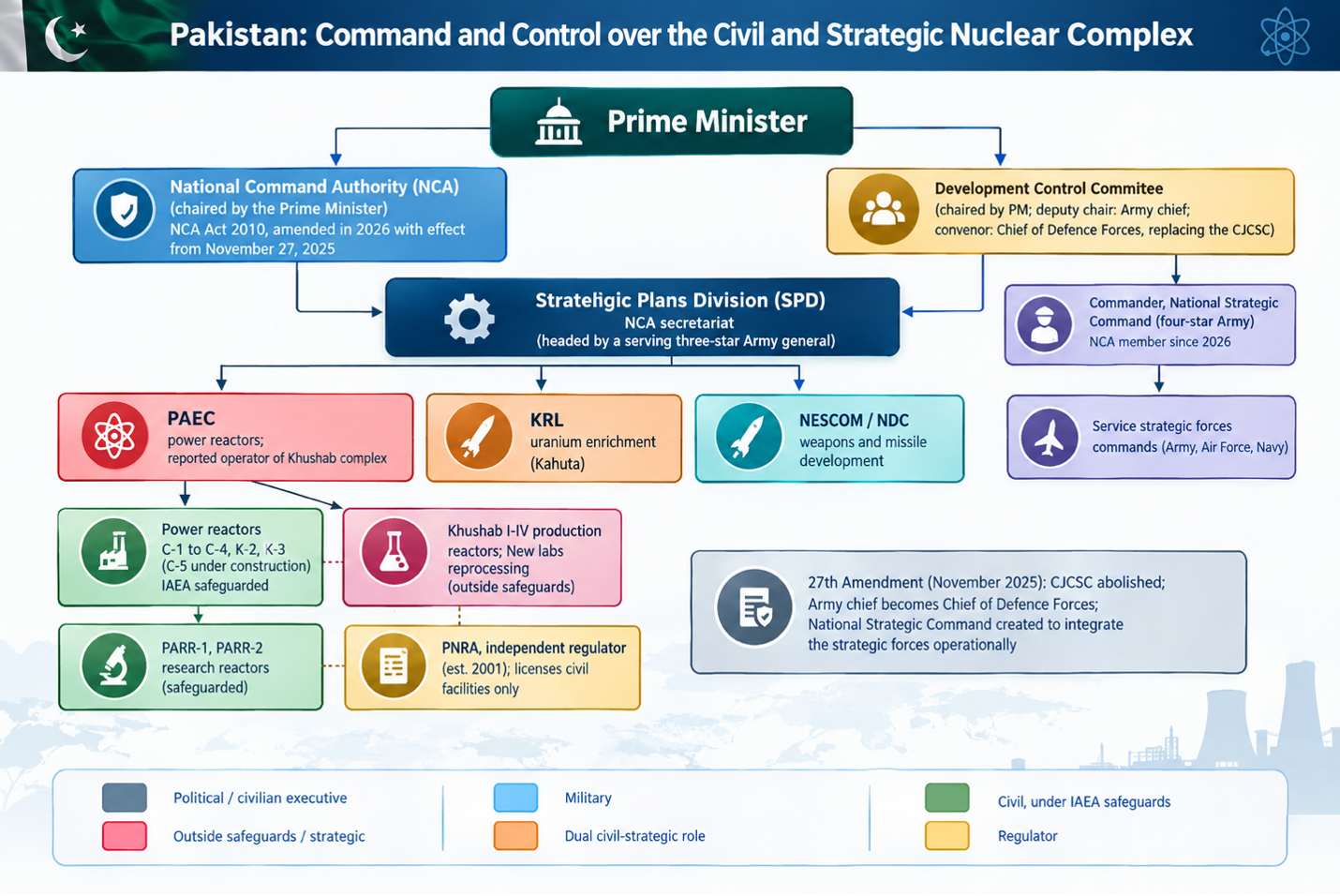
Sources: NTI; Business Recorder; Arms Control Association; PAEC; Institute for Science and International Security. The chart is simplified; the attribution of the Khushab complex to PAEC rests on public reporting.
Table 4. Institutional control of the two nuclear programs
| Function | India | Pakistan |
|---|---|---|
| Apex authority | NCA Political Council, chaired by the Prime Minister; DAE reports directly to the Prime Minister | NCA, chaired by the Prime Minister (NCA Act 2010, amended 2026) |
| Senior military role | Chief of Defense Staff as military adviser; tri-service Strategic Forces Command | Army chief as Chief of Defense Forces; Commander, National Strategic Command (NCA member) |
| Day-to-day control of the atomic establishment | Civilian (DAE) | Military (SPD, headed by a three-star Army general) |
| Power-reactor operator | NPCIL; BHAVINI | PAEC |
| Weapons fuel cycle | BARC (plutonium); enrichment program | PAEC (Khushab and New Labs, as reported); KRL (Kahuta) |
| Warhead custody | BARC (fissile cores) and DRDO (firing assemblies) | SPD and the strategic forces commands |
| Regulator | AERB (statutory under the SHANTI Act, 2025) | PNRA (established 2001) |
| Governing law | SHANTI Act, 2025 (replacing the Atomic Energy Act, 1962) | NCA Act, 2010, as amended in 2026 |
What the “Civilian” Label Actually Does
If the label does not describe a real technical firewall, what work does it do? It performs chiefly diplomatic and commercial work. India and Pakistan occupy almost identical structural positions: both stand outside the NPT, both accept only item-specific safeguards, and both maintain unsafeguarded weapons complexes fed by fuel cycles they decline to partition. Yet, the international system has treated them very differently. India’s act of separation, however self-serving its boundaries, secured a Nuclear Suppliers Group waiver and entry into legitimate civil nuclear trade. Pakistan’s comparable posture secured no equivalent opening, leaving it dependent on Chinese-supplied, individually safeguarded reactors. India’s SHANTI Act, which replaces a liability law long cited as a deterrent to suppliers, is likely to widen that gap.
The “civilian” designation, in practice, functions as a passport for trade and international legitimacy, granted to one state and withheld from the other on strategic rather than technical grounds. The differential treatment is usually justified by pointing to India’s larger economy and strategic weight and to Pakistan’s record of onward proliferation through the network. Those are real considerations, but they are political and strategic ones; they do not correspond to any measurable difference in the civilian purity of the two fuel cycles, which is the criterion the label ostensibly describes. For the nonproliferation regime, the lesson is an uncomfortable one. Comprehensive safeguards remain the only meaningful test of whether a program is genuinely civilian, and neither South Asian state accepts them. Facility-specific inspection, layered over an integrated fuel cycle and, in Pakistan’s case, a militarily administered establishment, cannot by itself certify that any reactor is purely peaceful.
Conclusion
Asking how civil these “civilian” programs are yields a consistent answer for both states: less civilian than the term suggests, and civilian in a sense defined by diplomacy rather than physics. India’s civil and military nuclear activities are branches of one institution under civilian political control, and its newest breeder reactor now produces plutonium beyond any inspector’s reach. Pakistan’s civil establishment operates under military administration that recent reforms have made more Army-centric. In both, the fuel cycle knits the declared and undeclared sectors together, and inspected reactors coexist with expanding weapons stocks. In South Asia, the boundary that the word “civilian” promises is largely a drafting convenience. Recognizing this is not an argument against engagement with either program. It is an argument for describing them accurately and for treating the presence of item-specific safeguards as a limited assurance about particular facilities rather than a verdict on the character of a national nuclear enterprise.