





Chaplains and Commissars: An Analysis of the People’s Liberation Army’s Political Work System and the Will to Fight

Abstract: This paper posits that the People Liberation Army’s (PLA) political work system, in addition to its role in the dual-commander system and enforcing party loyalty, are also relied upon to raise esprit de corps and nurture soldiers’ “will to fight.” To elucidate this point, the paper uses a metaphor from Liu Cixin’s The Dark Forest to explicitly compare political commissars to the US chaplain corps, while also highlighting the differences between Western and Chinese conceptions of will to fight. In potential future conflicts, Western forces can reduce the PLA’s will to fight by undermining belief in the chain of command and CCP more broadly.
“In the military, you have political commissars and we have chaplains.”
This comparison, proposed by a character in Liu Cixin’s The Dark Forest, compares the role of political commissars (政委) in the People’s Liberation Army (PLA) to that of chaplains in western militaries. On the surface, the two roles seem to be extremely dissimilar. Most analyses of political commissars in Western military literature focus on the two main roles of the political commissar: ensuring loyalty to the party, and the dual-command structure (双首长制) of the political commissar and the traditional commander. By comparison, chaplains primarily offer religious support to soldiers and advise commanders on the impact of religion within their formation and operational mission requirements.
However, Liu’s metaphor posits a third role of the political commissar, one that is adjacent to the role of the chaplain: to raise esprit de corps and increase the will to fight. The idea of “will to fight” is a central concept in western military thought, dating back to Clausewitz, who used this term in defining an enemy’s power as: “the sum of available means and the strength of the Will.” While defining the “will to fight” is notoriously difficult, this paper will use RAND’s definition: “the disposition and decision to fight, act, or to persevere when needed.” Understanding any enemy’s will to fight is crucial in analyzing and understanding combat effectiveness.
Chinese conceptions of will are rooted in fostering belief in the efficacy of the chain of command and the CCP, whereas Western military concepts such as “spiritual readiness” view will as an individual function as well.
This paper argues that Chinese leaders view the role of the political work system, to include political commissars, as strengthening party loyalty while also simultaneously raising the will to fight among soldiers. Chinese conceptions of will are rooted in fostering belief in the efficacy of the chain of command and the CCP, whereas Western military concepts such as “spiritual readiness” view will as an individual function as well. In a potential future conflict, Western militaries can target the PLA’s “will to fight” by reducing belief in the PLA’s Chain of Command and the CCP more broadly.
The People’s Liberation Army and the Political Work System
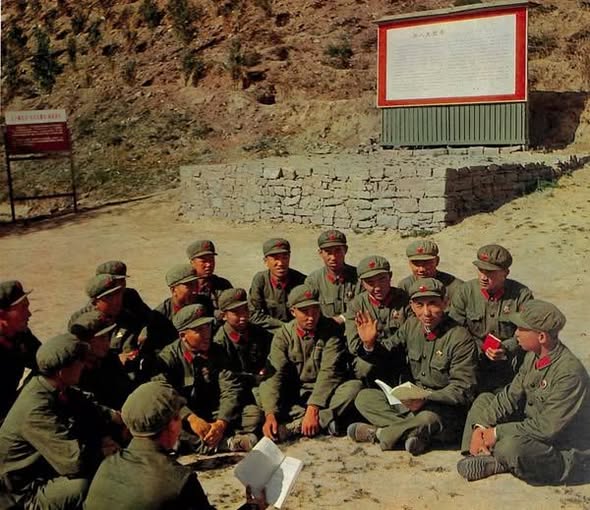
Chinese Communist leaders have always recognized the power of the military and the role they play in achieving political objectives. Mao Zedong himself famously said that “political power grows out of the barrel of a gun (枪杆子里面出政权),” and Xi Jinping often talks about the need for the PLA’s absolute loyalty to the party. Many of Xi’s actions can be seen as conforming to this world view. In speeches he talks about the need to “confirm officer’s eternal obedience to the words of the party, and to walk with the party (确保官兵永远听党话、跟党走).” The political work system (总政治部) is the primary mechanism that the CCP uses to ensure the enforcement of party loyalty in its officers.
In theory, the political commissar and the unit commander are positioned as co-equals, but in practice, structural advantages give the political commissar more power over the direct military commander.
At the core of the political work system are the Party Standing Committees (PSC) and the PLA’s dual command structure. The PSC only exists above the regimental level and is responsible for daily decision making. This organization is chaired by the regimental political commissar with the unit commander serving as the deputy secretary, who are also the two leading figures in the dual command structure. Most political officers have military backgrounds and are chosen from junior military officers who are also Communist party members.
In theory, the political commissar and the unit commander are positioned as co-equals, but in practice, structural advantages give the political commissar more power over the direct military commander. For starters, there is the aforementioned asymmetry in the PSC. Secondly, political commissars are often responsible for providing feedback to the military commander’s supervisor, a direct conflict of influence that ensures military commanders are adhering to the political commissar’s “advice.” Thus, in reality, this structure does not naturally lend itself to war-fighting, and is instead reflective of the CCP’s intense insecurity about keeping control over the PLA.
As Xi Jinping has stated, the party must be present at every level of leadership to ensure there is no room for corruption. Thus, the political work system is found at every echelon, to include the regimental, battalion, and company level. The regimental level consists of political commissars, while the battalion level has political directors (教导员) and the company level has political instructors (指导员). Political workers at the squad level are known as small group leaders (党小组长). Members of this last group are not considered political officers but are still part of the political work system. Officers in each of these positions are responsible for implementing CCP policies, enforcing party discipline, and overseeing political education. These political officers also work in tandem with their commander counterparts to make decisions, a practice in line with traditional Marxist philosophy on collective leadership.
The political work system has also recently undergone wide ranging reforms that go beyond simply “enforcing the party line.” These reforms are broken into seven sections. While two of these sections are focused on “strengthening party loyalty” (强化政治忠诚) and “abiding by party principles,” (恪守党性原则) the remaining five sections are focused on re-defining personal conduct and shaping operational priorities (with a heavy emphasis on fairness in personnel management and “reinforcing a people-centered mindset” (树牢群众观念). This last point especially focuses on addressing soldier grievances and raising esprit de corps. Thus, these reforms point to an expanded purpose beyond only serving as a party apparatus.
Chaplains, Political Commissars, and the Will to Fight
Many scholars have used The Dark Forest to analyze 21st century Chinese geopolitical thinking, with the title of the book even lending itself as the name of an explanation to the Fermi Paradox. “The Dark Forest Hypothesis” postulates that space is like a dark forest, where civilizations must keep quiet to avoid encountering other, potentially hostile civilizations. Likewise, much has been written about this book and its larger value in terms of understanding China’s strategic environment, yet it also has much to say on the PLA’s larger war fighting philosophy and Chinese conceptions of “will” and esprit de corps.
While Liu’s metaphor about political commissars and chaplains is intriguing, it is not particularly appropriate to compare the two positions. The role of the Chaplain in western militaries, while tied to esprit de corps, is markedly different from that of the political commissar. Chaplains are responsible for providing spiritual care and emotional guidance while also working to build resilience among soldiers. To put it simply, there is not an analogous figure in the PLA’s military structure. Western militaries, including the United States, use chaplains to emphasize spiritual readiness in war fighting and increase the will of individual soldiers to fight.
The chaplain system exists as a result of the First Amendment of the US constitution, specifically the “free exercise clause,” which prohibits the infringement of religious beliefs. Thus, as the US military bases the legitimacy of its chaplain corps off the constitution, it follows that a self-described atheistic state would not have religious advisors. The CCP views no need for “spiritual fitness,” and has effectively replaced this with absolute adherence to the party. In fact, major organized religion is a threat to the Party, and is often subject to intense repression – Muslims in Xinjiang, Christians across China, and Falun Gong are just a few examples.
The United States views “will” as partially an individual function, encouraging soldiers to fight in combat and overcome personal hardships. Alternatively, Chinese leaders view “will” and esprit de corps as a means to achieving political objectives – the “greater purpose” that soldiers are fighting for is to achieve the party’s larger aims – as well as ensuring soldier’s overall loyalty to the party over any other loyalties.
A key concept in US military conceptions of warfare is that of spiritual readiness/fitness. As defined in FM 7-22, “Spiritual readiness develops the personal qualities a person needs in times of stress, hardship, and tragedy.” Likewise, the United States Army includes “Spiritual Fitness” as one of the five pillars of fitness (It should be noted that spiritual fitness is not tied to any religion). These ideas drive the idea of what motivates an individual soldier to fight, shaping the “will” that Clausewitz describes, and Chaplains are the key drivers of this spiritual readiness.
By comparison there is no conception of “spiritual readiness” or “spiritual fitness” in the PLA. Instead, the CCP uses Marxist-Leninist thought and obedience in the party to instill their vision of “esprit de corps” – Maoist ideas of responsive leadership, where the leader is continually responding to feedback of subordinates, are meant to serve as a way for soldiers to give input and feel valued by their individual commander. In this vision, it is the feedback mechanism between leader and subordinate, Party and military, that shapes the “will to fight.”
It is instead through the lens of obeying the party as raising esprit de corps that Liu Cixin describes the “political commissar,” highlighting how China’s conception of the will to fight is different from the US. The United States views “will” as partially an individual function, encouraging soldiers to fight in combat and overcome personal hardships. Alternatively, Chinese leaders view “will” and esprit de corps as a means to achieving political objectives – the “greater purpose” that soldiers are fighting for is to achieve the party’s larger aims – as well as ensuring soldier’s overall loyalty to the party over any other loyalties.
Conclusion & Implications for Future Conflict
Ultimately, what is worth noting is that the lack of a spiritual dimension in PLA doctrine creates a distinct difference between American and Chinese conceptions of the “will to fight.”
In any future potential conflict, US and coalition forces should focus on reducing belief in both the chain of command and the CCP. There are a myriad of themes and narratives the US can emphasize, to include: identifying past failures and economic struggles, contrasting Xi’s rule with leaders such as Zhu Rongji, Jiang Zemin, and Hu Jintao, and highlighting the purging of leaders with wartime experience such as Zhang Youxia. The US can only undermine PLA “will” by understanding what motivates them.
The CCP’s political work system is a crucial component in fostering the PLA’s “will to fight,” and understanding this concept provides critical insights into their war-fighting mechanisms and philosophies. The PLA bases its leadership philosophy on Maoist ideas of “collective leadership;” this collective leadership also ensures that the PLA is fully implementing the CCP’s policies, even if it could potentially degrade combat effectiveness.
In light of the political commissar’s multi-faceted role, comparing “chaplains and commissars” is a fraught effort – the two positions are simply too disparate, with starkly different responsibilities. Whereas a chaplain is primarily concerned with raising esprit de corps and increasing morale, political commissars have direct command responsibility and a political dimension that chaplains do not. However, recent reforms continue to expand the purpose of the political work system, to include shaping leaders’ conduct and defining how they should interact with subordinates.
This understanding provides crucial insight into PLA conceptions of warfighting, without endorsing any belief system over another. The PLA views the will to fight as increasing faith in the chain of command, whereas the US military has a personal dimension as well. Whether or not one of these is more effective is up for debate; concepts such as “spiritual fitness” and “spiritual readiness” are notoriously difficult to objectively measure and thus under-researched. Likewise, just because these concepts exist does not mean the US does not need to cultivate belief in the chain of command and the US government. Ultimately, what is worth noting is that the lack of a spiritual dimension in PLA doctrine creates a distinct difference between American and Chinese conceptions of the “will to fight.”
The views expressed in this article are those of the author and do not reflect the official policy or position of the USAICOE, Department of the Army, Department of Defense, or the US Government.


