





Unleashing Achilles: How the Army Can Build a Faster Learning Force

Nestor: “We need Achilles and his Myrmidons.”
Agamemnon: “Achilles …. He can’t be controlled. He is as likely to fight us as the Trojans.
Nestor: “We don’t need to control him. We need to unleash him.”
Nestor’s ancient challenge still echoes: institutions say they want innovation, yet instinctively try to control it. The U.S. Army faces the same tension. Senior leaders increasingly call for transformation, warning that autonomous systems, proliferating sensors, and rapidly evolving dual‑use technologies are outpacing traditional Army processes. The message is clear: to maintain advantage, the Army must change how it fights, trains, organizes, and buys equipment.
Recent guidance reinforces this urgency. The Army Transformation Initiative and the 30 April 2025 acquisition reform memorandum direct the force to field unmanned systems across divisions, improve counter‑UAS at maneuver echelons, expand additive manufacturing, and shift toward capability‑based funding. These are not calls for new objects—they are calls for a faster learning organization.
The Army’s core innovation challenge is not imagination but throughput. The deeper question is whether the institution can build a system that gathers useful ideas, screens and tests them with discipline, shares them with speed, and scales them without smothering the very creativity that produced them.
Senior leaders have flagged this bottleneck before. The Army Innovation Strategy called for systems to surface, vet, refine, track, and implement workforce‑generated ideas—and to remove bureaucratic barriers—treating timeliness itself as a performance metric. Yet by 2025, the Defense Innovation Board still warned that DoD could not mass‑test, procure, and field emerging capability in months or weeks. The persistence of the same critique across years shows the problem is institutional throughput, not a shortage of ideas.
A Small Classroom Moment, A Larger Institutional Warning
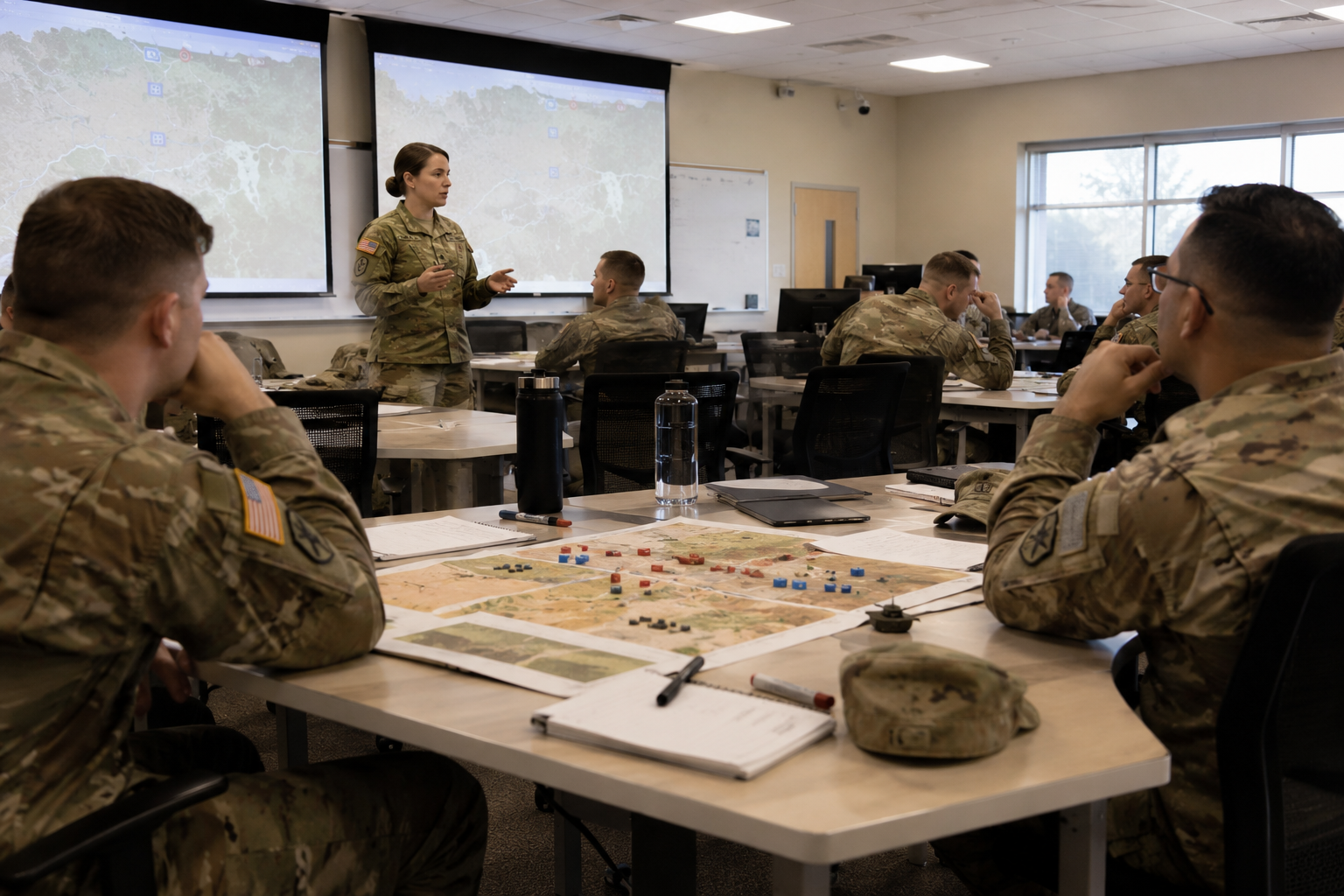
This hesitation surfaced recently at the U.S. Army Command and General Staff College. An instructor handed out modeling clay and asked officers to sculpt what they learned. The exercise was harmless, even playful, yet it unsettled students. The discomfort revealed something deeper: a cultural resistance to intellectual risk, even in a zero‑threat environment.
If officers struggle to embrace mild discomfort in a classroom, what happens when the battlefield demands rapid, unconventional thinking?
The clay episode does not prove that classroom discomfort produces battlefield rigidity. The link is narrower: ambiguity tolerance supports creativity, and military education is one of the few places where leaders can practice uncertainty without real‑world consequences. Research supports that relationship, but not an automatic transfer across domains. That makes exercises like this most valuable as diagnostics and repetitions—structured chances to generate, explain, and revise unfamiliar ideas before the stakes are real.
The issue is not clay. It is whether officers can tolerate ambiguity, experimentation, and temporary embarrassment—traits essential to warfighting. PME already recognizes the need for creative and critical thinking, but recognition is not the same as practice.
The Army does not lack creative Soldiers. It lacks a fast, trusted, repeatable way to gather their ideas, test them, share them, and scale the ones that work. The friction lies between imagination and institutional adoption.
Ukraine: Innovation Under Fire
Ukraine’s war offers the clearest example of how modern advantage depends on rapid adaptation. Under existential pressure, Ukrainian forces built a bottom‑up innovation ecosystem that continuously modifies commercial technologies, tests them in combat, and shares lessons across units at a pace traditional militaries struggle to match.
Ukraine’s urgency can’t be replicated in peacetime, and its risk appetite shouldn’t be imported. What can transfer is the mechanism: shorter user‑developer loops, operator‑driven problem definition, and bounded testing authority, reinforced by fast lesson flow. The U.S. Army can rehearse those mechanisms in training, schoolhouses, battle labs, and experimentation while preserving its legal, safety, and acquisition standards.
Commercial drones became reconnaissance tools, strike systems, loitering munitions, and electronic‑warfare platforms. Units iterate designs in days, not months. Civilian volunteers refine adaptations and push updates back to the front. Commanders encourage experimentation because the battlefield demands it.
This cycle—observe, adapt, prototype, test, share, counter, adapt again—is now the rhythm of modern conflict. CSIS describes Ukraine as a live laboratory where both sides continuously evolve unmanned systems and countermeasures, producing a fluid drone–counter-drone competition rather than stable technological advantage. Advantages are temporary, local, and easily erased by the next adaptation.
The lesson is not “buy more drones.” It is shorten the learning loop.
Ukraine succeeded because it created parallel pathways for commercially derived capabilities and pushed requirements closer to the operational environment. Tactical innovation now moves through distributed networks, not centralized programs.
For the U.S. Army, the uncomfortable truth is simple: the enemy is not waiting for us to finish our staffing process.
Brave1: A Model for Gathering and Sharing Innovation
Ukraine’s Brave1 initiative shows how a military can accelerate adaptation by treating innovation as a distributed, user‑driven ecosystem rather than a headquarters function. Brave1 links soldiers, engineers, civilian makers, and defense‑tech developers in a single digital environment where users submit problems, prototypes, and solutions. Developers respond with designs, funding proposals, or improvements. Validated tools move quickly to the front through a marketplace connecting units with mission‑focused technologies.
Brave1 succeeds because it reduces friction, rewards experimentation, and enables rapid iteration across a wide network of contributors. It is not a model to copy wholesale—Ukraine’s wartime pressures differ sharply from U.S. conditions—but it illustrates the kind of learning architecture the Army still lacks. A kind of marketplace for war.
Brave1’s scale is clear. By April 2025, Ukraine reported 1,500 companies, 540 grants worth UAH 2.2 billion, and 1,000+ solutions on Brave1 Market, where verified military users could browse technologies and negotiate directly with manufacturers. Those numbers don’t prove every product worked in combat, but they show the system evolved from a suggestion portal into a functioning discovery, funding, and field‑access architecture.
Soldiers need a fast, trusted, repeatable pathway to submit problems, share prototypes, compare similar efforts, and route promising ideas to the right institutional owner. Innovation scales when institutions stop trying to control every idea and instead build mechanisms that unleash disciplined experimentation inside clear boundaries.
The Army’s Problem Is Not Ideas—It Is Throughput
The Army is full of Soldiers, NCOs, officers, civilians, and contractors who see problems clearly because they live inside them. They know which forms are redundant, which systems do not talk to each other, which training requirements consume time without producing readiness, which field expedients work, and which tools fail under pressure.
The problem is not observation. It is the absence of trusted pathways for turning observation into shared institutional learning.
Innovation enters the Army through thousands of doors and does not travel through a common hallway. Some ideas go to centers of excellence, some to T2COM, some to Futures and Concepts Command, others into informal networks—or nowhere at all. The Army’s 2025–2026 realignment makes this sharper: Soldiers need clear routing guidance for where an idea should go.
The Army’s culture often rewards polished certainty more than early learning. A young leader may hesitate to share a crude prototype because it feels too small or too risky. Reasonable questions arise: Who owns this problem? Who can test the idea? Who protects me if it fails? Has someone already solved it?
These questions are design requirements. If the Army wants innovation at scale, it must answer them before the Soldier gives up.
A Proposed Army Innovation Learning Architecture
A Brave1‑inspired model should be a practical learning architecture built around five verbs:
- Capture: Make local innovation visible. A squad’s drone training lane, a battalion’s maintenance tracker, or a schoolhouse’s creative PME exercise should not disappear with PCS cycles. A secure, tiered Army Innovation Commons should allow Soldiers to submit problems, prototypes, lessons, and adaptations in a standard format.
- Screen: Sort ideas without killing them prematurely. Some ideas should be rejected for safety, legal, ethical, security, or resource reasons. Others need more evidence. AI can help refine rough concepts, compare similar submissions, identify missing evidence, and provide structured initial review—without replacing human judgment.
- Test: Connect innovators with validators. Not every idea needs to become a program of record. Unit‑level training events, exercises, and schoolhouse experiments can provide evidence to determine whether a local solution deserves broader attention.
- Share: Make useful adaptations searchable. Database tags for warfighting function, echelon, domain, mission set, equipment type, training environment, and threat condition allow users to see who tried the idea, where it worked, and what limitations were observed.
- Institutionalize: Route successful ideas to the right owner—doctrine, training packages, schoolhouse modules, acquisition requirements, or local initiatives. The goal is to prevent valuable learning from dying at the edge.
The Defense Innovation Board warns that acquisition barriers stem not from lack of ideas but from counterproductive incentives. Soldiers should know that submitting a well‑documented problem and prototype is professionally useful even if the answer is “not yet.” Leaders should know that disciplined failure is different from recklessness.
Innovation Without Permission Is Not Innovation Without Standards
Mission command is the foundation for disciplined experimentation. Subordinates exercise initiative within commander’s intent when situations change and orders no longer fit. Commanders do not need to approve every creative thought before it occurs—they need to establish boundaries, communicate priorities, and create channels for useful adaptations to be tested and shared.
Institutional control is not the enemy. Military experimentation carries real safety, legal, and cybersecurity risks. The design question is where control belongs: early ideation should face low barriers, while review should tighten as concepts near live testing, funding, or fielding. The Army already treats failure as useful when bounded by deliberate learning objectives and risk controls.
Doctrine reminds the Army that operations occur in complex environments where commanders and staffs must continuously assess, learn, and adapt. A force unable to practice intellectual risk in peace will be slower to practice operational adaptation in war.
History offers a clear analogy. Interwar Fleet Problems and Naval War College wargames shaped carrier concepts later decisive in WWII; the Marine Corps’ amphibious doctrine likewise enabled Pacific campaigns. The lesson is not that rehearsal guarantees adaptation, but that institutions enter war with habits, concepts, and networks they have already practiced.
PME as the Innovation Gym
PME is one of the Army’s best places to normalize creative behavior before war forces it upon us. All PME can become innovation gyms: places where professionals exercise creative thinking, prototype solutions, challenge assumptions, and learn to present unconventional ideas without fear.
A military education system that rewards only polished briefings risks producing officers who can describe complexity but not act creatively inside it. A more adaptive model would ask students to build, test, revise, and defend ideas under constraints. The OPMEP vision calls for joint warfighters who can think critically, creatively apply military power, and fight under disruptive change.
A PME course on innovation should produce a usable artifact: a problem statement, prototype description, and recommendation for who should receive the idea next.
The modeling‑clay exercise is not childish. It is a low‑risk rehearsal for the high‑risk creativity war demands.
From Suggestion Box to Battlefield Learning Network
The Army should treat innovation as an institutional nervous system, not an episodic campaign.
An Army Innovation Commons would organize submissions by warfighting function, echelon, domain, mission set, equipment type, training environment, and operational problem. Each submission would answer:
- Problem: What is not working?
- Context: Where did it occur?
- Attempted solution: What was tried?
- Evidence: What changed?
- Risk: What could go wrong?
- Transferability: Who else might benefit?
- Status: Idea, prototype, local use, validated.
This allows clever field hacks to be seen, promising tools routed to experimentation, dangerous ideas flagged early, and successful practices scaled.
Most importantly, Soldiers would see that the Army is listening.
Mission‑Metric Mismatch and Orphaned Innovation
A Soldier may believe an innovation supports warfighters, improves training, or strengthens PME, but belief does not create sponsorship. If an idea does not advance the immediate mission or rated outcomes of the first leaders who encounter it, they may have little incentive to champion it. The result is orphaned innovation—too developed to dismiss, too misaligned with local metrics to be owned.
Cross‑domain innovations require cross‑functional panels, not single gatekeepers. Future military innovations will cross domains: human skills, AI literacy, manufacturing, ethics, acquisition, and warfighting. No single reviewer can adjudicate all of that.
Angus Fletcher’s research shows humans are natural innovators, but when learners believe there is only one right answer, they generate fewer new ones. Early‑stage ideas arrive partially legible—sketches, prototypes, training aids, field expedients. If the Army evaluates them only by whether they fit existing categories, it will mistake unfamiliarity for lack of value.
The solution is to separate sponsorship from adjudication. A leader may decline to champion an idea locally, but the institution should still have a neutral process to determine whether it has value elsewhere.
Bottom‑up innovation is not a threat to discipline; it is organizational reconnaissance.
The Cultural Barrier: Fear of Looking Unmilitary
The deepest barrier may be aesthetic. Institutions unconsciously decide what “serious” looks like. In the Army, serious often looks like a slide deck, sand table, doctrinal citation, or rehearsed brief. When seriousness becomes tied to familiar appearance, unfamiliar methods are dismissed before their value is examined.
Ukraine shows that useful innovation may emerge from hobby drones, garage workshops, volunteer 3D printers, and informal feedback loops. The battlefield does not care whether an idea looks military. It cares whether it works.
The instinct to ask “Does this look professional?” should be replaced by better questions: What problem does it solve? What assumptions does it challenge? What evidence supports it? What risks does it introduce? Who else needs to see it?
If something looks strange but works, it should not be dismissed simply because it violates expectations.
Recommendations
- Establish a lightweight, secure, searchable system to capture and share bottom‑up innovation.
- Make innovation capture routine in CTC rotations, Warfighter exercises, PME, and major training events.
- Protect constructive failure; distinguish disciplined experimentation from recklessness.
- Reward leaders who foster adaptive climates and scale useful ideas.
- Keep decentralized creativity alive at the edge; headquarters should remove barriers, not dictate solutions.
- Avoid burying reforms under bureaucracy; speed and adaptability must remain central.
Conclusion: Returning to the Lesson
The discomfort officers felt when asked to model concepts with clay was never about the clay. It was a warning. If a harmless exercise unsettles us, how will we respond when the battlefield demands rapid, unconventional thinking?
Brave1 shows what becomes possible when a military stops fearing unorthodoxy and treats creativity as a core competency. The Army cannot afford to treat innovation as a side project. In a world where change accelerates, advantage belongs to the force that experiments boldly and adapts without hesitation.
The 9/11 Commission warned that the most important failure was one of imagination—and that bureaucracies must find ways to routinize it. Without disciplined imagination, institutions recognize new dangers only after the cost of adaptation becomes catastrophic.
The comparison is about process, not stakes. The Commission argued bureaucracies need routines that force unfamiliar possibilities into collective consideration before crisis makes imagination unavoidable. An Army innovation system serves the same role at a different scale: normalizing the surfacing of anomalies, testing unconventional ideas, and routing weak signals before urgency turns them into emergencies.
The Army does not need to choose between discipline and imagination; it needs both. Discipline without imagination becomes rigidity. Imagination without discipline becomes noise. Together, they become adaptive power.
We do not need to control every Achilles—we need to unleash enough of them before the next war reveals the cost of resisting change.


