Stepping On Legos: The All Too Familiar Pain of Being Behind the Curve in the Information Environment

Abstract
Operating under the assumption that a war against Iran is orders of magnitude less complex than a potential war with China, this article makes the exhortation: If the Joint Force has a process, procedure, staffing mechanism, etc., buckling under the strain of Operation Epic Fury, then it should be assumed untenable for a China conflict and immediately re-evaluated. To that end, this article explores the surprisingly robust Iranian information warfare exploits during Operation Epic Fury and juxtaposes them with known capabilities of the People’s Republic of China in order to infer ways in which Epic Fury has revealed shortfalls in U.S. informational preparedness before a potential conflict with China in 2030 or beyond.
“It’s only hubris if I fail” – Julius Caesar
Whether this quote is actually from the historical figure or merely the HBO adaptation of the Roman Emperor is irrelevant; the profundity of the statement stands. Contained within it is a competing duality whereby the essence of a decision is adjudicated in the post facto by the results rather than the intrinsic qualities that went into it.
Over time, this line of thinking (intentional or otherwise) can set conditions where the perceived continual absence of failure gradually gives way to a superiority complex that subliminally imputes a level of infallibility to the methodologies employed. Sun Tzu cautioned against this intellectual pitfall: “Do not repeat the tactics which have gained you one victory, but let your methods be regulated by the infinite variety of circumstances.” Nevertheless, the allure is persistent and enduring.
Its surreptitious influence can arguably be seen in Marine Corps Commandant General Eric Smith’s confidence in the battle-tested history of the U.S. armed forces: “Our last combat was captured on somebody’s iPhone 14…The Chinese’s last combat was captured on oil and canvas, and they should not forget that.” While his broader assertion of “our experience in the cauldron of combat will give us an advantage in any future fight” is not without some merit, the crux is assuming a transcendent advantage in any future fight based on the success of the past. This essentially plays out in one of two possible ways. If the U.S. wins, then it was not arrogance or misplaced faith in American distinctive capabilities and comparative advantages – it was the epitome of leadership and readiness within the profession of arms. If the US fails, on the other hand, then the post facto hubris designation enters the chat…
This raises a crucial question: In the absence of war in the Indo-Pacific, how does one validate and/or invalidate preparedness for the China fight? Too much presumed efficacy can lead to the same logical fallacies whereby deterrence is assumed to be working so long as thermonuclear war is not happening. Too little presumed efficacy can spark costly initiatives to fix what isn’t broken or create more problems than they solve. But rather than embark upon a journey to ascertain the Goldilocks “just right” theoretical answer, there is a more immediate, realistic, and pragmatic opportunity to refine our preparedness for the China pacing threat: War against Iran across all domains and temporal conditions (e.g., geography; access, basing, and overflight; military size; munition quantities) is orders of magnitude less complex than a potential war with China – If the Joint Force has a process, procedure, staffing mechanism, etc. buckling under the strain of Operation Epic Fury, then it should be assumed as untenable for a China conflict and immediately re-evaluated.
One such area that Epic Fury has already exposed as being in dire need of attention is activities in the information environment.
Red vs. Blue: Information Advantage Lies with US Adversaries
If it is only hubris if it fails, then to ignore failure rather than embracing it as a catalyst for humility is something more egregious. Although the military did add information as the seventh Joint Function (i.e., command and control; intelligence; fires; movement and maneuver; protection; sustainment; and information) in 2017, operational planners are still tempted to regard information as a perpetually supporting function to the others’ support. Informational effects (much like their cyberspace operation counterparts) are too often bolted onto a plan as opposed to fully integrated as a foundational element of the operation as a whole. Consequently, the US’s fixation on kinetic conflict and its inability to seamlessly integrate globally has caused the US to struggle with generating outcomes at speed and scale in the information environment. In short, the US continues to fail informationally, and moving the proverbial needle proves elusive.
Meanwhile, Iran is demonstrating what can be accomplished when Information is treated as a main line of effort rather than an afterthought. As Clemson University scholar Darren Linvill put it recently, Iran is “winning the propaganda war” (at least in terms of output and volume, but more on that later). With content being rapidly produced and diffused across numerous platforms, the Iranian regime is informationally campaigning to undermine support for the war while simultaneously soliciting sympathy in support of its own national image. One of Tehran’s most prolific Information Warfare “payloads” is AI-generated Lego-style videos that hit topics including (but not limited to): Israel dragging the US into conflict; Big and Little Satan; Iranian collaborative alliances with Russia and China; Iran winning the conflict and ready to repel more attacks; Kharg Island; President Trump is hiding a terminal illness while playing politics with the lives of America’s sons and daughters; the war being a distraction from the Epstein Files; and Iran holding the moral high ground. Because these particular pieces of content are constructed in a high-quality and low-cost manner, social media users find themselves “stepping on Legos” everywhere (e.g., Telegram, X/Twitter, YouTube, TikTok) and to the tune of millions of views. The engagement potential offered by a children’s toy can cause people to lower their cognitive defenses.
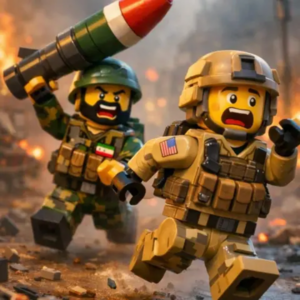
Image 1: This scene inaccurately portrays Iranian ground forces as having American forces outmatched, outgunned, and on the run. At a more subliminal level, it also communicates that U.S. ground forces are in active combat against the Iranians – when they are in fact not.
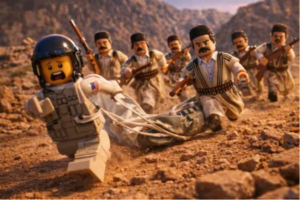
Image 2: This scene portrays the Iranians in hot pursuit of the downed F-15E crew behind enemy lines, communicating an erroneous message that U.S. forces are not only in danger but also that one of America’s sons/daughters would soon be a Prisoner of War (POW). Of note, both crew members were in fact recovered by the U.S. military.

Image 3: This scene portrays a contentious, fear-laden conversation between President Trump and Israeli PM Netanyahu, communicating an underlying false message that the broader war effort is not going according to the original plans and that these two world leaders were regretting their decisions.
Information as a Main Line of Effort
First, this essay does not argue that the US is losing Operation Epic Fury because it is losing the Information War. But rather than highlight the successes of the deliberate air campaign, the recovery of downed F-15E crewmembers, or the first sinking of a surface combatant by torpedo since WWII, the time is better spent reflecting on the shortcomings of Epic Fury in order to extract the datapoints necessary to enhance Joint Force preparedness for the next conflict – especially if the next war is in the Indo-Pacific (reinsert previous point: If the Joint Force has a process, procedure, staffing mechanism, etc. buckling under the strain of Operation EPIC FURY, then it should be assumed as untenable for a China conflict and immediately re-evaluated).
The Joint Force was not prepared for the Iranian regime’s efforts to exploit information as a main line of effort, which means it reasonably follows that the Joint Force is potentially not ready for the Chinese Communist Party’s (CCP) information warfare in a conflict scenario. This is not an esoteric assertion made in a vacuum; it is an inductive “canary in the coal mine” that should be sounding alarms with anyone seeking good-faith introspection on the Joint Force’s preparedness for the China fight. One only needs to examine the ways Iran integrates the other Joint Functions in a supporting role to information as the supported and juxtapose with known-knowns about the Chinese information warfare apparatus.
- Command and Control (C2): Having efficacy within the C2 realm enables Iran’s responsiveness and adaptability to changes in the environment, as seen by pivoting peacetime social media trolls from politically divisive narratives to pro-Iranian war messages at the start of Epic Fury or by actively claiming to have captured the downed F-15E amidst ongoing recovery efforts. Given the successes of the Iranians in this space, how much more robust would the Chinese capabilities be in a wartime scenario given they have already executed the world’s largest online disinformation operation(s) and have already demonstrated the ability to synchronize their troll activities around specific hashtags (e.g., #Xinjiang) with such precision that they successfully disrupted social justice commentators shedding light on the CCP’s human rights violations?
- Intelligence: Intelligence drives targeting; without intelligence, the targeting process devolves into a real-world variation of the Milton Bradley board game Battleship (i.e., shooting blindly until striking something). In addition to demonstrating aptitude for targeting societal fissures to undermine public support for the war (e.g., Epstein Files, US fighting on behalf of Israel), Tehran demonstrated capacity for persona-level targeting when it tweeted the names and official photos of the top two officers aboard a US Navy warship. How much more prolific might the information warfare targeting of China look like when armed with the data from the 2015 Office of Personnel Management (OPM) hack and other CCP cyberespionage exploits. Anecdotally, even in peacetime, the author of this essay has been a topic of discussion by a Chinese-affiliated firm; however, it remains unclear what objective is served by taking a Clemson News article and republishing an LLM-plagiarized alternative.
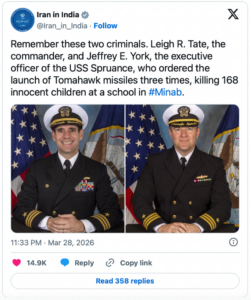 Image 4: Iranian release of personally identifiable information (a.k.a., “doxing”) about the leadership of the USS Spruance.
- Fires: Information fires, unlike their kinetic counterparts, are cheap and often essentially free. Tweets, videos, photos, short-/long-form content, etc., do not require the investments of physical munitions. Generative AI has only further lowered the threshold and associated opportunity costs for Iran (e.g., fake images of Iranians capturing U.S. forces, fake footage of strikes on the USS Abraham Lincoln). Given the unfortunate reality that China’s DeepSeek AI model came as a strategic surprise to many, it should be assumed the CCP is all the more prepared to wage an all-out information war in a conflict scenario – particularly since they have already employed AI in aspects of their information operations. Coming on the heels of then-Speaker of the House Nancy Pelosi’s visit to Taiwan (August 2-3, 2022), the Chinese disinformation actor Dragonbridge quickly employed #urge at least 69,803 times from August 18-31 in a sustained barrage narrative urging Taiwan’s president and military leaders to surrender. Moreover, discussion of fires also evokes the notion of restraint and determining what constitutes a valid military target (i.e., some of the foundational principles of the Law of Armed Conflict). It is hard to ascertain just how far the CCP might go informationally during war, considering they have already proven willing to extend sexually suggestive threats against the 16-year-old daughter of a politically inconvenient dissident.
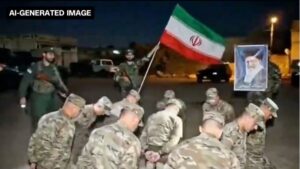
Image 5: An AI-generated image falsely claiming that Iranian forces have captured U.S. ground forces in an effort to demoralize pro-war audiences. Once again, at a subliminal level, it also falsely implies that U.S. ground forces are in active combat against the Iranians.
- Movement and Maneuver: Iranian information operations are digitally everywhere, with sightings on X/Twitter, Instagram, Facebook, BlueSky, TikTok, and beyond. In light of the CCP having a single campaign below the threshold of war that impacted 465 unique domains (e.g., X/Twitter, Facebook, LinkedIn, Medium, Pinterest, Reddit, Quora, Tumblr, YouTube, numerous messaging/blog platforms), China’s information warfare apparatus on a wartime footing should be reasonably predicted to eclipse anything Iran has demonstrated.
- Sustainment: When one social media account is deleted for violating terms of service, the same operator can simply create another – perpetuating a cycle where the platforms are always reactive rather than proactive. In addition to wielding large numbers of accounts, Iran has embraced the Theory of the Firm (i.e., make or buy?) and outsourced the Lego video creation to what some claim is a team of 10 people aged 19-25. Regardless of whether China wields in-house operators or outsources to informational mercenaries (or a combination thereof), the scale should be expected to be exponentially larger than Iran’s. One study examined all 87,437 state-sponsored trolls within the X/Twitter information operations archive. Despite having trolls from 20 different countries, 31,150 of the sample were Chinese – constituting more than one-third of the global dataset (and X/Twitter stated these were not all of the Chinese trolls de-platformed but rather a smaller subset of the tens of thousands of Chinese trolls actually de-platformed). Again, given China has already executed the world’s largest online disinformation operation(s) and sustained these capabilities throughout peacetime, the ability to sustain the Chinese information warfare apparatus on a wartime footing has arguably been stress-tested already.
- Protection: As the old adage goes, the “best defense is a good offense.” The constant bombardment of information fires will never be fully countered by USCENTCOM’s fact-checking initiatives, which in turn impose a cost on overall US information warfare capacity. But there are also ways to play preemptive defense in the information environment. For example, Iranian expatriates have reported online warnings and phone calls threatening their citizenship and/or families in Iran if they do not stop posting anti-regime content. In a wartime scenario, China should be expected to engage in coercive measures such as these on the basis that we have already observed them slandering and even doxing University of Pennsylvania-trained virologist Li-Meng Yan, a Chinese expatriate who was one of the first to contend that COVID-19 originated in a laboratory. China has also pioneered and employed unique digital tactics to algorithmically suppress and/or outright delete narratives online they deem counterproductive to their desired end state, even to the point of manipulating (i.e., weaponizing) Pinterest’s community guidelines protocols to remove content that challenged the CCP’s position.
Begin the Debrief Now!
The debrief of Operation Epic Fury will be years in the making, likely fueling the authorship of books and possibly a Behind Enemy Lines-style movie of the rescue of the F-15E crew. Waiting for the end of the conflict to begin the debrief would be strategically foolish. Fortunately, the introspection required is relatively simple: If there is anything buckling under the strain of Operation Epic Fury, then it should be assumed as untenable for a China conflict.
To be clear, this article has emphasized Iran’s output and engagement as a measure of performance in the information environment – however, this should not be misconstrued as claiming that the overwhelming majority of viewers have their beliefs and opinions changed by this content (after all, engagement and virality are not universal measures of effectiveness for information operations). Further complicating matters, it is empirically impossible to measure belief change and attribute cause-and-effect to information operations outside of a controlled experiment in a laboratory setting. These epistemological challenges notwithstanding, Iran’s output in the information environment still came as a surprise, and thus the alarm bells ringing for Joint Force introspection should be heard if for no other reason than it is a known position of disadvantage relative to an adversary. The reality is, Legos are being stepped on in the information environment now, and current approaches to information are proving insufficient to keep up. While this is unlikely to set conditions for overarching failure against Iran given the operational successes thus far, the hubris of assuming the successes of the past will guarantee success in the future should be avoided.
This is particularly true in the Indo-Pacific because the margin for error in a China conflict will be much smaller than war with Iran, and as such, ceding the initiative in the information environment to an adversary is not an option for a conflict that will likely force the entire world to pick a side. The US needs to examine ways in which it can engage in informational fires faster, with a coherent C2 mechanism that better empowers digital movement and maneuver. This is not an advocacy to engage in disinformation campaigns; to the contrary, the US needs to tell the truth faster. The Iranians spent weeks massacring thousands of their own civilians in the lead-up to Epic Fury. The reality that global audiences are not seeing large-scale messaging on that topic but are instead encountering Lego videos and other propaganda attests to the need for organizational re-evaluations on the part of the Joint Force.
For one, authorities for strategic messaging and informational “fires” need to be pushed down to lower echelons – perhaps in ways similar to NSPM-13 flattening the decision-making process for offensive cyber. Second, Joint Force leadership should set a demand signal seeking to propagate a culture of “informational warfighters” within public affairs channels, shifting the emphasis from base magazines and press releases to outing and combating foreign malign influence in a great power competition environment. Lastly, the informational fight will require unity of effort with big tech and private industry (i.e., a digital arsenal for democracy?). While an argument can be made that social media companies should be required to validate the humanity of their users to preemptively disrupt foreign information operations across the entirety of the conflict continuum, there are stop-gap incentive structures available now that could be established via mechanisms such as an NDAA to encourage public-private partnerships in the information environment (e.g., while Section 230 should continue to provide immunity to platforms for the behavior of their users, during a time of war it could be reasonably stipulated that US platforms not doing enough to remove an adversary’s information operations is de facto “material support” to an enemy of the state).
In the end, and regardless of what reforms are or are not enacted in the near future, one thing is for certain: If the US waits for the proverbial balloon to go up and step into an Indo-Pacific war with the same informational tactics, techniques, and procedures of today, then she will likely concede the information environment to her adversaries at the onset of hostilities…if for no other reason, a war with China is the one scenario where knockoff Legos from Temu are better than the original.
Disclaimer: The ideas, views, and opinions presented in this article are those of the author.