Review: Shadows Over Kabul by Hamdullah Mohib and Tam Hussein
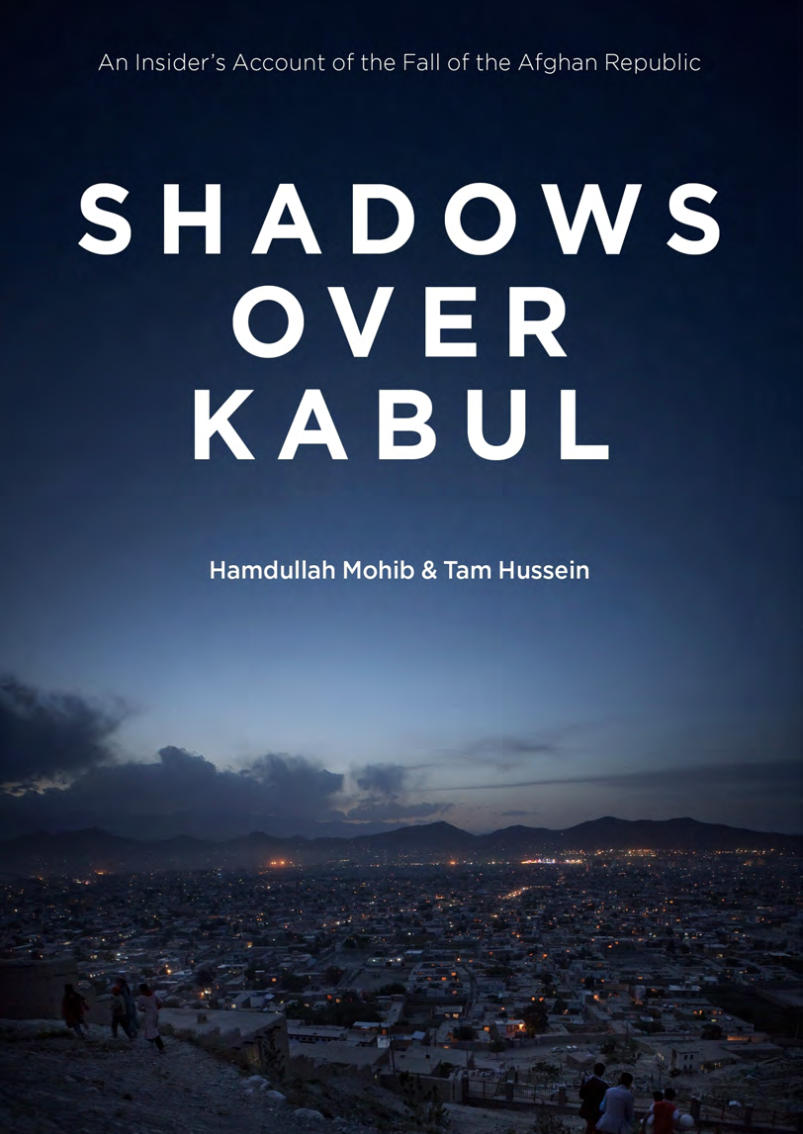

Shadows Over Kabul by Hamdullah Mohib & Tam Hussein. Bloomsbury Publishing, 2026. ISBN: 9780755658466, pp 248. $19.44
Written by former Afghan National Security Advisor Hamdullah Mohib and award-winning investigative journalist Tam Hussein, Shadows Over Kabul: An Insider’s Account of the Fall of the Afghan Republic is as much a memoir as it is a retrospective study on the complexities of war and democracy. Shadows Over Kabulchronologizes Afghan history through the lens of Mohib’s life from how war shaped his childhood to the collapse of the Afghan government in 2021. Throughout the book, Mohib is as equally open to acknowledging missteps and doubts as he is to praise accomplishments. The effects of foreign intervention in Afghanistan are weighed equally to the actions of Afghan political leaders, Mohib included. Mohib’s is a story told with a humility and empathy that breaks through the muddled haze of what might be perceived as propaganda.
The book begins with introductions from Mohib and Hussein as well as a concise overview of Afghanistan’s history from 550CE to present. Presented as a dramatis personae, also included in the forward is a list of relevant individuals, their positions, and political affiliations. The body is divided into four sections, each of which recounts a stage of Mohib’s life and career, with Hussein’s footnotes explored in the back matter.
The first section, “The Beginning – From Refugee to Politician,” opens before Mohib’s life began, with the Soviet Invasion of Afghanistan in 1979, and with the story of his father, Mohammed Yunis. It is through his father’s history as an “Accidental Mujahid” – the chapter’s namesake – that the reader is introduced to Afghanistan and indeed, the life of Hamdullah Mohib. As Mohib states “[his father’s life is] emblematic of Afghanistan’s larger story.” By the end of the book, this is apparent. The section guides the reader through Mohib’s childhood, his time as a refugee, work at the American Institute in Afghanistan, and concludes with his return to the UK to complete his PhD.
“The Rise – Politics of Hope,” the second section of the book, opens with the birth of Mohib’s daughter, which occurred while he is completing his PhD. The section outlines when Ashraf Ghani asked Mohib to create a team for Ghani’s 2014 presidential campaign – Mohib’s official entrance into the political sphere. It also details his years as Afghan Ambassador to the United States where he dedicated himself to cultural outreach to “change how Afghanistan was perceived.” He and his wife created informational booklets outlining progress in education, launched an exchange program for male and female Afghan students, and connected with the Afghan diaspora. During this time, he also discovered unexpected advocacy and support from American veterans who served in Afghanistan. The section ends with Mohib’s appointment as Afghanistan’s National Security Advisor and his return to Afghanistan.
The third section, “The Fall – Why the Republic Fell,” discusses Mohib’s time as National Security Advisory as well as the history of the Taliban’s rise, including Pakistani involvement. Most poignantly, Mohib discusses navigating negotiations with Zalmay Khalid, the U.S. State Department’s Special Representative, and the Afghan government’s exclusion from talks leading to the US-Taliban Deal. He also reflects on the subsequent release of five-thousand Taliban prisoners from Afghan prisons. Mohib dubs the release of the final four hundred war criminals, “…the moment when the Afghan Republic lost the momentum in the war.”
The concluding section, “The Collapse – From Rumors to Reality,” includes only a single chapter as Mohib describes a chain of events leading to the Afghan government’s collapse: failed negotiations, rapid withdrawal of US troops, and Taliban disinformation campaigns. He candidly discusses his thoughts and fears as the Taliban approached Kabul, culminating in his decision to flee Afghanistan with President Ghani. In the final paragraphs, he provides insight into his mindset as they fled from Kabul into Uzbekistan.
Upon the conclusion of Shadows Over Kabul, I found myself returning to the story of Mohib’s father, the “accidental mujahid” and the idea of honor as introduced in the first chapter. When the Soviet Union invaded Afghanistan, Mohammed Yunis was older, with a family, and had an established career as a civil servant. When Mohib’s cousin, an economics’ professor, disappeared, Yunis went in search of him and later, in search of revenge. As Mohib describes, within Afghan culture, a man’s identify and self-worth are tied to his home and his family. This is reinforced by the moral and social framework of Pashtunwali. Yunis was upholding the values of honor as defined by his culture. It was with this example of honor Mohib was raised, and it was this example he knowingly sacrificed when he decided to evacuate President Ghani to avoid “an ethnic bloodbath” that could follow a violent government collapse.
The difference between Mohib’s life and his father’s lays predominantly in the breadth of conflict. When Afghanistan’s centrist government was overthrown by Soviet-supported Marxist-Leninists sects, it was not with majority support. The subsequent purges and reforms were considered communist and anti-Islam which galvanized those who would be known as Mujahideen. The Mujahideen, while never a singular body, were supported by volunteer forces and multiple states.
On the other hand, the collapse of the Afghan Republic was a result of a war on multiple fronts in which former allies instead supported opposing interests. There were no galvanizing moments as in the Soviet-Afghan War and internal discord remained a key issue. As Mohib describes, “We were worn down by incoherence, by the erosion of trust, and by our failure to forge a singular national story.” This dissonance made the Afghan Republic more susceptible to disinformation campaigns and foreign influence.
One of the book’s greatest successes is Mohib’s ability to weave his endogenous awareness of Pashtunwali, Islam, and Afghan political tradition within a broader historical narrative. While a complete absence of bias when retelling one’s own life may be impossible, Mohib and Hussein elegantly balance memory, history, and hindsight without jeopardizing a sense of authenticity. In Mohib’s words, Shadows Over Kabul aims to “offer a deeper understanding of how Afghanistan’s fate was molded over the past forty-five years, shaped both by external forces and internal decisions.” And in this, I believe, it succeeds.
As Mohib states in his introduction, “…beyond blame, this book seeks to illuminate what that collapse meant for the Afghan people: how their dreams were betrayed and the price they paid.” The sociocultural context interwoven throughout, supported by Hussein’s meticulous research, adds a depth to the prose that makes it accessible to both the practitioner and the casual reader.
Beyond an eyewitness account, Shadows Over Kabul is a reminder of sameness, of shared human experience. We are all, in the end, products of our circumstances. Mohib was a child of war raised with Pashtunwali values – it is not a stretch of the imagination to understand why Mohib felt called to serve. Tradition and history shape all of us, this is not a unique phenomenon, regardless of where we are born.