





Review: Fight Like a Machine by Thomas M. Hunt
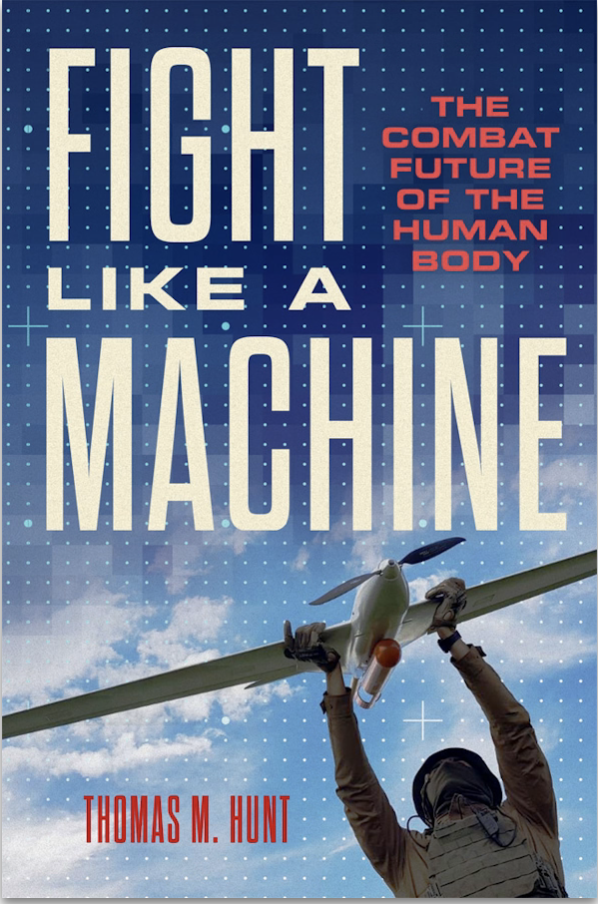

Fight Like a Machine by Thomas M. Hunt. University of Oklahoma Press, 2026. ISBN: 9780806197340, pp. 270. $19.95
The combat-capable human body has taken on a new meaning. As technology advances, humans remain essential to combat – but our conception of a fit fighting force must evolve. Thomas M. Hunt, a professor of Kinesiology and Health Education at the University of Texas at Austin, argues in his book Fight Like a Machine that the integration of humans and technology is central to the future of warfare. Hunt goes beyond advocating for more technology in the military. He contends that the military has reached a point where existing systems – health education, training, and recruitment – are no longer sufficient to meet the demands on the services and service members. The military must adapt to build a system around humans who are increasingly dependent on and augmented by machines.
Well-established health issues, fluctuating recruitment success, and technological innovation demand that the U.S. military examines how it uses its forces’ bodies. Historically, the military had an extractive approach – using bodies up and spitting them out. Uniformed personnel operate on minimal sleep and with limited preventative care, resulting in foreseeable training-related injuries. Hunt argues, the military must shift its approach to one that emphasizes longevity. Hunt also highlights the contributions of older volunteers in Ukraine as a reason to raise recruitment age, underscoring that sustaining service members’ long-term health and capacity can strengthen military effectiveness. Treating their bodies as expendable resources will hinder these efforts.
The topic is timely – the military is at an inflection point around physical fitness and health. The Army has published official ads such as “Stronger people are HARDER to KILL! [sic]”, borrowing a phrase from strength coach Mark Rippetoe. Defense Secretary Pete Hegseth has criticized overweight service members and announced sweeping changes to the military’s fitness standards, including twice-yearly fitness testing and body composition tests. The Pentagon’s official newswire posted an article entitled “Unfit, Undertrained Troops No Longer Tolerated,” in September 2025. The message from the top is clear: a more fit military is in demand.
Hunt walks a line, acknowledging the military does have a fitness issue. He broadens the aperture to flag common service- and training-related issues arguing that the military has the duty to integrate technology and best practices while modifying certain protocols to provide better care. Under the Pentagon’s new fitness directives, services must base training and standards on scientific evidence, monitor injury risk, account for fatigue, and report musculoskeletal injuries annually. However, the steep consequences for failing new fitness standards risk more of the same: frequent and preventable injuries.
Fight Like a Machine also suggests who comprises the fighting force may need to change. Ukraine’s volunteer drone operators may not pass conventional military fitness tests and screening protocols, but they have proven essential to the war effort. As the demands of warfare change, so too must the demands on the human body. Certain military occupation specialties that focus more on technical integration will not require the same standard of deployability, broadening the recruiting pool. Hunt takes this argument further, suggesting we need to integrate technology responsibly to transcend the limits of the human body. Our ability to overcome nature unaided is limited. Human progression in breaking elite sports records is slowing down – we are reaching the ceiling of what maximized nutrition and healthcare can achieve. If the military wants to reach new heights, it will have to commit to human-machine teaming.
In 116 pages, Hunt covers considerable ground. He takes the reader through discussions of physical fitness, performance enhancement, the role of digital gaming in training service members, the proliferation of uncrewed systems in combat, and the role of women in the military. He argues that policymakers must “reimagine the nature of combat physicality and embrace new tools of war.” Fight Like a Machine reviews a large body of literature and commentary by relevant thinkers in the medical, technological, military, and policymaking worlds. Hunt draws on literature spanning gender, biopolitics, defense policy, technology integration, and how American youth use technology to examine how these issues converge around the future of the combat-capable body. The breadth of that approach is one of the book’s strengths, but it can also make Hunt’s own argument difficult to distinguish from the debates he surveys.
The book’s subtitle, “The Combat Future of the Human Body,” lays a certain expectation of the topic matter. It conjures images of mech suits and commandos wearing AI-enhanced goggles. In reality, Fight Like a Machine is a marriage between two issues: the integration of digital technologies and the reduced centrality of the human body in combat, and an overview of the existing health and physiological challenges facing the U.S. military. The multiple strands of Hunt’s case are related, but the book does not always make their relationship explicit.
For example, Hunt highlights how the military is shooting itself in the proverbial foot by failing to better recruit and maintain female service members – and to structure assessments that include them. This furthers Hunt’s broader contention that a narrow scope of a combat-capable body will harm military effectiveness. He notes that many physical standards are sex-blind, and that women have to wear equipment designed for male bodies. But the argument’s placement also illustrates one of the book’s weaknesses. A 12-page discussion of women and the female body bisects chapters on the war in Ukraine, digital gaming, and unmanned systems. The chapter contains useful information, but its position in the book contributes to the sense that Hunt is moving between related debates rather than building a single sustained argument.
The book is a survey course in many of the defense establishment’s opinions and debates, which at times leaves Hunt’s own position less developed than the evidence he presents. He cites retired naval officer and author David Poyer’s idea that universal military training and universal healthcare could address a population increasingly unfit to serve but does not endorse nor reject the idea. This approach gives the reader an overview of the debate, but it can also make the book feel less like an argument than a catalog of questions facing the defense establishment. However, the terse and evidence-packed style will suit the largely military and policymaker audience for this book.
Fight Like a Machine’s greatest contribution is a comprehensive walk-through of how the current system cannot remain static. Hunt does not offer a single prescription; however, he does make the compelling case that existing structures are not suited to meet the needs of the moment. While the nature of war remains unchanged, its character is evolving via the rapid technological transformation of the modern age and a shifting social and cultural landscape. The breadth of the problem set will require an equally broad response.


