





The Warfighter-Cyborg Problem: How stacked wearable technologies may reshape identity, judgement, and battlefield ethics

Abstract
As the Department of Defense increasingly equips warfighters with multiple wearable technologies, additional research and attention must be paid to how these systems collectively shape human cognition, identity, and moral decision-making. This article argues that stacked wearables may foster excessive reliance on machine-generated information, inflate perceptions of power, and create psychological distance from the consequences of lethal actions, potentially degrading judgment and increasing vulnerability to moral injury. It recommends integrated cognitive testing, professional military education on “cyborg awareness,” calibrated-trust design, sensible limits on system stacking, and structured psychological support to ensure that technological enhancement through stacked wearables strengthens rather than undermines human judgment.
Introduction
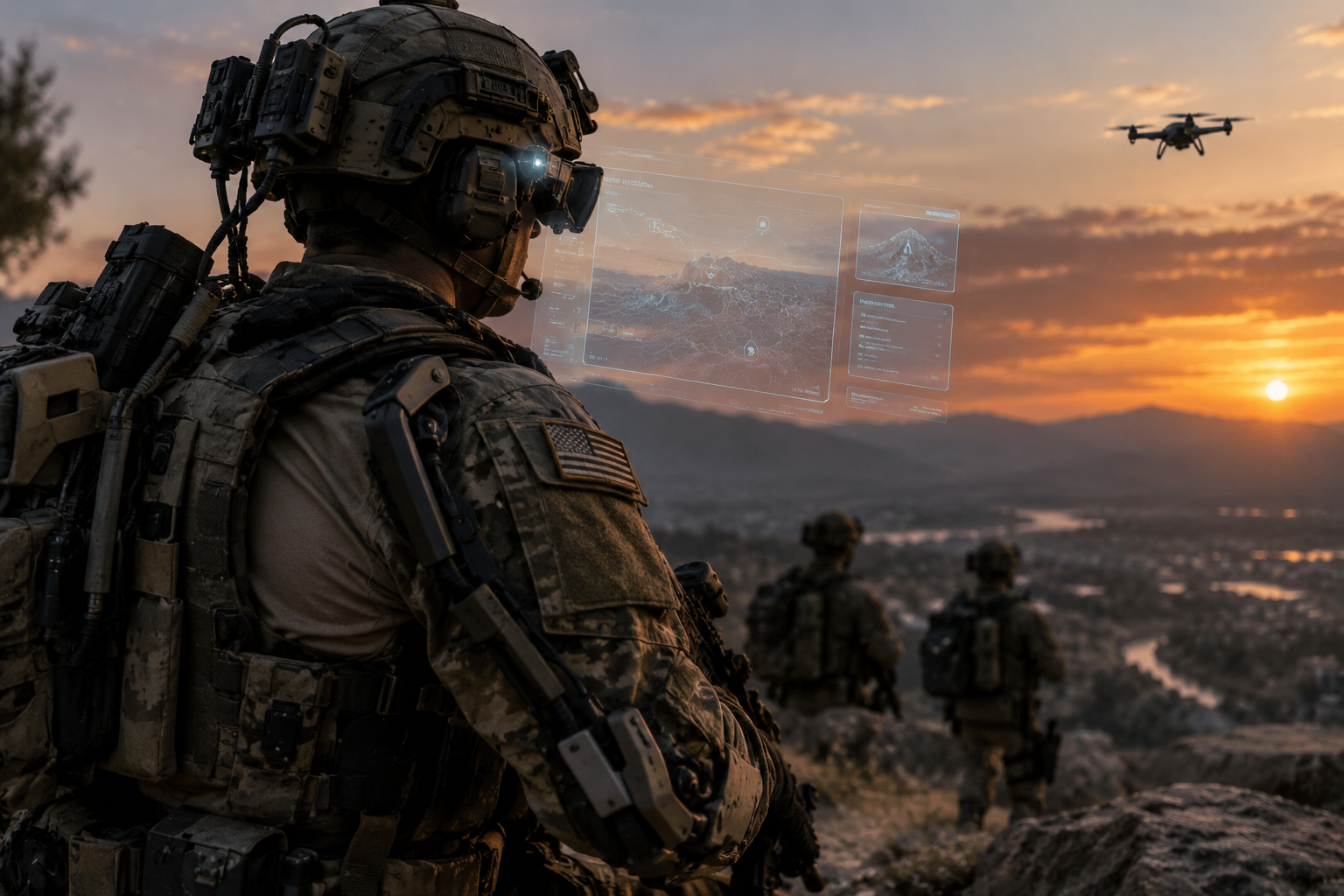
For decades, popular culture has imagined the ultimate “super soldier” as something like Halo’s Master Chief. They visualize a human whose strength, awareness, and lethality are amplified by a fully integrated suit of technology. The power does not come from the individual alone, but from the seamless fusion of human and machine. Today, Master Chief’s Spartans are no longer confined to fiction. As the Department of Defense (DoD) advances toward Combined Joint All-Domain Command and Control (CJADC2), the integration of Artificial Intelligence (AI), Augmented Reality (AR), and wearable technologies has become central to maintaining a competitive edge. Moreover, tactical decision-making is increasingly pushed down to junior leaders, who are expected to operate autonomously and with greater speed, accuracy, and lethality, often enhanced by this growing array of wearable devices. These technologies are designed to optimize performance across physical, cognitive, and operational domains. Wearable systems ranging from heads-up displays and exoskeletons to AR headsets and biometric sensors form a networked ecosystem that blurs the boundary between human and machine.
Much of the current discussion has focused on preventing distraction or cognitive overload. These are important concerns, and the U.S. Army and the Defense Advanced Research Projects Agency (DARPA) have made considerable progress in this area, particularly with systems like the Integrated Visual Augmentation System (IVAS). However, far less attention has been paid to the cumulative psychological effects of multiple systems used simultaneously by a single operator. While individual technologies may be tested for cognitive bias and performance optimization, little integrated analysis examines what happens when numerous systems converge on one warfighter, especially when those systems are developed by different entities without a complete understanding of how they will interact.
The convergence of stacked wearable technologies can do more than enhance performance. It can reshape the warfighter in three critical ways. First, it can alter identity, as wearables become embodied extensions of the self and multiple wearables subtly shift the locus of judgment from human to machine. Second, stacked wearables can change perceptions of power, increasing confidence and perceived control in ways that can distort decision-making under pressure. Third, the more wearables on a warfighter, the stronger the pull of moral buffering may be, where technologically mediated actions create distance between the warfighter and the consequences of those actions. Together, these dynamics do not simply improve capability. They also have the potential to redefine how decisions are made, how responsibility is experienced, and what it means to be a warfighter in increasingly augmented environments.
Understanding these shifts requires moving beyond individual wearable technologies to examine how their combined effects shape the human at the center of the system. As these technologies stack, they do more than enhance performance. They also risk reshaping cognition, judgment, and identity. The result is not merely a technologically augmented operator, but a new class of decision-maker: the warfighter-cyborg.
Not Just Tools but Identity
This emerging warfighter-cyborg reflects a long-standing vision of human-machine integration. But what was once confined to specialized environments, like the symbiosis between an aviator and his cockpit, is now becoming a reality for ground forces.
How humans develop identity is complex, but it is widely accepted that objects can become part of the self. Research on wearable technology shows that devices worn on or integrated into the body can function as a kind of “second skin,” becoming inseparable from the user’s sense of identity. Individuals who use such technologies often come to see them not as tools, but as extensions of themselves. Engineer Kevin Warwick is often credited with becoming the first real cyborg in 1998 when he implanted a computer chip into his arm. He expressed surprise with how quickly the implant (and the computer it was linked to) felt like a part of him.
As wearables accumulate, this process may become more pervasive. This may not necessarily be because each additional device produces an equal increase in embodiment, but because multiple devices can simultaneously extend different aspects of the user’s physical and cognitive experience. Rather than interacting with a single technological extension, the warfighter may experience several simultaneous extensions across physical, cognitive, and informational domains. For example, a heads-up display may extend perception, a biometric sensor may extend awareness of the body’s internal state, and an AI-enabled system may extend information processing or decision support. Together, these systems can create a more continuous technological presence around the warfighter. The warfighter is no longer simply using equipment. The equipment is experienced as an extension of self. Over time, this can shift how they perceive themselves, and they could feel more connected to their machines than to themselves. This concept has been called “wearable technology embodiment.”
Research on wearable technology embodiment supports the idea that these devices can be experienced as extensions of the body, cognition, and self. Importantly, however, the existing literature does not establish that simply adding more devices necessarily produces proportionally greater embodiment. The significance of stacking may instead lie in the different functions being simultaneously incorporated into the user’s experience. When physical, cognitive, and informational capabilities are all mediated through technology, the boundary between the warfighter and the technological system may become increasingly difficult to distinguish.
This shift has consequences. As identification with technology increases, so too can reliance on it. If a device becomes experienced as an extension of the self, information produced by that device may also feel less like an external recommendation and more like an extension of the user’s own perception or judgment. Trust in machine-generated outputs may begin to override independent judgment, subtly shifting decision-making authority away from the human. The danger is not necessarily that the warfighter consciously surrenders control to a machine, but that repeated reliance can make machine-generated information feel increasingly natural, authoritative, and difficult to question. When identifying more with a machine, the faith and trust in the machine’s technology can become like a virus, overtaking the “natural host” and the human mind.
In high-stakes environments, this matters. A warfighter who defers too readily to wearable systems, particularly those powered by AI, risks losing the ability to critically evaluate information, question recommendations, or adapt to ambiguity. The more deeply integrated these systems become with the warfighter’s perception and decision-making, the more important it may be to preserve an awareness of where the human ends and the machine begins. The danger is not that machines will fail, but that humans may stop thinking for themselves. Donna Haraway, well-known for her revolutionary work The Cyborg Manifesto, explored this concept of technology overtaking human judgement by noting, “our machines are disturbingly lively, and we ourselves frighteningly inert.”
The Problem With Power
Stacked wearable technologies do more than alter identity. They may also shape how warfighters perceive their own capabilities and vulnerability. A warfighter equipped with multiple enhancements may begin to experience these capabilities not simply as external tools, but as extensions of what they can see, know, and accomplish. Psychologists define power as the perception of having an asymmetric advantage over others. While technological capability is not the same as interpersonal or structural power, it may contribute to a related psychological experience of having a heightened sense of competence and control.
Technologies that enhance physical or cognitive capabilities can reinforce this perception, making individuals feel faster, stronger, more informed, and more capable than their adversaries. In fact, studies about amputee identity have revealed that some amputees view their prosthetics as a bionic upgrade and therefore may opt to leave their prosthetic limbs exposed, instead of covering them with skin-like covers called cosmeses. Research on bionic prostheses also suggests that technological augmentation can affect users’ self-perceptions of competence and self-efficacy, with some users developing positive identification with their technological capabilities. Additional research on this area is needed to determine if those same results are found with other types of augmenting devices, such as those utilized in military settings.
Self-proclaimed “Cyborg Anthropologist” Amber Case takes this a step further by noting that humans previously modified themselves with tools that helped extend the physical self and allowed them to move faster or hit things harder; however, technology has now extended more than just the physical self but also extended and improved the mental self. The expectation that warfighters use technology to see farther, process more information, communicate faster, and act more effectively may therefore reinforce the perception that technological enhancement is necessary for optimal performance.
This provides a possible mechanism for understanding how the psychology of technological augmentation might transfer from prosthetic users to warfighters using removable equipment. The situations are not identical. A prosthesis replaces or augments a missing limb, while military wearables are typically external tools used by otherwise able-bodied operators. However, both involve technology being experienced as an extension of human capability. Research on wearable exoskeletons provides another bridge between these contexts. While an exoskeleton did not automatically increase self-efficacy, workers who perceived the technology as more useful or physically relieving were more likely to report increased confidence in their ability to perform their tasks.
The mechanism, therefore, may be less about “bionic pride” specifically and more about perceived competence. When technology repeatedly expands what a person can physically or cognitively accomplish, those capabilities may become incorporated into how that person evaluates their own abilities. For a warfighter, being issued increasingly sophisticated systems may also communicate an organizational expectation that these technologies are necessary to perform at the level demanded of the mission. The operator may consequently experience a feedback loop in which technology expands capability, expanded capability reinforces confidence, and confidence reinforces the perceived need for further technological enhancement.
When outfitted with multiple technologies, the warfighter may therefore begin to perceive human limitations as increasingly manageable through technological augmentation. The fragility of the body and limitations of human perception have not disappeared, but the operator may experience them as less consequential because technology appears to compensate for them. The more systems simultaneously extend physical, cognitive, and informational capabilities, the more comprehensive this sense of augmentation may become.
When applied to the battlefield, the implications are significant. A warfighter operating with enhanced vision, real-time data feeds, and decision-support systems may feel not only more capable, but less vulnerable. The cumulative effect may be less about any individual device and more about the overall perception created by the technological system that the warfighter can see more, know more, react faster, and potentially control more of the environment.
This matters because perceived power shapes behavior. Research shows that individuals who feel powerful are less attentive to external constraints, more likely to rely on their own judgment, and more prone to overconfidence. Importantly, this does not mean that technological capability is equivalent to the interpersonal or hierarchical power typically studied by psychologists. Rather, the relevant connection is the subjective experience of control. Individuals who feel powerful have also been found to be more likely to discount advice and exhibit what psychologists call “illusory control.” This is the belief that they have more time and control over outcomes than they do. Fast and colleagues similarly found that experiencing power can increase an individual’s perceived control over outcomes, even when their actual ability to control those outcomes has not changed.
For a warfighter-cyborg, technological capability could create a related distortion. Enhanced sensors provide more information but do not eliminate uncertainty. AI decision-support can provide recommendations without guaranteeing that they are correct. Physical augmentation can increase capability without eliminating vulnerability. Yet when these systems operate together, their combined presence may create the impression that uncertainty and human limitation have been substantially reduced.
The result is a potential paradox of technological enhancement where the systems designed to make the warfighter more capable may also make the warfighter feel more capable than the situation warrants. For a warfighter-cyborg making rapid decisions in complex environments, this combination of enhanced capability, reduced perceived vulnerability, and inflated control could degrade decision quality. The challenge is therefore not to prevent warfighters from feeling capable and confident, but to ensure that confidence remains calibrated to the actual capabilities and limitations of the human-machine system.
The Moral Buffer
Multiple wearable technologies not only shape how warfighters process information but may also influence how they make moral decisions. Many wearable-enabled actions occur through mediated interfaces, such as selecting a target on a display, activating a system, or transmitting a command. These actions resemble what psychologists describe as “moral-impersonal” decisions, which are indirect actions that create distance between the actor and the outcome. This distance matters. Research on moral judgement, obedience, and empathy suggests that individuals may be more willing to take harmful actions when they are physically or psychologically separated from those affected. Additional research has similarly found that physical distance can facilitate moral disengagement, suggesting that the separation between an actor and the consequences of an action can influence moral engagement. The presence of a technological interface may therefore act as a psychological buffer, reducing the emotional weight associated with a decision and facilitating moral disengagement.
Bandura’s theory of moral disengagement provides a useful conceptual basis for describing technology as a possible moral buffer. Bandura argued that harmful behavior becomes easier when responsibility is displaced or diffused, consequences are minimized or obscured, and actions are cognitively reconstructed so that the actor feels less personally responsible. Technological mediation can potentially contribute to several of these processes by determining what the user sees, how information is presented, and how directly the user interacts with the consequences of an action. Researchers studying technology-facilitated violence have similarly argued that technologies do not simply extend human capabilities but can also shape users’ perceptions, experiences, and actions. Wearable technologies may therefore create greater physical and psychological distance between the individual and the consequences of their actions.
By using multiple wearable technologies on the battlefield, this distance may acquire multiple layers. Long-range sensors, remote targeting systems, visual overlays, AI-enabled decision support, and communications systems can each mediate a different part of the relationship between the warfighter and the target. One system may create physical distance, another may filter or interpret information, and another may facilitate the final action. The warfighter therefore may not experience a single barrier between action and consequence, but a chain of technological mediation. The warfighter may see a target, but not the full context of that target’s environment or humanity. The question is not necessarily whether every additional device produces an equal increase in moral distance. Stacking may instead create additional opportunities for responsibility and emotional engagement to become distributed across the human-machine system.
This distinction addresses an important question about whether moral buffering actually compounds. It may be more accurate to think of stacking as adding layers of mediation rather than assuming a simple linear relationship between the number of devices and the amount of moral disengagement. The first technological interface may create a substantial psychological separation, while subsequent systems may either deepen that separation or produce diminishing effects. Their influence may depend on what each system specifically does. Thus, the psychological effect of stacking may depend less on the number of devices than on how their functions combine.
Stacked wearables may nevertheless reinforce a sense that the warfighter is acting through a system rather than acting alone. When responsibility is distributed across sensors, algorithms, interfaces, and human decisions, the operator may have more difficulty identifying precisely where their own moral agency begins and ends. A highly integrated system could make it easier for a warfighter to think, consciously or unconsciously, that the technology identified the target, the system generated the recommendation, and the interface merely facilitated the action. This does not remove human responsibility, but it may complicate the operator’s subjective experience of that responsibility. In this sense, the moral buffer may operate not only by creating physical distance from the target, but by creating psychological distance from one’s own agency.
This moral buffering can enable faster, more detached decisions. In some cases, this may be operationally advantageous. Reducing emotional interference can allow warfighters to act decisively under pressure, and technological mediation may sometimes improve rather than impair moral decision-making by providing additional information or reducing uncertainty. The concern arises when emotional distance becomes so great that it weakens the warfighter’s ability to recognize the human consequences of an action.
Additionally, the effects of this distancing do not necessarily end when the mission is over. While technology can provide a psychological shield at the moment, it may leave warfighters more vulnerable to moral injury afterward. Once the immediacy of action fades, individuals may revisit their decisions without the same buffering effect, confronting the full moral weight of what occurred. Emerging research on unmanned aerial vehicle (UAV) operators has identified similar tensions. Although remote operators are physically removed from the battlefield, they may still experience substantial psychological and moral strain. In some cases, their technological proximity to targets can produce a paradoxical combination of physical distance and psychological intimacy. Recent research likewise describes emerging military technologies as producing a tension between estrangement and intimacy, in which technology can make violence feel detached and game-like while simultaneously exposing operators to unusually detailed views of its consequences.
This can be compounded by ambiguity around responsibility. In highly integrated systems, warfighters may question the extent to which decisions were truly their own. Did they act independently, were they guided, or perhaps even influenced by the system? The more layers of technological mediation involved in a decision, the more complicated this question may become. Responsibility can remain legally and ethically human even when the subjective experience of agency becomes distributed across the human-machine system. Such questions can complicate how individuals process their experiences, potentially intensifying psychological strain.
Moral injury is not simply a function of what was done, but how it is understood and internalized. For this reason, the moral consequences of stacked wearables may emerge not only during the decision itself but afterward, when the warfighter reconstructs what happened and determines what role they believe they played. Wearable technologies, particularly multiple worn at once, may alter both the experience of moral decision-making and the interpretation of responsibility that follows it. The moral buffer may therefore protect the warfighter from the emotional immediacy of an action in the moment while simultaneously creating a more complicated moral reckoning afterward.
Implications for the Joint Force
To responsibly integrate stacked wearable technologies into the future force, the DoD should take proactive steps to address their potential cognitive and ethical consequences. Below are a few potential steps as a start to that conversation.
The first step is to establish cognitive integration testing. Current testing often focuses on individual systems, but the primary risk lies in their combined use. Testing should evaluate how multiple wearables interact and affect decision-making, including impacts not only on attention and situational awareness but trust, power, and the potential for moral buffers.
Second, incorporating “cyborg awareness” into training and professional military education can provide much needed information around potential consequences of stacked wearable technologies. Warfighters should understand how the use of multiple wearable technologies can shape perception, cognition, and identity. Training should include scenarios that require individuals to critically evaluate system outputs and prioritize human judgment in complex situations.
Third, stacked wearable technology systems should be designed for calibrated trust. Systems should be built to support appropriate levels of trust and not blind reliance. Transparent interfaces, confidence indicators, and explainable outputs can help warfighters understand system limitations and maintain active engagement in decision-making.
Fourth, experts in these technologies should consider possible limits on system stacking. Until the cumulative effects of multiple wearables are better understood, the number of simultaneously deployed systems should be carefully managed. More technology does not always produce better outcomes.
Finally, mental health support and structured reflection should be integrated for warfighters engaging with multiple wearable technologies. Warfighters operating in highly augmented environments may face unique psychological and ethical challenges. Providing opportunities for reflection and access to support can help mitigate long-term consequences, including moral injury.
Conclusion
Wearable technologies promise significant gains in speed, awareness, and effectiveness. But as the military moves toward deeper human-machine integration, it must also confront a fundamental question: Are these systems enhancing the warfighter, or transforming what it means to be one?
As stacked wearable technologies accumulate and converge on the warfighter, they do more than extend capability. They shape perception, influence judgment, and mediate moral decision-making. The warfighter-cyborg is not a distant concept; rather, it is an emerging reality. Unchecked integration risks eroding the very qualities that make human decision-making valuable, such as critical thinking, moral awareness, and adaptability in uncertainty. Enhanced perceptions of power, increased reliance on machine input, and the distancing effects of technological mediation may degrade performance in complex, high-stakes environments.
To remain both effective and human, the DoD must move beyond system-level optimization and consider the cognitive and ethical dimensions of stacked wearable integration. The warfighter-cyborg of the future must not only be more capable, but more self-aware. Failing to anticipate these effects risks undermining the very advantages these technologies are designed to provide.
Disclaimer: The opinions and views expressed are those of the authors alone and do not necessarily represent those of the US government, US Department of Defense or its components, to include the Department of the Navy or the US Naval War College. All statements of fact, opinion, or analysis expressed are those of the authors and do not reflect the official positions or views of the US government. Nothing in the contents should be construed as asserting or implying US government authentication of information or endorsement of the authors’ views.


