





Greater Than the Sum: Considerations for Framing Force Modernization


Abstract
Five American military services—Air Force, Army, Marine Corps, Navy, and Space Force—are modernizing concurrently while the joint mechanism for reconciling their designs is itself being rebuilt. In the midst of these changing dynamics, no common structure exists for comparing efforts that each service names and frames differently. This article proposes one: a four-function model spanning strategy to tactics and theory to practice, comprising Describe the Environment, Develop Concepts & Capabilities, Deploy the Force, and Decipher Trends, with the service’s hypothesis of success circulating among them. Describe the Environment and Decipher Trends, by their nature, are critical and continuous activities that do not produce observable finished products. The absence of such products allows years of underinvestment to pass without notice. Naming both as distinct functions gives the services a place to assign persistent responsibility and gives observers a basis for comparing service designs at the level of assumptions rather than budget disputes.
Jockeying For Relevancy
The United States has spent ten years orienting itself towards competition with China. Consistent guidance and associated investments have identified the nation as the principal threat actor from the standpoint of great power competition. At the core of this prioritization lies an unspoken, often unarticulated presumption: military formations capable of waging war against a near-peer competitor will suffice for any future engagements, regardless of that conflict’s character or potential opponents. While debates and policymaking appear to focus heavily on the competition between powers, recent activities by the U.S. military have exposed this presumption’s vulnerabilities. Sustained operations in the Western Hemisphere, including Joint Task Force-Southern Spear (recently replaced by Joint Task Force-Western Hemisphere) and Operation Absolute Resolve, are estimated to have cost more than $4 billion. Meanwhile, Operation Epic Fury figures are estimated between $34 and $42 billion as of the Memorandum of Understanding signing between the United States and Iran in mid-June 2026. More importantly, both lines of effort have consumed munitions at rates that will take years to replace, exhausted critical components of military readiness, and reopened questions about the United States’ approach to its stated priority threat.
While American armed forces are actively observing events of contemporary conflicts from their experiences and those of others, these military services are all simultaneously implementing their versions of force modernization. The Marine Corps is in its sixth year of executing its Force Design initiative and was a first mover among its peers. The Army announced its Transformation Initiative in May 2025 which issued sweeping reforms to capability procurement and force structure. The Navy has embarked on its Golden Fleet initiative while the Air Force and Space Force have highlighted modernization priorities during budget testimony.
These concurrent efforts are not an accident of timing nor evidence of dysfunction. Title 10 assigns each service the responsibility to organize, train, and equip its forces, permitting service leadership to design independently and answer for those designs separately. What has changed is the mechanism that reconciled those independent designs against joint requirements. The Department dismantled the Joint Capabilities Integration and Development System in 2025 and provided an updated charter for the Joint Requirements Oversight Council. These shifts are compounded by the extensive changes to federal procurement by way of defense acquisition reforms. While Congress has broadly backed these reforms, it has voiced its concerns regarding individual services prioritizing service-specific solutions over joint ones, a concern that echoes Carl Builder’s 1987 finding that service strategies, however they are defended in terms of national security, are more deeply motivated by institutional autonomy and mission independence.
Today, the five services are redesigning concurrently with different origins, motivations, and timelines. At the same time, the very process of integration among these transformations is undergoing a reformation. Under the assumption that the services operate within a larger hierarchical agency towards achieving a common goal stipulated by strategic guidance, it becomes necessary to assume that each service achieves this common goal through its own route based on its particular hypothesis of success. These hypotheses, in turn, result from both cultural and contemporary contexts of the service itself. Policy outcomes in large institutions often emerge from bargaining among actors advancing organizational interests; the United States military is an example of this model. The services have spent decades competing for resources, authorities, access, and influence in ways that have proven remarkably durable. A service facing a finite pool of all four has reason to design its force in ways that secure its standing with decision makers while protecting the interests built into its heuristics and biases. That reason is not the same as designing the force best suited to the role the service is meant to fill; where the two pull apart, the tendency to protect the service’s identity or interest is unlikely to yield. Before asking whether these efforts align, it is necessary to establish what force modernization consists of irrespective of what any individual service calls it. What follows is a proposed common structure for that purpose (see Figure 1). This framework is not offered to criticize ongoing modernization efforts, but to describe the essential functions that any such effort comprises.
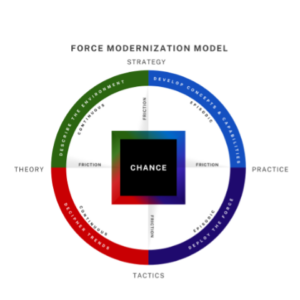
Figure 1: Force Modernization Model
Modeling Force Modernization
The Force Modernization Model proposes a model for understanding modernization based on two dimensions. This framework is not offered to criticize ongoing modernization efforts, but to describe the essential functions that any such effort comprises. The vertical axis spans strategy to tactics and captures the echelon of decision involved. Meanwhile, the horizontal plane represents the gap between theoretical examination of the force versus practical implementation. Individually considered, none of these distinctions present innovative concepts. However, combined into a matrix, these four quadrants capture unique considerations surrounding efforts towards modernizing services.
Rather than linear phases, these quadrants represent ongoing processes carried out by various stakeholders at varied points in time under differing authority structures. Therefore, it would be misleading to construe the framework as chronological phases, but rather a classification scheme. Spanning the entirety of all four quadrants is the service’s hypothesis of success, which evolves during its journey throughout the quadrants. This hypothesis can be subjected to the scrutiny of existing information and revised, and the use of this hypothesis as the basis for force design means that this hypothesis is open to questioning.
Two elements appear in the model that operate independently of discrete processes and are not limited to any particular quadrant. Friction occurs within each of the four seams that separate the end result of one process from the start of another process. There is friction inherent in any modernization, although it is especially pronounced at transitions between quadrants. In other words, there must be an understanding and relevancy between each sequential output. Within every transition, a cost must be paid, whether in precision, speed, or adaptability for organizational change, that makes one approach successful but unsustainable at transition points.
The second element of the framework is chance. By virtue of chance’s significance to organizational transformation, it is fundamental within this conceptualization. Chance affects each of the four functions equally while remaining outside of each function entirely. However, the concept of chance does not exist as a corrective measure for friction. Friction imposes a burden upon organizations, whereas chance may work positively or negatively upon a service without being bound to a cost. This classic “black box” phenomenon cannot be designed out or addressed through standard methodologies. Instead, the challenge of chance requires a recognition that a service is vulnerable to success or failure contingent upon conditions unrelated to the merits of its performance.
The first quadrant represents Describe the Environment, the space between theory and strategy. It is the function through which a service forms a picture of the world it expects to operate in, encompassing the threat it anticipates facing, its own position relative to that threat, the standing of allies and of the other services, and the domestic and political conditions that determine what the nation is willing to resource and permit. This analysis is never-ending due to the constant evolution of the adversaries, shifting alliances, and fiscal priorities established by Congress annually. Any interpretation of a strategic environment conducted at the beginning of modernization is already obsolete upon completion. In order to anticipate future war, services need a process to sustain their understanding of the operational environment.
Understanding the broader strategic environment is fundamental to any following activity associated with modernization. Each of the five services observes the same set of conflicts. Nevertheless, mere access to information does not guarantee that all five services reach the same conclusion based on analysis. Every service draws its conclusions regarding the environment within its history and organizational context. Thus, it is reasonable for each of the services to arrive at very different limitations based on observations of the same set of campaigns. Neither conclusion is incorrect in and of itself, yet each conclusion leads to unique hypotheses for success and distinct requirements downstream.
The second quadrant, Develop Concepts & Capabilities, bridges strategy and practice. This function describes the translation of a broader environmental interpretation into concepts that serve as inputs for capabilities via experimentation, requirements determination, and procurement processes. This function occurs episodically and culminates with documentation in conceptual reports, verified requirements, and structural changes to the service. Each of these outputs answers a narrower question than the concept itself poses, which means the function can be no more reliable than the environmental assumptions that produced the concept. Additionally, Develop Concepts & Capabilities is the most publicly visible stage within the process, as this is where congressional scrutiny occurs and budgets are contested.
While the analytic tools used during the modernization process are most prominent in this area, they are not solely confined to this quadrant. Methods such as wargaming, modelling, and simulation are employed across the model. Moreover, a service may reasonably use the same technique in more than one function. What distinguishes the quadrants is not the instrument itself but the purpose of the instrument. A wargame conducted to understand how an adversary is likely to fight belongs to Describe the Environment, while a wargame conducted to determine whether a proposed concept survives contact with a plausible opponent belongs to Develop Concepts & Capabilities. The distinction matters because these questions have different customers, different timelines, and different consequences for producing unvalidated or outdated responses.
Deploy the Force represents the third quadrant and occupies tactics and practice. It is the function through which a service’s hypothesis is tested against conditions that no amount of prior experimentation or rigorous analysis could fully anticipate; it is the only function in the model that generates evidence rather than analysis of evidence produced elsewhere. Deploying the designed force reveals whether the formations can be sustained at the tempo the concept assumed, whether the units built for one purpose are the units commanders reach for, and whether the capabilities delivered perform against an adversary who is adapting in response.
This function exhibits the property of episodic occurrences, where each deployment occurs with definable beginnings and endings. However, the demand for rotational deployments persists consistently across all other factors. The marked difference in this quadrant is the limited role of the service itself; while the service is responsible for designing the force under its Title 10 authorities, the Combatant Commanders and civilian decision-makers are ultimately responsible for the utilization and employment of that force created. In such a dynamic, a service may find its hypothesis tested on an altered timeline, in a theater it did not prioritize, against an adversary it did not design against. Still, the observations produced in that setting are no less valid than those a service might have gathered on its own terms; those findings represent the body of evidence available for observation.
Decipher Trends occupies the fourth quadrant and represents the connection between tactics and theory. It is the function through which a service reads the accumulated evidence that the deployed force produces and determines what, if anything, that evidence indicates about the service’s current hypothesis. The function is continuous for the same reason that describing the environment is continuous: evidence does not arrive on a set schedule and the significance of those observations often appears in the aggregate. A service examining a single engagement is examining an event that may have been shaped by the particular adversary, by conditions unlikely to recur, or, least legibly, by the elements of friction and chance.
The analytic difficulty here is that the same body of evidence may support multiple or even conflicting conclusions. The munitions expenditure of recent operations can be read as demonstrating that inventory depth is the binding constraint, that the cost asymmetry between defending and striking is the more serious problem, that allied capacity and arrangements are critical to an adversary’s threat perception, or that a campaign against a regional adversary indicates comparatively little about a fight against a peer competitor. Each reading is defensible on the available evidence and, as a result, services will find some of them more congenial to their existing hypothesis than others.
This is because all that is done in this function is the testing of the hypothesis itself. Evidence could modify the hypothesis, or it could create an entirely new hypothesis. Either way, what goes back into Describe the Environment function from this is different than what came out of it. An institution with the function institutionalized is able to make a deliberate decision. If the institution did not institutionalize this function, it will have to rely on some decision-making process fueled by institutional inertia which will tend towards whichever interpretation requires the least change to pre-existing views.
Beyond the Sum
Where Develop Concepts & Capabilities results in documented output and Deploy the Force creates operational plans, activities within Describe the Environment and Decipher Trends cannot produce deliverables. These functions run constantly, with neither having definitive endpoints nor producing deliverables whose absence signals completion. As a result, a service can therefore underinvest in either of these functions for years and nothing in its own reporting would reveal it.
It is precisely these functions that determine whether a hypothesis is actively examined or passively held. A service that performs both deliberately can say what it believes about the environment and what would change that belief. A service that does not will hold its hypothesis longer than the evidence warrants, revising only in ways that follow institutional convenience.
The services will not converge on the same hypothesis since competition exists among the joint force, nor are they incentivized to reach consensus considering the competitive nature of their relationships. The concern is that the differences between each of the services’ modernization efforts originate in the functions least likely to be examined. These differences evolve and mutate, surfacing later as disputes over force structure, roles, and missions that appear to be about resources rather than assumptions.
Whether the services should retain their present authority over force modernization or whether the Chairman or the Department-level should hold a larger share of it is a contested question that this article does not attempt to settle. The difficulty this model identifies persists no matter how it is settled: it is a problem of organization rather than authority. Services routinely assign analytic work to action groups, operational planning teams, and similar bodies convened against a defined problem and dissolved once a product is delivered. Such an approach works fine for episodic roles; however, it often gets used inappropriately when dealing with matters that need to be handled continually. A temporary team convened to assess the environment delivers a product and dissolves, leaving an assessment that is dated the moment it is filed. An ad hoc group created to draw conclusions from a recent operation reports out and disperses, and the evidence keeps accumulating with no one assigned to read it.
Aligning standing analytic organizations to the continuous functions, treating environmental assessment as a persistent responsibility rather than a periodic deliverable, and building the capacity to read employment evidence as it arrives are practical steps that require no change to existing authorities. They matter because each service’s design rests on assumptions about what the other services will provide. Those are assumptions about the environment, held in the function that produces nothing anyone can inspect. Naming Describe the Environment and Decipher Trends as distinct functions gives the services a place to assign that responsibility and gives observers a basis for comparing service designs at the level of assumptions rather than budget disputes. The premise of a joint force is that the combination of military elements brought to bear yields effects-at-scale no service generates alone, which makes the sum produced by five separate force modernization efforts the minimum rather than the objective. The question is not whether any one service modernizes well. It is whether the five services, taken together, produce a force that is greater than the sum of its parts and capable of the demands the nation places on it.


