





Dual-Theater Competition: How the US Avoids Being Stretched Thin and Wins Where It Matters
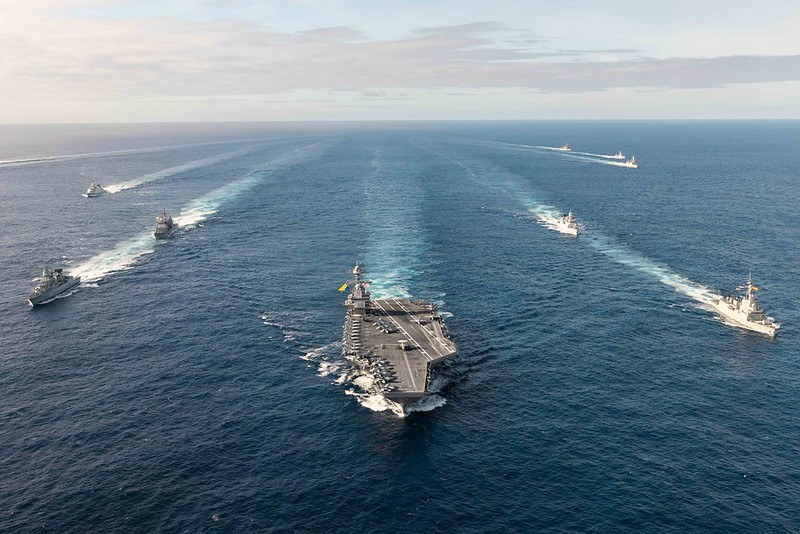

At times, the strategic conversation of the United States appears to be a zero-sum bargaining exercise: push the majority of assets to the Indo-Pacific Region, do away with other theaters such as the Middle East. This is an incorrect template for questioning. The right approach is not about where to invest all the assets, but rather how to best organize American power and allied industrial capabilities so that the US can deter high-end war in the Indo-Pacific while also being meaningfully involved and resilient in other regions. The alternative, however, is brittle: either to be overcommitted or to invite strategic surprise.
The 2022 US National Defense Strategy explicitly laid out the core fact claiming China to be the primary pacing threat, and the Pentagon must work to build “enduring advantages” along with integrated deterrence to beat the odds. However, words alone cannot drive the country to success; doing so will leave it vulnerable to simultaneous crises. Therefore, the US must accept the fact that it need not, and in reality, cannot achieve every objective everywhere. Rather, it should opt for a balanced, deliberate strategy that gives primacy to deterrence in the Indo-Pacific while delegating risk and responsibility in other theaters through smarter burden sharing, a retooled industrial base, and a distributed force posture.
Three Pillars of a Resilient Defense Posture
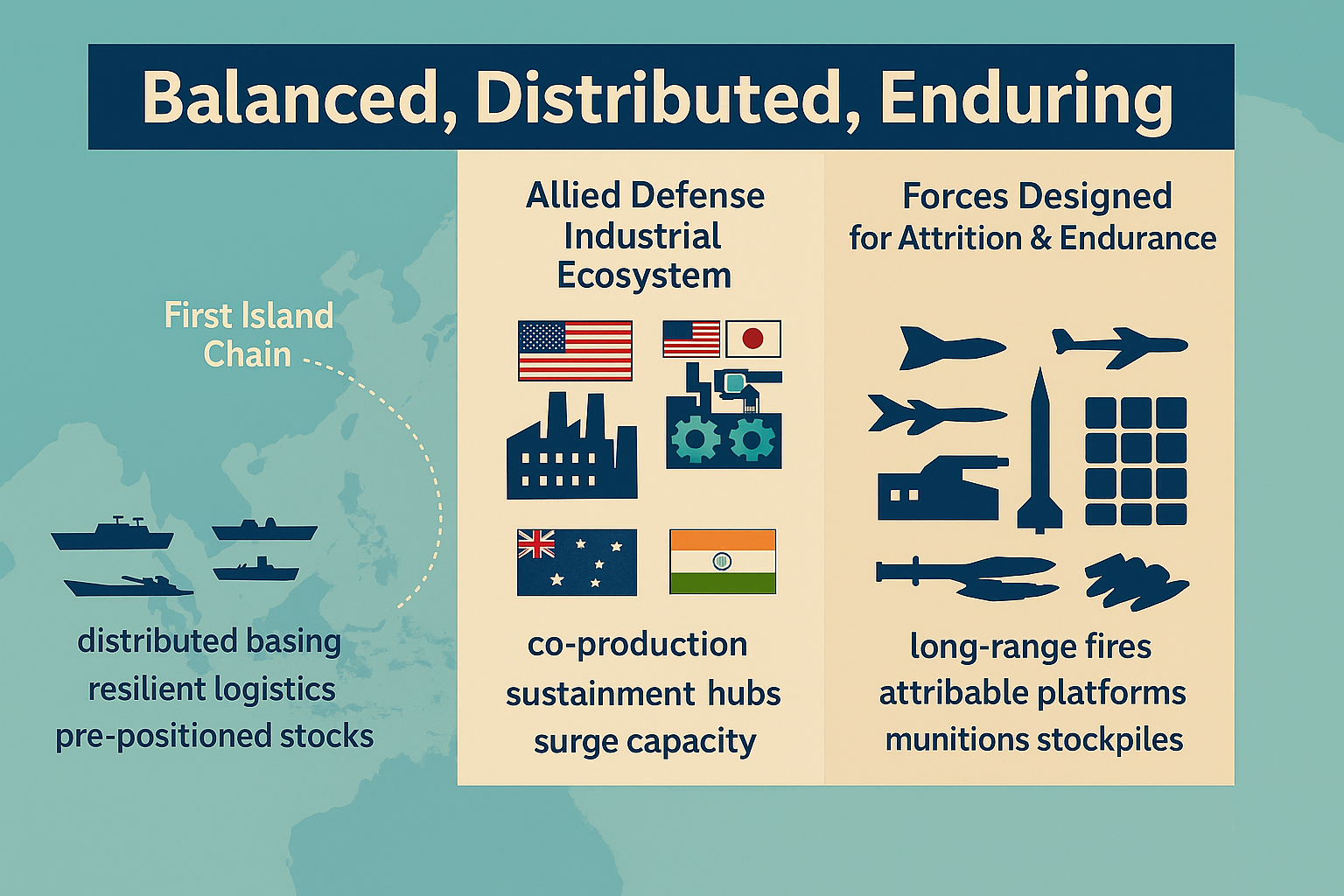
Three concrete moves will produce leverage far greater than marginal increases in ship or brigade counts. First, around the First Island Chain, commit to a distributed force and decisively make investments in forward logistics. Dispersed allied forward-basing, distributed maritime operations, and resilient logistics make it difficult for an adversary to generate rapid strategic effects while allowing the US to sustain a protracted contest. The operational concepts are well-established but lack the political will and funding commitments necessary to harden hubs, pre-position supplies, or expand expeditionary maintenance and munitions capacity in allied ports. Distributed operations are not only a preferred mode for the Navy, they are the sinews of deterrence by denial.
Second, increase the production capability of allies and foster joint industrial ecosystems. AUKUS and other cooperative ventures are not merely terms on paper; they are templates for shifting points of production and sustainment into allied hands so that their fleets are more organized, larger, interoperable, and survivable. The US should consider expanding its partnerships in shipbuilding, sustainment hubs, and munitions production with allies across the Indo-Pacific. These investments should be tied to shared training and surge plans. This approach would bring down the risks associated with the US’s single points of failure, while also increasing the cost for any adversary contemplating coercion.
Third, design forces for both attrition and endurance, and not just for short, decisive campaigns. Deterrence will be attached to the perception that any attempt to seize territory would become prolonged and costly. According to expert literature on war, the ideal positioning is to convince potential aggressors that wars over Taiwan, for instance, would be futile, unwinnable, and protracted in strategic terms. Posture and procurement must reflect that logic. That suggests more distributed sensors, long-range fires in allied hands, attributable platforms, stockpiled munitions, and avoiding a return to a large expeditionary force modelled on past wars.
Addressing the Objections
Objections to this model include its prohibitively expensive nature, the risk of entangling alliances, and the potential vulnerability of other theaters. Each objection has an answer. In terms of financial cost, investing in the capacity building of allies is an expensive venture, but still cheaper than trying to deploy and maintain massive US expeditionary forces across multiple theaters. Shared production also creates economic and political buy-in from partners. Congress should fund force multipliers, such as resilient logistics nodes and munitions factories, rather than symbolic platforms. The 2022 strategy’s call to build “enduring advantages” provides the programmatic framing for that reprioritization.
Regarding the issue of strategic entanglement, some fear that commitments will drag the US into unwanted conflicts. That risk is reduced by making allied capabilities sovereign and resilient (so partners can defend themselves) and by building clear escalation management and decision-sharing mechanisms. Clarity in policy and public communications, rather than ambiguity, strengthens deterrence. Lastly is the fear of neglecting other regions. Though the primary focus is shifting to the Indo-Pacific, other theaters such as the Middle East and other regions still matter. The correct model is not abandonment but a lighter, smarter footprint: diplomatic leadership, coalition air and maritime surveillance, targeted capabilities for counter-terrorism and counter-proliferation, and robust partner capacity building. That approach accepts risk where necessary, but does so within a conscious, prioritized strategy rather than ad hoc crisis management.
The Path to Implementation
Operationalizing this plan does not require grand gestures. It requires bureaucratic discipline and sustained political will. The Pentagon must reallocate budget lines to prioritize logistics resilience and munitions. Meanwhile, the State Department must lock in basing and industrial cooperation agreements as Congress seeks ways to reward permanence in surge production. Lastly, the White House must make a public case for a pragmatic strategy that acknowledges limits. The payoff is strategic flexibility: a US posture that deters high-end aggression, absorbs shocks, and scales up without immediate, politically costly mobilization.
Washington’s leaders must make hard choices—not a misguided decision in distant theaters but a series of practical, prioritized investments that multiply allied power and hedge American risk. If the US commits to distributed forces, allied industrial ecosystems, and endurance-oriented force design, it will be far better placed to defend friends, preserve deterrence, and deter a future that otherwise looks perilously narrow.


