Deterrence in the Pacific: Rethinking Geography and Building Resilience

Abstract
Strategic competition in the Pacific has forced a reevaluation of traditional models of power projection. This paper argues that the principal obstacle to effective deterrence is not geography itself, but the cognitive architecture through which military planners interpret it. Conventional map orientations and longstanding assumptions about force projection encourage viewing the Pacific as a vast barrier separating the US from its allies. By conceptualizing the region as a distributed network of allied capabilities, the Joint Force—and the US Army in particular—can transition from vulnerable linear operations to resilient, multi-domain architectures. Recent conflicts have demonstrated that survivability depends less on concentrating combat power than on dispersing it across interoperable networks. In a contested maritime theater facing advanced pacing threats, distributed sustainment, coalition integration, and operational resilience become not merely supporting functions but central instruments of deterrence.
Reframing the Pacific Battlespace
Discussion of deterrence in the Pacific frequently centers on capability. Strategic debates emphasize long-range precision fires, hypersonic weapons, Multi-Domain Task Forces (MDTFs), anti-access/area-denial challenges, and contested logistics. These capabilities are essential, but they are only part of the strategic equation. Strategy begins not with weapons platforms, but with how decision-makers perceive the operational environment.
For generations, military planning has been unintentionally shaped by conventional world maps that place America near the center and portray the Pacific Ocean as an immense expanse separating Washington from its allies. While cartographic orientation is merely a convention, it subtly reinforces a strategic mindset in which forward forces appear isolated and reinforcement from the continental US becomes the dominant operational problem.
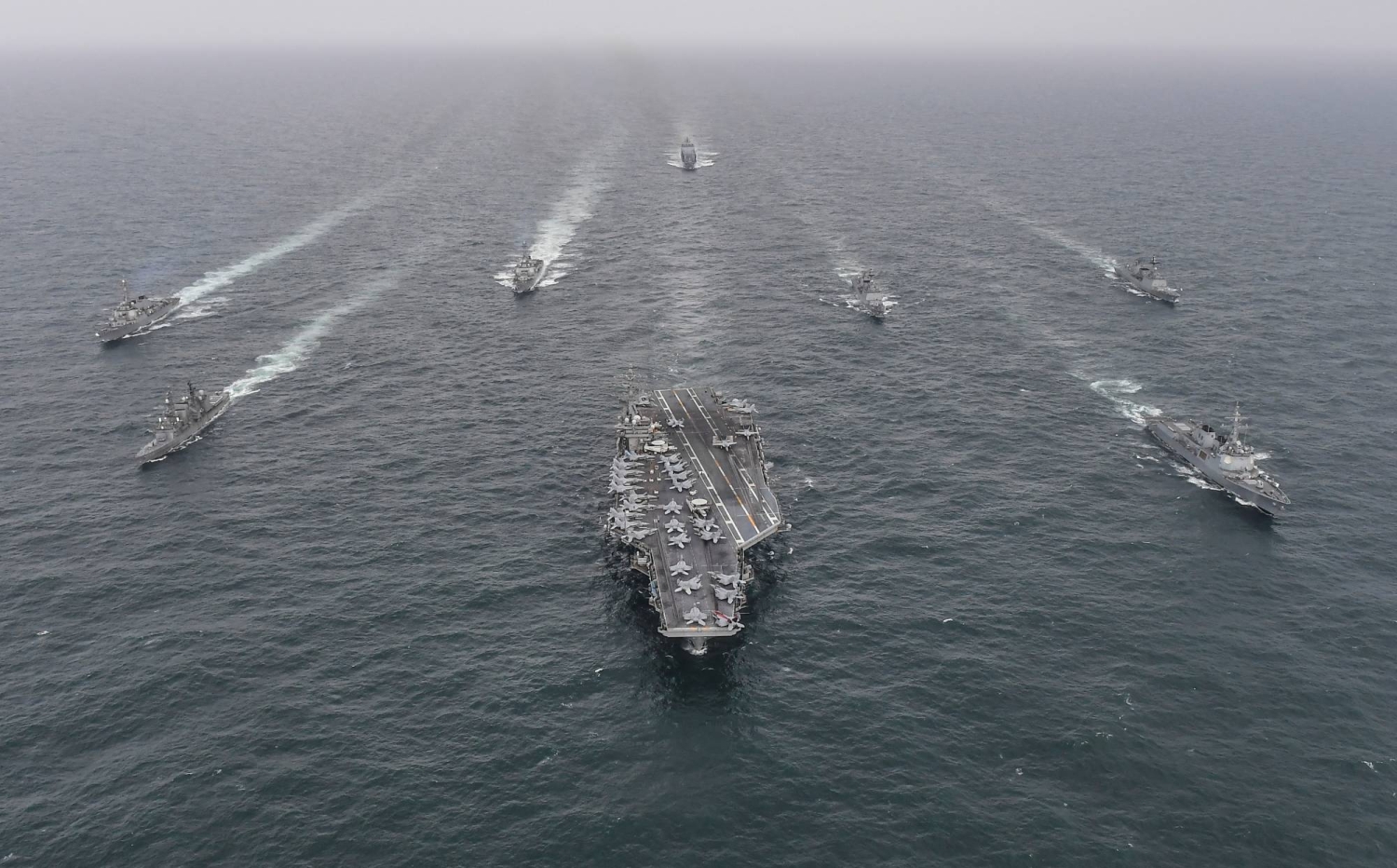
Reorienting the map—or more importantly, the geostrategic lens—changes the strategic picture. Viewing the theater through an alternative orientation, such as the East-Up projection proposed by GEN Brunson, Commander, US Forces Korea, places allied territory and partner nations into a more connected operational framework. Japan, South Korea, the Philippines, Australia, and other regional partners emerge not as distant outposts but as mutually supporting nodes along critical maritime approaches. The issue is no longer how to cross an ocean, but how to leverage an existing network of capable allies.
This distinction is critical because adversary capabilities have fundamentally altered the survivability of concentrated forces. North Korea’s proliferation of advanced theater ballistic missiles (such as intermediate-range platforms capable of striking Guam), China’s hypersonic glide vehicles (DF-17), and pervasive space-based Intelligence, Surveillance, and Reconnaissance means that large, static bases are increasingly vulnerable. If military planners view the Pacific primarily as distance to overcome, they naturally prioritize massed reinforcement and centralized logistics hubs—exactly the targets pacing threats are designed to neutralize. If they view it as a distributed coalition, they design forces optimized for dispersion, resilience, and collective defense.
Recent conflicts have reinforced the consequences of these choices. Russia’s invasion of Ukraine demonstrated both the vulnerability of centralized headquarters to precision strike and the resilience provided by dispersed command structures. Likewise, attacks on commercial shipping in the Red Sea illustrated how relatively inexpensive systems can disrupt global supply chains, underscoring that logistics is now a contested domain. In the Pacific, geographic scale amplifies these vulnerabilities and opportunities.
From Linear Operations to Distributed Resilience via CJADC2
This conceptual shift has significant implications for the role of the US Army in a predominantly maritime theater. Rather than replicating the traditional missions of the US Air Force or Navy, the Army contributes most effectively by increasing the resilience of the Joint Force. For decades, military operations relied heavily on linear sensor-to-shooter architectures that maximized efficiency under relatively permissive conditions. Such systems perform exceptionally well until critical nodes are disrupted. An adversary capable of degrading communications, destroying sensors, or targeting command posts can fracture an otherwise sophisticated operational network.
The strategic value of MDTFs and complementary land-based capabilities lies in reducing this fragility, enabled directly by Combined Joint All-Domain Command and Control (CJADC2) initiatives. CJADC2 provides the data-sharing architecture necessary to weave distributed sensors, long-range precision fires, electronic warfare, cyber capabilities, and mobile command-and-control nodes into overlapping layers of redundancy. Through this networked approach, if one sensor is blinded by counter-space operations, another can assume the mission. If one firing platform is neutralized, alternative systems preserve combat effectiveness.
This concept represents a broader shift from optimizing efficiency to maximizing resilience. Redundancy, once viewed primarily as excess capacity, is now an operational necessity. However, institutional adaptation requires overcoming organizational habits that favored centralized headquarters. Distributed operations introduce greater complexity, increase coordination requirements, and demand seamless technical integration among coalition partners.
Exercises such as Operation Pathways and Talisman Sabre provide opportunities to test these CJADC2 concepts before conflict occurs. Beyond validating technical interoperability, they cultivate shared planning processes, legal authorities, and personal relationships among allied militaries. Persistent campaigning serves not only as preparation for deterrence but as a visible demonstration of coalition readiness.
Sustainment as a Strategic Signal
Operational resilience ultimately depends upon a function that rarely attracts public attention: sustainment. Military history consistently demonstrates that campaigns are won through the ability to generate and sustain combat power over time. The challenge today is ensuring that sustainment networks survive under persistent surveillance and precision attacks. For potential adversaries, deterrence is measured not solely by whether coalition forces can respond during the opening days of a conflict, but whether they possess the endurance to sustain operations over weeks or months. A force capable of absorbing initial strikes while generating combat power presents a far less attractive target for coercion.
Distributed sustainment directly contributes to this calculation. Decentralized maintenance facilities, fuel storage, munitions stockpiles, and repair capabilities reduce dependence on a handful of vulnerable hubs. Equally important, they transform allied nations into active contributors to collective combat power.
Critics rightly point out that distributed operations are astonishingly logistics-intensive. Moving from centralized hubs to fragmented networks creates massive transport inefficiencies and makes prepositioned caching difficult to secure and maintain. However, in a contested environment, inefficiency is the necessary price for survivability. Highly efficient, centralized hubs are precisely the targets adversary precision missiles are designed to destroy. The strategic calculus dictates that complex, resource-heavy sustainment is vastly preferable to an efficient system neutralized in the opening hours of a conflict.
Furthermore, establishing this web of distributed logistics is not politically frictionless; it requires intensive diplomatic groundwork and careful management of host-nation sensitivities. Arrangements like the Enhanced Defense Cooperation Agreement sites in the Philippines are critical examples of this effort.
Yet, allies face severe anxiety over alliance entanglement—the fear of being dragged into a US-China conflict. As South Korean defense analysts have noted regarding their own country’s hesitation to fully integrate into multilateral frameworks like the PACOM Mission Network, the alternative is the cost of exclusion. Allies that fail to proactively define their roles in this new regional architecture risk being left strategically isolated. When successful, diplomatic victories that bridge these gaps strengthen deterrence by physically demonstrating that coalition endurance cannot be neutralized through a single opening onslaught.
The Human Dimension and Mission Command
Distributed operational concepts remain ineffective without the people who execute them. Behind every dispersed command node, autonomous logistics network, and distributed fire unit stands a service member making decisions under conditions of uncertainty, degraded communications, and incomplete information. Therefore, mission command becomes more than a leadership philosophy; it becomes an absolute operational requirement.
When communications are jammed by adversary electronic warfare or higher headquarters become temporarily inaccessible, subordinate leaders must possess both the authority and the confidence to continue executing the commander’s intent. Technology enables distributed operations, but professional judgment makes them resilient. Developing that judgment requires sustained investment in professional military education, realistic multinational training, and institutional cultures that reward disciplined initiative. Human capital ultimately provides the adaptability that no technological system can fully replicate.
Resilience as the Foundation of Deterrence
Deterrence in the Pacific is ultimately as much a problem of perception as of capability. Maps and mindsets do more than represent geography; they shape assumptions about distance, vulnerability, and operational design. If planners continue to view the Pacific primarily as an empty ocean separating the US from its commitments, force design will remain oriented toward reinforcing vulnerable forward positions across immense distances. If they instead recognize the theater as a dense network of allied capabilities already distributed throughout the region, they can design forces that emphasize resilience, adaptability, and persistent campaigning.
As a result, the central competition in the Pacific is not simply one of technological innovation or military capacity. It is equally a competition in operational architecture, institutional adaptability, and strategic imagination. In the twenty-first century, deterrence rests not on the ability to concentrate on overwhelming force at a decisive moment, but on the ability of resilient alliances to absorb disruption, sustain operations, and deny an adversary confidence that aggression can achieve its objectives. Resilience – not mass – is the enduring currency of deterrence.
Disclaimer: The views expressed are those of the author and do not reflect the official position of the Department of the Army or the Department of War.