Sovereign Shield, Alliance Sword: Evolving NATO’s Strategic Communications Doctrine for Cognitive Warfare

Abstract
Cognitive warfare is routinely described as something a state does, or as a new name for propaganda, disinformation, Strategic Communications, or Information Operations. It is none of these. It is the fight itself, and the confusion is not academic, because it is misshaping how the Alliance writes and reads its doctrine, and how it organizes, resources, and trains for a fight it is already in. This article corrects the record on what NATO’s Cognitive Warfare Concept establishes, and argues that Alliance doctrine must evolve to transform reactive narrative defense into persistent narrative offense, divided between a Sovereign Shield protecting the domestic cognitive space and an Alliance Sword pointed outward by design.
The Fight We Are Already Losing
In March 2018, Sergei Skripal, a former Russian military intelligence (GRU) officer who had spied for Britain, and his daughter, Yulia, were found slumped on a bench in Salisbury, UK, poisoned with Novichok, a military-grade nerve agent developed by the Soviet Union. The forensic evidence pointed to the Kremlin. But rather than deny the attack or offer a singular counter-story, Russia offered dozens—the agent had come from Porton Down; the British had staged it; the Skripals had poisoned themselves. Each account was implausible, but the Kremlin’s intention was never about creating belief in one thing. Its goal was to ensure that anyone encountering the story came away thinking the matter was disputed, complicated, and probably unknowable. The creation of doubt, something inherently cognitive, was the primary objective.
In this instance, London responded uncharacteristically. Rather than countering each narrative, as doctrine often prescribes, UK Prime Minister Theresa May ordered the public release of classified intelligence identifying the GRU as the guilty party. Within weeks, more than 150 Russian diplomats and intelligence officers were expelled by almost 30 countries.
Compare this event to a similar one in 2006, when Alexander Litvinenko was murdered in London with radioactive polonium. The intelligence was substantially there, but its release took nearly a decade, so the global response was muted, and no coalition materialized.
Seen side by side, it is tempting to view Salisbury as a communications success and Litvinenko as a failure, but the takeaway is doctrinal. What worked in the Salisbury case was not better messaging but a change of posture. The UK chose the terrain and the timing, and by making the intelligence public, gave its Allies no choice but to act. Without that shift in posture, the problem is not that we respond poorly, since many Allied rebuttals are excellent. It is that responding is exactly what the adversary wants, because every rebuttal concedes the subject, the timing, and the terms to whoever spoke first. As Ronald Reagan aptly observed, “If you’re explaining, you’re losing.”
The Emergence of the NATO Cognitive Warfare Concept
To address some of these issues, the recently approved NATO Cognitive Warfare Concept (NATO Allied Command Transformation, 2025) set out to fill gaps in Alliance thinking. The Concept defines cognitive warfare as “the fight for cognitive superiority,” noting that “contesting in this environment comprises deliberate, synchronized military and non-military activities throughout the continuum of competition designed to gain, maintain and protect cognitive advantage.” The definition’s wording is intentional and designed to address existing frictions within the wider cognitive warfare discourse that continue to muddy how we speak about it. Namely, cognitive warfare is not something we do; it is the fight itself. It is not an activity a state conducts, nor a capability fielded by a military. It is the battlespace, defined like land, air, or maritime warfare, by the contest waged within it rather than the instruments used to wage it. And like those, it can be won or lost.
Unfortunately, the current discourse does not account for this distinction because cognitive warfare is still routinely misrepresented as something a state or military does, and it is still treated as interchangeable with propaganda, disinformation, strategic communications (StratCom), or information operations (Info Ops). The question, “isn’t this just propaganda?” is ubiquitous. But cognitive warfare is not propaganda, nor is it disinformation by another name.
Take a campaign aimed at breaking an enemy’s will to fight. We might combine heavy bombardment with leaflets, broadcasts, and posts that convince the adversary’s soldiers their commanders have abandoned them. The bombardment is not there to take ground; it is there to make the abandonment feel real. The messages are propaganda, which is simply a way of delivering an idea. PsyOps is the capability that crafts and delivers those messages to that audience. Info Ops is the function that decides the effect is worth pursuing in the first place, and that lines up everything the force does to support it, including the bombardment. Strategic Communications is the doctrine governing whether we should be doing any of this at all, and the function that ensures we do it properly.
Fires, maneuvers, propaganda, disinformation, PsyOps, Info Ops, and Strategic Communications are all used inside the fight. None of them is the fight, in the same way that a torpedo is an instrument used within submarine warfare rather than a synonym for it. Conflating the tool with the fight fundamentally misshapes how institutions organize themselves to respond.
In this case, the confusion runs deeper than vocabulary. Cognitive warfare is generally discussed only within the Strategic Communications family, and that placement risks narrowing it. Once the conversation turns to doctrine, cognition is often collapsed into information, and the fight incorrectly becomes a contest of messaging. But the cognitive dimension is not the information environment by another name. Messaging is merely one route in—as are troop movements, blackouts, and bridges or buildings destroyed. They all reach a human being whose perceptions and judgments are shaped by culture, memory, social identity, group belonging, and the physiological conditions under which thinking happens. This is also why disinformation is only the tip of the iceberg, though it is the tip we focus on most. As Krewson has argued elsewhere, adversaries are most effective when the material they peddle is true, when they seize a real grievance—be it individual, group, or societal—and inflame the identity beneath it. Identity-based manipulation (IBM) requires no falsehood at all, yet countering and debunking falsehoods remains our primary focus. An alliance that mechanistically perceives the fight as informational will organize to manage information, missing the criticality of everything that determines whether it lands at all.
If cognitive warfare is the fight, then what places an activity within it is whether its primary objective includes not just what people think, but how they think. A commander may destroy a bridge to disrupt a supply route, but the population, seeing their infrastructure destroyed, will conclude whether their government can protect them. That cognitive effect is a byproduct. An identical strike, chosen for what the bridge’s loss will mean to that population rather than for the supplies it shuttles, is an activity in the cognitive fight: same explosion, different logic.
This is where most institutions are struggling, and their struggle is largely structural rather than intellectual. NATO’s own defense planning bears this out. Capability codes for Strategic Communications were established through the NATO Defense Planning Process (NDPP), yet most remain unmet by member nations’ capability commitments. The requirement is agreed; the resourcing is not.
Further, since the cognitive dimension crosses every domain, militaries and governments often treat cognitive effects as something layered onto traditional military activities. Yet, as the bridge example illustrates, the same action can either produce a cognitive effect as a byproduct or constitute a deliberate action within the cognitive battlespace. The difference lies in whether the cognitive effect was the primary point from the beginning. Part of what makes this so difficult to correct—and even understand—is that cognitive effects are rarely as overt as kinetic effects. A struck building, particularly if civilians are found beneath it, is visible and emotionally palpable, while a population scrolling itself into distrust of its own institutions is less so. Thus, the add-on problem is not just organizational; it represents a failure of imagination about what “damage” actually looks like and who is responsible for mitigating or addressing it. As a result, caring about an effect and being organized to generate it—regardless of how long it takes to see the fruits of that generation—are not the same thing.
This gap between caring and being organized frames the argument of this article: to effectively deter in the cognitive dimension, NATO must transform its status quo reactive narrative defense into persistent narrative offense because an alliance organized to answer stories will always arrive after the adversary has chosen the terrain. Real narrative offense means identifying, understanding, and occupying that terrain before the adversary claims it. Easy in principle; hard in practice.
The Doctrine Lags the Concept
NATO’s current Strategic Communications doctrine describes a persistent battlespace contested throughout the continuum of competition, particularly below the threshold of conflict. Yet the core Allied Joint Publications governing it, principally AJP-01, AJP-10, and AJP-10.1, are often read as defensive and reactive, justified by the fact that NATO does not initiate aggression. Our adversaries have already organized this way. Russia’s reflexive control and China’s cognitive-domain operations both build around the effect on the mind rather than the medium carrying that effect. The open question is whether the Alliance will organize around the effect as deliberately as our adversaries have theorized it.
In other domains, “defensive” rarely means “reactive.” For example, NATO polices Baltic airspace persistently rather than responding after an incursion, and it forward-deploys land forces against attacks that have not happened. Neither is a reactive position, since a defensive alliance that moves only after being struck possesses little deterrent value below the threshold.
The same logic is transferable to the cognitive dimension. Persistent air policing and forward-deployed land forces impose a cost by forcing an adversary to respond, limiting their ability to mass without exposing a weakness elsewhere. Pressing truth into an adversary’s information space works the same way, since it forces them to divert capability to counter the incursion. We know this because it is precisely what the Kremlin does to us, generating activity that keeps NATO and the EU chasing the narrative. Why, then, do we frame our posture in the cognitive dimension as something requiring us to move second?
To be clear, this is not a failure of doctrinal drafting; only of doctrinal reading. The Alliance too often interprets narrative-led doctrine as an instruction to counter stories rather than to create them, yet correction, rebuttal, and debunking—regardless of how well-reasoned—still cede the subject, the timing, and the terms to the adversary.
The Offensive Logic: Persistence, Denial, and Specialization
The theoretical foundation for the mindset shifts this article proposes already exists in a neighboring domain. Cyber persistence theory states that in an environment of constant contact, deterrence understood as the threat of response or punishment offers little protection, because an actor only engaging in response cedes the initiative permanently. Instead, advantage comes from persistent engagement: continuously contesting the environment rather than punishing discrete acts after the fact.
What transfers is the logic rather than the method. The principle holds wherever a domain is actively contested because a purely defensive posture cannot win; it can only wait for the adversary to lose. In cyberspace, that means contesting those conducting the attacks rather than the adversary’s networks at large. In the cognitive dimension, it means choosing where, when, and to whom we press our truths, so adversary detection and response capabilities turn inward to protect their own information space rather than outward against ours. The instruments and the staff differ, which is why this article argues for separating them. However, the underlying logic of contesting does not.
This does not mean deterrence stops mattering. It means we must be honest about which kind is still available to us, because our adversaries often work through proxies they can disown, rarely presenting a front to retaliate against. In the cognitive dimension, deterrence by denial requires an almost-utopian inoculation at scale or, perhaps more realistically, the ongoing ability to make adversary operations harder to run, easier to expose, and more politically costly at home.
Denial of that kind cannot be improvised, which exposes a structural problem. The current approach starts with the capabilities the Alliance already has and asks what objectives they can serve. The alternative, and the argument of this article, is to start with the cognitive effect required and build the capability around it. Effects-first thinking is already embedded in Alliance doctrine and planning, but force structure, budget lines, career pathways, and training pipelines are organized around platforms rather than effects, and, whether we like it or not, that machinery dictates what actually gets done.
Doctrine alone cannot close that gap, because it depends on a specialism the Alliance lacks. No Allied navy would put an officer who had never served in submarines in command of one, yet we routinely put people in charge of cognitive effects because they are “good communicators,” as though understanding cognition follows from possessing it. For example, it is common for nations to put officers with no background in psychology or the information environment in command of information capabilities, and to assign officers with the same limited foundation to senior NATO StratCom positions. This does more damage than the immediate mismatch, because filling senior posts from outside the discipline leaves the specialists who have spent careers building the expertise with nowhere to be promoted to.
This is not to say the Alliance is without capable people. NATO and allied nations have a pool of skilled Info Ops planners, military public affairs (MilPA) communicators, and PsyOps practitioners, and some nations have built serious professional pipelines around them. But this is precisely the point. Formations such as the British Army’s 77th Brigade and the US Army’s Fort Bragg PsyOps Group illustrate the problem rather than solve it, because they remain national investments in a discipline the Alliance has never built or exercised collectively. Centers of excellence, working groups, and bilateral exchanges circulate what these formations know, but no Alliance-level pathway forms practitioners in the first place. As a result, the depth available to NATO is whatever its members happen to have built at home.
The problem is not only where practitioners are formed, but what they are formed in. The discipline cannot be built out of communications expertise alone. Understanding why a narrative takes hold in one society, yet fails in another, requires cultural and anthropological knowledge that no message-testing framework supplies, and understanding why fear and sustained threat change what a population will accept and believe requires psychology alongside the physiological realities of how people process information under stress. None of this sits inside a single profession, which is why a shared standard would have to be built across several.
Governance: The Sovereign Shield and Alliance Sword
Before any of this can be built, narrative offense raises two governance questions: whom are we doing this to, and who is authorized to do it? The first draws a line between when we must tell the truth and when deception is legitimate. MilPA exists to tell the truth, which is not a constraint but the entire basis of its value, since credibility, once destroyed, cannot be rebuilt quickly enough to matter in a crisis. At the other end, military deception against enemy forces in the field is legitimate and sometimes decisive, as Ukraine’s 2022 Kharkiv counteroffensive showed. These extremes, telling the truth to your own populations and allies while deceiving an enemy in the field, can coexist inside one campaign without contradiction. The mistake is viewing narrative offense in reductionist black-and-white terms, when the hard questions often live in the middle ground where most communication sits. What governs that middle ground is not a wall but two principles: 1) attribution—we do not pretend to be someone else when speaking to audiences entitled to our name, and 2) audience—deception is only aimed at military opponents, never at our own publics or the press that serves them.
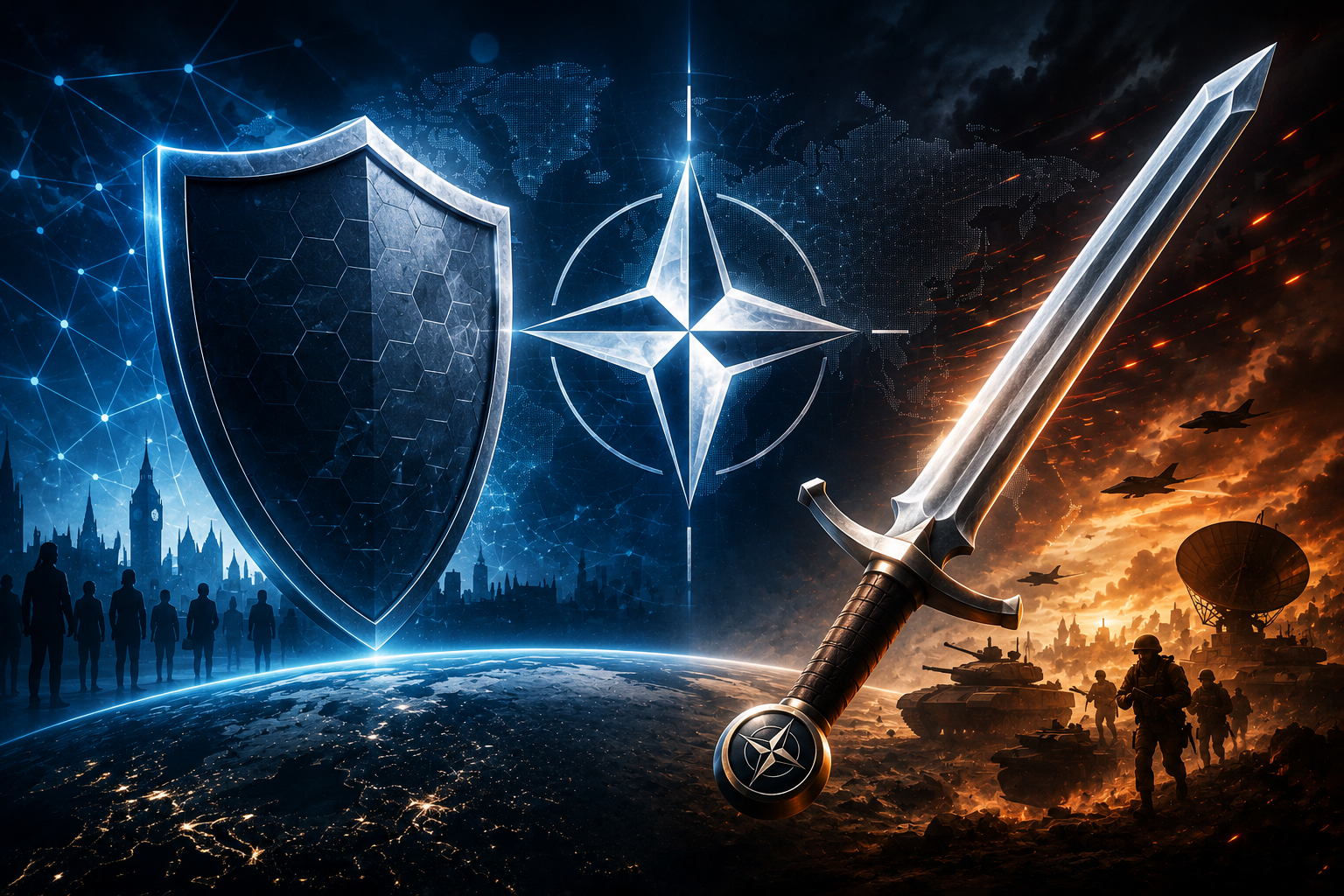
The second question, who is authorized to do it, asks us how the work should be divided, which gives this article its title. The defense of the domestic cognitive space is the Sovereign Shield. It must remain a national responsibility led by civilian institutions, because a military instrument that polices what its own population believes has already abandoned the democratic values it exists to defend. Yes, military resources can and should support that effort, but the rules must be clear, publicly accountable, and drawn in doctrine before the capability exists.
Taking the fight to the adversary is the Alliance Sword, and it inverts that arrangement. It must be led collectively, through integral Alliance functions and capabilities supported by national assets, orchestrating cognitive effects under rules of engagement agreed for the cognitive dimension. Where the Shield is national and civilian by necessity, the Sword is Alliance-wide and military by design, delivering deterrence by denial across peace, crisis, and conflict.
The Shield and the Sword are not rival descriptions of the same task but complementary answers to different questions, so keeping them distinct is how democracies stop frightening themselves out of competing at all.
Particularly in the space between peacetime and a formalized Article 5 declaration, which our adversaries have normalized fighting within, the cognitive contest is continuous. Yet existing Alliance decision-making requires crisis-level consensus for every below-threshold action. This is not only unsustainable; it leaves us arriving second on ground someone else has chosen. The remedy is the logic we already apply in the air: the North Atlantic Council is not convened to approve each intercept over the Baltic. The cognitive fight needs the same. Standing peacetime authorities would assess the information environment and act below the threshold under agreed rules of engagement, within boundaries set politically in advance. The intelligence disclosures before Russia’s 2022 invasion showed what this looks like in practice, and what it costs to improvise without such authorities.
The Objections Worth Taking Seriously
Our argument attracts five predictable objections. The first is that this is just hybrid warfare with a new label. It is not, though the two overlap. Hybrid warfare describes how instruments are combined below the threshold of armed conflict. Cognitive warfare describes what they are aimed at. For example, hybrid framing tells us an operation combined cyber intrusion, proxies, and economic pressure to disable an energy network. It does not tell us whether the objective was the network itself or the population’s confidence in the government that failed to keep the lights on.
The second objection is escalation. If we engage continuously rather than only when provoked, does that risk pushing an adversary to retaliate at a higher level? On this front, the scholarship is genuinely divided, but we do not need to resolve the debate to act. Helping populations—both ours and our adversaries’—recognize manipulation and openly disclosing what adversaries are doing sit at the de-escalatory end of the spectrum.
The third objection is that we become what we fight, but this mistakes the method for the posture. The adversary’s method is covert manipulation, meaning operations that only work because, often, no one can prove who is behind them. This article proposes the opposite: open, attributable truth that works specifically because everyone knows where it comes from. Radical transparency is not the sibling of authoritarian information control; it is its antidote. The line drawn between when we must use truth and when deception is legitimate exists precisely to preserve it.
Building upon this, the fourth objection is one of ethics. Why are we more comfortable authorizing a strike that kills people than authorizing a social media post directed at the population those people came from? This asymmetry rarely headlines the discourse, but we must scrutinize it. If we are prepared to bomb a society but not to tweet at it to avert the need for kinetic action, we should ask ourselves where our ethics actually lie. Is our discomfort genuinely principled or simply misunderstanding masquerading as righteous constraint? Narrative offense is often the more humane option, because getting accurate information into an adversary’s information space can change calculations before lives are lost. Moreover, deterrence is itself a cognitive effect. Making an adversary’s operations harder to run and more costly to sustain is not separate from the humane case, because deterring an adversary from moving to physical attack saves military and civilian lives on both sides. The question is not whether it is ethical to act offensively, but whether we can keep justifying the tangible, often human, cost of refusing to do so.
Moreover, pushing truth into an adversary’s information space is neither new nor a departure from our democratic principles; it is an application of them. Since 1948, Article 19 of the Universal Declaration of Human Rights has held that the right to seek, receive, and impart information runs “regardless of frontiers.” Authoritarian governments assert a sovereign right to decide what their citizens may know, so treating their border as a line we dare not cross with the truth concedes that claim. International law prohibits coercion, and open, attributed disclosure coerces no one. Moreover, staying silent while our own populations are manipulated covertly is not neutrality; it is choosing—and make no mistake, it is a choice—to let our adversaries win without contest.
The final objection asks whether any of this works. In all honesty, the empirical record for influence operations of every flavor is thin. The Salisbury disclosures and the intelligence releases before Russia’s 2022 invasion of Ukraine, for all their success in stripping deniability, did not stop Russia’s tanks. So, the case cannot rest on rapidly changing minds at scale. Instead, it must rest on disruption, cost, and initiative: forcing authoritarian regimes—more brittle than they appear—to spend finite bandwidth policing their own information space, and ensuring the contest happens on a terrain of our choosing. Measured as mass persuasion, the evidence is modest. But persuasion should not be the goal. The goal is making the adversary’s job harder and more expensive, and that is a lower bar than changing minds.
The same honesty must carry into the doctrine itself, which should state the limits of the evidence as plainly as the intent. Doctrine that overpromises persuasion will be discredited by its first assessment cycle, and credibility is what makes boldness affordable.
What Must Change: Re-Engineering NATO Doctrine
Nothing above asks NATO to invent a new doctrine, only to continue developing the one it already has. What follows is a practical agenda.
- Recast the language. AJP-01 and AJP-10 should state that in a dimension of constant contact, advantage comes from persistence, initiative, and cost-imposition, and that reactive response is merely a decision to lose slowly.
- Info Ops already has doctrinal responsibility for coordinating cognitive effects across everything the force does, though its name is a legacy of the framing this article rejects. What must be made clearer is its authority to direct any activity whose primary purpose is cognitive rather than physical, whether munitions, maneuver, cyber, or information.
- Draw a line between cyber effects and cyber-enabled cognitive effects. Operations acting on machines belong to the cyber staff; those using the same networks to reach a human audience belong to Info Ops. Shared infrastructure is no reason to share staff.
- Make the governance framework structural rather than assumed. Write the Shield and Sword division into doctrine, so the offensive boundary points outward by design rather than relying on individual initiative.
- Establish standing below-threshold authorities, with political boundaries agreed in advance rather than mid-crisis.
- Resource the specialism. The Alliance needs a career field for orchestrating cognitive effects, resourced by member nations, with a shared training pipeline and a body of practice drawing on cultural, psychological, and physiological expertise rather than communications training alone. Again, we must stop assuming practitioners understand cognition simply because they have it.
There is evidence that the tectonics are already shifting. NATO’s PsyOps doctrine has recently moved into the Strategic Communications family and is the first publication there to cite the Cognitive Warfare Concept by name. The move was met with resistance, but it was deliberate and consequential.
A Decision Made in Advance
This article’s argument comes down to a single chain of reasoning: cognitive warfare is not a capability but the contest itself. It reaches past information into everything that shapes how we perceive and engage with the world, impacting who we believe we are and what we stand for. The contest is continuous, an ever-present fight within our day-to-day lives. Thus, a posture built on myopic response is merely a slow concession on the way to surrender. On the surface, there may be no blood to staunch or ground to hold, yet societies are inherently breakable. They thin from the inside, until the trust that tethered people and institutions together no longer tethers anything at all.
Combating this descent does not require the Alliance to become something it is not, because the entire design rests on a critical advantage that adversaries do not have: our ability to be seen. Closed, authoritarian systems spend enormous resources controlling what their people know, while open, democratic societies are, by their nature, on the side of more information rather than less. This is why attributable truth is our natural instrument, and using it does not betray the order we exist to defend. The Sovereign Shield and the Alliance Sword are not a contradiction; they are a uniform idea. Democracies can protect their own cognitive space with civilian and national hands, while still contesting adversarial actors with a collective military instrument pointed explicitly outward. This division is not a constraint on how we fight; to the contrary, it is how we engage in and defend against cognitive warfare without becoming a casualty of the fight itself.
Every contest for superiority is won by the side that understands what it is actually contesting. In this one, the prize is not territory, systems, or even influence. It is whether populations can still think for themselves at all, and whether the cognitive conditions for free thought and self-determination still exist. That is what we risk losing.
It is also why doctrine matters, unsexy and boring as it is. Beneath the structured language and carefully curated words, doctrine is a decision made in advance about who we will be when the next Salisbury arrives. Litvinenko produced the managed story, but Salisbury produced the coalition because Theresa May chose to act outside the established playbook. Our current doctrine is still written for the Litvinenko response, but the fight in front of us has changed. Continuing to assume a back-foot posture is no longer prudent or feasible.
Free thought is still ours to defend. We must evolve.
Disclaimer: All opinions expressed in this article are those of the author. They do not necessarily reflect the views or positions of NATO or its member states.