The Inevitability Trap: How Narrative Reframing of Destiny Shapes Cognitive Warfare in the Taiwan Strait
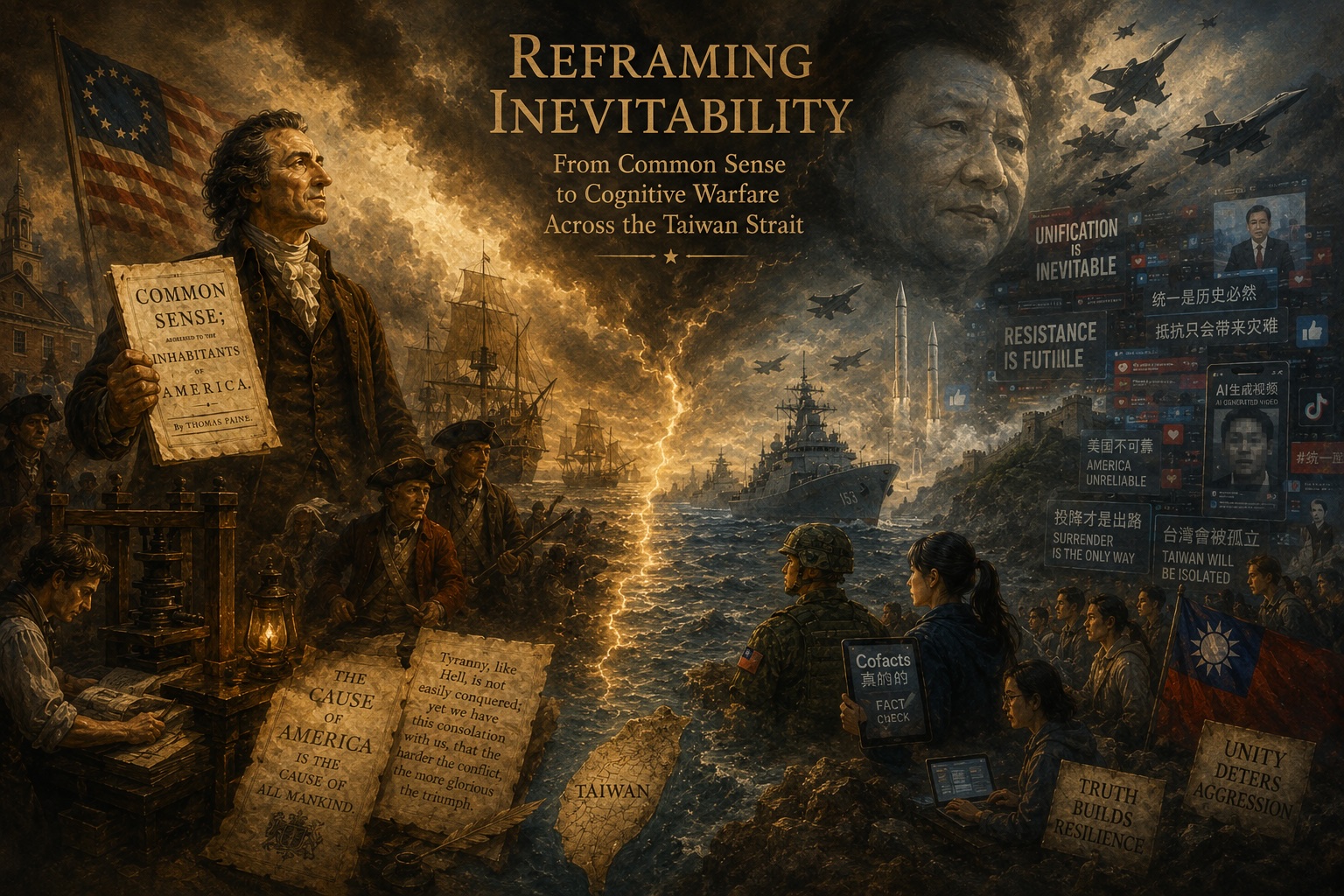

The Power of Inevitability Narratives in Asymmetric Conflict
Modern conflict rarely begins with gunfire. It begins with expectations. Cognitive warfare operates in this psychological space, and its most effective tactic is simple: portray a preferred outcome as inevitable. When people believe resistance cannot alter the end state, the will to resist erodes long before any physical confrontation occurs. Power shifts through perception rather than force.
The American Revolution offers an early example. When Thomas Paine published Common Sense in January 1776, independence remained controversial even among colonial elites. Paine reframed the debate: independence was not a gamble but history’s natural course. Monarchy appeared irrational; subordination seemed absurd. Separation looked morally necessary and inevitable. The pamphlet spread rapidly, selling hundreds of thousands of copies in a population of a few million, reshaping political imagination.
Two centuries later, similar logic appears across the Taiwan Strait. The People’s Republic of China frames unification with Taiwan as unavoidable, while resistance appears futile. Digital campaigns amplify this message at scale. Taiwan’s National Security Bureau (NSB) identified over 45,000 coordinated fake accounts and more than two million pieces of disinformation. The message is consistent: China’s rise is unstoppable, foreign support unreliable, and eventual integration inevitable.
This essay examines how inevitability narratives function in asymmetric contests. Paine’s pamphlet and contemporary Chinese campaigns show how framing the future can invert apparent power imbalances but also reveal vulnerability. When audiences detect manipulation, narratives backfire. British coercion in the eighteenth century reinforced Paine’s claims; today, clumsy propaganda triggers rapid debunking and public skepticism in Taiwan.
However, the comparison has limits. Digital communication far outpaces colonial pamphleteering, the cross-Strait dispute unfolds under a nuclear shadow, and shared cultural ties complicate identity politics. Yet the contest is familiar: actors compete to define whether the future is fixed or still open to choice. When claims of inevitability falter, the psychological terrain can shift unexpectedly.
Paine’s Reframing: Tactics and Impact
When Common Sense appeared in January 1776, it did not introduce the idea of American independence. Colonial leaders had debated separation for months, and many colonists still hesitated. Independence felt uncertain, risky, and perhaps unnecessary. Thomas Paine altered the emotional and intellectual terrain of that debate. His pamphlet did not merely advocate separation. It reframed independence as the natural direction of history.
Paine began with language ordinary readers could grasp immediately. Eighteenth-century political writing often relied on dense prose and classical references. Paine rejected that style. He wrote short sentences and direct statements, adopting a conversational tone rather than a scholarly one. Farmers, shopkeepers, and militia volunteers could follow the argument without formal education. Paine understood that persuasion in a revolutionary moment depended on accessibility. Ideas that traveled widely mattered more than arguments crafted for elite circles. The pamphlet, therefore, sounded less like a treatise and more like a voice from the street.
Clarity enabled a second maneuver: moral inversion. British authority had long rested on the belief that the monarchy represented stability and divine order. Paine attacked this assumption directly. He mocked hereditary rule as irrational and degrading. His description of the king as a “Royal Brute” did more than insult the crown. It reframed loyalty as submission to absurdity. In Paine’s formulation, monarchy did not protect liberty. It corrupted it. Once this inversion took hold, the moral burden shifted. Supporting the crown no longer signaled prudence or tradition; it suggested complicity in injustice.
From this pivot, Paine advanced his most powerful claim: independence was inevitable. He portrayed separation not as a reckless gamble but as the logical outcome of political development. Geography itself made imperial rule unnatural. A vast continent, he argued, should not remain subordinate to a distant island. Paine blended Enlightenment ideas about natural rights with biblical imagery familiar to colonial readers. The result suggested historical momentum rather than political choice. Events had already placed the colonies on the road to independence. The only question concerned how soon they would arrive.
Paine reinforced this argument through emotional layering. He invoked guilt by reminding readers that submission tolerated tyranny. He stirred shame by suggesting that hesitation revealed cowardice. Yet he balanced these pressures with hope. Independence promised a new political order, free from the corruption of European power politics.
Paine later described this possibility as helping to establish “a new empire in the world, founded on a new system of government,” yet he imagined not a conventional empire of conquest or hereditary power, but a republic that could transform global politics by exemplifying liberty and self-governance. Gradually, fear of separation yielded to eager anticipation.
Distribution magnified the message. Printers produced inexpensive copies that circulated quickly across the colonies. Taverns, churches, and militia gatherings became informal reading rooms where passages were read aloud. Paine’s structure encouraged this practice. Short sections and vivid phrasing translated easily into speech. The pamphlet, therefore, moved through both print networks and social networks, multiplying its reach.
Its impact proved extraordinary. Common Sense sold more than 500,000 copies in its first year within a population of roughly 2.5 million. More important than the numbers was the shift in political mood. Arguments for independence moved rapidly from the margins to the center of colonial debate. Even cautious leaders found themselves responding to a conversation Paine had accelerated.
British responses unintentionally strengthened this transformation. Blockades, military escalation, and proclamations against rebellion reinforced Paine’s warnings about tyranny. Each attempt to reassert imperial authority appeared to confirm his argument. Coercion became narrative validation. The more forcefully Britain resisted colonial defiance, the more plausible Paine’s claim of historical inevitability appeared.
British responses unintentionally strengthened this transformation. Blockades, military escalation, and proclamations against rebellion reinforced Paine’s warnings about tyranny. Each attempt to reassert imperial authority appeared to confirm his argument. Coercion became narrative validation. The more forcefully Britain resisted colonial defiance, the more plausible Paine’s claim of historical inevitability appeared.
People’s Republic of China’s (PRC’s) Campaigns: Modern Tactics and Execution
Contemporary influence operations directed at Taiwan rest on a simple narrative premise: unification represents the natural endpoint of history. Official messaging portrays political separation as a temporary deviation rather than a durable reality. Within this frame, resistance appears irrational and strategically self-defeating. The objective is less to persuade directly than to cultivate a quiet psychological conclusion that resistance merely delays an outcome already set in motion.
State media, military statements, and coordinated online messaging reinforce this premise through repetition. Commentaries often invoke historical continuity, presenting reunification as the restoration of a civilizational whole. Military messaging adds a complementary theme: delay carries costs. Statements accompanying major exercises frequently highlight the futility of outside intervention and the growing difficulty of sustaining separation. Inevitability and futility thus operate as twin pillars. One defines the destination; the other discourages resistance along the way.
Digital platforms allow this framing to circulate at speed and scale. Short-form videos on TikTok and Weibo compress political claims into emotionally charged fragments. Dramatic music accompanies clips of aircraft launches or naval formations. Text overlays offer a simple storyline: Taiwan appears surrounded, isolated, and increasingly unable to alter strategic momentum. Synthetic media sometimes amplifies the effect. Artificial intelligence tools can fabricate speeches, alter footage, or simulate statements by political figures. Even when these productions lack technical sophistication, repetition alone can create the impression that the strategic trajectory has already been decided.
Messaging also varies by audience. Younger viewers encounter narratives built around geopolitical skepticism. Rather than advocating unification directly, these messages emphasize uncertainty about foreign support. Videos question whether outside partners would intervene in a crisis or portray international commitments as fragile and transactional. The intended effect is not enthusiasm for Beijing but quiet doubt about the reliability of external guarantees.
Older audiences encounter a different appeal. Messaging directed at this demographic often draws on cultural continuity and familial metaphors. Commentators invoke shared ancestry, historical belonging, and generational responsibility. The emotional register shifts from cynicism to nostalgia. Reunification appears not only as political restoration but as the completion of a long-delayed historical reconciliation.
Military exercises increasingly supply the visuals for this narrative. Large-scale drills around Taiwan demonstrate force while generating imagery that reinforces the storyline of inevitability. During major maneuvers in 2025, online videos depicted simulated encirclement operations accompanied by captions predicting Taiwan’s eventual isolation. Some posts combined naval footage with fabricated claims that quarantine measures had already begun. Artificial amplification spreads these clips widely, producing the impression of a tightening strategic ring.
Official rhetoric reinforces the same message. Official rhetoric reinforces the same message. Chinese military commentary occasionally describes psychological pressure as an operational objective, emphasizing the need to induce confusion or hesitation within Taiwanese society. State media repeats the language of historical momentum. Reunification appears not as one possible outcome but as a trend of the times that is moving steadily toward completion, as President Xi Jinping explicitly stated in his 2026 New Year address.
Yet the contemporary information environment complicates the effectiveness of such campaigns. Taiwan’s digital ecosystem includes a dense network of journalists, civic technologists, and fact-checking communities that scrutinize viral claims. Manipulated images and fabricated videos are often traced and debunked within hours. Government agencies have also developed rapid response mechanisms that flag false information before it spreads widely.
These responses matter because inevitability narratives rely heavily on credibility. A persuasive story can shape expectations, but repeated exposure to crude fabrications weakens the emotional premise of the message. When audiences recognize manipulation, the narrative shifts. Instead of reinforcing the perception of unstoppable momentum, the campaign begins to appear intrusive and clumsy.
Public opinion trends occasionally reflect this dynamic. Periods of intense information pressure sometimes coincide with modest increases in expressions of Taiwanese political distinctiveness, particularly among younger respondents. Exposure to overt propaganda can strengthen the perception that external actors seek to shape domestic debate. The narrative of historical convergence then encounters an unexpected countercurrent of social consolidation.
Structural factors complicate the campaign further. Cultural and historical ties provide Beijing with a shared symbolic vocabulary, yet they also constrain the narrative. Appeals to civilizational unity coexist uneasily with coercive signaling. When military exercises accompany the rhetoric of familial reunion, the emotional tone shifts from reconciliation to pressure.
The resulting contest unfolds within a crowded cognitive landscape where narratives rarely move uncontested. Information travels quickly, but so do corrections, satire, and reinterpretation. Claims of inevitability must therefore defend their own plausibility. Each debunked fabrication introduces a small fracture in the storyline of historical certainty, revealing how even a carefully constructed sense of destiny can erode when audiences retain the habit of questioning the script.
Comparative Analysis: Parallels, Lessons, and Cautions
The comparison between Thomas Paine’s Common Sense and contemporary PRC messaging toward Taiwan reveals a durable logic of persuasion in asymmetric conflict. Both campaigns attempt to compress political uncertainty into a single trajectory. Each frames history as already moving in one direction and invites the audience to accept the inevitable.
Paine achieved this with remarkable clarity. He recast independence not as rebellion but as political maturation. Britain appeared less a legitimate sovereign than a fading relic obstructing progress. By simplifying grievances into a moral narrative, Paine quickly shifted perception. Once independence seemed natural, loyalty to the crown appeared irrational.
PRC messaging adopts a similar structure. Official statements and digital campaigns describe unification as the “trend of history.” Resistance appears futile and destabilizing. Economic opportunity, cultural belonging, and national revival form the promised rewards. The campaign rarely argues that unification should occur. It insists that it will. This framing seeks to weaken the psychological foundations of resistance before any military confrontation.
Accessibility remains central. Paine used plain language and inexpensive pamphlets circulated through taverns and meeting houses. Modern campaigns rely on short videos, algorithmic distribution, and AI-generated content. The medium differs, but the objective remains constant: rapid diffusion through everyday communication networks.
Emotion also anchors persuasion. Paine blended shame toward monarchy with hope for republican renewal. PRC messaging leans on fear of geopolitical isolation and appeals to cultural continuity. Yet emotional pressure carries risk. When manipulation becomes visible, persuasion reverses.
This danger is illustrated by backfire dynamics. When coercive messaging or overt manipulation is employed, it often produces the opposite of the intended effect and strengthens the audience’s resistance instead. British coercive measures reinforced Paine’s depiction of imperial tyranny. In Taiwan, poorly executed disinformation and debunked deepfakes frequently generate ridicule and defensive solidarity. When inevitability narratives appear forced, they undermine their own credibility.
Important differences remain. Modern information ecosystems amplify narratives at unprecedented speed, allowing false claims to spread before they could be corrected. Strategic misperception also carries greater consequences in a nuclear environment. Identity structures further complicate persuasion. American colonists could reject British rule without confronting shared ethnicity, whereas Taiwan operates within a more complex cultural landscape.
Recent cases illustrate the same dynamic. During Russia’s 2022 invasion, President Volodymyr Zelenskyy of Ukraine used direct video appeals to frame Ukrainian resistance as both moral and viable, countering narratives of inevitable defeat. In Southeast Asia, the Philippines responds to maritime confrontations with the People’s Republic of China by rapidly publicizing incidents, turning transparency into a strategic narrative.
Across these cases, the lesson remains consistent. Inevitability is rarely an objective fact. It is a narrative constructed through language, imagery, and expectation. When that narrative persuades, resistance weakens. When it falters, psychological momentum shifts toward the side that refuses to accept that the future has already been decided.
The table below summarizes these parallels and the cautionary lessons they offer.
| Element |
Paine’s Tactics (1776) |
PRC Campaigns (2025–2026) |
Lesson / Caution |
| Inevitability Framing | Independence portrayed as natural destiny | Unification framed as historical inevitability | Reframing shifts the will to resist |
| Accessibility & Reach | Plain language, cheap print, read-aloud culture | Short-form video, algorithmic amplification, AI tailoring | Speed and scale magnify narrative influence |
| Emotional Hooks | Guilt, shame, and hope for a new political future | Fear of isolation, cultural guilt, promises of prosperity | Messaging backfires when manipulation becomes visible |
| Backfire Dynamics | British coercion validated Paine’s narrative | Crude propaganda often strengthens Taiwanese unity | Overreach can become a strategic liability |
Policy Recommendations and Implications
Inevitability narratives work by shaping expectations of the future. Resilience demands more than reactive fact-checking; cognitive warfare must be treated as a measurable strategic domain. The first step is tracking psychological endurance. Metrics should go beyond disinformation volume or account counts to capture real shifts in public confidence. Poll rebounds, enlistment trends, civil defense participation, and trust in institutions signal societal durability. When these indicators hold or recover under pressure, they document a form of deterrence often invisible in traditional balance sheets.
A second priority is exploiting propaganda missteps. Large-scale campaigns prioritize speed and reach over subtlety, leaving fingerprints in recycled narratives, AI-generated videos, and amplification networks. Rapid exposure of these flaws does more than correct misinformation; it reframes the episode as evidence of manipulation. Governments and allied partners can reinforce this by publicly highlighting failures, turning technical missteps into strategic liabilities. When international media amplify these exposures, the effect shifts from domestic rumor correction to a broader demonstration of coercive overreach.
Third, demographic resilience is essential. Cognitive campaigns rarely target a uniform audience: youth face narratives that question partner reliability, and older citizens receive appeals rooted in cultural familiarity. Tailored programs, such as media literacy in schools and community verification initiatives for seniors, alter the cognitive environment without eliminating propaganda entirely. They make manipulation more costly and less credible.
Finally, ethical guardrails must govern defensive AI and content moderation. Opaque tools risk eroding public trust. Transparency about detection methods, moderation policies, and algorithmic limits preserves legitimacy while highlighting the contrast between open information ecosystems and centralized propaganda systems.
These measures underscore a core strategic insight: inevitability derives power from confidence. Once audiences detect exaggeration or manipulation, the narrative falters. Taiwan’s experience shows that resilience does more than blunt cognitive pressure; it can transform it into evidence of coercion, subtly tilting the psychological balance toward those who refuse to accept the future as predetermined.
Conclusion
Paine’s Common Sense demonstrated how carefully constructed narratives of inevitability can invert power asymmetries, turning a scattered colonial population into a movement confident in its destiny. Beijing’s modern campaigns follow the same principle in reverse, seeking to render resistance futile through repeated appeals to historical and cultural inevitability.
Yet, even with technological amplification, these efforts reveal persistent vulnerabilities: overreach, clumsy messaging, and rapid exposure of fabricated content frequently strengthen the very resolve they aim to weaken. Taiwan’s rapid counter-framing and deeply ingrained societal skepticism act as a contemporary echo of patriot resilience, showing that audiences are not passive recipients of narrative pressure. In 2025–2026, sustained clarity, coordinated allied signaling, and continuous measurement of public endurance operate as subtle but potent instruments of deterrence.
Cognitive warfare rarely delivers decisive blows; its true power lies in shaping expectations and perceptions. When inevitability narratives falter, the psychological terrain shifts, favoring those who actively refuse to accept a predetermined future, and revealing that resilience itself can become a strategic advantage