Economic Compellence Beyond the Buyer: Targeting Iran’s Oil-Revenue Network in China

Abstract
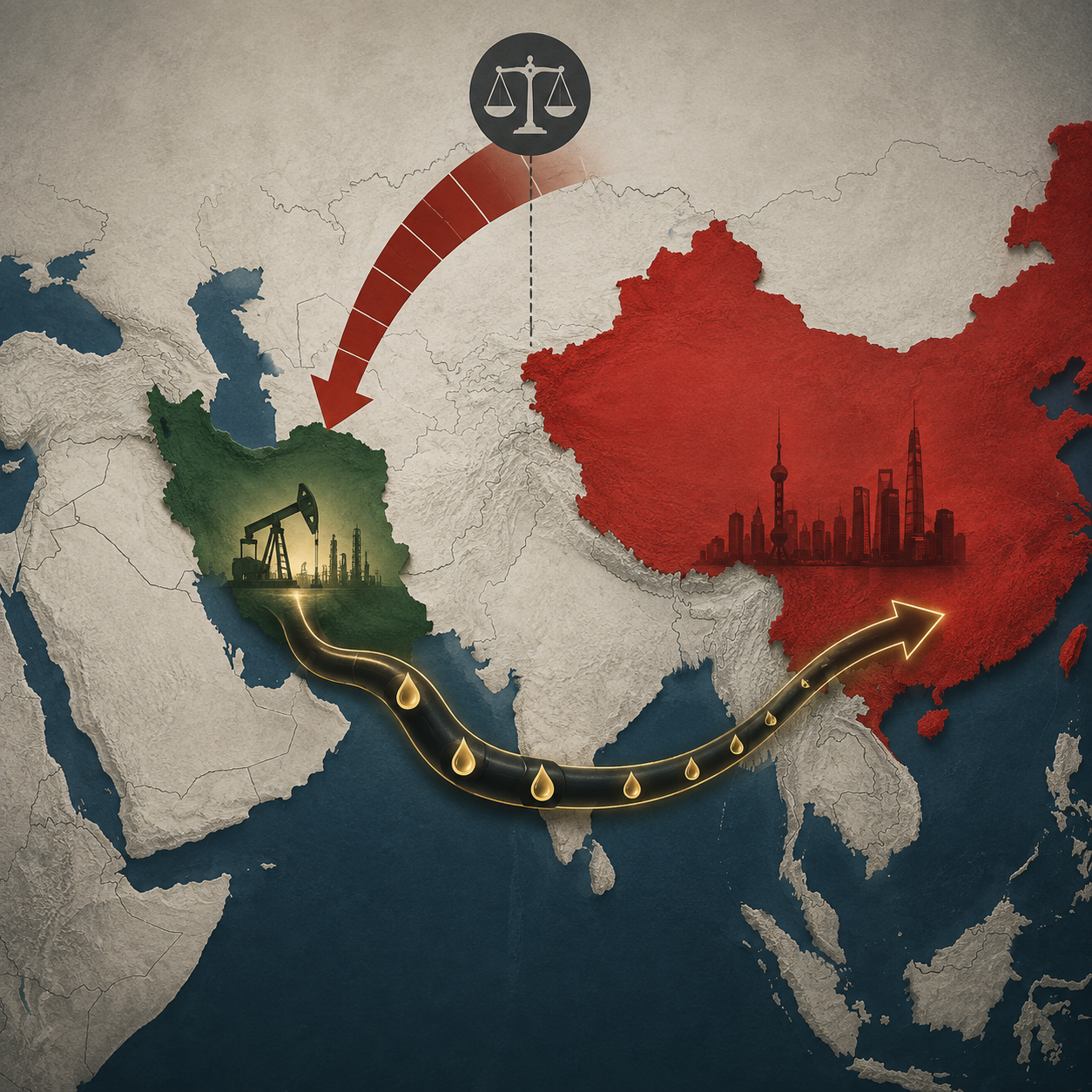
Operations Epic Fury and Roaring Lion created significant military leverage against Iran but have not secured the broader strategic objectives sought by the United States and Israel. Three lines of effort follow: supply-side interdiction, building oil pipelines around Iranian control of Hormuz, and demand-side pressure on what still gets out. Earlier analyses set out the first two. This article takes the third and asks whether the United States can alter China’s commercial incentives enough to foreclose Iran’s principal remaining oil-revenue channel. Beijing’s May 2026 blocking order substantially insulates China’s teapot refiners, its small private processors, from the designations aimed at them. The instruments that remain work above and around the refineries to the parent groups exposed in Western markets, and the registries, insurers, and financial counterparties that move and finance the cargo. Operation Economic Outcast, announced August 24, maps those nodes correctly while holding the most consequential enforcement in reserve. Iranian crude is commercially replaceable. Gulf energy stability is not.
Introduction
Clausewitz viewed military operations as instruments for influencing political decisions rather than ends in themselves. Economic compellence is an additional mechanism for converting battlefield success into political outcomes.
Epic Fury and Roaring Lion degraded Iran’s nuclear infrastructure, missile capabilities, and air defenses. Thirteen nights of strikes followed the collapse of the Islamabad Memorandum in July 2026. Those gains have not produced the strategic outcomes sought. Iran has not agreed to forgo nuclear weapons capability, end Islamic Revolutionary Guard Corps (IRGC) support for proxies, constrain missile and drone programs, end attacks on Gulf neighbors, or guarantee freedom of navigation through the Strait of Hormuz. The three lines of effort work on that list from one direction: deny the IRGC the revenue that sustains it, and strip the Strait of its coercive value. The objective is not to persuade Tehran but to narrow what it can afford, setting security-force pay, infrastructure, fuel subsidies, proxy funding, and missile reconstitution against a shrinking pool. Compellence operates on the budget, whatever the regime intends.
Two companion analyses set out the first two legs: closing off what Iran can ship, and building around the chokepoint to blunt the coercive value of Iranian attacks on the Strait. This article addresses the third demand side, and the question Operation Economic Outcast now poses: where to apply pressure when Beijing can shield the buyer.
Crude sales to teapot refiners beyond the reach of the naval blockade (dark fleet vessels) continued generating revenue available to the IRGC during its July 2026 missile campaign. That channel has narrowed sharply but remains open through crude already outside the blockade.
The Financial Case for Demand Interdiction
Oil revenues finance the IRGC and its affiliated commercial enterprises. The IRGC is widely believed to control or influence close to 30 percent of Iran’s economy.
The April 13 naval blockade imposed severe and rapid economic costs without producing political change. The Soufan Center reported the blockade cut approximately 70 percent of Iran’s export income, which US Treasury Secretary Scott Bessent put at roughly $170 million per day. Financial compellence must target the institution’s own revenue, not merely the civilian economy.
The naval blockade, Kharg strikes, and dark fleet enforcement address the supply side, not who purchases what Iran still manages to export. Before the latest disruptions, China purchased approximately 80 to 90 percent of Iranian crude exports, primarily through teapot refiners willing to process discounted Iranian oil despite US sanctions. United Against Nuclear Iran estimates Iran generated over $5 billion in revenue available to the IRGC through dark fleet exports after the Islamabad Memorandum was signed.
Why China Matters: Structural Leverage Created by Sanctions
Years of international sanctions have steadily reduced Iran’s pool of major oil customers. European buyers exited after the 2012 embargo and the 2018 withdrawal from the nuclear agreement. Indian, Japanese, and South Korean purchases followed. As alternative buyers exited, China became the destination for the overwhelming majority of Iran’s exportable crude.
The question is not whether China prefers Iran as a partner, but whether Beijing values discounted Iranian crude more than uninterrupted access to Gulf energy markets, stable maritime commerce, and avoidance of proliferation of nuclear weapons in the Middle East.
Iran is no longer selling into a diversified market. Its dependence on a single dominant customer gives Beijing greater potential influence over Iranian oil revenues than any other external actor. Whether China chooses to exercise that influence is a policy question. The structural leverage exists because sanctions enabled it.
This near-monopsony means that even modest reductions in Chinese purchases could impose disproportionate revenue losses on Iran.
Three facts make that leverage commercially rational for Beijing. First, before the disruption, Iranian crude was roughly 14 percent of China’s seaborne crude imports in 2025, a smaller dependency than Europe had on Russian gas, meaning substitution cost is manageable. Saudi Arabia and the UAE supply comparable Arab Medium and Heavy grades requiring minimal refinery adjustment, and both can reach water outside Hormuz, by Petroline to Yanbu and ADCOP to Fujairah, with a combined 5 million barrels a day of reroute capacity. Iraq has no such route. Second, Hormuz disruption at sustained elevated risk premiums costs more than the Iranian discount saves it. China imports roughly 11 million barrels of crude per day, roughly half of it through Hormuz, dwarfing its Iranian purchases. The $8 to $10 billion annual discount is a fraction of that exposure; Bessent made the same point on August 20, observing that China draws half its energy from inside the Gulf. Third, Beijing has reason to avoid an Iranian nuclear breakout. Iranian nuclear weapons capability would substantially raise the risk of a proliferation cascade across the Gulf region that China depends on for long-term energy security. These factors strengthen Beijing’s incentive to diversify, not its willingness.
Aligning China’s Interests with US Strategic Objectives
The Emirates offers a control case. On August 18, the United Arab Emirates suspended financial and economic transactions with Iran, after weeks of American pressure and after the UAE reported attacks on seven of its ships that month and two ballistic missiles fired toward the country. The instrument was money and trade rather than crude, but the lesson carries. A state complies when compliance serves its own interest, and Tehran supplied the Emirati interest itself.
The reach has limits. Treasury reports that many tankers in Iran’s shadow trade are owned or managed by UAE-based firms, and Emirati officials describe a gradual escalation, keeping channels to Tehran open. Beijing has no comparable exposure, and none can be manufactured by threat.
The teapot trade exists for one reason. Margins are thin, and Iranian crude has been discounted at times by a quarter. That discount is gone for the moment. The little cargo still sitting east of the blockade is scarce, so it sells dear. When the barrels flow again, the discount returns with them. Price is the instrument, and the one a blocking order cannot reach. Beijing can order a firm to ignore a designation. It cannot order it to pay more for crude.
Russia supplied over 45 percent of Europe’s gas before 2022. The International Energy Agency documented that as Russian pipeline deliveries collapsed in 2022, European LNG imports grew over 60 percent. Russia lost that leverage not because buyers were coerced but because credible alternative supply existed at manageable premiums.
Washington should offer participating Chinese refiners reliable access to those grades as fast as pipeline and terminal capacity permit, with trade incentives that let Beijing present compliance as a commercial rather than a strategic decision. Treasury’s Economic Fury sanctions against major teapot refiners make enforcement threats more credible. UANI, Windward, and Kpler already monitor these shipments through Automatic Identification System (AIS) data and satellite imagery, detecting transponder shutdowns and identity spoofing without Chinese or Iranian cooperation. With Kharg struck and the dark fleet interdicted, Iranian crude is hard to obtain regardless of Chinese preference, and the supply guarantee becomes the obvious alternative.
Beijing may still conclude that strategic competition outweighs the commercial costs. If China absorbs secondary sanctions and maintains purchases, the demand-side instrument fails without alternative enforcement. The objective is not to guarantee compliance but to raise the marginal cost of continued purchases and lower the cost of substitution.
That is what occurred. On April 24, 2026, Treasury designated Hengli Petrochemical’s Dalian refinery along with roughly forty shipping firms and vessels. On May 2, China’s Ministry of Commerce issued a prohibition order under its 2021 blocking rules, directing that the designations against Hengli and four other refiners not be complied with. Designation bites where dollars are needed. China’s hundred-plus teapot refiners have minimal need for dollars and therefore little at stake in a designation. The instrument was aimed at the one participant that neither needs American currency nor lacks government protection.
The corporate family does not share that immunity. The parent’s shipbuilding arm is China’s second-largest yard, with an order book running through 2030 exceeding $25 billion and heavily European: twenty very large crude carriers for Greece’s Dynacom, eleven more worth roughly $1.4 billion for Capital Maritime.
Designating the group would not compel the shipyard. It would force its customers to choose, since they finance, insure, and class their hulls through Western institutions on which Beijing’s order has no purchase. That is how the pressure reaches Hengli. Treasury says the refining unit bought billions of dollars of Iranian petroleum, which Hengli denies; the yard sells hulls into dollar markets on Western finance and insurance. Group designation risks the second to preserve the first, and no prohibition order can make a Greek owner take delivery. The path is complex: affiliation rules turn on ownership thresholds, shipbuilding is not a designated sector, and the blocking rules themselves expose a complying firm to suit in Chinese courts. China’s April 2026 countermeasures regulation goes further, asserting jurisdiction over conduct with an appropriate connection to China, wherever the firm sits. The domestic authority is substantial; the international-law standing of secondary sanctions is not settled. China is also a major supplier of rare-earth minerals to the United States, and escalation against a conglomerate of this standing invites retaliation. It is an escalation to be analyzed before it is chosen, and never stumbled into.
The same logic reaches the intermediaries. Every barrel arriving at Changxing Island moves under a flag registry, a classification society, and a protection and indemnity policy, all seated where dollar exposure remains decisive. Treasury has now named those nodes itself, along with the free-trade zones that host them. Naming is not designating, and the August 24 package held immediate secondary sanctions against the largest trading partners in reserve. US Secretary of State Marco Rubio has already threatened secondary sanctions against any entity complying with the blocking order.
The President has now announced a campaign broadly consistent with that architecture. On August 19, 2026, he declared an “Economic D-Day,” warning that any country whose financial institutions, businesses, airports, or government entities extend Iran a lifeline will face economic consequences, and naming the targets: oil smuggling, swap lines, cash transfers, exchange houses, ship registries, front companies. These are the channels that analysis named in July. The mechanics arrived on August 24 as Operation Economic Outcast, roughly sixty designations against procurement, cyber, and oil-revenue networks, and a map of the nodes Treasury means to reach. Major trading partners received a period to disengage before broader secondary sanctions, and the Secretary called it a warning shot. Not one category is the buyer. Each names an intermediary, and the intermediaries are where the exposure lives: the registries that flag the tankers, the insurers that cover them, the banks that finance the yard’s Greek customers. Beijing’s order protects the refinery. It reaches none of them. Enforcement built on that map will not reach the refinery at Changxing Island, and should not be judged by whether it does.
This demand-side strategy rests on several contestable assumptions: that Gulf producers can supply commercially acceptable substitute grades; that designating a Chinese refiner creates enough exposure to change its behavior; that Iran cannot redirect comparable volumes through alternative channels; and that sustained revenue losses will influence Tehran’s assessment of institutional survival and capability regeneration. The second has now been tested and did not hold, and Operation Economic Outcast is a second test of the same proposition at wider scope. The others remain plausible but not certain. An escalation ladder, published conditions for relief, and a defined substitute-supply offer would test the remainder, and would supply the stable bargain whose absence has been the campaign’s most consequential coercive failure.
Conclusion
Five months of operations have created the leverage compellence requires without converting it. The supply side has been partially engaged. Refinery-level demand pressure has been tested and blunted. Operation Economic Outcast maps the intermediaries correctly while holding the most consequential enforcement in reserve. The blockade meanwhile has done what refinery-level designations could not. No visible supertanker carrying Iranian crude has crossed Hormuz since mid-July, the floating stock still reachable outside the blockade has fallen by roughly a quarter, and Chinese teapots have begun seeking substitutes. That is the case for combining physical interdiction with network pressure rather than relying on either alone. Mahan’s treatment of the Napoleonic wars made a similar point. British sea power did not defeat the Continental System in a single decisive action. Sustained maritime and economic pressure helped exhaust it. The instruments are now financial as much as naval. Strikes on loading infrastructure, naval interdiction, and financial compellence together reduce what Iran has to sell. Demand-side interdiction raises the cost of moving and financing what remains. Bypass capacity does the third. Every barrel reaching water outside the Strait makes Tehran’s chokepoint threat worth less. Together the three constrain what Iran can regenerate, whether or not they change what Iran wants. Any negotiation that follows would confront an institution whose capacity to regenerate has been systematically constrained.
The proposal does not require China to be a strategic partner, only that its commercial interests align with a supply guarantee. Iranian crude is commercially replaceable. Gulf energy stability is not.