





The Faceless War: How Artificial Intelligence Rewrote the Map of Power

Abstract
A small number of private technology firms now build the infrastructure on which both military power and the public’s perception of reality depend. Drawing on a 2025 wargaming experiment at the U.S. Army Command and General Staff College and on the documented information war of the June 2025 Israel-Iran conflict, this essay argues that simulated combat and cognitive warfare increasingly depend on the same technological ecosystem — shared firms, infrastructure, and supply chains — with direct implications for doctrine, training, and mid-sized powers such as Brazil.
A Hegemony Written in Code
Power has historically followed infrastructure: control of sea lanes defined the nineteenth century, control of oil and industry defined the twentieth. In this century, the decisive axis has shifted to digital infrastructure and artificial intelligence (AI). This is not a future possibility; it is a present condition. Whoever controls information systems can shape more than data: that control increasingly influences perception, behavior, and how populations interpret events. Every advanced AI model depends on a physical layer of semiconductors, data centers, and satellite links, which makes that physical layer, rather than any single algorithm, the true strategic terrain. Washington has increasingly treated China’s technological rise as a hegemonic challenge rather than mere commercial competition, since military capability, industrial autonomy, and normative leadership now converge on control of computing, data, and networks. Between the United States and China — and between the private companies that supply both — lies the central contest of contemporary geopolitics: a competition over semiconductors, advanced computing, and autonomous systems in which the winner sets the terms for every nation that depends on that infrastructure.
The New Infrastructure of Power
A relatively small group of private firms now supplies infrastructure once built primarily by states themselves. Palantir, founded in 2003 with early funding from the Central Intelligence Agency’s venture arm In-Q-Tel, operates the Maven Smart System, which processes drone and sensor data for targeting decisions. In July 2025, the U.S. Army signed an enterprise contract with Palantir with a $10 billion ceiling over ten years, consolidating seventy-five prior contracts and following the earlier Tactical Intelligence Targeting Access Node (TITAN) award.
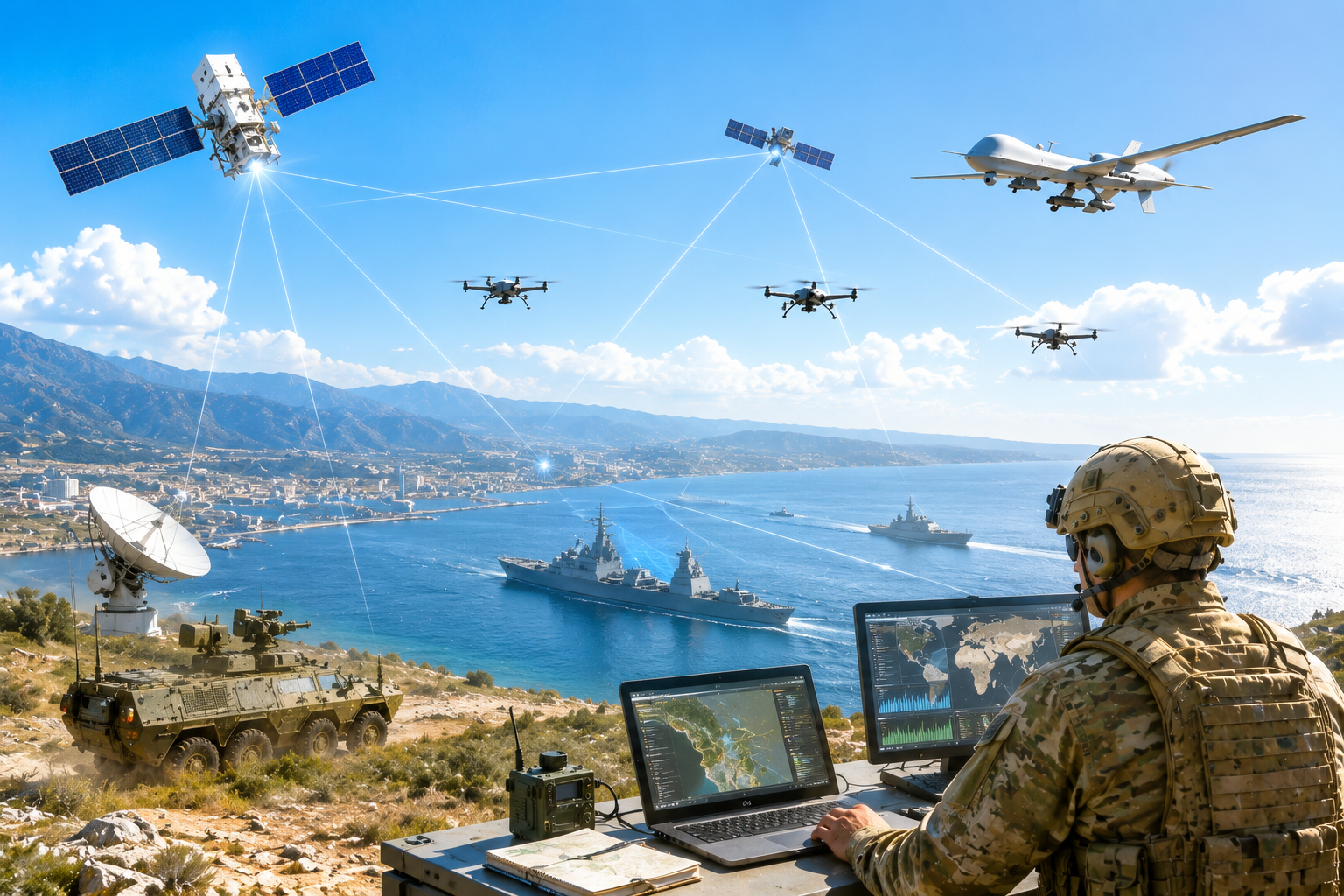
SpaceX, through its Starshield division, provides the orbital backbone for military communication and target-tracking, using large constellations of small satellites to preserve connectivity under electronic-warfare conditions. Microsoft supplies sovereign cloud infrastructure to the Department of Defense and has tested the augmented-reality Integrated Visual Augmentation System (IVAS) with soldiers in the field. In February 2025, control of the twenty-two-billion-dollar IVAS program was set to transfer from Microsoft to Anduril Industries — a company founded in 2017 by Palmer Luckey that also develops the Lattice command software and autonomous drone systems. This transfer remained subject to Department of Defense approval.
Google supplies data infrastructure to defense agencies through Google Public Sector, but internal opposition has repeatedly constrained that work: in 2018, more than three thousand employees signed a letter opposing Project Maven, several resigned in protest, and Google subsequently declined to renew the contract. Oracle hosts isolated, hardened databases for the U.S. intelligence community. NVIDIA manufactures the graphics processors that underpin nearly every military AI application, from war-gaming simulation to autonomous targeting, while Broadcom supplies the hardened semiconductors and network components behind radar and satellite systems. OpenAI and Anthropic supply the language models increasingly integrated into intelligence analysis, cybersecurity automation, and logistics planning. None of these firms was elected; together they constitute an informal general staff for the defense architecture of the United States and its partners.
Why the Shift Is Improbable
The economics of AI make reversal implausible. Training a frontier model costs hundreds of millions of dollars, but deploying it costs a fraction of a cent per use, so once built, the capability propagates at near-zero marginal cost. Militaries that adopt AI-assisted planning do not regress to manual methods any more than air forces return to celestial navigation after adopting GPS. Private investment has also outpaced the ability of most legislatures to regulate it in real time. These dynamics mirror earlier arms races — the repeating rifle, the submarine, the atomic bomb — with one structural difference: the firms building the current generation of weapons-relevant technology are civilian, transnational, and often headquartered outside the countries whose forces rely on them.
Command Intent Versus Micromanagement: Lessons from a Wargame
A 2025 staff wargame at the U.S. Army Command and General Staff College (CGSC) tested whether a large language model could support realistic course-of-action analysis. When given highly detailed, step-by-step instructions, the model systematically favored friendly forces and required constant human correction. When given only the commander’s intent and key tasks, a second instance of the same model produced substantially more realistic assessments. In the wargame’s decisive scenario, a friendly battalion of three companies was tasked with fixing a defending force of more than five companies; the model returned an assessment of friendly combat power remaining at seventy-five percent against an enemy reduced to forty percent, a result the staff initially distrusted but confirmed after review: the model had correctly accounted for the effects of close air support, attack aviation, and artillery that the human planners had themselves underestimated.
Similar findings have emerged elsewhere in U.S. professional military education. The Naval War College has used AI to reduce the variable space of its 2025 wargames, and the Army War College has used large language models to support Free Kriegsspiel-style adjudication in unclassified scenarios. Across these cases, human oversight remained essential: officers corrected AI-modeled enemy lethality, enforced movement restrictions on logistics nodes, and re-established scenario context after the model lost continuity — with AI augmenting the capabilities of intelligence professionals rather than replacing them, in line with doctrinal norms. The central finding is that excessive procedural detail degrades AI performance by preventing the model from applying its doctrinal knowledge, while clear intent, combined with accurate underlying data, improves it. Writing effective instructions for an AI system is converging with writing an effective operations order, and the resulting bias exposure functions as an informal test of a staff’s own planning assumptions.
The Price of Almost Nothing: The Israel-Iran Information War
Simulated battle is one half of this problem; contested perception is the other. The twelve-day war between Israel and Iran in June 2025 provides a documented case of AI-enabled information warfare at scale. A study by the Israel Internet Association, based on 592 fast-checks published by 50 organizations across 23 countries, found that roughly one-fifth of false content examined was generated from scratch using AI, while more than 70 percent was authentic footage stripped of its original time and place and recirculated as if documenting the current conflict. The researchers assessed that 72 percent of the examined false content could have served Iranian interests, as could 90 percent of the AI-generated content, a pattern consistent with, though not conclusive proof of, a strategic recalibration by Iran: compensating for the battlefield setbacks suffered by its non-state allied groups, a weakened Hezbollah and a severely debilitated Hamas, by turning to influence operations aimed at the adversary’s morale rather than its decision-making process. The inference remains circumstantial, but the timing and target selection lend it plausibility.
Israel’s institutional response illustrates one way to organize against this threat. The IDF’s C4I and Cyber Defense Directorate has restructured to create dedicated AI and spectrum warfare divisions. Within this reorganization, the new Sphera unit consolidates electromagnetic-spectrum operations and strategic communications under a single command — a recognition that the two functions belong to the same battlespace, even as AI-enabled analysis is managed through a separate, parallel structure.
This institutional capacity was not built for the Iran conflict alone. A parallel civil-military monitoring structure has taken shape around organizations like FakeReporter, an independent NGO that has operated as Israel’s primary open-source intelligence and disinformation monitoring body since the Gaza war, documenting more than two hundred distinct disinformation narratives in that earlier conflict’s first week alone. Israel has also developed a broader distributed monitoring network integrating military and civil society actors, though the precise channels linking NGO findings to military intelligence remain undocumented in open sources. Detection tools nonetheless struggle to keep pace with rapidly improving generation tools — a structural gap documented across the field, not a temporary lag. In this environment, prioritizing response speed — publishing verified information and correcting errors quickly — offers a more sustainable posture than an unwinnable race to detect every fabrication before it spreads, a logic consistent with the approach observed in Israeli information operations.
Implications for Doctrine and for Mid-Sized Powers
These two cases point to the same underlying infrastructure. The chips and cloud platforms that train a model capable of realistic combat-power estimation are drawn from the same supply chain used to train a model capable of generating synthetic battlefield imagery. Simulated war-gaming and the war for perception increasingly run on a shared technological ecosystem — common cloud infrastructure, common model providers, and, in some cases, the same defense-analytics firms that supply both targeting systems and narrative-monitoring tools. This overlap creates common points of failure: a vendor outage or breach can degrade military planning and public-facing information defenses at once, and it concentrates significant leverage in the hands of a small number of private companies whose commercial incentives do not necessarily align with military doctrine or institutional accountability. For military institutions, this implies that AI competency belongs in doctrine and professional military education rather than in a technology office: officers require the same discipline in writing intent for AI systems that they apply to operations orders, and information-verification capacity requires the same institutional priority as intelligence and fires.
For nations without a Palantir, a Starshield, or a leading-edge semiconductor industry, three outcomes are plausible. A small oligopoly of powers could consolidate control over AI and military infrastructure, leaving most states dependent on imported capability. Alternatively, falling model costs and technology diffusion could extend AI-enabled cognitive and combat capability to smaller states and non-state actors, increasing instability. A third path — pursued deliberately rather than by default — involves building sufficient independent capacity in data governance, AI-assisted planning, and disinformation verification to avoid total dependence on great-power infrastructure, without pretending to compete with it directly. This course suits mid-sized states with large domestic data pools and diversified diplomatic ties — Brazil among them — better than it does smaller or more exposed powers. Which path predominates will depend less on the pace of technological change than on sustained institutional investment and doctrinal adaptation, since forces that continue preparing for the previous war risk losing the current one before it is formally declared.


