





The First US Army War College Wargaming & Professional Military Education Symposium: A New Home for a Growing Community

Abstract
The inaugural US Army War College Wargaming & Professional Military Education Symposium, held August 11–13, 2026, gave the international PME wargaming community its first dedicated forum, combining research panels with extensive hands-on game demonstrations. Strong participation from institutions like the U.S. Army War College and National Defense University pointed to real demand for such a gathering. Organizers hope it becomes an annual fixture for a field that, until now, had never had one.
Introduction
Wargaming has long served as one of the military’s most effective tools for teaching judgment under uncertainty: forcing students to make decisions, live with the consequences, and reason through complexity in a way that lectures and case studies cannot replicate. As professional military education has leaned more heavily on wargaming to develop strategic and operational thinking, the field has expanded faster than its own infrastructure: practitioners across the services have often designed, evaluated, and taught wargames largely in isolation from one another, with few shared venues to compare methods or agree on standards. That gap is what made a dedicated PME wargaming symposium overdue, and why its first-ever staging carries great potential for the community it serves.
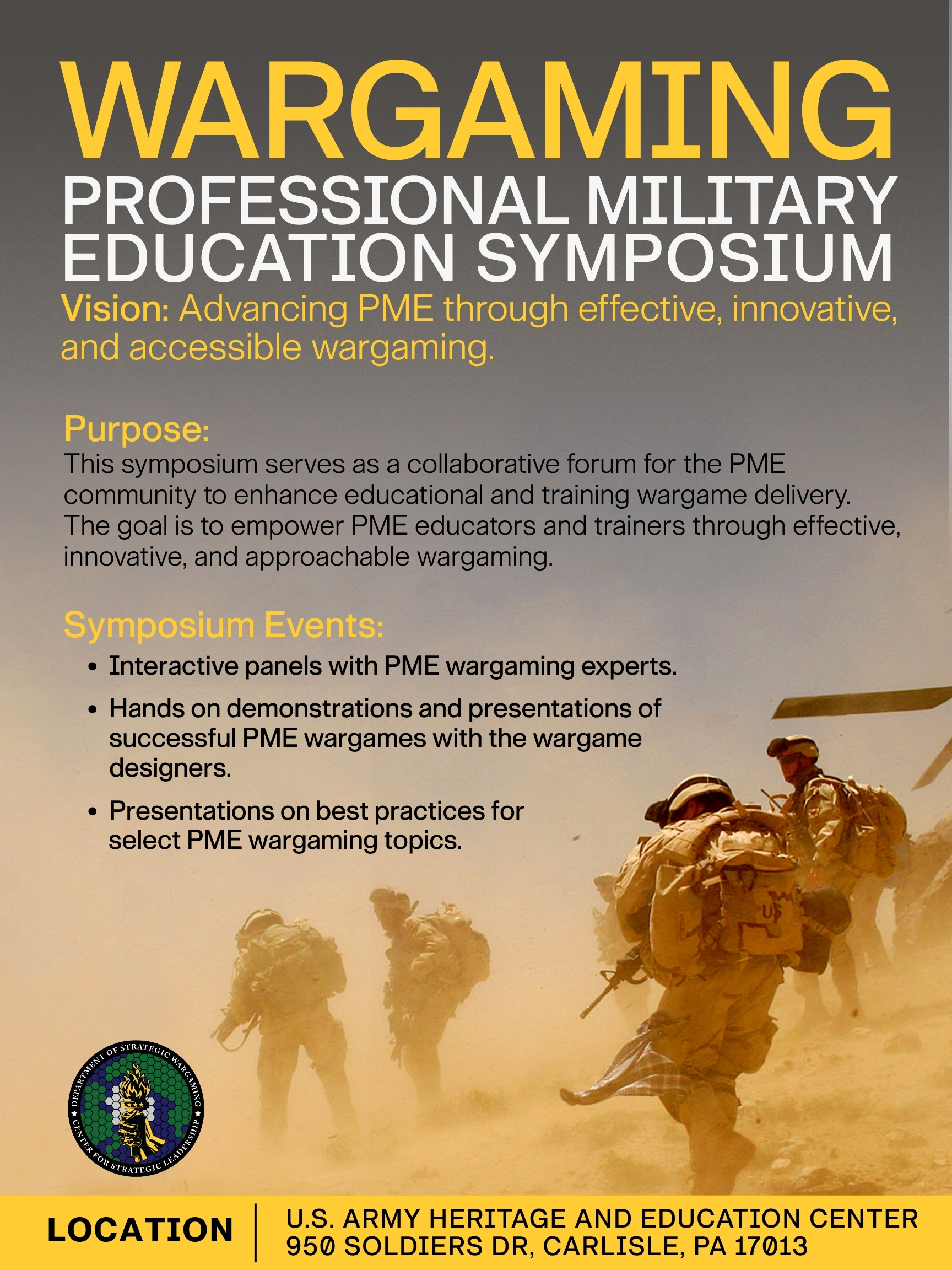
From August 11 to 13, 2026, the US Army Heritage and Education Center (AHEC) in Carlisle, Pennsylvania hosted the inaugural US Army War College Wargame Professional Military Education Symposium. For a field that has grown rapidly in visibility and importance over the past decade, but which has lacked a dedicated forum of its own, the symposium marked a significant milestone: an opportunity for practitioners, researchers, and educators from across the international PME community to gather, share methods, and build the kind of collaborative infrastructure that the discipline has long needed.
Purpose and Vision
The symposium’s purpose was to serve as the premier collaborative forum for the international PME community to enhance wargaming delivery, and to empower practitioners’ teaching through wargaming that is effective, innovative, and accessible within service education. That mission shaped every element of the program, from the research-focused panels to the hands-on demonstrations that filled the event’s afternoons.
Day One: Setting the Tone
The symposium opened on the morning of August 11 with opening remarks, followed immediately by the event’s keynote address from Dr. Sebastian Bae. As one of the field’s most recognized voices, Bae’s keynote set an ambitious tone for the days that followed, framing wargaming’s role in PME not simply as a teaching tool, but as a discipline in its own right, one still working out its own standards, evaluation methods, and best practices even as demand for it grows across the professional military education landscape.
A panel on “Successful Wargaming Programs in PME” followed, bringing together perspectives from several of PME’s flagship institutions for a grounded, institution-by-institution look at what has worked in PME wargaming programs to date, useful context-setting for a symposium built around sharing practice rather than theory alone.
The rest of the morning saw individual presentations, running in parallel across two tracks and covering a range of research and practical experience from across the PME wargaming community.
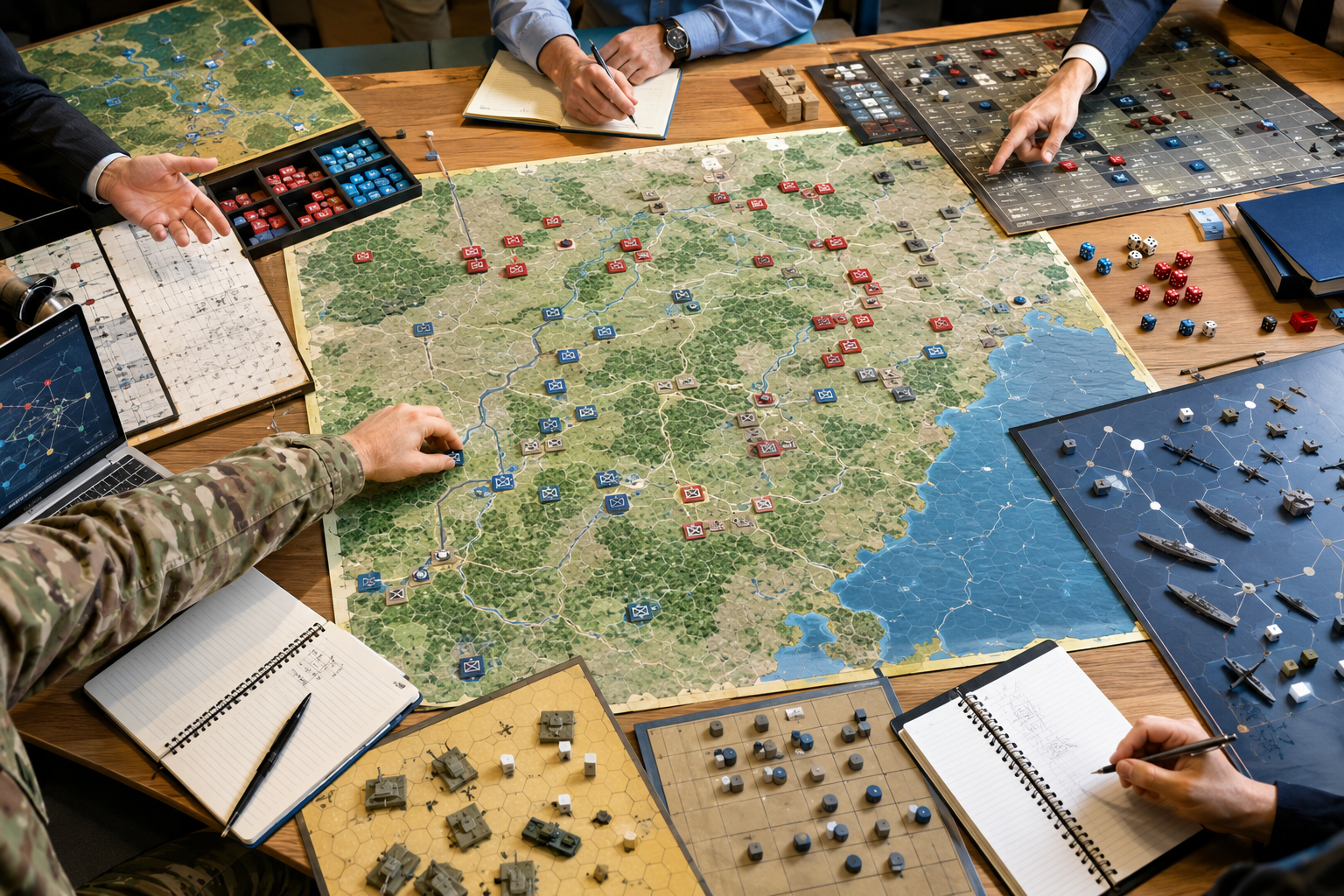
The afternoons of the first two days were devoted to hands-on demonstrations of wargames that have been used successfully in PME settings, with designers and facilitators on hand to walk attendees through each game’s context and application. The demonstration slate was extensive (roughly eighteen games in all), giving attendees a rare chance to experience a wide range of approaches to PME wargaming in a single event.
Day Two: Depth and Evaluation
The symposium’s second panel, “Evaluation and Assessments in PME Wargaming: Assessing PME Student Military Judgment Through Wargaming,” turned to a harder and arguably more urgent question than Day One’s opening panel: how do practitioners actually know whether their wargames are achieving their educational goals, specifically, whether they’re truly assessing student military judgment? Evaluation and assessment remain some of the thorniest open problems in PME wargaming, and devoting a full panel to the topic reflected the symposium’s willingness to engage with the field’s genuine growing pains rather than only showcase success stories.
The day’s presentations followed a similar format to Day One, continuing across two parallel tracks. The afternoon again gave way to game demonstrations, with a second full slate of designers and facilitators running games through the afternoon before a 4:30 PM closeout.
Day Three: Innovation and Closing
The symposium’s final day, August 13, opened with its third and final panel, “Innovation and the Future of Wargaming in PME.” Closing the symposium on a forward-looking note, this panel took stock of where the field is headed: an apt close for an event whose very existence signals a discipline coming into its own even as it grapples with its growing visibility.
A Foundation for What Comes Next
Taken as a whole, the symposium’s structure reflected a clear editorial choice: research and evaluation deserved serious, structured discussion, but so did the simple act of playing games together. By splitting each day between panels, individual presentations, and extended hands-on demonstrations, we hope to have built something that functioned as much as a working community gathering as an academic conference.
The event drew a range of participants spanning the U.S. Army War College, the National Defense University, the Brute Krulak Center for Innovation and Future Warfare, and a wide roster of wargamers from other PME institutions, independent researchers, and designers, indicating that, in its very first year, there is genuine pent-up demand for exactly this kind of forum. The organizers envision that this may be on its way to becoming a fixture: an annual gathering point for a field that, until this August, had never had one.
—
One final word. A special note of thanks goes to the Director of Strategic Simulations at the United States Army War College. He and his team deserve credit for all of the hard work they did in bringing an idea together and for enabling this to happen.
Disclaimer. There is a conflict of interest. I sponsored the symposium and originated the idea of bringing the PME wargaming community together in this way. The views shared above are mine, and mine alone.


