The Tomahawk Changed Modern Warfare. America Can’t Build Enough of Them.
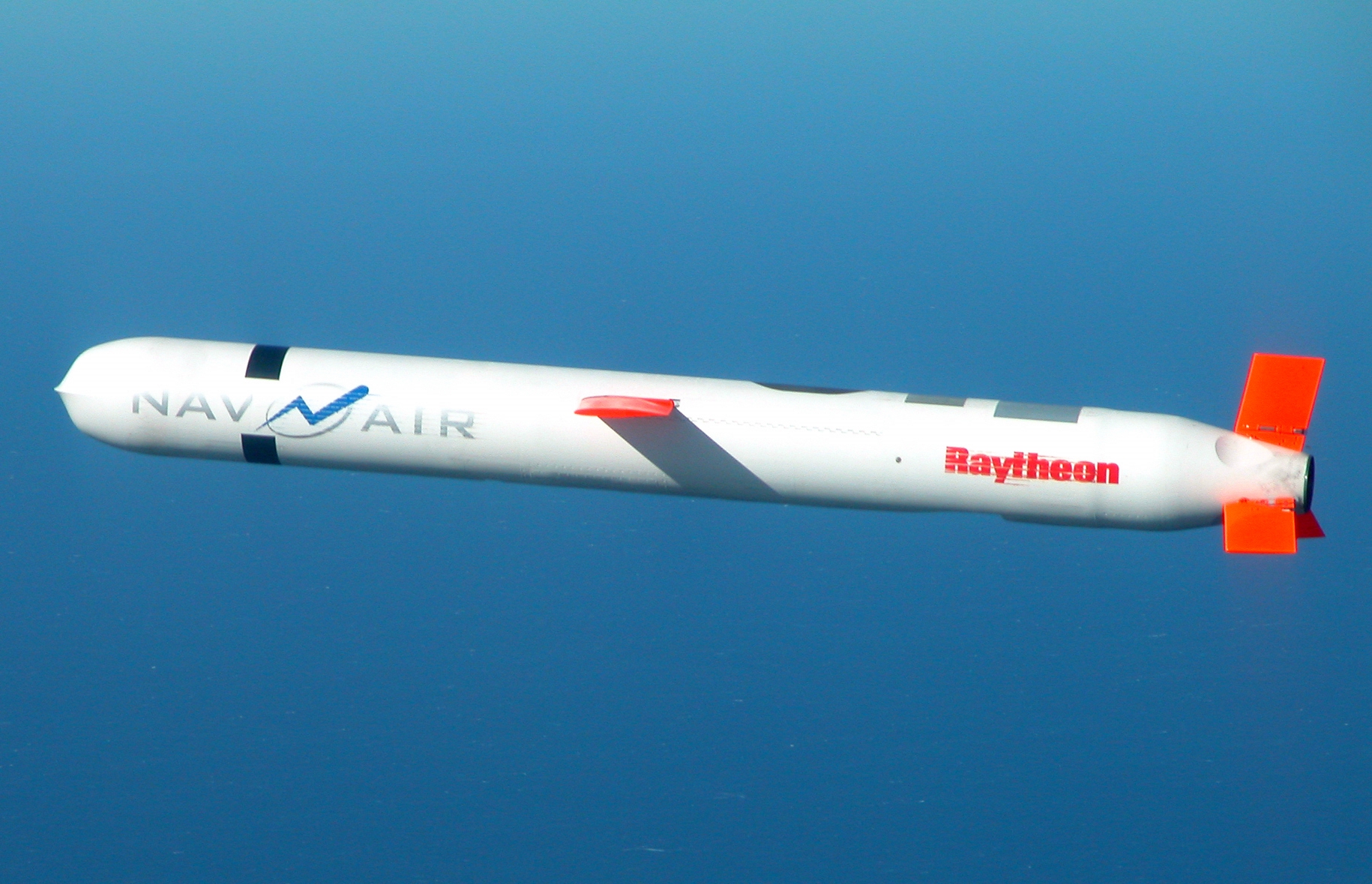

January 17, 1991. The USS San Jacinto fires the opening shot of Desert Storm. A BGM-109 Tomahawk roars out of the ship’s hull, flies low and slow over the Iraqi desert, threads between buildings in downtown Baghdad, then slams into a communications hub.
The world had seen America’s precision weapons before, but then, in grainy video footage taken from the weapon’s nose cone broadcast on TV days later, the message was plainly revealed: we can reach you anywhere, and you will not see it coming.
That was thirty-five years ago, and yet the Tomahawk has still not been retired. It continues to prove irreplaceable. Every president since George H.W. Bush has used it. The value of a weapon that can fly a thousand miles hugging the ground, change course, loiter if the target is not ready, and accept new coordinates mid-flight is impossible to overlook. Add to that a modular design that allows it to be launched from destroyers, cruisers, and submarines, one that handles both conventional and nuclear warheads, and a system equally adept whether fixed to a ship or a submarine.
Even now, decades later, no other weapon in the American arsenal can offer all these capabilities. The Tomahawk remains a linchpin weapon to the extent no combatant commander would even think to plan a strike package without it.
The Sudden Supply Deficit
On June 11, 2026, the White House did something highly unusual: It invoked a Cold War-era emergency law from 1950 to allow missile manufacturers to form “voluntary agreements” and coordinate production between themselves, a rare allowance for the tightly regulated industry.
Back then, in the face of rapid Cold War expansion against the Soviet Union and China, the Defense Production Act was passed to bridge the gap between private manufacturing and urgent national security needs. When time is of the essence, the free market is liable to move too slowly. The DPA addresses this by allowing a degree of collusion that would normally be forbidden in order to accelerate the supply lines. Now, over 70 years later, the White House has invoked it because America cannot manufacture Tomahawks fast enough.
Though the Department of Defense does not divulge the precise number of Tomahawks in the U.S. arsenal, estimates put the number pre-Operation Epic Fury at somewhere between 3,000 and 4,000. Since then, over a thousand of them have been fired. More are earmarked for Iran contingency planning, for Pacific deterrence, for the expanding Southern Command operations against cartels and other transnational groups that the administration has set about targeting. With production rate standing at about 100 to 125 missiles per year, it will take around eight to ten years just to regain previous levels of strength. And that number only holds on the assumption that none are fired in the meantime, a highly unlikely scenario.
It gets worse. Earlier this year, the United States told Germany it could not deliver a consignment of Tomahawks that Berlin had previously ordered. Germany went to the only country that makes the Tomahawk. And the answer was, “Sorry, we need them ourselves. We cannot spare any.”
Put another way, the country that invented the world’s most sophisticated strike weapon and has relied on it more than any other in its arsenal over the last thirty years must pick between being able to produce enough for its own needs and supplying a key ally.
In response, Congress has recognized the problem and tried throwing money at it, but production rates have barely shifted. The reason is at once both simple and complicated: it is the production system itself that needs to change.
Every Tomahawk comprises over a thousand precision-machined parts. Each component is typically produced by a small, specialized manufacturer. And often these shops are the only ones in the entire country to make that specific piece. Companies such as Re Manufacturing, Machina Labs, and Hadrian have begun demonstrating how greater automation, flexible precision-production capacity, and additive manufacturing could reduce some of these single-source dependencies, but such approaches have yet to be adopted across the industrial base at the scale required.
This dependency on small, bespoke, unique companies means problems are liable to rapidly stack up. Something as small as a key employee at one such shop falling ill causes the entire supply chain to hold. So, when a few shops experience minor inconveniences, the delays compound.
None of these are catastrophic failures in isolation, but when so much depends on a small workforce with highly specialized knowledge, the issue is not of money but of efficiency. And, with the workforce aging and not being replaced, the problem is only getting worse. Hadrian’s use of automated manufacturing systems and accelerated technician training offers one indication of how the labor constraint might be addressed without waiting years for a new generation of traditionally trained machinists. The firm’s technology provides for factory autonomy that interprets and accelerates complex legacy designs – an example of the surge in production capacity that the defense industry desperately needs, one reflective of lighthouse manufacturing, deemed to be the fourth iteration of the industrial revolution.
Multi-faceted Production
The decision to invoke the DPA is an implicit admission by the government that the situation is unsustainable and must change. But this can only be the start. Voluntary supplier agreements can go only partway, but without a modernized workforce and alternative sources of parts, it will never be able to produce precision munitions at the rate required by a country at war. The broader shift towards software-defined and reconfigurable production, also reflected in Anduril’s Arsenal manufacturing model, suggests that defense manufacturing need not remain permanently tied to inflexible production lines and fragile supplier networks.
As America struggles with its production rates, China is taking note. Russia has already learned its lessons in Ukraine. It discovered there that the country that can produce great volumes of munitions, and with greater speed, than the other will dictate the pace of a war.
Both China and Russia are closely following the extent of the Tomahawk inventory’s depletion. And both of them are weighing their next moves, making calculations about American staying power at a time when America is significantly under-weaponed and unable to recover quickly.
The Pentagon is now confronted by a basic reality. Weapons that cannot be replenished within a reasonable time frame are weapons with severely limited deterrent power. Even if those weapons are highly effective, when supply is limited, deterrence is impaired.
With deterrence draining, it’s now virtually inevitable that one of America’s many adversaries will test the waters. Will America have fixed its production problem by then? If it does not, it will find itself in the unenviable position of scrambling to build missiles while in the middle of a fight. The United States cannot let that happen.