





Drones Are Widening the Jungle Fight

Abstract
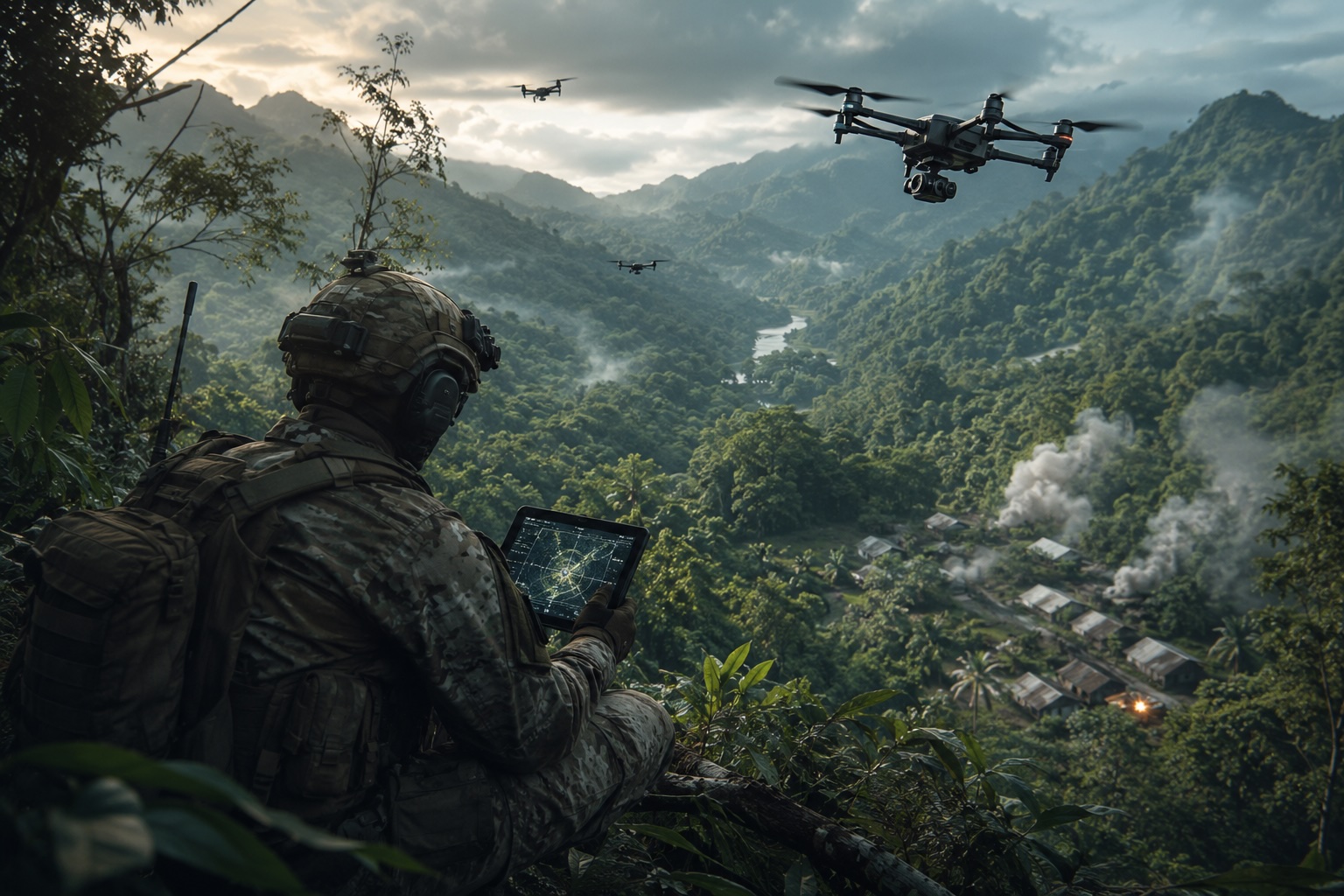
Myanmar’s civil war and the Thai-Cambodian border fighting show that drone-enabled ground combat in Southeast Asian terrain is already emerging. The U.S. Army has begun adapting to drones, but its drone, counter-drone, jungle, and Pacific training efforts remain insufficiently integrated against the kind of adversary now visible in Myanmar.
The Southeast Asian Drone Test
According to Armed Conflict Location & Event Data (ACLED), Myanmar’s civil war now ranks third globally in recorded drone events, behind only Ukraine and Russia. Unlike Ukraine’s largely open battlefields, much of Myanmar’s drone war is unfolding across terrain broken by jungle canopy, hills, and dispersed armed networks. In May 2025, during fighting around Bhamo, the Kachin Independence Army (KIA) claimed its fighters used rockets and drones against Myanmar military Mi-17 helicopters. The junta blamed a technical fault, but a KIA spokesman claimed responsibility to The Irrawaddy, and footage later circulated appearing to show a first-person-view (FPV) drone detonating near one helicopter’s rotor system. By February 2026, an alleged FPV suicide-drone attack damaged a Myanmar National Airlines ATR-72-600 aircraft at Myitkyina Airport, a sign that drone reach now extends beyond frontline ambushes. All of these developments strongly suggest that drones are beginning to shape how forces fight in modern Southeast Asia.
Myanmar could be dismissed as evidence relevant only to insurgencies. Yet drones have also found increasing use in large-scale conventional operations. When fighting erupted between Thailand and Cambodia in July 2025, drones appeared alongside artillery and airpower over dense border terrain. By the December round of fighting, Thailand’s army accused Cambodian forces of using bomb-dropping drones alongside artillery and rocket fire, while Thailand responded with airpower and other operations aimed at degrading Cambodian military positions. State-on-state warfare in Southeast Asia now includes low-cost drone airpower.
The Army’s Pacific Gap
The United States Army has paid too little attention to what this change implies. Even amid the pivot toward near-peer conflict, the Army appears to be planning for the war it would prefer to fight rather than the one it may actually face. That vision emphasizes a fast, decisive, technology-driven campaign centered on air and maritime power. But wars rarely unfold as planned. A conflict in the Indo-Pacific could easily become a prolonged war extending beyond sea and air into sustained ground combat. Myanmar’s internationally neglected civil war offers a rare contemporary case study. The conflict shows how forces are innovating in terrain where American soldiers may one day have to fight.
Much public discussion of the Army’s Indo-Pacific role has emphasized long-range fires in support of a maritime fight, alongside distributed sensing and other theater-enabling missions. These missions will be essential in any future conflict. But that emphasis understates both the Army’s capabilities and the demands a prolonged regional conflict could place on it. Soldiers may still have to seize terrain, clear enemy positions, defend partners, and fight through decentralized ground threats that long-range fires alone cannot solve. The Army’s current posture has said far less about that fight than about the fires and support missions that would precede it. The deeper problem is one of integration. The Army has not yet combined its drone, counter-drone, jungle, and Pacific training efforts against an enemy that uses drones to find, move, strike, and disappear.
What Myanmar Shows
Myanmar’s civil war is challenging long-held assumptions about combat in the jungle. For decades, jungle terrain has been treated as a great equalizer: a hostile environment where heat, humidity, thick vegetation, and restricted movement compress warfare into close-range infantry clashes. That assumption is increasingly outdated. Small drones do not remove the jungle’s friction, but they can move information and explosives through it faster than ground patrols or conventional reconnaissance systems can. Forces in Myanmar are already exploiting this shift, as the Bhamo incident suggests.
The key lesson is not simply that drones can kill. It is that drones let small units compress the time between detection, movement, and assault, exposing routes and assembly areas that vegetation once protected. Ukraine has taught armies what drone saturation looks like on open and semi-open battlefields. Myanmar is beginning to show what it looks like when the battlefield is broken by canopy, hills, rivers, and dispersed armed networks. The jungle still compresses movement, but drones widen the fight.
Myanmar also demonstrates how drones enable decentralized maneuver. The Kachin Independence Army and allied resistance groups combine formal command structures with decentralized tactical execution, using commercial communications and low-cost systems to employ drones for three functions: finding the enemy, enabling movement, and striking targets. During Operation 1027, a large-scale military campaign, resistance drone use contributed significantly to ground advances that seized real territory from the junta. A single engagement can move from a firefight in dense vegetation to a bounding assault into a small village and then to a hasty defense along a river corridor, all within the span of an afternoon. Drones did not replace close combat. They made it faster and harder to control.
Pieces Without Integration
The Army has made a substantial effort to adapt to these new demands. The Purpose-Built Attritable System program is designed to field low-cost FPV strike drones across Army formations. Units such as the 173rd Airborne Brigade’s Hawkeye Platoon are building FPV drone setups for roughly $400 to $500. Project Flytrap, one of the Army’s most visible counter-drone experimentation efforts, has scaled from individual soldiers to full squadrons fighting through drone-saturated environments. In the Philippines, the 25th Infantry Division has assembled FPV drones at Fort Magsaysay for the Joint Pacific Multinational Readiness Center-Exportable (JPMRC-X), enabling the deployment of more than 100 FPV drones during the rotation. These efforts are promising, but they remain too disconnected to test the problem as a whole. The publicly documented Flytrap iterations have centered on European training environments, where units test responses to the low-cost drone threats reshaping modern battlefields. The publicly documented Philippines rotations demonstrate FPV assembly and unmanned aircraft system integration, but offer far less evidence of Flytrap-style counter-drone architecture being tested under jungle conditions. Public descriptions of those rotations also do not yet show an opposing force built around the dispersed, evasive, drone-equipped adversary demonstrated in Myanmar. If the Army wishes to succeed tomorrow, it must learn how to communicate with itself today.
Assemble the Pieces Before Contact
The United States should take several concrete steps to close this gap. First, the Army should bring Project Flytrap’s integrated counter-drone architecture to the Pacific. Systems that work over European pine forests must be forced to survive triple-canopy jungle, where line of sight can break, satellite navigation signals can degrade, and drones may have to be launched and recovered beneath the same vegetation that blinds everything else. JPMRC-X already provides the venue. Second, current doctrine does not appear to include a dedicated battle drill for locating and closing with an enemy that evades detection and repositions within minutes. That is a genuinely different sequence from detecting a target and calling for fires, and jungle doctrine should incorporate it. Third, the opposing force at Pacific training rotations should be rebuilt around the adversary that already exists. It should fight in small, dispersed cells, use drones for both reconnaissance and strike, and disappear before it can be fixed. Myanmar’s resistance groups already demonstrate this model, while the Thai-Cambodian border fighting suggests that it is no longer confined to civil war. None of these steps requires a new platform or a decade-long acquisition program. The Army has already built these capabilities. It has simply never integrated them in the environment where they will be tested first.
The Army faces a double challenge in the Indo-Pacific. It must visualize a war in which ground combat is shaped in ways not yet fully absorbed into its training, while guarding against plans built for battles that will not occur in the ways it expects. To succeed, the Army will have to fight against its own assumptions and interrogate its vision of war in the region. It must then integrate the capabilities it has already built before the first jungle fight forces the test. Myanmar is where that interrogation should begin.
(The views expressed are solely those of the author and do not necessarily reflect the official policy or position of the U.S. Army, the Department of Defense, the Army Reserve Officers’ Training Corps, Virginia Tech, or any other U.S. government agency).


