Review of Bing West’s Cat 5: The 2033 War
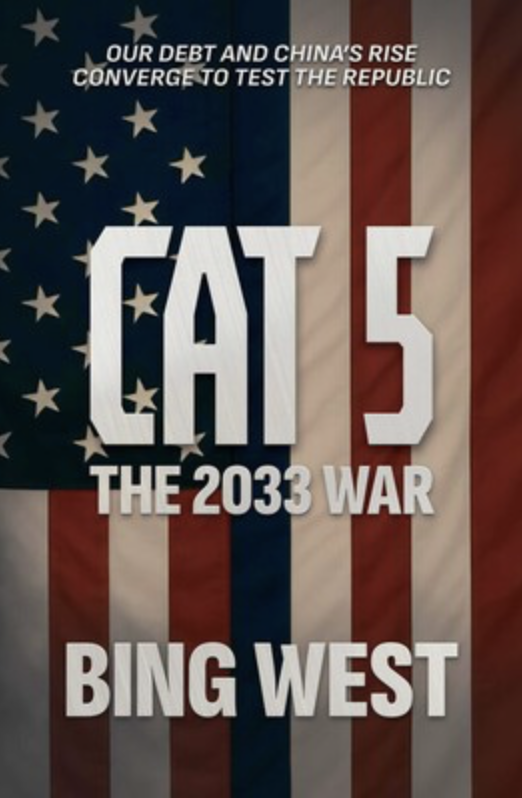

Are We Preparing to Defeat China’s Military or China’s Strategy? Bing West’s Cat 5: The 2033 War Review
Cat 5: The 2033 War by Bing West. Knox Press, 2026. ISBN13: 9798895656525, pp. 216. $28.99
Bing West’s Cat 5: The 2033 War is less a prediction than a warning. Its strength comes from a simple proposition: the United States remains extraordinarily capable of fighting wars, yet it has repeatedly struggled to convert military power into durable political outcomes. West looks back at Vietnam, Iraq, and Afghanistan and then forward toward China. He sees a strategic storm forming from American hubris, fiscal weakness, military overstretch, technological change, and an increasingly capable adversary.
The Jupiter Complex and the Failure of Strategy
West calls one source of the problem the “Jupiter Complex,” the belief that overwhelming American power gives Washington latitude to enter conflicts without sufficient discipline about political objectives, costs, duration, and termination. Vietnam, Iraq, and Afghanistan were very different wars, but each exposed the same strategic weakness. American forces could achieve remarkable tactical and operational results while policymakers struggled to turn those results into acceptable political conditions. West’s argument matters because military activity acquires strategic value only when it advances a defined political end state.
The Strategic Storm Toward 2033
This problem frames West’s approach to 2033. He sees American fiscal constraints tightening as Chinese power and ambition grow. Debt service competes with defense spending, industrial investment, technological modernization, alliance commitments, and domestic priorities. Fiscal weakness therefore narrows strategic freedom of action. China, meanwhile, can choose where and when to apply pressure and can exploit the limits of American attention, resources, and endurance.
Taiwan is the obvious flashpoint, and West gives particular attention to blockade and coercion as alternatives to an immediate amphibious invasion. That possibility deserves serious attention. Beijing does not need a Normandy-style assault across the Taiwan Strait to create a strategic crisis. It can seek conditions in which Washington and Taipei judge the costs of reversing Chinese actions to be greater than the costs of accepting them. The contest would then turn on political will, alliance cohesion, economic resilience, and escalation management as much as on firepower.
Political Warfare Before Conventional War
Here West’s warning can be extended. The Chinese Communist Party is already competing through economic coercion, cyber operations, espionage, technology acquisition, diplomatic pressure, maritime coercion, information manipulation, military intimidation, and lawfare. These activities form a political warfare campaign designed to shape choices and conditions before conventional war becomes necessary. China can weaken alliances, deepen economic dependencies, penetrate information environments, control critical technologies, and create incremental faits accompli without defeating the U.S. military in a climactic battle.
This raises the essay’s central strategic question: What happens if the United States prepares superbly for a major war while China pursues a strategy designed to gain political objectives without fighting on American terms? Competition is already underway, and conventional war would be one phase of a broader contest. A defense strategy centered mainly on the future battle risks conceding the political terrain on which that battle may be prevented, delayed, or made unnecessary from Beijing’s perspective.
The Problem of Simultaneity
Taiwan also cannot be examined in isolation. A crisis there could create opportunities for Russia, Iran, and north Korea, even without a formal alliance or integrated command structure. A Taiwan confrontation could coincide with north Korean missile launches, mobilization, cyberattacks, GPS interference, maritime provocations, sabotage, or limited military action. Russia could increase pressure on Europe, while Iran could exploit American distraction in the Middle East. Cyber and influence operations could compound the burden by attacking critical infrastructure and deepening domestic political divisions inside the United States and allied countries.
The resulting strategic problem is simultaneity. Can the United States deter several opportunistic adversaries when each understands that American military capacity, political attention, industrial production, and fiscal resources are finite? West’s fiscal argument makes this question harder to dismiss. Much of post-Cold War American strategy rested on economic predominance, technological superiority, secure logistics, and the ability to concentrate overwhelming military power. Each assumption now requires deliberate reexamination.
Thinking in Time: Using History with Discipline
History must also be used with discipline. Richard Neustadt and Ernest May warned policymakers against transferring lessons casually from one historical case to another. Vietnam, Iraq, and Afghanistan were profoundly different from a potential conflict with China, a nuclear-armed state with immense industrial capacity, global economic influence, sophisticated cyber and space capabilities, advanced missiles, a large navy, and a worldwide political warfare apparatus. The useful historical lesson is therefore found in the recurring American difficulty of connecting military operations to sustainable political outcomes, adapting strategy when assumptions fail, and matching commitments to available means.
Strategic Complacency and the 2033 Trajectory
West’s deepest contribution may have little to do with the precision of the year 2033. His real target is strategic complacency. American power has long given policymakers a large margin for error. Money could compensate for institutional inefficiency, technology could offset numerical disadvantages, and tactical excellence could mask ambiguity at the political level. That margin is shrinking, and a fixed date can create false comfort if it encourages leaders to imagine that the decisive competition lies somewhere in the future.
It is more useful to think in terms of a 2033 trajectory. Beijing can apply pressure continuously, learn from American responses, and shape the environment long before a military crisis. Rebuilding conventional power remains essential. The United States needs munitions, ships, aircraft, drones, resilient command systems, hardened bases, secure logistics, industrial surge capacity, and forces able to operate in contested environments. Those capabilities are necessary for deterrence and warfighting, but they cannot by themselves defeat a political warfare campaign.
Campaign Design for Continuous Competition
The United States therefore needs campaign design that integrates military, diplomatic, informational, economic, cyber, technological, financial, intelligence, and legal instruments of national power. Alliances must be able to resist coercion before war. Economic and technological security must support national power. Information and influence capabilities must contest adversary narratives and expose coercion. Irregular and unconventional warfare options should impose costs and create dilemmas inside adversary systems. Most important, policymakers must define the political conditions American power is intended to produce and organize sustained campaigns to achieve them.
Conclusion: Defeating China’s Strategy
Cat 5 should be read as a serious strategic warning. West forces readers to confront the gap between American tactical competence and strategic effectiveness while highlighting fiscal deterioration, military strain, political dysfunction, and Chinese ambition. His warning also points beyond the prospect of a specific war in 2033. The larger test is whether the American national security system can compete effectively before war, shape the environment, sustain alliances, protect political cohesion, preserve freedom of action, and impose dilemmas on adversaries that are already campaigning against U.S. interests.
West asks whether America has learned from wars in which battlefield success failed to produce durable political success. The harder question is whether the United States understands the character of the competition its adversaries are already waging. Before 2033 arrives, policymakers should ask: Are we preparing to defeat China’s military, or are we developing a strategy to defeat China’s strategy?
“Thus, what is of supreme importance in war is to attack the enemy’s strategy.” – Sun Tzu