





The Iran War and the Art of Storytelling
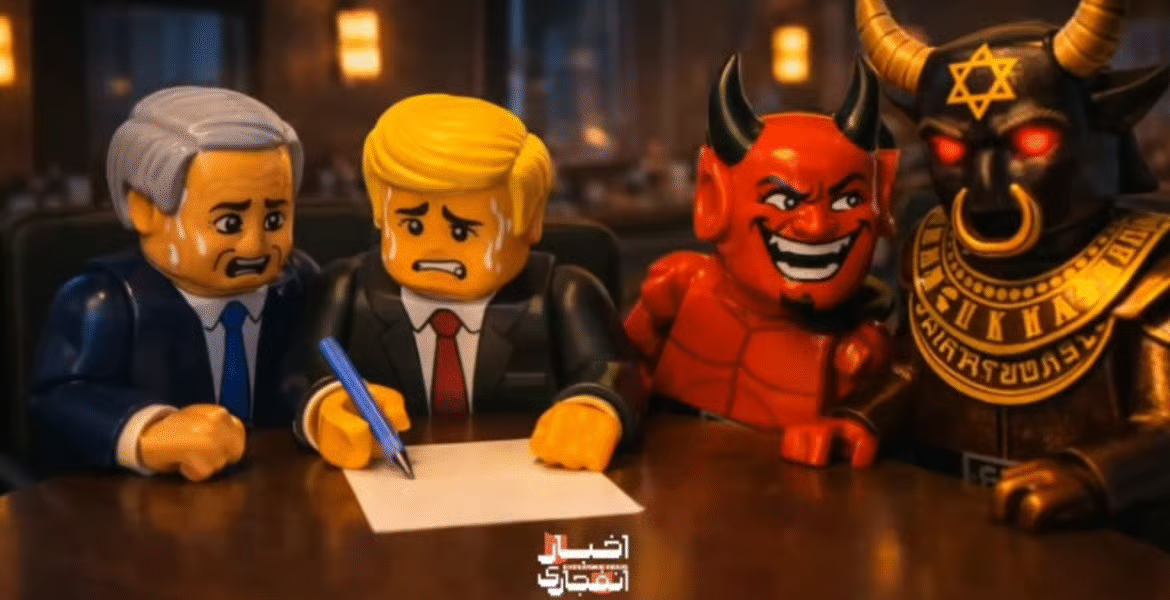

Abstract: This article examines the effectiveness of Iranian messaging during Operation Epic Fury using the five elements of storytelling (plot, characters, theme, setting, and conflict). The article argues that Iranian messaging follows a story format called “Overcoming the Monster,” which resonates with its target audience.
War is politics through other memes.
– Clausewitz, probably
Legos. Rap Battles. Animal Kung Fu dramas. When Sun Tzu and Clausewitz wrote about warfare, neither of them imagined that a digital battlespace would emerge alongside the physical one. While both Clausewitz and Sun Tzu cover the importance of the battle for the mind, the means of fighting for the mind have changed dramatically in recent conflicts. Information can travel across the world in milliseconds and has the potential to affect the masses in magnitudes the military thinkers could previously never imagine.
There are many different ways to tell a good story, with some noting that there are only seven archetypal types of stories. It appears in Iranian messaging that the story Iran is telling is a variation of the “Overcoming the Monster” story.
Iran is waging a highly effective war in the minds of the world. Memes and funny videos flood the internet, drawing millions of views and traffic to Iranian backed accounts. Using humor to delegitimize regimes and bring about social change is not anything new. However, even more serious posts have something compelling about them. Ultimately, the Iranians are successful because they are telling a story. By telling a story that sticks with the target audience, Iran is affecting terrain far beyond the physical battlefield.
There are many different ways to tell a good story, with some noting that there are only seven archetypal types of stories. It appears in Iranian messaging that the story Iran is telling is a variation of the “Overcoming the Monster” story. By breaking this story form into the basic elements of storytelling (plot, characters, theme, setting, and conflict), we can see how Iranian messaging fits the story type and why it is effective.
Wait, What’s Happening?
Good stories need a starting point and an ending point. Without direction, the story goes nowhere. The “Overcoming the Monster” plot follows a basic formula: identify a hero, a monster emerges that threatens the people, the hero goes on a journey to kill the monster, the hero acquires magical weapons, the hero slays the monster, and then the hero gets a reward. Many Iranian messages follow this formula. The Iranian people are living their lives in peace. Suddenly, American and Israeli leaders decide to attack Iran (emerging monster). After this sudden attack, the Iranian military comes together to respond (identify a hero). The military must now fight to defend its people and save the homeland (journey to kill the monster). But the United States is so strong! It will be too hard to defeat the monster unless the Iranians find drones which can strike important infrastructure and waste air defenses (magical weapons). In the end, the Iranian military overcomes the United States (slay the monster) and Iran emerges as a stronger nation (hero’s reward)!
The plot is simple. While the last two pieces of the formula are futuristic, they complete the plot. With the structure set in a way that everyone knows and understands, character development comes next.
Who’s Who in the Zoo?
Good stories need two basic characters: a hero and a villain. In the “Overcoming the Monster” story, the monster (villain) is evil in pure form with some sort of power that makes it impervious to normal people. In contrast, the hero possesses qualities opposite the monster. While different stories can have other characters that fill distinct roles, Iranian messaging has kept it simple with two main characters: Iran (hero) and the United States and Israel (villain), instantly recognizable characters. These characters can be Legos, 80s artists, flags, etc.; everyone who sees the message knows who the characters are and the role they play in the story.
Iran’s stories all end in the same way as every good “Overcoming the Monster” trope: the hero wins in the end. This is key; as Kendall Haven notes, any gap in the story invites the audience to fill in with their own experience and potentially counter the author’s intended message. All good stories have a theme and examining Iran’s central message is necessary to understand the story.
What Is All This About?
Iranian messaging follows a simple formula: they will overcome and destroy the evil that is threatening them. In other words, “we will beat the evil bad guy.”
The theme is the message, or the “Moral of the Story.” It is the defined idea of what the characters are doing in the story and why. Themes can take on many different meanings and serve as a lesson for the end of the story. While there might be different plots and subplots in a story, the theme stays constant. If a story tries to fit in too many themes, the story confuses the audience and leaves them without anything to take away. Iranian messaging follows a simple formula: they will overcome and destroy the evil that is threatening them. In other words, “we will beat the evil bad guy.” It is not complex, it is easy to understand, and it fills the “Overcoming the Monster” plot perfectly. Even with the theme, characters, and plot, the setting of the story creates rules and helps the audience understand the world.
What Year Is It, and Where Am I?
Time and location tell the audience where they are. Without this, it becomes hard to tell a story. Iran has kept the setting simple: Iran, the United States, and sometimes the Gulf States in the year 2026. Each location is immediately recognizable to the viewer and frames the story. More importantly, Iran creates an impactful connection with the viewer as the audience pictures themselves in the story. The audience sees themselves at the White House, feels the sands of the Middle East, or sails on a ship in the Persian Gulf. By creating a world the audience knows, sees, and feels, the focus is on the story with the setting creating the boundaries of the world. In the end, all stories need a good conflict and a final showdown between good and evil.
No, You Are the Bad Guys!
Every good story has conflict. The good versus evil trope. If there is no conflict, there is no room for the hero to grow, and if the hero cannot grow, what is the point of the story? For Iran, the conflict comes easy when they portray a literal conflict. Iranian messaging portrays the United States and Israel as aggressors, while Iran is defending itself and its people, which is the conflict in the “Overcoming the Monster” story. The hero is at home when a monster attacks. The hero gets the call to defend his home, which he does reluctantly. Along the way, the hero gets the tools needed to defeat the monster, which he eventually confronts in the final battle. The hero defeats the monster and returns to his home as the hero he was always meant to be. The key difference in the “Overcoming the Monster” conflict rather than a “Tragedy” conflict is that the hero always wins over the villain. Even though the war is not over, Iran completes the “Overcoming the Monster” story arc in their messaging by eventually beating the United States.
Wrapping It All Up
What makes the Iranian messaging effective? It is not the Legos, the memes, the Pixar-like animations, or the platforms. It is the story that the Iranians have crafted. Iran is using the well-known “Overcoming the Monster” story to sell its message to great effect. It covers the five elements of storytelling in such a way that a viewer does not need to think too much about what the Iranians are trying to say (this is not to discredit the homework that the Iranians have done on the United States). Using Legos and Pixar-like animations does create a connection to American audiences and shows that Iran understands American culture. However, at the end of the day it is the story that sticks with the audience.


