





Legos at War: Iranian Information Operations

Abstract
The Iranian regime has displayed an increasingly active information operations campaign in response to US military operations. Its widespread and apparently effective online messaging in particular suggests a government that is becoming adept in the information environment.
Introduction
Those of a certain age will remember that the predominant information operations (IO) efforts of Iran in the past consisted largely in having mass crowds chanting “Death to America” and ineffectual governmental condemnations of US activities. It seems to be fair to assume that Iranian IO was not a particularly high priority for US planners in the leadup to the military operations against Iran. The reality, however, is that Iranian IO has become an increasingly salient aspect of the conflict.
Explosive Media
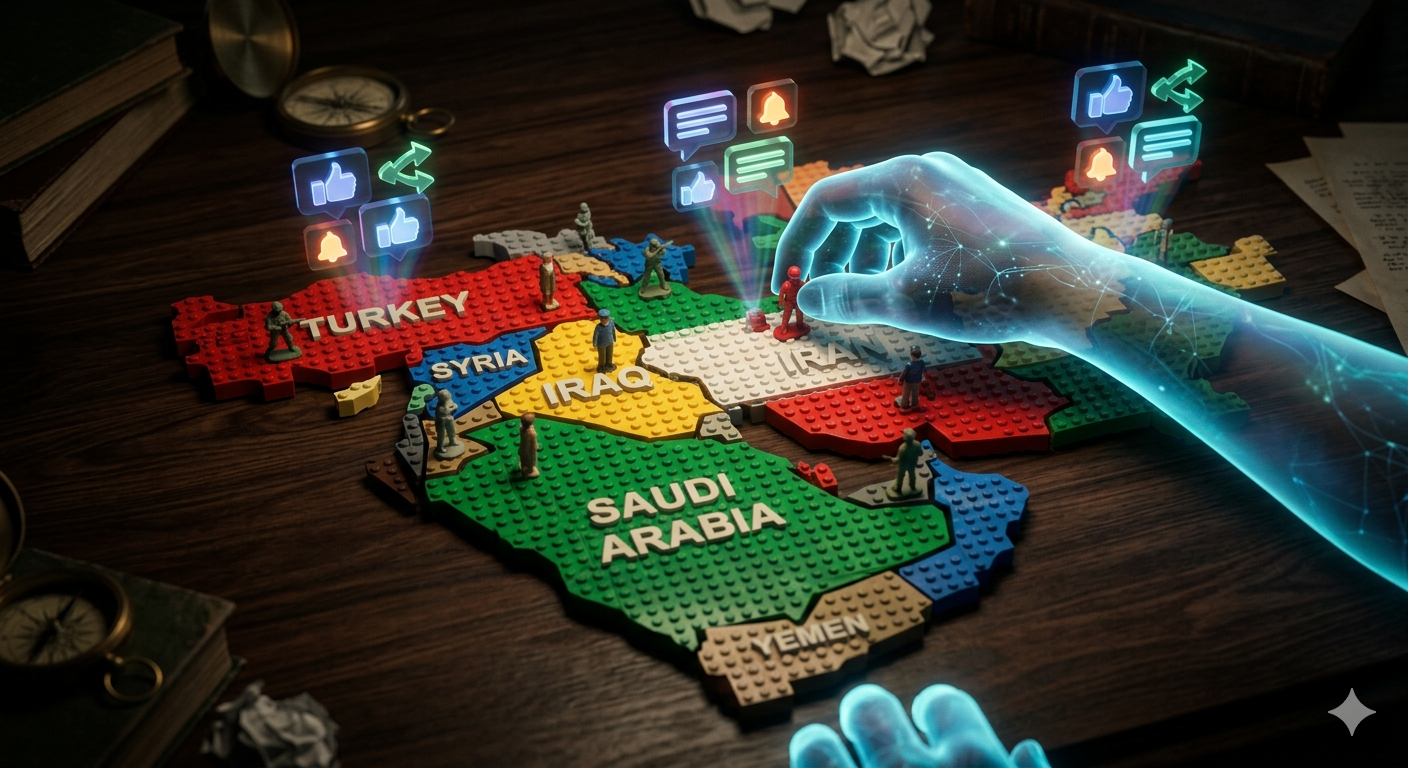
The best-known aspects of Iranian IO have been a series of video produced by Explosive Media, a company in Iran, reportedly with under 10 employees. Although it refers to itself as “independent” a leader of the group acknowledged that the Iranian government is a “customer.” The group – called by another source as Explosive News – existed before the war, but its output reportedly was rather primitive.
The company has released about 10 videos with Lego-style animation, and typically hip-hop soundtracks. A spokesperson for the company said that “Working full time, we can produce a two-minute video in about 24 hours.” Its output has become sufficiently high since it began posting teasers on upcoming videos. Two longer videos have become particularly prominent. The first features memes involving heavy US casualties, the Epstein Files, a crowned Donald Trump, and a repeated motif of “loser.” The second stresses the role of Israel in ‘controlling’ the American government, culminating in President Trump planting an Israeli flag on the Capitol Dome. Similar animated Iranian posts (apparently not produced by Explosive Media) have depicted Trump as a puppet of Israeli Prime Minister Netanyahu. Others have incorporated current controversies, including the Truth Social post of President Trump as a Jesus figure.
These and other products of Explosive Media were removed from YouTube on April 12, 2026, and the company’s channel blocked “for violating our Spam, deceptive practices and scams policies.” It might be fair to assume that this removal was based on quiet American government ‘encouragement.’ Somewhat curiously, the videos remain posted on X, at least at the time of this writing. Likewise, they remain on multiple other social media sites.
Iranian Government IO
Some Iranian official sources have dipped their toes into the IO campaign beyond the expected strategic communications efforts. Iranian embassies in particular have increasingly become active in their IO efforts. In some ways, there seems to be almost a competition among Iranian embassies for who can post the catchiest IO meme. It is not possible from open sources to determine if the embassies are being provided common themes from the Ministry of Foreign Affairs or the Iranian Revolutionary Guard Corps or if they simply are individually determining what would seem to be effective.
As examples, the Iranian Embassy in Thailand posted a screen shot looking like a Trump campaign poster but reading “TRUMP $20.28 [and in small print] per gallon”. The Iranian Embassy in South Africa posted a meme that read “Say hello to the new world superpower,” with a picture of the Iranian flag. The Iranian Embassy in Russia published an AI clip of Trump as a Minion trying to open the Strait of Hormuz.
The Iranian Embassy in the Hague posted an animated video titled “Inside Out: Epstein’s Client”, with the supporting text of “In memory of the 168 innocent schoolchildren of #Minab whose lives were cruelly taken by the most evil people on earth. Their names may fade from the headlines, but they must never fade from our conscience.” Somewhat more brutally, the Iranian Embassy in Tajikistan posted a short video starting with the Trump as Jesus Truth Social meme and concluding with Jesus punching Trump who then falls into a fiery pit.
Iran also has made ample use of AI-created videos to support its claims of success against the US operations. This is not a new issue created by the war. As early as April 2025, then-Supreme Leader Khamenei said: “Artificial intelligence is advancing at an astonishing pace, to the point that people are amazed at the speed of this technology. Therefore, one of the fundamental issues that must be reflected upon, relied upon, and deepened is artificial intelligence.” The Iranian goals for AI certainly extended beyond propaganda videos, but Tehran has grasped the value of AI for information operations.
More prosaically, the Iranian government has tried to garner international support by extensive coverage of civilian human chains surrounding civilian targets potentially subject to US or Israeli bombing. Given the earlier massive anti-government protests in Iran, how many of the participants in the human chains were ‘drafted’ versus true volunteers might be open to question, but they have provided good visuals for the regime. The Iranian government also has been very active in ‘white’ strategic communications.
Impact of Iranian IO
One study found that two pro-Iran networks had racked up more than a billion views on X in the first month of the war. More broadly, virtually all major international media have reported on the various videos posted by Explosive Media. In many ways, the videos have been covered as much as novelties as they have with the overall IO effort, but the coverage almost certainly has led to increased attention. Much of this reporting has not provided full videos, but they typically have included the principal themes. As such, the mainstream media have indirectly reinforced some of the Iranian efforts.
One reflection of the potential effectiveness of the Iranian IO campaign in other countries is that American embassies in Bahrain, Indonesia and Azerbaijan reportedly sent cables to the State Department arguing that the US needed to be more proactive in countering Iranian IO. It might be noted that the Iranian IO efforts are in the wake of the disestablishment of the US Counter Information Manipulation and Interference Office of the State Department in April 2025. This almost certainly has impacted the ability of the State Department to craft a unified response to Iranian IO.
The various tropes in the Iranian IO campaigns indicate a thorough and relatively sophisticated understanding of significant issues within the US that could be used to weaken support among the public for the Administration’s goals. Likewise, the rapid spread of the messaging globally likely will resonate with other countries’ populace who already are (at best) uncertain as to the underlying goals of the US. One notable factor is the speed at which newly emerging themes have been incorporated into the messaging. For one example, although even the earlier messaging suggested Israeli influence over the US, after the increasing debate within the US over this issue, it received much more prominence. Likewise, the controversy over the Trump social media image of him as a ‘healer’ quickly became a key meme on some Iranian IO messaging.
There remain questions as to whether there is an overarching strategic plan for Iranian IO or whether the efforts are more directed at ‘targets of opportunity’, and this represents a potential weakness. Nevertheless, the Iranian IO campaign has been significant, particularly in comparison with the much weaker US efforts. Iran increasingly has become an adversary showing impressive skills in the information domain.


