Russian and Chinese Strategic Gains from the US–Iran War
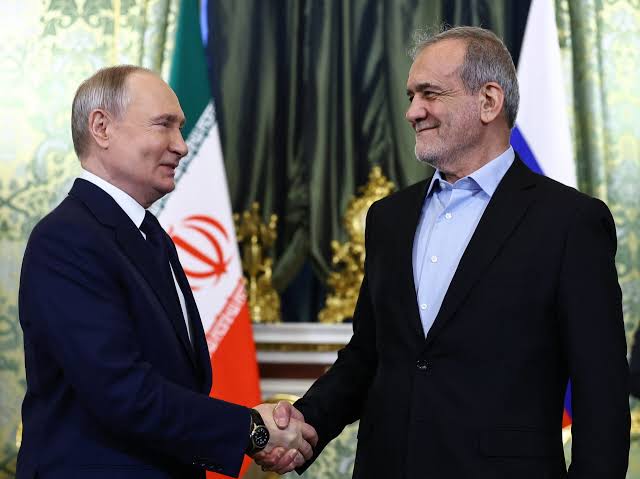

Neither Moscow nor Beijing has entered the war openly. Both are extracting strategic value from it, but for different reasons, through different instruments, and with sharply different exposure to its costs.
The United States, Russia, and China are the three states with genuinely global aspirations, and each has spent the past decade positioning itself for a world in which American primacy is no longer assumed. None of the three has any appetite for direct armed confrontation with the others. Instead, they compete through proxies, sanctions, technology and information, and each treats a rival’s entanglement as an opportunity to be worked rather than a crisis to be resolved. The war that Israel and the United States opened against Iran on February 28, 2026, is the clearest recent case in point. For Moscow and Beijing, it is someone else’s war, and both are quietly converting Washington’s exertion into strategic advantage.
The temptation is to treat Russia and China as a single revisionist bloc pulling in the same direction. That framing is convenient but analytically lazy. The more accurate picture is of two very different powers with partially overlapping interests: a declining but disruptive Russia that gains almost unambiguously from American distraction, and a rising China whose interests in this particular conflict are genuinely cross-cutting. Getting that distinction right is the difference between a slogan and an assessment.
The Eroding Unipolar Moment
For roughly three decades after 1991, the United States enjoyed a margin of power that made the label “superpower” descriptive. That margin has narrowed, but it has narrowed unevenly, and it is worth being precise about how. China has become a peer competitor across the economic and, increasingly, military dimensions of power. Russia is a different case. Four years of grinding war in Ukraine have exposed and degraded its conventional forces rather than showcased them. Russia’s contemporary strength lies not in the ability to build order but in the capacity to disrupt it: energy coercion, information operations, intelligence services, and a willingness to accept costs that deter more status-quo powers.
So, the honest formulation is not that two co-equal challengers have risen to match Washington. It is that American unipolarity has eroded, that China is closing the gap while Russia spoils from a position of relative weakness, and that both find the Iran War a low-cost way to accelerate the drift toward a more contested, multipolar system. What each is doing behind the public rhetoric of restraint follows directly from that difference.
Russia: The Disruptor’s Dividend
Russia’s calculus in the Gulf is inseparable from Ukraine. Moscow has spent four years absorbing the cumulative weight of NATO assistance to Kyiv and, above all, American assistance, and it has every incentive to impose reciprocal costs wherever it cheaply can. Iran offers exactly that opportunity. Tehran supplied Russia with drones and missiles during the Ukraine War; the relationship now runs in the other direction, and it does so in a theater where the burden falls on the United States rather than on Russia.
The most consequential form this has taken is intelligence. Multiple US outlets, first the Washington Post, then CNN and the Associated Press, reported that Russia has passed Iran intelligence on the location and movement of American troops, ships and aircraft, much of it imagery drawn from Moscow’s satellite constellation. Ukrainian defense intelligence has separately corroborated that Russia is feeding Tehran signals and imagery products. Washington has publicly played the reporting down, but the same period saw a marked improvement in the accuracy of Iranian drone and missile strikes against US assets in the Gulf, a correlation that senior former officers have been quick to draw.
A further and more serious allegation is now under examination. US analysts are reported to be investigating whether Russia supplied Iran with the locations of covert CIA facilities in the region. This remains an allegation under investigation rather than an established fact, and it should be treated as such, but if substantiated, it would represent a qualitative escalation from targeting support to the compromise of American clandestine infrastructure.
The dividend for Moscow is threefold. First, resource diversion: every carrier group, air-defense battery and intelligence asset committed to the Gulf is one not available to deter Russia in Europe. Second, reciprocity: Russia inflicts on Washington a version of the external support that Washington has sustained against it in Ukraine. Third, positioning: Russia does all of this while keeping its own hands clean of combat, having neither committed troops nor closed off its diplomatic options, and having abstained rather than voted at the Security Council. It is a near-costless way to bleed the hegemon.
China: Opportunity Braided with Exposure
Beijing’s position is more complicated, and the popular image of China “planning aggression behind the curtain” misreads it. China does derive real strategic benefit from the war, but it also carries real and immediate costs, and its behavior reflects that ambivalence.
On the benefit side, the war is validating Chinese military technology in live conditions. China granted Iran military-grade access to its BeiDou satellite navigation system back in 2021, giving Iranian munitions an alternative to US-controlled GPS. Whether Iran is now using BeiDou to guide strikes in real time is not definitively established from open sources, and the authoritative US-China Economic and Security Review Commission is careful on this point, but the circumstantial evidence of improved Iranian precision after a period of GPS jamming has led numerous analysts to that inference. Beijing also gains a stream of combat data on how its navigation, and potentially its components, perform against Western electronic warfare, intelligence that no exercise can replicate. Chinese ports have, in addition, been reported to load Iranian vessels with sodium perchlorate, a solid-rocket-fuel precursor, and US intelligence has assessed that China may be preparing to supply spare parts and missile components. Every one of these transactions advances Beijing’s interest in a distracted and overstretched United States.
Against all of this stands a hard constraint that Russia does not share: energy. China is the world’s largest crude importer, taking in roughly eleven million barrels a day, and it draws about half of that from the Middle East. A war that threatens the Strait of Hormuz threatens China directly. This is precisely why US officials describe Beijing as the more cautious party, one that actually wants the war to end because it endangers the flow of oil. Chinese state media conspicuously omitted any mention of Beijing’s participation in this year’s Iran-Russia naval exercise in the Strait of Hormuz, a silence some analysts read as deliberate distancing, and Chinese trade with Iran collapsed sharply once the fighting began. Beijing is hedging, not charging.
The Energy Dimension, Corrected
It is worth dwelling on the energy relationship because it is frequently stated backwards. It is often said that China depends on Iran for around eighty percent of its oil. The eighty percent figure is real, but it runs the other way. China buys roughly 80% or more of Iran’s crude exports. Iran, by contrast, supplies only about 12 to 15 percent of China’s crude imports, around 1.38 million barrels a day in 2025, according to tanker-tracking data, much of it relabeled as Malaysian to disguise its origin.
The direction of dependence matters enormously. It means China is Iran’s economic lifeline rather than its dependent and therefore holds leverage over Tehran rather than the reverse. Beijing has used precisely this position, reportedly pressing Iran to keep the strait open for Chinese-linked shipping. China’s true vulnerability is not Iran specifically but the Gulf as a whole and the Hormuz chokepoint through which a fifth of the world’s seaborne oil passes. That is the asymmetry that a serious assessment must hold in view.
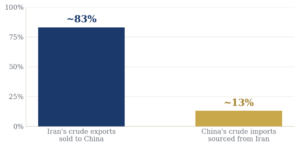
Figure 1. Who depends on whom: the oil-trade asymmetry, 2025. The eighty percent runs the other way. China absorbs the great majority of Iran’s sanctioned crude, but Iran is a modest slice of China’s supply, making Beijing the party with leverage. Sources: Kpler and China customs data via the Center on Global Energy Policy, Columbia University; Modern Diplomacy.
| Source | Share | Note |
| Russia | ~19% | Discounted post-2022; China’s single largest supplier |
| Saudi Arabia | ~14% | Long-standing anchor supplier |
| Iran | ~13% | Largely relabeled as “Malaysian” to evade sanctions |
| Iraq | ~11% | Middle East, Hormuz-exposed |
| United Arab Emirates | ~7% | Middle East, Hormuz-exposed |
| Oman | ~6% | Middle East, adjacent to Hormuz |
| Others | ~30% | Incl. Malaysia (relabeled), Brazil, Angola, West Africa |
Table 1. China’s principal crude oil suppliers, 2025 (approximate share of imports). Shares indicative and rounded; roughly half of China’s crude originates in the Middle East, the core of its Hormuz exposure. Compiled from China General Administration of Customs data and Kpler tanker tracking via the Center on Global Energy Policy and Visual Capitalist.
The Price Shock and The Wider Order
The war’s effect on oil markets illustrates why China cannot simply cheer Washington’s difficulty. As the fighting spread to the strait, Brent moved from the low eighties before the strikes to a four-year high around 126 US dollars a barrel by late April, with US crude posting its largest weekly gain since the futures contract began trading in 1983. Prices of that order damage every large energy importer, China foremost among them, and they feed directly into the domestic inflation that Beijing can least afford. A war that overstretches the United States is welcome in Beijing; a war that closes Hormuz is not.
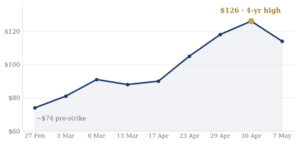
Figure 2. Brent crude during the war, February to May 2026 (US dollars per barrel, indicative). A shock that cuts both ways: the war drove Brent to roughly 126 dollars, a four-year high, hurting every major importer including China. Trajectory indicative, compiled from contemporaneous market reporting on the 2026 Strait of Hormuz crisis.
This is where the war intersects with the deepest layer of American power and with the point that any major change in the Middle East redraws the global order. Since 1974, the petrodollar system has underpinned dollar primacy: oil priced and invoiced in dollars generates perpetual global demand for the currency, allows Washington to run deficits cheaply, and gives its sanctions their bite. The Gulf is not merely an energy region for the United States. It is the foundation of the dollar’s reserve status.
The Iran War is straining that foundation in a way that serves Beijing. Reports indicate that Iran has offered passage through Hormuz to selected tankers on condition that oil and transit fees are settled in Chinese yuan or stablecoins, which analysts at Deutsche Bank flagged as a potential watershed for oil-trade invoicing. China is the structural beneficiary of every non-dollar energy transaction, securing discounted supply while advancing the internationalization of its currency. The realistic prospect is not the sudden collapse of the petrodollar but its gradual erosion, and this war has moved that erosion from a theoretical risk toward a structural trend. For Beijing, that slow reordering of global energy finance may prove the single largest long-term gain of all.
| Dimension | Russia | China |
| Core motive | Reciprocity for Ukraine; bleed and distract the US | Weaken US primacy while protecting its own energy security |
| Principal instrument | Intelligence and satellite imagery on US assets | BeiDou access, dual-use components, oil purchases |
| Posture | Active spoiler; near-costless involvement | Cautious hedger; wants the war contained |
| Chief exposure | Limited, constrained mainly by the Ukraine War | High; about half of crude from the Middle East, Hormuz risk |
| Strategic prize | US resources diverted from Europe | Erosion of the petrodollar; combat-tested technology |
Table 2. Two powers, two strategies
Conclusion
The war that Washington and Israel opened against Iran is, for its two great-power rivals, a strategic gift they did not have to pay for in blood. But the gift is not identical for both. Russia is the clearer winner: it diverts American attention and resources, repays Western support for Ukraine in kind, degrades US clandestine and conventional advantages in the region, and does so while keeping its own forces uncommitted. China gains too in combat validation of its technology and, more importantly, in the accelerating erosion of the dollar order, yet it pays a real price in energy insecurity and price shocks, and it therefore wants the conflict contained rather than prolonged.
The analytical error to avoid is collapsing these two into a single hostile bloc. They are better understood as opportunists whose interests overlap without coinciding. What they share is the underlying wager that a United States expending itself in the Gulf is a United States less able to shape the emerging multipolar order, and on the evidence of the past five months that wager is paying off. Any lasting change in the Middle East, whether in the security of the strait, the survival of the petrodollar, or the balance among external powers, will help define the world order that follows. On present trends, that order is being written a little more in Moscow’s and Beijing’s favor and a little less in Washington’s, with each passing month of the war.