





Glass Cannon in the First Island Chain: How China Can Fracture the US-Japan-South Korea Warfighting Network
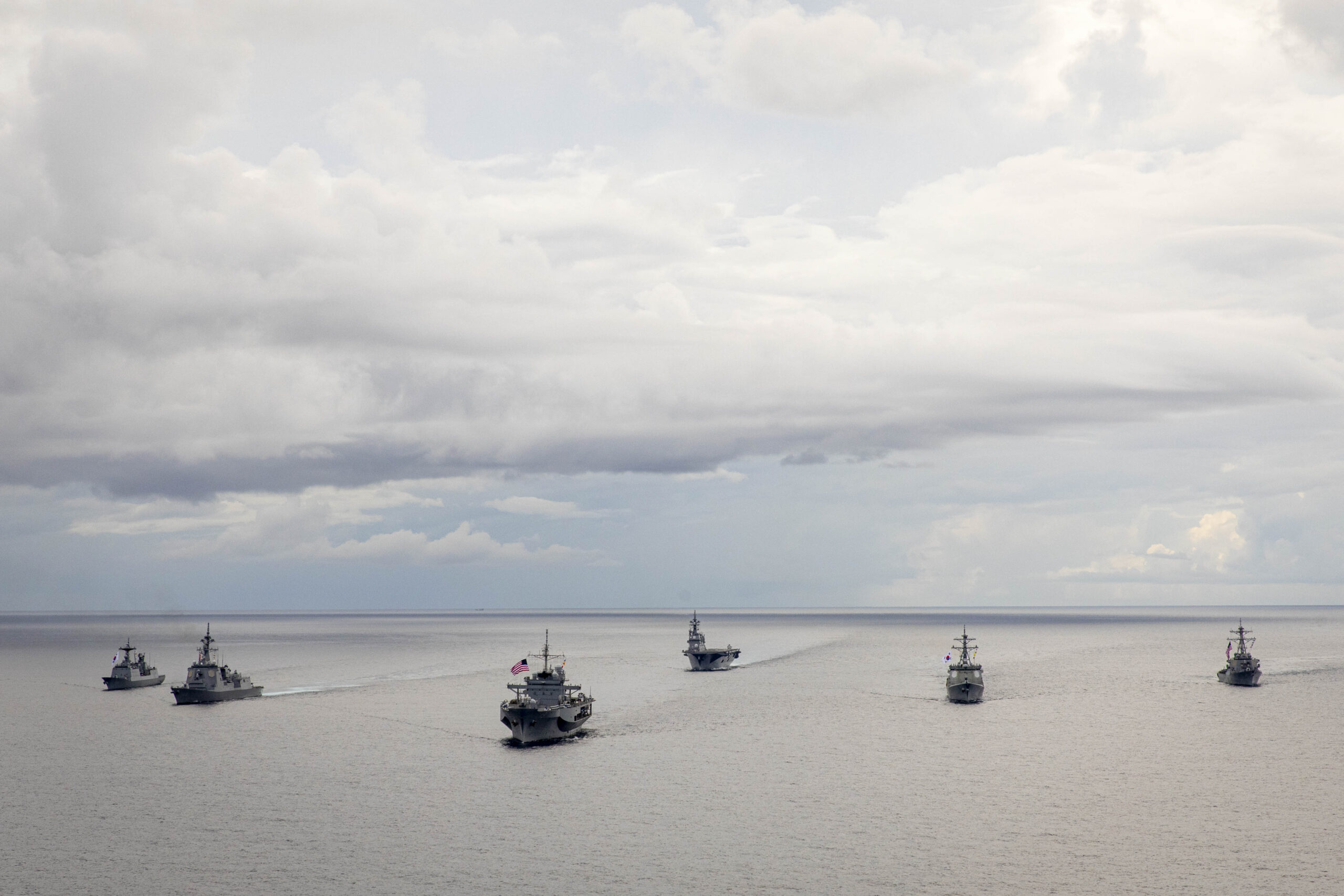

The rapid transformation of the US-Japan-South Korea security alliance from a traditional hub-and-spoke model into an integrated, machine-speed warfighting network is a monumental shift in Pacific deterrence. To survive a battlespace increasingly dominated by adversaries’ hypersonic weapons and AI-enabled targeting, the three allies are pursuing seamless command-and-control architectures, rapid data-sharing, and automated sensor-to-shooter loops. However, this hyper-connectivity introduces a critical point of failure. The emerging trilateral network risks becoming a “glass cannon”—exceptionally lethal under ideal conditions, but highly vulnerable to sophisticated Chinese counter-space, cyber, and electronic warfare campaigns designed to fracture allied cohesion by degrading trust in shared data.
This systemic shift moves beyond the traditional hub-and-spoke alliance model toward a more networked approach to coalition warfare. Recent trilateral initiatives—including institutionalized security cooperation following the 2023 Camp David summit and increasingly sophisticated exercises such as Freedom Edge—illustrate this trajectory toward deeper operational integration. As these efforts mature, the coalition’s center of gravity extends beyond ships, aircraft, or missile batteries to encompass the technical systems and political trust required to enable three sovereign militaries to operate as a single fighting network. This emphasis aligns closely with the People’s Liberation Army’s (PLA) concept of Systems Destruction Warfare, which prioritizes disrupting an adversary’s operational architecture rather than simply destroying individual platforms.
Applied to the emerging trilateral defense network, Beijing’s most promising avenue may be less about overwhelming allied forces through missile volume than about degrading confidence in shared information, complicating decision-making, and exploiting residual political friction within the partnership. Even temporary uncertainty regarding the integrity of shared data can significantly reduce operational tempo if commanders abandon automated coordination and revert to slower, nationally isolated decision processes. Such hesitation may provide an adversary with the opportunity to pursue a rapid, limited fait accompli before allied decision-making regains coherence.
The Electronic Illusion: Targeting the Data Fusion Matrix
The opening phase of such a campaign could emphasize operations in the electromagnetic spectrum rather than immediate kinetic strikes. Modern operational integration depends upon rapid, trusted exchange of data with enough quality to engage adversarial targets. A Japanese early warning radar must be able to pass precise tracking information to the interceptor—whether American or South Korean—best positioned to engage an incoming threat. The critical requirement is not simply network speed but sustained confidence that the underlying data accurately represents the battlespace.
Available evidence suggests that directly penetrating heavily encrypted tactical data links remains exceptionally difficult. Instead, PLA investments in AI-enabled electronic warfare, counter-space capabilities, and counterintelligence, surveillance, and reconnaissance appear increasingly oriented toward degrading the reliability of sensor fusion itself. Rather than flawlessly fabricating an entirely false operational picture, electronic attack may seek to introduce ghost tracks, localized timing inconsistencies, conflicting telemetry, or intermittent data degradation sufficient enough to generate uncertainty among commanders.
Therefore, the objective of such attacks is not technical perfection but operational hesitation.
Modern tactical networks incorporate substantial redundancy, alternate routing, and strong cryptographic protections. Yet, operational effectiveness ultimately depends upon confidence in machine-generated recommendations. If commanders cannot rapidly distinguish genuine threats from electronic deception during compressed engagement timelines, the natural temptation is to suspend delegated authorities and demand additional verification.
Therefore, the objective of such attacks is not technical perfection but operational hesitation. Machine-speed warfare depends less on perfect automation than on institutional confidence that automated recommendations remain reliable under contested conditions. With sufficient doubt, even a technically resilient network can experience significant degradation in decision tempo.
Fragmenting the Infrastructure
A parallel effort would degrade the physical and digital infrastructure supporting coalition operations. Targeted electronic attacks, cyber disruption of commercial logistics networks, interference with communication nodes, and attacks against space-enabled services could fragment the common operational picture short of complete network collapse.
Distributed fire-control architectures depend upon highly synchronized Position, Navigation, and Timing (PNT) data to correlate information across geographically dispersed sensors. Localized GPS interference and timing disruption—capabilities demonstrated in multiple contemporary conflicts—illustrate how even modest inconsistencies can complicate the generation of weapon-quality tracks. As synchronization deteriorates, allied forces increasingly rely upon locally generated information, gradually reducing the advantages of distributed sensor-to-shooter integration.
Rather than producing a dramatic systems failure, such degradation would more likely create localized operational fragmentation in which portions of the network remain functional while confidence in shared information steadily declines.
The Political Vector: Weaponizing Sovereign Vulnerabilities
Technical disruption alone is unlikely to prove strategically decisive. Its greatest value lies in amplifying political uncertainty between members of the alliance. Operational integration inevitably intersects with sensitive questions of sovereignty, accountability, and domestic political legitimacy. As allied governments expand automated data sharing and consider greater delegation of defensive authorities, public sensitivity regarding responsibility for unintended casualties or escalation is likely to increase. These dynamics are particularly relevant within the US-Japan-South Korea relationship, where historical grievances continue to require sustained diplomatic management despite significant recent improvements.
Such operations need not fundamentally alter long-term public opinion to achieve operational success. They need only generate sufficient political controversy during a compressed crisis window to complicate executive decision-making and delay coordinated military action.
Under its concept of the Three Warfares—public opinion, psychological, and legal warfare—Beijing has long emphasized shaping adversary decision-making beyond the kinetic battlefield. In a crisis, an electronic warfare anomaly or failed interception could quickly become the catalyst for an information campaign employing AI-generated synthetic media, coordinated social media amplification, and carefully tailored narratives designed to misattribute responsibility before technical investigations can correct the record.
These narratives would likely differ across domestic audiences. In Washington, narratives would likely focus on the costs and risks of extended deterrence commitments. In Tokyo, campaigns might portray increasingly automated trilateral operations as inconsistent with constitutional constraints or as creating unnecessary escalation risks. In Seoul, messaging could emphasize concerns regarding sovereignty. Such operations need not fundamentally alter long-term public opinion to achieve operational success. They need only generate sufficient political controversy during a compressed crisis window to complicate executive decision-making and delay coordinated military action. Targeted economic coercion exploiting supply-chain dependencies or critical technologies could reinforce these pressures by increasing the perceived domestic costs of alliance cohesion.
Building Institutional and Technical Resilience
Preventing the emerging warfighting network from becoming a glass cannon requires shifting emphasis from maximizing connectivity to ensuring resilience under degraded conditions. The US Pacific Command, the Japan Self-Defense Forces, and the Republic of Korea Armed Forces should routinely train under conditions of severe network degradation. Trilateral exercises should regularly simulate prolonged PNT denial, corrupted sensor fusion, contested electromagnetic environments, and communications outages, evaluating commanders not on maintaining perfect connectivity but on sustaining operational effectiveness despite uncertainty.
Furthermore, the US and its allies should develop a formal doctrine of graceful degradation. Rather than assuming uninterrupted connectivity, command and control architectures should be designed to preserve combat effectiveness even if portions of the network go offline. Automated decision-support systems should provide commanders with confidence assessments reflecting the consistency and quality of underlying sensor data, enabling leaders to evaluate not only what the network recommends but also how reliable those recommendations remain under contested conditions.
Ultimately, the effectiveness of the emerging US-Japan-South Korea warfighting network will not be determined solely by the speed of its algorithms or the sophistication of its weapons. It will depend on whether allied institutions can preserve trust when information is deliberately corrupted, communications are degraded, and political cohesion is placed under sustained pressure.
Institutional resilience is equally important. Allies should establish pre-negotiated legal authorities and clearly defined command relationships governing operations during communications blackouts or periods of ambiguous data integrity. Technical fallback options provide limited value if commanders lack political authorization to act when connectivity is degraded.
The alliance should also institutionalize a permanent trilateral mechanism dedicated to countering disinformation and rapidly coordinating intelligence declassification during crises. Timely, coordinated public communication can reduce opportunities for adversaries to exploit uncertainty before inaccurate narratives become politically entrenched.
Ultimately, the effectiveness of the emerging US-Japan-South Korea warfighting network will not be determined solely by the speed of its algorithms or the sophistication of its weapons. It will depend on whether allied institutions can preserve trust when information is deliberately corrupted, communications are degraded, and political cohesion is placed under sustained pressure. A network designed to function only under conditions of perfect connectivity risks becoming a glass cannon—exceptionally powerful under ideal circumstances but increasingly fragile when confronted by a sophisticated systems-destruction campaign. Therefore, durable deterrence in the First Island Chain will depend not only on technological superiority, but on the alliance’s ability to fight cohesively through uncertainty.
Disclaimer: The views expressed are those of the author and do not reflect the official position of the Department of the Army or the Department of War.


