The Strategic Messages of Operation Epic Fury
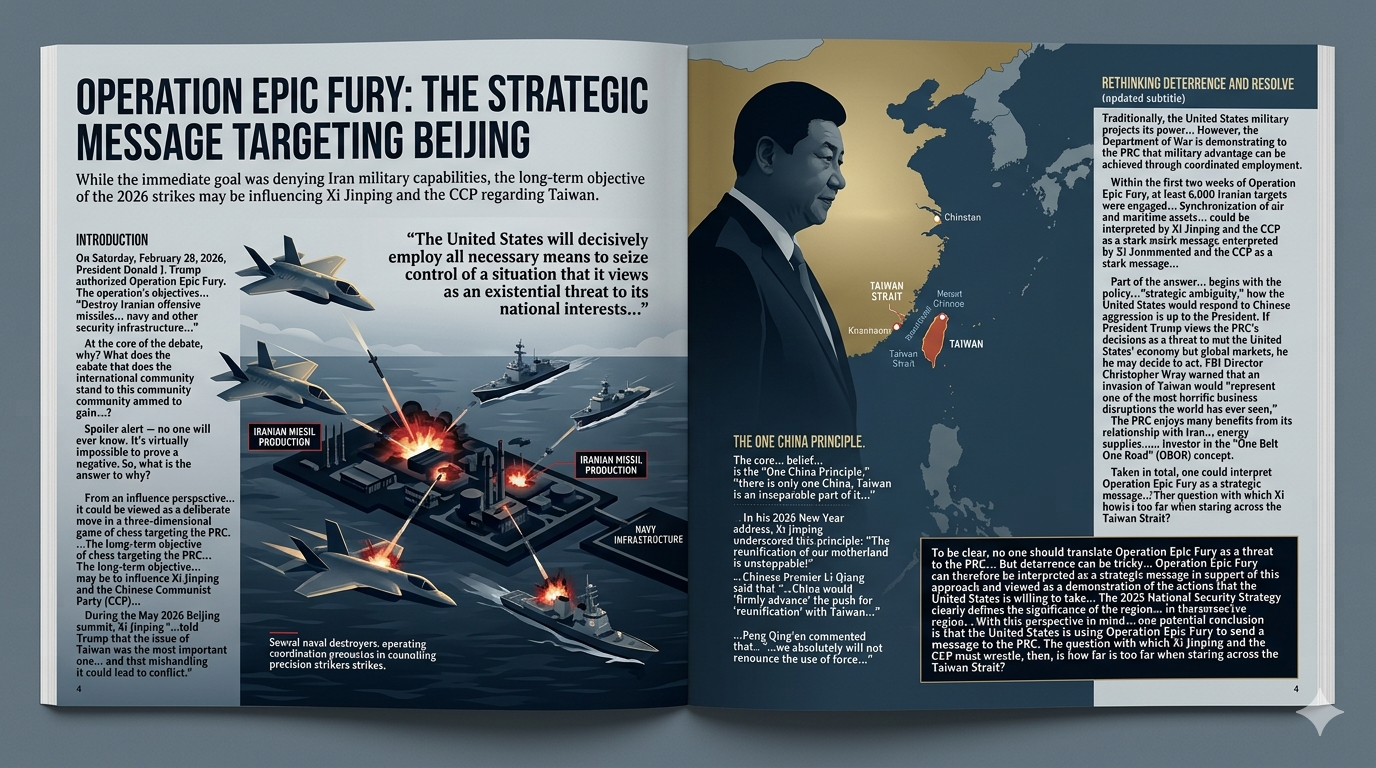

Strategic messaging is a powerful tool in deterrence that encapsulates not just traditional forms of communication to convey a message, but the synchronized use of information, policy, activities, and capabilities. With this strategic backdrop in mind, Operation Epic Fury could be viewed by countries who threaten global economic and geopolitical ecosystems as a signal of potential consequences that they could endure should the United States feel that its interests are threatened. More specifically, the Chinese Communist Party (CCP) may benefit from viewing Operation Epic Fury as a strategic message that the United States will decisively employ all necessary means to seize control of a situation that it views as an existential threat to its national interests and strategic goals.
Introduction
On Saturday, February 28, 2026, President Donald J. Trump authorized Operation Epic Fury. The operation’s objectives, as laid out by the Secretary of War, were clear: “Destroy Iranian offensive missiles, destroy Iranian missile production, destroy their navy and other security infrastructure – and they will never have nuclear weapons.” It’s as simple as that. Or is it…? The veracity of President Trump’s decision and the Department of War’s swift action will be debated for years to come. At the core of the debate, elected officials, political theorists, academics, political junkies, the “MAGA Movement,” and “Never Trumpers” will try to answer one question – why? What does the United States, Israel, and the rest of the international community stand to gain from this decision? If the answer to the question is: “Iran was never able to attack the West or Israel,” it should be met with justified apprehension because the simple retort will be framed as a question: “How will the world ever know if Iran would have ever used those tools to attack Israel, the United States, or anyone else?” Spoiler alert – no one will ever know. It’s virtually impossible to prove a negative. So, what is the answer to why?
From an influence perspective, one could make the argument that the answer goes well beyond the potential near- to mid-term threat that Iran posed to the international community. On the contrary, it could be viewed as a deliberate move in a three-dimensional game of chess targeting the PRC in a bid by the United States to maintain its position as the leader of the free world. Viewing Operation Epic Fury through this long-term lens allows it to be interpreted as an example of strategic messaging, or the coordinated and synchronized use of information, activities, and capabilities to advance a nation’s interests through the implementation of policies and execution of operations. When viewed through the lens of strategic messaging, one possible answer to “why” becomes clearer: While the administration’s immediate short-term goal is to deny Iran of the military capabilities required to threaten the United States and its partners and allies, the long-term objective of Operation Epic Fury may be to influence Xi Jinping and the Chinese Communist Party (CCP) from fixing their sights on Taiwan, a task that is going to prove to be more challenging as time passes. During theMay 2026 Beijing summit, Xi Jinping “…told Trump that the issue of Taiwan was the most important one in US-China relations, and that mishandling it could lead to conflict.” With that in mind, the Trump Administration may be looking to maximize indirect approaches to signal to PRC leadership that a forceful reunification with Taiwan is not in anyone’s best interest.
The One China Principle
The core, underlying belief that guides CCP decision making is the “One China Principle,” or the belief that “there is only one China, Taiwan is an inseparable part of it, and the People’s Republic of China (PRC) alone has the right to rule over all of it.” In his 2026 New Year address, Xi Jinping underscored this principle: “We Chinese on both sides of the Taiwan Strait share a bond of blood and kinship. The reunification of our motherland, a trend of the times, is unstoppable!” And this theme continues to guide the PRA’s foreign policy strategy around the world. During the National People’s Congress on March 4, 2026, Chinese Premier Li Qiang said that “…China would ‘firmly advance’ the push for ‘reunification’ with Taiwan while opposing external interference, and [sic] strive to work with regular Taiwanese to realize the rejuvenation of the Chinese nation.” The Ambassador of China to Ireland Zhao Xiyuan echoed similar sentiments in a letter to The Irish Times where he wrote: “There is but one China in the world, Taiwan is an inalienable part of China, and the government of the People’s Republic of China is the sole legal government representing the whole of China. The abiding commitment of the international community to the one-China principle is unshakeable.” These sentiments demonstrate why preventing the CCP from fixating on Taiwan is going to be a very difficult task in the years to come. Moreover, since the establishment of the PRC and the CCP in 1949, Taiwan has never been governed by the PRC, thereby making the “reunification” assertion of Chinese leaders false.
Regardless, PRC leadership remains focused on pursuing this idea and resolving what it refers to as the “Taiwan issue.” Peng Qing’en, a spokesperson for China’s Taiwan Affairs Office, commented that using peaceful means is the preferred method to bring Taiwan fully under PRC control but went on to say that “[…] we absolutely will not renounce the use of force and reserve the option to take all necessary measures.” If the CCP views the use of force as an option to gain control of Taiwan, the global impacts will be catastrophic. There will be myriad questions hanging over the international community that must be addressed in the near-term: What are the conditions that will trigger this decision by the CCP? Is there anything that can be done to prevent it? If not, what can be done to deter it for as long as possible? While Operation Epic Fury addresses the threats posed by Iran and the Trump Administration’s stated objectives, it may be a strategic signal to the PRC that is meant to address these and similar questions.
Deterrence in Action
Traditionally, the United States military projects its power through the air, on land, and at sea, and decisive victory has traditionally required boots on the ground. However, the Department of War is demonstrating to the PRC that military advantage can be achieved through the coordinated employment of, at a minimum, operations in the maritime and air domains (while other domains such as cyber and space have been alluded to by United States Central Command). Within the first two weeks of Operation Epic Fury, at least 6,000 Iranian targets were engaged by the United States and Israel. They included, but were not limited to, Iranian vessels, military headquarters buildings, intelligence sites, weapons production facilities, and missile sites. Synchronization of air and maritime assets, coupled with other special capabilities, provided United States Central Command with access and placement into a denied area at the time and choosing of the United States and its partners and allies. With that in mind, this could be interpreted by Xi Jinping and the CCP as a stark message of the potential consequences should they decide to attempt to seize control of Taiwan by force. Said differently, the United States’ actions in Iran could be viewed as an answer to the following question: Would the United States engage the PRC in a similar fashion and, if so, what would trigger the United States to do so?
Part of the answer to this question begins with the policy through which the United States views China. For decades, the United States has been committed to the “One China” policy, or the United States Government’s recognition of “[…] the PRC as ‘the sole legal Government of China’ and maintained relations with Taiwan on an unofficial basis.” This policy is often mentioned alongside the long-term policy of “strategic ambiguity,” or the idea that the actions that the United States would take to defend or support Taiwan in response to a PRC attack on the island are not clearly defined since there is no formal security agreement between the United States and Taiwan. Instead, how the United States would respond to Chinese aggression is up to the President of the United States at the time of the aggression. With that in mind, when looking at United States’ actions in Iran from a PRC perspective, the signaling coming from the Trump Administration could be viewed as a deterrence signal: If the United States felt that Iran’s pursuit of a nuclear program threatened its interests, the administration has demonstrated the resolve to act. What actions, then, could the PRC take that would make the United States feel as though its interests were threatened?
“Speaking in 2022 alongside MI5 General Director Ken McCallum in London, FBI Director Christopher Wray warned that an invasion of Taiwan would “represent one of the most horrific business disruptions the world has ever seen,” […]” Hence, if President Trump views the PRC’s decisions regarding its handling of the “Taiwan issue” as a threat to not just the United States’ economy but global markets, he may decide to act. The calculus that he uses to inform his decisions is atypical from other presidents who favored predictable processes and institutions to inform their foreign policy. This shift to developing foreign policy based on a president’s personality vice a more traditional path puts more onus on other countries to engage bilaterally with the United States and rewards those countries that are willing to engage vis-à-vis with President Trump. Coupling the existing “One China” policy that favors strategic ambiguity with the United States’ un-forecasted actions in Iran to protect United States’ interests could be viewed by the CCP as a significant strategic message: do not do anything that could be viewed as provocative in Taiwan. Moreover, Xi Jinping and the CCP may benefit by viewing Operation Epic Fury as a cue to engage with President Trump on their ambitions in Taiwan to avoid the possibility of military actions in and around the PRC.
Moving beyond the United States’ policies on how to coexist with the PRC, it’s important to also examine the PRC’s partnerships with other countries, especially in the Middle East. The PRC enjoys many benefits from its relationship with Iran. These include but are not limited to: discounted rates on energy supplies required to fuel their military; an ally whose government is not aligned with Western principles and values; a potential investor in the PRC’s “One Belt One Road” (OBOR) concept (i.e. – a self-serving theory to expand investment in the PRC’s economy and provide the CCP with access and placement in not just Iran but vulnerable states around the globe); and revenue generation that comes from Iran’s purchase of arms and technology to augment its military.
In short, when the CCP analyzes the Trump Administration’s decision to execute Operation Epic Fury, they may see more than a tangible demonstration of U.S. resolve to directly eliminate threats that are not aligned with the interests of the United States and its partners and allies. They may also interpret the United States’ actions as having a negative impact on the PRC’s ability to establish and leverage relationships to advance the CCP’s political objectives; a deteriorated ability for the People’s Liberation Army (PLA) to plan, execute, and sustain military operations to further its interests as a result of decreased access to energy sources; and a decline in foreign direct investment into the PRC’s economy. Taken in total, one could interpret Operation Epic Fury as a strategic message to not just the PRC but other states around the world that partnering with the PRC could carry catastrophic consequences.
To be clear, no one should translate Operation Epic Fury as a threat to the PRC by the United States nor any of its partners and allies. On the contrary, the 2025 National Security Strategy specifically calls for a “…robust and ongoing focus on deterrence to prevent war in the Indo-Pacific.” But deterrence can be tricky… It requires willful participation from an adversary, “[…] a threat to keep an adversary ‘from starting something,’ or ‘to prevent [an adversary] from action by fear of consequences.’” Operation Epic Fury can therefore be interpreted as a strategic message in support of this approach and viewed as a demonstration of the actions that the United States is willing to take when it feels its interests are threatened. While the immediate effect is an impotent Iran that is unable to effectively employ its military, direct its global proxy network, or mature a nuclear weapons program, these effects should be viewed as short-term objectives in a long-term competition for global leadership. The 2025 National Security Strategy clearly defines the significance of the region: “The Indo-Pacific is already the source of almost half the world’s GDP based on purchasing power parity (PPP), and one third based on nominal GDP […] which means that the Indo-Pacific is already and will continue to be among the next century’s key economic and geopolitical battlegrounds.” With this perspective in mind and when analyzed in terms of long-term strategic goals, one potential conclusion that can be reached is that the United States is using Operation Epic Fury to send a message to the PRC.
With this strategic backdrop in mind, Operation Epic Fury should be viewed by countries who threaten this global economic and geopolitical ecosystem as a signal of potential consequences they could endure. And if that is indeed the case, the PRC would greatly benefit from this strategic message: Without question, the United States will decisively employ all necessary means to seize control of a situation that it views as a threat to its interests and goals. The question with which Xi Jinping and the CCP must wrestle, then, is how far is too far when staring across the Taiwan Strait?