





Mind the Gaps: Rethinking Landpower in a Maritime Environment

Abstract
The decisive terrain in a Taiwan contingency extends beyond the Taiwan Strait to the maritime gaps of the First Island Chain, where land forces will play a critical role in deterring and contesting Chinese power projection. This article argues that the US and allied land forces are already evolving into a distributed network of sensing, fires, and sustainment designed to secure these key chokepoints. However, to remain effective against a peer adversary, forward-positioned forces must combine resilient network-enabled munitions, modular containerized systems, and distributed logistics to survive and persist inside contested maritime terrain. These capabilities are essential to strengthening deterrence, preserving allied freedom of maneuver, and preventing a strategic breakout into the Pacific region.
The Maritime Gaps: The New Front Line in the Pacific
According to the memoirs of General Dwight Eisenhower, a major concern of the United States Department of War in early 1942 was “securing practical battlefield experiences [for the Army in the Philippines] before the whole of it should finally be thrown into a life-and-death struggle.” That struggle arrived abruptly for forces in the Philippines against the invading Japanese, and much of the hard-fought experience they gained on Corregidor and Bataan was lost before it could be fully understood. Today, the United States faces a similar challenge in the Pacific: understanding how land forces forward-positioned across an archipelagic environment will contribute before a crisis escalates into open conflict.
While some analysts look to the Strait of Hormuz for littoral lessons, the operational realities of the Pacific suggest that the decisive lessons are emerging not from the Middle East, but from the land power network currently operating in the maritime “gaps” of the First Island Chain. As Admiral Samuel Paparo emphasized in recent testimony before the Senate Armed Services Committee, the Pacific region is the one theater where all four lines of effort in the National Defense Strategy converge every single day.
Iran’s asymmetric tactics in the Strait—including fast attack craft, sea mines, coastal anti-ship missile batteries, and drones—complicate navigation and raise the cost of access. US land forces have played a significant role in countering this, illustrating shore-based forces’ ability to shape maritime maneuvers. Yet, more importantly, the United States is not the only actor learning from this conflict. Observers like the People’s Republic of China (PRC) would also identify land force vulnerabilities exposed by these operations—namely, an overreliance on forward basing, an unsustainable munitions cost curve, and an expectation of persistent communications. As a result, the operational problem facing the Joint Force in the Pacific is far larger in both scale and consequence.
In a Taiwan contingency, the immediate frontlines would not be a single chokepoint, but a series of interconnected maritime gaps stretching across the First Island Chain—including the Miyako Strait, Yonaguni Gap, Luzon Strait, and Bashi Channel. Control of these passages will determine whether the PRC can project power, isolate Taiwan, and prevent US and allied forces from intervening effectively.
Across these gaps, mobile, distributed, and networked land forces are already securing critical terrain, complicating adversary options, and reinforcing deterrence.
To remain relevant in Taiwan contingency, however, these forces will depend not just on forward position but on enhanced network connectivity and the ability to remain mobile, logistically sustainable, and capable of operating under persistent observation and threats across contested maritime terrain.
Strategic Competition and Coercive Behavior: Why the Gaps Matter
Understanding the necessity for adapted land forces begins with recognizing the immense strategic and economic stakes defining the Pacific. The 2026 National Security Strategy underscores that a sustained military imbalance could effectively deny the United States access to the world’s economic center of gravity. While maritime chokepoints like the Strait of Malacca carry roughly 40 percent of global trade annually, in a Taiwan contingency, the decisive front lines would emerge farther north along the maritime gaps adjacent to Japan and the Philippines.
Successfully isolating the Taiwan Strait and executing a Joint Island Landing Campaign requires more than an immediate blockade of Taiwan itself. China must extend its anti-access/area denial (A2/AD) network eastward into the East Philippine Sea to increase its range to detect, target, and strike US air and naval forces. This defense-in-depth depends upon the People’s Liberation Army (PLA) projecting force through critical maritime chokepoints—particularly the northern passages through the Japanese Southwest Islands and southern passages near northern Luzon in the Philippines. Control of these gaps is essential for enabling PLA maneuver, preventing US counter-intervention, and sustaining operational access beyond Taiwan’s immediate periphery. Unchecked, this expansion would severely constrain Washington’s ability to defend regional allies, effectively shifting the Second Island Chain into the last forward line of defense.
This expansion is not hypothetical. Beijing’s ongoing coercive activities already function as operational rehearsals for a Taiwan contingency. The PRC routinely employs maritime militia, coordinated Coast Guard patrols, and its maritime safety administration to rehearse blocking formations around Taiwan. These grey-zone maneuvers—including enhanced customs inspections that function as de facto quarantines—allow Beijing to pressure Taiwan below the threshold of open conflict, impose economic hardship, and compel unification under a veneer of legal ambiguity.
Simultaneously, major PLA exercises such as Joint Sword and Justice Mission demonstrate how these concepts translate into conventional fires and maneuver. During these operations, the PLA has surged surface combatants through key maritime gaps, including the deployment of the Shandong Carrier Strike Group through the Luzon Strait just 200 nautical miles off Northern Luzon, while irregular maritime formations have challenged Philippine vessels in adjacent waters. Further north, PLA naval task groups have transited the Miyako Strait and, more recently, have operated closer to the Japanese mainland than ever before. Collectively, these movements reinforce the PLA’s outer defense layer to preserve interior maneuver options around Taiwan through routes such as the Bashi Channel and Yonaguni Gap.
Ultimately, these actions matter because they actively shape the operational conditions for a Taiwan contingency. If the United States and its allies fail to contain PLA access through First Island Chain gaps, Beijing will gain the ability to project power deeper into the Pacific, as demonstrated by recent dual-carrier operations beyond Guam. Preventing this strategic breakout, therefore, requires holding key maritime chokepoints, driving the urgent transformation of the allied land-power network into a coherent system capable of sensing, contesting, and controlling these gaps from the shore.
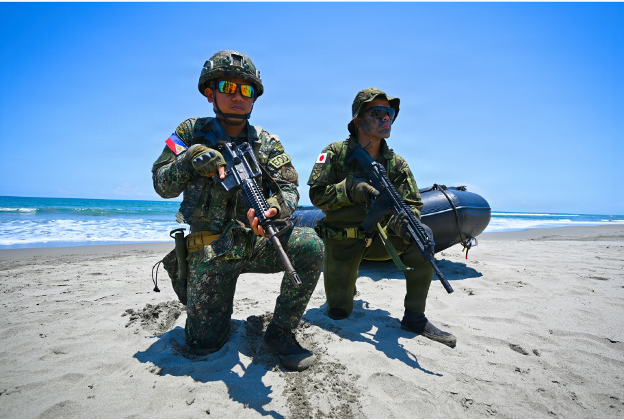
Japan Ground Self-Defense Force and Philippine Army service members establish a security position on the shoreline while conducting an amphibious assault during Exercise Balikatan 2026 at Aparri, Philippines, April 28, 2026. Balikatan is a longstanding annual exercise between the Armed Forces of the Philippines and the US military that represents the strength of our alliance, improves our capable combined force, and demonstrates our commitment to regional peace and prosperity. (Courtesy Photo by Japan Self-Defense Force)
From Coercion to Contested Control: Adapting Landpower for the Maritime Gaps
In response to China’s expanding power projection, allied land forces across the First Island Chain are increasingly orienting their posture, exercises, and modernization efforts toward securing key maritime gaps from the shore. While each service and partner force contributes distinct capabilities, together they are forming an integrated land power network of sensing, fires, mobility, and access denial designed to complicate PLA freedom of maneuver through the region’s littorals.
Through its concept of Expeditionary Advanced Base Operations, the US Marine Corps leads the joint force in littoral maneuver. Forward positioned units, including newly established Marine Littoral Regiments, are actively training to seize, occupy, and sustain austere island positions using unique rotary-wing aviation, amphibious landing craft, hydrographic survey, and expeditionary engineering formations not resident in other services. Under Force Design 2030, this transformation is accelerated through highly mobile sensing and the Navy-Marine Expeditionary Ship Interdiction System, enabling distributed forward sensing and anti-ship fire zones. These capabilities directly contest PLA naval movement through key chokepoints and represent the Joint Force’s most developed framework for enabling sea denial from the shore.
US Special Operations Forces (USSOF) complement this network by enabling access to key physical and human terrain while integrating partner capabilities into distributed kill webs. While Tier 1 SOF units must retain specialized capabilities demonstrated in other theaters, the broader USSOF enterprise functions as a persistent enabling layer for the Joint Force in the Pacific. SOF elements facilitate distributed sensing, resilient command-and-control, and partner-force integration—including support to the Philippines’ development of anti-ship and asymmetric strike capabilities ranging from the Philippines’ BrahMos anti-ship missile systems, domestically produced one-way attack munitions, and unmanned surface vessels. In an environment where air and space domains may be degraded, USSOF’s ability to operate in denied and politically sensitive areas becomes critical to sustaining the Joint Force’s Intelligence, Surveillance, and Reconnaissance architecture and providing target-quality data to joint munitions across maritime gaps.
Alongside these enabling forces, the US Army is actively restructuring its posture to reinforce littoral deterrence through multidomain experimentation and the forward employment of Multi-Domain Commands and Multi-Domain Task Forces. These formations are now routinely positioned to provide extended-range sensing and strike capabilities, as well as disruptive cyber and space effects, strengthening the land-power network across the First Island Chain littorals at stand-off distances. Recognizing its evolving maritime role, the Army has also expanded its watercraft formations to enhance operational mobility and sustainment in distributed environments. While these vessels lack the high-speed beach landing characteristics of Marine amphibious platforms, they provide essential logistics capacity and operational flexibility that enable persistent operations across dispersed terrain. More recently, the Army has scaled these concepts into operational formations—including the transforming 7th Multi-Domain Command Pacific and 25th Infantry divisions—expanding the Joint Force’s ability to disperse fires, sustain expeditionary operations, and contest PLA maneuver from land.
In parallel, Japan has fundamentally reoriented its ground posture in direct response to the growing coercive pressure from the PRC in the Southwest Islands. The Japan Ground Self-Defense Force has established bases, electronic warfare, coastal radar sites, and underwater sensing and communication nodes across the Ryukyus to monitor activities within key maritime gaps. Reflecting a shift toward cross-domain deterrence, Japan has deployed domestically produced surface-to-surface missiles across Amami Oshima, Miyako, Ishigaki, and Okinawa. The fielding of these systems, along with new anti-ship capabilities including the Type 88 anti-ship missiles used during the Philippine exercise Balikatan and planned hypersonic variants, further enhances Japan’s ability to detect, target, and contest PLA maritime activity along the Ryukyu chain.
The Armed Forces of the Philippines (AFP) are likewise undergoing a historic shift from internal counterinsurgency toward external maritime defense against PRC coercion. Working in close coordination with US military forces, the AFP has established fusion centers to monitor and respond to Chinese grey-zone activities. It is also integrating land-based strike capabilities, including the activation of its first BrahMos anti-ship missile battery. At the same time, the AFP is reinforcing its northern posture through Marine outposts and sensing sites on Batan and Mavuli Island, extending allied awareness and deterrence into the northern maritime approaches.
Collectively, these developments reflect not isolated modernization efforts but a broader and increasingly coherent transformation in Pacific deterrence architecture—driven by the operational demands of competing within the First Island Chain gaps. However, establishing this distributed land power network is only the first step. Protracted operations inside contested maritime gaps against a peer adversary require forces that are highly adaptive, survivable, and logistically self-sustaining. Meeting this challenge will require network-enabled munitions capable of collaborative lethality and of directly influencing adversary maneuver within maritime gaps, alongside highly mobile, containerized systems that reduce signatures while simplifying sustainment across dispersed terrain.
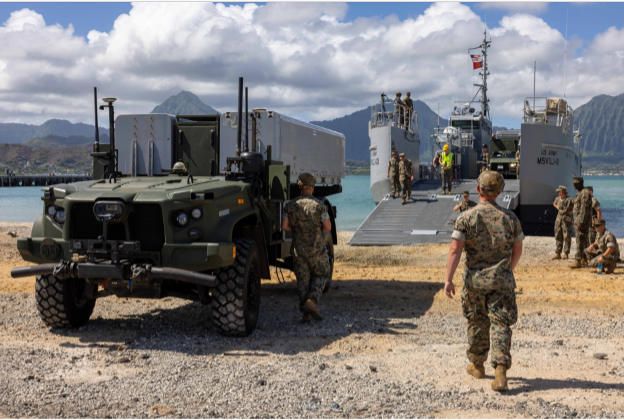
A US Marine, assigned to the 3rd Marine Division, ground guides an NMESIS onto a US Army Maneuver Support Vessel (Light) (MSV(L)) at Marine Corps Base Hawaii, Hawai’i, Sept. 17, 2025. The NMESIS is a US Marine Corps System of land-based launchers that fire missiles within a wide range to sink warships. (US Army photo by Sgt. Samarion Hicks)
Network-Enabled Lethality and Kill Webs in the Gaps
The land-force advantage in the Pacific is anchored in establishing interior lines across the littorals, realized through a fully integrated fires complex before the opening stages of a Taiwan contingency. Within this construct, the traditional pillars of collection, command-and-control, and protection are being transformed by treating every asset, including the munitions themselves, as interconnected nodes within a broader digital ecosystem.
At the same time, the Department of War is entering an unprecedented period of munition expansion. Sustaining this shift requires ongoing reforms, including drone proliferation, spiral development, modular design, and adaptive manufacturing, to accelerate fielding timelines. Initiatives like “Arsenal of Freedom” and modular open systems architecture further enable multi-vendor competition and integration of government and commercial-off-the-shelf technologies to increase resilience and production capacity. However, because China is already fielding large volumes of capable systems at lower cost, the United States cannot compete with a peer adversary through magazine depth alone.
Instead, future advantage will depend on increasing the effectiveness, adaptability, and sustainability of munitions through connectivity. Future weapons should be best understood not simply as single-purpose effects, but as “network-enabled munitions” that function as nodes within a broader kill web capable of communicating, receiving updates, and collaborating across platforms to increase effectiveness while reducing overall munition consumption. This level of dynamic, in-flight connectivity is necessary to detect, track, and successfully engage maneuvering maritime targets inside the gaps. Because the Joint Force cannot rely on either high-end precision fires or mass alone, future kill webs will depend on a “high-low” mix that pairs exquisite long-range weapons with large numbers of affordable, network-enabled systems capable of overwhelming defenses through scale and adaptability.
At the high end of land-force capability, systems such as the Tomahawk and Standard Missile variants already operate as network-enabled munitions by leveraging ground antennas, radars, datalinks, and relay nodes to support mission planning and execution. This logic is now extending to the tactical edge, where low-cost drones and affordable mass munitions function simultaneously as off-board seekers, loitering effects, and collaborative strike platforms. Rather than relying solely on pre-programmed targeting, these systems employ mesh networking, GPS-independent navigation, and intermittent connectivity that provide options for human intervention during execution.
Recent combat experiences in Europe and the Middle East highlight this evolution, where low-cost drones and precision fires collaborate to improve targeting accuracy and lethality against mobile targets. Pairing tactical drones with cannon and mortar-fired guided rounds is demonstrating a new dynamic of “munitions guiding munitions” with impressively lethal effects. Some systems now operate with limited independence, using agentic AI and onboard processing for target identification, navigation, and collaborative behavior. Even as autonomy increases at the tactical edge, these systems remain dependent on an enterprise layer that continuously updates signature libraries, adversary tactics, and environmental data.
In a protracted war against a peer adversary, advantage will accrue not to the force with the largest magazine depth, but to the force capable of continuously adapting and coordinating its effects across the battlespace.
However, network-enabled munitions alone do not resolve the equally critical challenge of how to deploy, conceal, and sustain those systems across dispersed maritime terrain. In a contested First Island Chain environment, operational resilience depends on the ability to transport, camouflage, and reposition capabilities before and between engagements. This requirement drives the need for a complementary approach that extends the logic of network-enabled systems into the physical domain of mobility and survivability.
Thinking Inside the Box: Containerized Solutions for Operating in the Gaps
Even the most advanced systems are only effective if forces can deploy, sustain, conceal, and reposition throughout an adaptive, protracted war. In the First Island Chain, the standard “scoot and shoot” concept for launchers is challenged, and even ostensibly simple tactical drones impose nontrivial logistic burdens when employed at scale.
A practical, universal solution already exists: the standardized 20-foot shipping container. In 2005, ships carrying 8,000 20-foot containers were unusually large; a decade later, 20,000-unit vessels had entered the global fleet, and today Ultra Large Container Vessels exceed 24,000 units. This global standard has created a ubiquitous, interoperable logistics ecosystem spanning commercial and military infrastructure.
Leveraging this existing global standard simplifies deployment and sustainment, reduces the forward logistics footprint, and enables modular operations across dispersed terrain. As Admiral Paparo has noted, while Army fires is the capability he most treasures in the region, lift requirements and sustainment are “what won World War II”
Accordingly, the Army’s evolving watercraft and sustainment strategy increasingly emphasizes containerized solutions supported by predictive logistics enabled through artificial intelligence and real-time data. With global standardization, materiel handling equipment is readily available at every air and seaport, whether government or commercial, simplifying the movement of equipment across the theater.
Palletized launchers, now emerging within the Army’s long-range fires strategy, must conform to this containerized standard. Standardization reinforces modularity, enabling them to rapidly reconfigure capabilities, replace combat losses, and adapt force packages without bespoke logistics chains. Absent such standardization, operational tempo will be constrained by sustainment complexity rather than enabled by it.
Containerized solutions also enhance operational survivability. Critics argue that containerization makes concealment and tactical surprise easier, which precisely underscores their value. As General Ronald Clark, senior commander of US Army forces in the Pacific, explained, the Army’s ability to scale and deter hinges on employing “boxes of rockets” that appear as “boxes of something else.” This principle is illustrated by Ukraine’s strike against previously unreachable targets over 4,000 kilometers in Russia during Operation Spiderweb—not because of the drones’ endurance, but because they were transported most of the way in standard shipping containers hidden in plain sight.
Modular, containerized employment of munitions maximizes mobility, complicates adversary targeting, counters advantages in mass, and gives soldiers a fighting chance to survive inside a weapons engagement zone—all increasingly urgent requirements to reestablish deterrence.
Praise the Lord and Pass the Ammunition: Persisting in the Gaps
The central lesson in the First Island Chain is not that land power is newly relevant to maritime warfare, but that it is already being tested within it. Victory will not belong to the force that simply arrives first or strikes hardest, but to the force that can persist inside the gaps. Distributed land formations, network-enabled munitions, and containerized systems operating within an integrated joint ecosystem constitute the minimum conditions for maintaining relevance in this environment.
These gaps are already being shaped by Chinese coercion, rehearsed through grey-zone pressure, and refined through increasingly complex joint exercises. These are not indicators of a distant contingency, but the architecture of a conflict forming in plain sight.
Addressing this challenge requires more than new capabilities; it requires a mental shift. Escaping the gravitational pull of two decades of counterinsurgency demands that the US military look beyond the Middle East and treat the Pacific as the primary lens for understanding future war. If it does not, the Joint Force will not only struggle in the moment of crisis, but will arrive too late to shape its outcome.
Disclaimer: The views expressed are those of the author and do not reflect the official position of the Department of the Army or the Department of War.



