





The Shadow Fleet’s Sky War: Lessons from IISS on Russia’s UAV Campaign
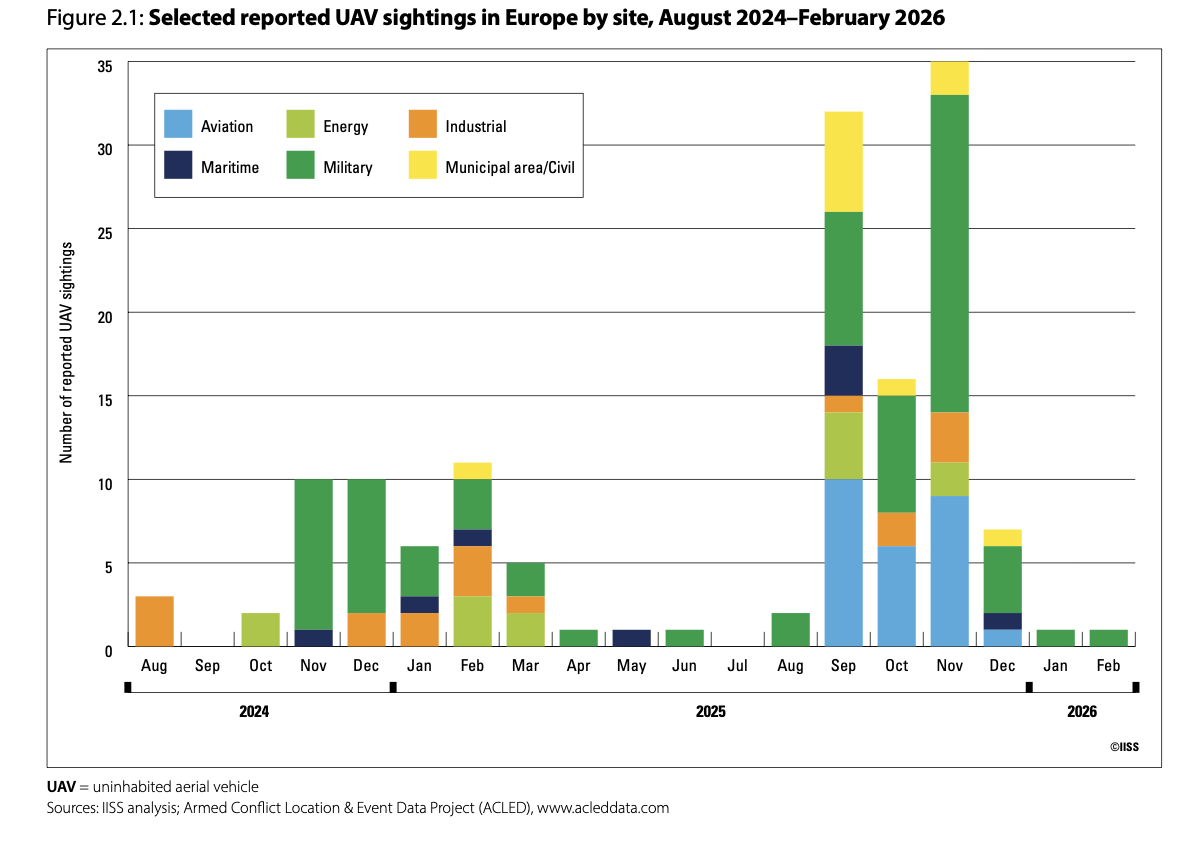

On July 2nd, the International Institute for Strategic Studies (IISS), working with the Hanns Seidel Foundation, published a report titled “Russia’s UAV Campaign Over Europe.” Authors Charlie Edwards, Rex Fox O’Loughlin, and Louis Bearn argue that Russia ran a deniable UAV reconnaissance campaign against Europe between August 2024 and February 2026 using shadow-fleet vessels as launch and recovery platforms. As part of the effort, the authors built a 144-incident dataset using the Armed Conflict Location & Event Data Project (ACLED), harvested open-source reporting, employed AIS/SAR maritime tracking, and interviewed European defence officials. That’s 144 UAV incidents tied to Russian shadow vessels.
The scary part is that the European air-defense architecture couldn’t stop it. Here’s why, and what this means.
Key Takeaways
The maritime-air seam is a vulnerability.
Land-border air defence assumes threats cross a border. This campaign launched from ships loitering in international waters or EEZs, exploiting AIS gaps, GNSS spoofing, and flag-of-convenience ownership to stay ambiguous. The Zhigulevsk–Charles de Gaulle incident (in which a Russian drone launched from the former vessel was neutralized en route to the latter) is the only clean attribution in the dataset. The ambiguity in all the other cases is by design.
Air incursions function as reconnaissance-by-battle.
Every European intercept, hastily scrambled jet, or jammer activation handed Moscow data on response times and rules of engagement. For the Russians, this was still successful intelligence collection.
Attribution paralysis is itself an operational effect.
No European government has formally pinned an incident on Russia. That hesitation, multiplied across a dozen states acting nationally rather than collectively, is the gap the campaign was designed to expose.
Legal authority lags behind capability.
Germany’s police-only shootdown authority, contrasted with Poland’s and Romania’s more permissive rules, produced visible alliance disunity that Russian information operations amplified.
Cost asymmetry favors the aggressor.
Cheap UAVs forcing expensive interceptor expenditure is a familiar Ukraine lesson now playing out on NATO’s home turf, with the European Drone Defence Initiative (EDDI) unlikely to close the gap before 2027.
Bottom Line
The central recommendation we’ve gathered from the report is to treat maritime domain awareness and airspace defence as one problem. As long as shadow-fleet vessels can loiter and launch with near-impunity, kinetic counter-drone investment inland only addresses half the threat.
This is a tricky, sticky problem that necessarily blends domains and borders. The capability to attribute incursions are there– there are examples of this actually happening, as the report notes. The question for Europe is whether “European governments are prepared to act on it,” through the regulatory and political hurdles.

