MOE as a Chimera: The Structural Limits of Army Campaign Assessment

Abstract
The Army demands credible measures of effectiveness (MOE) to judge operational progress and results, but it has never built the analytic discipline required to derive them. Current doctrine provides a process without an underpinning methodology, leaving staffs dependent on intuition, vendor tools, and ad hoc judgment. This article explains why these institutional gaps persist and what they mean for assessment in strategic competition. What this article does not do is propose a new assessment framework; it examines why the Army’s current doctrinal and institutional approach leaves Theater Army and Corps staffs ill-equipped to assess campaigning during strategic competition.
“We need measures of effectiveness.”
“We need to do a better job demonstrating return on investment.”
These refrains have become habitual battle cries for senior Army leaders across campaign design, operational execution, and even budget justification. Yet despite their frequency, the Army continues to struggle with what it demands most: credible evidence that its activities produce intended outcomes.
In the summer of 2022, I took over as the information advantage director for a major Army command in the Indo‑Pacific. Shortly afterward, my team was tasked to assess the effectiveness of a large multinational exercise with a key regional partner. The command relied heavily on publicly available information tools that scraped social media and online news to estimate shifts in sentiment and narrative activity. Midway through the exercise, a high‑visibility geopolitical incident involving Taiwan dominated global media coverage. During our initial assessment brief, the staff concluded that the exercise had “limited impact” because the online conversation was overshadowed by the crisis.
That conclusion was intuitively wrong. Social media is only one slice of the information environment, and intelligence and diplomatic reporting suggested the exercise was shaping partner perceptions and complicating adversary planning. The problem was not the tools themselves, but the absence of an analytic framework that defined what mattered, why it mattered, and how evidence of change should be collected. Without that structure, the staff defaulted to the data that was easiest to access with available tools, not the data that was most meaningful.
This experience reflects a broader institutional problem. Across strategic competition, Army commands are expected to demonstrate the effectiveness and return on investment of their operational work. Yet doctrine provides only process guidance, not a standardized analytic approach. It does not show staff how to design effective indicators, collect evidence, or assess change over time.
The Army’s struggle with measures of effectiveness (MOE) is not fundamentally solvable through technology, but rooted in shortfalls in doctrine, education, organization, and analytic capacity. Until the institution treats operation assessment as a discipline, supported by validated methodology and dedicated expertise, the Army will continue to campaign without fully understanding whether its activities produce meaningful effects. Measures of effectiveness will remain what they are today: an ethereal chimera—endlessly sought after but never fully realized.
The Army Expects Assessments It Cannot Produce
Demand for MOE has become especially pronounced at the Theater Army and Corps levels, where commanders are responsible for planning and executing long-duration campaigns in strategic competition. Yet despite their centrality to decision-making, operation assessment remains underdeveloped, inconsistently trained, and poorly resourced. Across joint and Army doctrine, assessment is treated as a process to be managed rather than an analytic approach to be applied. Doctrine establishes assessment as a required activity, but it does not provide the methodological foundations needed to determine what matters, why it matters, or how to evaluate change over time. The result is predictable: inconsistent application of assessments and missed operational opportunities.
The Army expects credible MOE, yet it has not built the institutional machinery necessary to consistently identify, collect, and analyze indicators across commands. This gap is persistent and consequential. Strategic competition and fiscal constraints place increasing pressure on commanders to demonstrate progress and to justify their operations, activities, and investments (OAIs).
At first glance, this may appear to be a measurement problem. In reality, it is an institutional limitation embedded in the Army’s doctrine, organization, training, education, and resourcing. Developing meaningful MOE requires more than process compliance. It requires analytic expertise, methodological rigor, and institutional capacity sustained over time and across campaigns.
Doctrine Provides Process, Not Methodology
Army and joint doctrine establish operation assessment as a core component of planning and campaigning, but they primarily frame it as a managerial process rather than an analytic discipline. Military publications such as Joint Publication (JP) 5-0, Joint Planning and Army Techniques Publication (ATP) 5-0.3, Multi-Service Tactics, Techniques, and Procedures for Operation Assessment, describe when assessment occurs and how staffs organize to conduct it. They provide little guidance on how to design indicators, collect evidence, or conduct rigorous analysis in complex campaigning environments.
Annex H to JP 5-0 illustrates this limitation. Its six-step assessment process appears coherent, including: develop assessment approach; develop assessment plan; collect information and intelligence; analyze information and intelligence; communicate feedback and recommendations; and adapt plans or campaigns. However, it glosses over the critical details of indicator identification, evidence collection, and analysis within complex, adaptive social systems. Indicator selection and data interpretation are treated largely as matters of professional judgment rather than reproducible analytic practice. Army doctrine inherits and reinforces this structural deficiency.
Army doctrine such as Army Doctrine Publication (ADP) 5-0, The Operations Process describes assessment as a continuous activity while it emphasizes staff organization, battle rhythm requirements, and the production of assessment updates. It offers little guidance on how Theater Army and Corps staffs should determine what to measure or how to analyze change in complex campaigning environments. Therefore, ADP 5-0 underscores the importance of assessment while leaving the methodological gap inherited from joint doctrine unresolved.
Since ADP 5-0 does not provide the deeper intellectual underpinnings for assessment, one would expect that material to be included in Army Training Publication (ATP) 5-0.3, Operation Assess. As a multi-service techniques publication, it is intended to translate the concepts and processes described in ADP 5-0 and other Service doctrine into practical application for the user level. This volume provides additional detail on assessment roles, products, working groups, and integration within the operations process while relying heavily on illustrative examples, templates, and notional products. Though these products show what assessment products might look like, they do not capture how to develop or adapt them to the political and social dynamics of strategic competition.
Across all three publications, doctrine is consistent in its lack of analytic progression. These shortcomings, coupled with parallel gaps in institutional education and training, mean that commands must construct their own approaches to assessment in real time rather than drawing on methods developed and taught by the Army institution. The result in the field is wide variability, uneven rigor, and continued reliance on intuition over analytics.
Why Theater Armies and Corps Struggle to Assess Campaigning
While doctrine describes the importance of operation assessment to planning and execution, further institutional shortcomings in the Army’s organization, training, education, and resourcing prevent Theater Armies and Corps from conducting meaningful assessment campaigns. Most Theater Army and Corps Modified Tables of Organization and Equipment (MTOEs), which define organizational structure and authorized personnel, do not include a dedicated assessment cell or any billets for assessment. Theater Information Advantage Detachments (TIADs) aligned to US Army Pacific, US Army Cyber Command, and US Army Europe and Africa represent an emerging recognition that information advantage requires dedicated analytic capacity. However, their limited scope underscores that assessment remains the exception rather than an institutionalized Army function. Looking beyond the TIADs, this organizational hole mirrors doctrine’s implicit assumption that staffs already possess the assessment expertise required, rather than requiring deliberate development. In practice, operation assessment is rarely treated as a dedicated function within Army headquarters. Assessment responsibilities are often assigned as an additional duty, with staff officers supporting assessment processes alongside their primary roles. These arrangements prioritize production over analysis, emphasizing briefs, products, and updates rather than sustained analytic effort. Under such conditions, assessment becomes episodic, lacks continuity, and cannot accumulate evidence over time.
Given these organizational challenges, Army operation assessments are sometimes assigned to Operations Research and Systems Analysis (ORSA) officers to lead by default. These officers are extremely valuable, with typically only one assigned to a staff. ORSAs bring specialized analytic skills to a staff, including training in statistics, modeling, decision analysis, and plan evaluation. However, relying on ORSAs as a de facto lead for operation assessment obscures the deeper institutional gap. Their broader responsibilities across command analytics make clear why they cannot—and should not—serve as the Army’s dedicated discipline for campaign-level analysis of political behavior, partner decision-making, and competitive influence. The Army lacks any discipline, proponent, or institutional home responsible for developing, validating, and teaching the analytic techniques required for operation assessment. If a separate career field is not warranted, at a minimum, one would expect in-depth staff training in operation assessment to be incorporated into Army branch and staff schools with sufficient depth to meet operational requirements.
Resourcing operation assessment reflects the institution’s fractured approach. Units are expected to contribute to campaign-level assessments without dedicated personnel, training, or analytic tools. As a result, when funding is available, it is often directed toward commercial vendor solutions focused on situational understanding of the information environment and the effects of narrowly scoped information operations activities. In practice, commands often contract different vendors. While they certainly provide useful analytic services, they are rarely integrated into a coherent assessment design. This produces a fragmented, tool-driven approach, with capabilities varying across commands and lacking alignment under any unifying program of record. These commercial services include social media scraping tools, survey data, commercially available information, or other insights into audience sentiment and media consumption. While these tools provide valuable data, they represent only subsets of what a comprehensive assessment requires. They cannot substitute for a coherent assessment design or a rigorous analytic methodology.
The Army Plans Linearly, but Effects Distribute Across Multiple Vectors
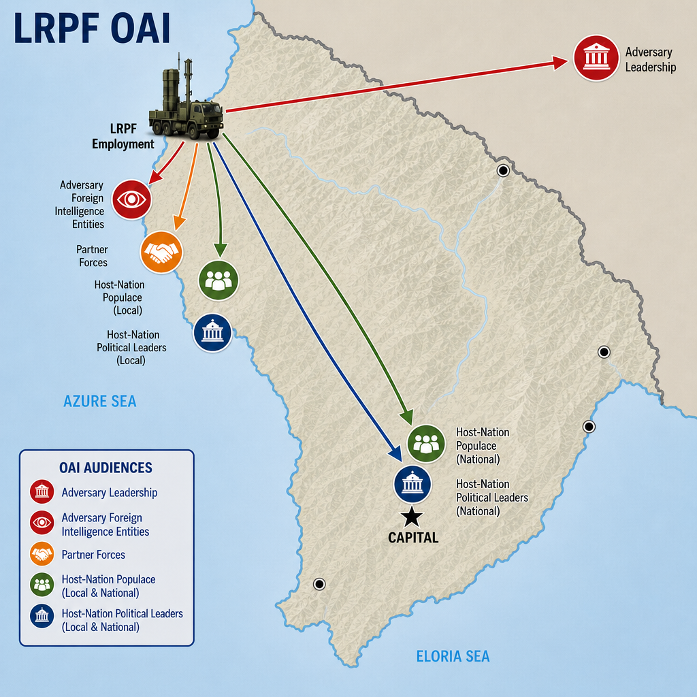
Theater Army and Corps activities in strategic competition require assessment approaches that can be sustained over long campaigns. Doctrine guides planners through a linear cascade of planning in which objectives lead to effects, which in turn drive development of tasks assigned to subordinate units conducting OAIs. This linear approach disguises the fact that Army activities in foreign countries generate distributed effects across multiple relevant audiences simultaneously, rather than influencing a single audience in isolation. As illustrated in Figure 1, a single Army OAI may generate simultaneous effects across multiple audiences relevant to campaigning and deterrence.
For instance, the dynamic force employment of a long‑range precision fires (LRPF) capability may be designed to influence an adversary’s risk calculus for deterrent purposes. Yet its effects cascade as they are simultaneously interpreted by multiple audiences. This distributed pattern highlights that effects occur along five major vectors of concern in a given country. These vectors include adversary leadership, host-nation political leaders, host-nation populations, adversary foreign intelligence entities, and partner forces whose interoperability, capability, and capacity gains must be assessed.
Within these vectors, effects often manifest at multiple levels — for example, host‑nation political leaders and populace audiences may respond differently at the local and national levels. This does not preclude acknowledging broader regional effects, but it underscores that the most immediate and consequential impacts of Army OAIs within a given country are expressed across these vectors because they bear directly on political-military risk, access permissions, and progress toward military objectives. These vectors matter because they shape the challenges Army forces encounter in strategic competition, deterrence, and posturing for crisis and conflict—and whether measured or not, these effects occur.

To measure progress toward objectives, commands should assess MOE indicators across these vectors at a minimum. Effective assessment is both an organizational and a process challenge. Commands cannot assess effectively without the right people, tools, and reporting structures. Effective assessment requires assigned and trained personnel, data storage and processing, and commercial tools capable of acquiring and analyzing publicly and commercially available information. It also requires clearly defined information requirements nested within collection plans and streamlined reporting mechanisms for subordinate units.
The five vectors span areas well beyond traditional intelligence collection, including diplomatic assessments and partner-force readiness. While the commander’s critical information requirements address many issues tied directly to decision points, assessment in strategic competition often demands broader data collection. Accordingly, mechanisms to incorporate feedback from interagency reporting—such as Department of State cables—along with subordinate unit assessments of partner force training, readiness, and capability development progress, are essential components of holistic assessment. Deliberately planning for and directing reporting across these areas is necessary to build a cumulative understanding of the operational environment rather than episodic snapshots.
Army and joint doctrine implicitly treat battle damage assessment as a specialized analytic task requiring dedicated collection, validated methods, and intelligence expertise. By contrast, MOE tied to campaigning, influence, deterrence, and partner behavior relies largely on indicators and professional judgment rather than validated analytic methods. This asymmetry matters in strategic competition, where the most consequential effects are political and social rather than physical, and where intuition alone may be less reliable. The result is a system that applies its most rigorous assessment methods to the most physically observable problems. Meanwhile, the political and behavioral dynamics that govern campaigning are left to far weaker, judgment-based approaches. Without persistent, structured analysis, commands repeatedly re-baseline their understanding of the environment, restarting assessment cycles rather than building cumulative insight.
Taken together, these organizational, training, and resourcing gaps produce an assessment enterprise that operates on an ad hoc basis rather than through the deliberate, focused analysis that campaigning requires. Headquarters comply with assessment requirements, generate regular products, and brief indicators upward, but lack the institutional capacity to design longitudinal, analytically defensible assessments. In effect, the Army has created expectations for assessment output without establishing the institutional machinery required to produce it.
Conclusion
Joint Publication 5-0 correctly notes that “there is no single way to conduct assessment.” However, the absence of a single method does not diminish the need to build institutional assessment capacity, refine analytic skills, and teach the force how to assess campaigning during strategic competition. Doctrine assumes staff already know how to design indicators, collect and interpret evidence, and distinguish correlation from causality. The Army seeks advantage over adversaries in competition and conflict, yet those advantages depend upon understanding whether OAIs are producing meaningful effects over time.
The modern information environment makes causal inference difficult, but not unattainable when supported by deliberate assessment design, longitudinal analysis, and disciplined analytic practice. Many indicators of effectiveness are currently overlooked, not because they are unknowable, but because commands neither identify nor collect them systematically. Greater fidelity will come only by advancing operation assessment as a professional discipline within the institutional Army. Doing so requires a doctrine that extends beyond process management. It also requires embedding assessment methodology into professional military education and staff training, and establishing organizational structures capable of sustaining campaign-level analysis over time.
At a minimum, Theater Armies and Corps require dedicated assessment personnel, standardized assessment training, and coherent reporting mechanisms nested within campaign collection plans. They also require analytic approaches capable of integrating data across the physical, informational, and human dimensions of the operational environment. The Army should also expand partnerships with academia and industry to strengthen expertise in behavioral analysis, experimental design, longitudinal assessment, and data integration. Professional military judgment and critical and creative thinking, while important, are insufficient as currently practiced to provide the methodological rigor necessary for campaign assessment in strategic competition.
The Army and the Joint Force are already investing heavily in commercial tools designed to improve understanding of the information environment and assess narrow information operations effects. Yet commercial capabilities alone cannot solve a fundamentally institutional problem. The current moment represents an opportunity to expand assessment beyond narrowly scoped information operations assessments toward holistic assessment across multiple vectors of influence and observation. Doing so requires integrating operational reporting, intelligence collection, commercially available information, diplomatic feedback, and partner-force assessments into coherent analytic frameworks that can measure cumulative effects over time.
The operational consequence of current institutional shortfalls is that senior commanders are often forced to make decisions without sufficient evidence. In strategic competition, as Theater Armies and Corps campaign for advantage across the physical, information, and human dimensions of the operational environment, assessment becomes the difference between activity and effect. If the Army cannot credibly assess whether its campaigns are working, it will operate in a sea of unseen risk—where gaps in posture, deterrence, and resourcing lurk beneath the surface until they manifest at the point of decision.
Disclaimer: The opinions expressed in this article are the author’s and do not represent the official policy or position of the Department of War or the US Government.