





The Black Box Problem in Cognitive Warfare: Why “Targeting Cognition” Is Not Enough


Abstract
Cognitive warfare is often presented as a distinct form of conflict because it targets cognition, the brain, or decision-making itself, but that claim becomes weaker when the analyst can observe only the relationship between informational inputs and behavioral, attitudinal, or organizational outputs. This essay argues that the cognitive middle layer, including attention, perception, memory, emotion, belief, reasoning, and decision-making, is usually a set of hypothetical constructs inferred from observable indicators, not a directly observed operational object. Cognitive warfare can still be a useful warning label for contemporary influence threats, but it becomes analytically useful only when the input, output, claimed cognitive process, and supporting evidence are made explicit and testable.
The Promise and the Problem of Cognitive Warfare
If commanders, analysts, and policymakers label too many influence activities as cognitive warfare, they may build concepts, training, and metrics around an effect that has not actually been demonstrated. The practical danger behind this seemingly theoretical debate is straightforward: cognitive claims can guide doctrine, training, and assessment before the claimed cognitive effect has been specified, measured, and distinguished from older psychological, informational, and political forms of influence.
Cognitive warfare has become one of the most attractive terms in contemporary security debates. It promises to capture something real about modern conflict: adversaries do not merely attack territory, systems, or messages; they also try to shape perception, trust, sensemaking, and decision-making. NATO’s recent report reflects this broader interest in how cognitive effects, technology, and influence activities may shape behavior in modern conflict. In an era of algorithmic amplification, AI-enabled social-media manipulation, cyber-enabled disruption, and strategic narratives, the idea that cognition has become a battlefield is intuitively compelling.
Small Wars Journal has already hosted a useful debate on this problem. Frank Hoffman argues that cognitive warfare competes in a crowded conceptual space and still lacks a common understanding. Matt Armstrong warns that the term can repackage older political-warfare problems. Other recent essays try to give the concept operational traction by defining it around decision disruption, ecosystem-speed governance, weaponized narratives, cost asymmetry, or NATO’s account of cognition itself.
Jonathan Kim’s recent Integrated Cognitive Assessment Framework makes this debate more urgent. Kim links influence activities to observable outcomes through a cognitive decision cycle and organizes non-traditional indicators across phases such as perception, emotion, memory, attitudes, decision, and behavior. That article usefully confronts the operational need to assess cognitive movement before behavior confirms it.
This essay responds to that line of argument in a friendly but cautionary spirit. The operational value of mapping perception, attention, memory, emotion, belief, cognitive resources, decision-making, and behavior is real. The caution is that such mapping also needs an explicit evidence standard. When an observable signal is assigned to a cognitive phase, analysts need to show why that signal supports the claimed process rather than merely naming the process after the observed effect.
The psychology and behavioral-science point is narrower: analysts usually observe stimuli and outputs, while the cognitive processes in between are inferred. They are hypothetical constructs, not directly observed operational objects. Cognition remains central to the problem, but cognitive claims require evidence standards rather than rhetorical novelty.
What Can Actually Be Observed?
A basic information-processing model is useful precisely because it shows both the appeal and the problem of cognitive warfare. An actor introduces stimuli into an environment: messages, images, rumors, falsehoods, threats, narratives, accurate but maliciously framed information, cyber disruptions, or repeated cues. A target individual, group, or organization responds in ways that can be observed: speech, writing, sharing behavior, compliance, resistance, confusion, delay, protest, voting behavior, organizational dysfunction, or physiological and neural measurements. Between these two sides sits a dense middle layer that analysts call attention, perception, interpretation, emotion, memory, belief, reasoning, and decision-making. Some existing accounts define cognitive warfare as manipulating environmental stimuli to affect mental states and behavior, but that formulation still leaves the analyst with the task of showing the evidentiary bridge from stimulus to process to output. Figure 1 presents this relationship as an observation problem: inputs and outputs are comparatively observable, while the information-processing components in the middle remain inferential.
Figure 1. Information-processing model of influence as an observation problem.
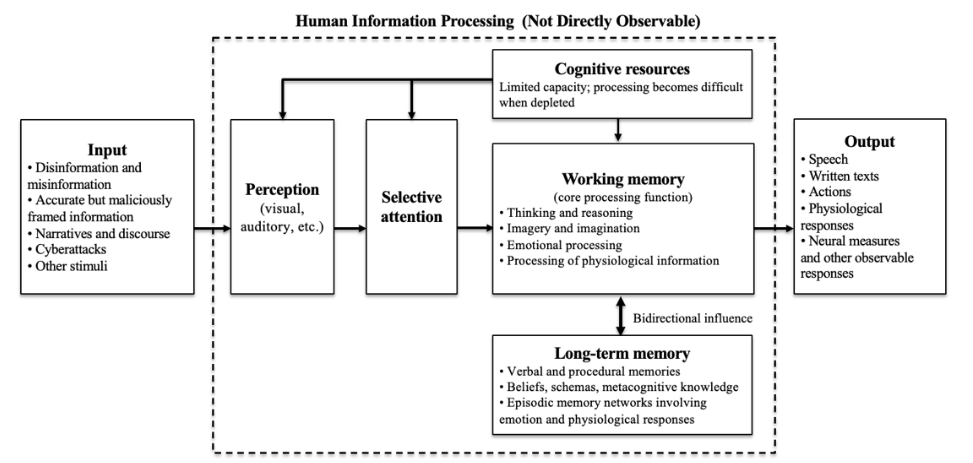
Source: Author’s synthesis, drawing on standard information-processing and memory models, working-memory theory, and psychological construct-validity theory.
That middle layer is analytically important, but it is not directly visible from outside. Even when neuroscience, psychophysiology, surveys, reaction-time tasks, or behavioral experiments are used, they do not reveal cognition as a concrete object. They provide measurements from which researchers infer latent processes. In the language of psychological measurement, constructs are not directly observable; researchers rely on indicators and must justify the theoretical link between those indicators and the construct. Classic work on construct validity made this issue central to psychological science: measures require an argument linking observations to the construct they are claimed to represent.
This is where cognitive warfare can become analytically loose. A campaign may expose a population to tailored narratives, after which analysts observe distrust, polarization, hesitation, or behavioral change. It is then tempting to say that the campaign targeted cognition. Unless the relevant cognitive process has been specified and measured, however, the claim remains an inference. It may be plausible and operationally useful, but it is still different from observing cognition itself. A careful reading of cognitive-warfare research should therefore separate the observed stimulus-response pattern from the inferred cognitive mechanism.
Three Labels, One Analytic Structure
Psychological warfare, information warfare, and cognitive warfare are often presented as different categories of influence. At the level of ordinary policy language, the distinction is understandable. Psychological warfare appears to foreground morale, fear, emotion, loyalty, and will. Information warfare appears to foreground information flows, deception, uncertainty, overload, and the reliability of systems. Cognitive warfare appears to foreground attention, memory, belief, sensemaking, and decision-making.
That conventional distinction is useful as a starting point, but it should not be mistaken for a clean analytical boundary. Once each category is translated into a basic information-processing template, the structure becomes strikingly similar. Each involves inputs introduced into an environment, internal processes that are usually inferred rather than directly observed, and outputs that can be described, measured, or contested. The difference lies less in the observable structure of the operation than in the vocabulary used to describe the middle layer and the evidentiary standard used to support that description. Table 1 summarizes this point by showing how the conventional labels appear different while the information-processing template reveals their overlap.
Table 1. Conventional labels and their overlap in an information-processing template.
| Label as Commonly Used | What the Label Appears to Foreground | Typical Inputs | What the Information-Processing Template Reveals |
|---|---|---|---|
| Psychological warfare | Morale; emotion; fear; loyalty; will | Propaganda; threats; intimidation; symbols; rumors | The claimed effects still depend on inferred internal states and observable outputs such as surrender, passivity, compliance, or loss of support. |
| Information warfare | Information flows; deception; uncertainty; trust in systems | Falsehoods; overload; denial; selective disclosure; system manipulation | The claimed effects still depend on inferred changes in perception, uncertainty, judgment, and coordination, as shown through observable decisions or disruptions. |
| Cognitive warfare | Attention; working memory; cognitive resources; belief; bias; sensemaking; decision-making | Narratives; tailored content; algorithmic amplification; AI-enabled targeting; repeated exposure | The claimed effects still depend on inferred cognitive mechanisms and observable outputs such as behavioral change, polarization, distrust, mobilization, or decision failure. |
Note: Author’s synthesis. The table is not intended to classify the three forms of warfare as neatly separable categories. It shows why the boundaries become unstable once each label is translated into the same input, inferred-process, and output structure.
The point is not to collapse psychological warfare, information warfare, and cognitive warfare into one category. They may differ in doctrine, institutions, technologies, targets, and preferred vocabulary. The narrower point is that cognition cannot by itself serve as the decisive boundary. Psychological warfare has long worked through emotion, belief, identity, morale, and will. Information warfare has often worked through perception, uncertainty, trust, and judgment. Cognitive warfare may add emphasis under conditions of algorithmic amplification and AI-enabled personalization, but that emphasis alone does not establish a distinct analytical category.
Why the “Cognitive” Difference Is Often Inferential
The term cognitive often does important rhetorical work. It gives old problems a sense of scientific precision. It suggests that the target is not merely opinion, morale, information flow, or political will, but the underlying machinery of human thought. This language can be useful when it forces analysts to think carefully about attention, memory, emotion, bias, and decision-making. But it can also become literary or folk-theoretical when it treats these words as if they named directly observable objects.
The stronger statement is this: cognition is not a hidden object that analysts can simply point to. The components of cognition are scientific constructs. The classic distinction between hypothetical constructs and intervening variables is useful here because it reminds analysts that some terms posit unobserved processes, while others merely summarize relations among observations. Cognitive terms help researchers organize observations, generate hypotheses, and build models. They do not become concrete operational targets merely because a military or policy document names them. To say that an adversary targets attention or memory should mean more than saying that the adversary introduced messages and later observed behavioral effects.
There is also a risk of circular explanation. If a population distrusts an institution and the analyst explains that output by saying the population’s trust was degraded, the explanation may only redescribe the output at a higher level of abstraction. From a behavior-analytic perspective, this is the danger of treating an inferred state as the cause of the very behavior from which it was inferred. Skinner’s critique of mentalistic explanation was directed at this kind of explanatory closure: the inner label can end inquiry rather than sharpen it.
This point also tempers claims of novelty. New technologies matter. Social media platforms change scale, speed, targeting, feedback, and persistence. AI may lower the cost of content production and personalization. Cyber operations may amplify uncertainty and undermine confidence in institutions. These developments can transform the conditions under which influence takes place. Technological novelty, however, does not automatically establish conceptual novelty. New tools may intensify familiar psychological and informational effects without creating a uniquely cognitive domain.
The same caution applies to claims about the brain. It is one thing to say that all influence ultimately depends on brains, bodies, and nervous systems. That is broadly true. It is another thing to say that an operation has demonstrated a specific effect on neural or cognitive mechanisms. The former is a general philosophical statement; the latter is an empirical claim. Cognitive warfare discourse often moves too quickly from the first to the second.
These points keep cognitive warfare useful by narrowing the claim rather than enlarging the label. Its distinctiveness has to be earned by showing what cognitive process is being claimed, what indicators support that claim, and how the claim differs from psychological warfare, information warfare, political warfare, strategic communication, or ordinary influence operations.
A More Useful Standard for Talking About Cognitive Warfare
Recent SWJ contributions point toward the right problem even when they answer it differently. Rushing, Xu, and Hersch propose a decision-centric definition and evaluative framework. Wirges shows how threat actors frame cognitive warfare through narrative, subversion, and distorted perception. Cleveland, Brookes, and Maxwell present NATO’s report as a starting point for distinguishing cognitive warfare from information operations, psychological operations, strategic communication, and cyber warfare. Russo stresses cost asymmetry as a strategic variable. These approaches are valuable because they move the discussion away from the mere phrase “targeting cognition” and toward criteria, mechanisms, and effects.
Kim’s ICAF is particularly relevant because it treats cognitive assessment as an indicator problem rather than a slogan problem. Its emphasis on perception, emotion, memory, attitudes, decision, and behavior helps show why the internal layer cannot be collapsed into a single word such as cognition. The same framework also illustrates the core challenge for any cognitive-warfare framework: observable signatures do not interpret themselves. Their value depends on the argument that connects a specific signal to a specific cognitive process and then to a plausible behavioral or organizational outcome.
The next step is to make the evidentiary standard explicit. Before labeling an operation cognitive warfare, analysts should ask four questions.
- What is the input? The analysis should identify the actual stimulus or intervention: a message, image, rumor, narrative, accurate but maliciously framed information, cyber disruption, platform manipulation, AI-generated product, or repeated cue. Vague references to the information environment are not enough.
- What is the output? The analysis should specify the observable result: a behavior, decision, delay, compliance pattern, mobilization, trust shift, organizational failure, or measurable physiological or neural indicator. Without an output, the claim cannot be evaluated.
- What cognitive process is being claimed? Attention, memory, working memory, cognitive resources, belief, emotion, cognitive load, bias, trust, and decision-making are not interchangeable. Naming a process is the beginning of analysis, not the end of it.
- What evidence connects the input to the process and the output? Was the process measured directly or indirectly? Is the claim supported by experimental evidence, survey data, time-series analysis, behavioral indicators, physiological measures, neural measures, or a structured assessment of observable signatures? Observable signatures are not self-interpreting; they become evidence only when the analyst explains why a given signal supports one cognitive interpretation rather than another. What alternative explanations have been ruled out?
Together, these questions make analysis stricter without making it impractical. Political grievance, group identity, social conformity, institutional distrust, prior belief, media ecology, and ordinary propaganda effects can all produce outputs that may be mistakenly labeled cognitive warfare. Operational judgment does not require laboratory certainty in every case. It does require preventing a label from doing the work that evidence should do.
This standard treats cognitive warfare as a set of claims that vary in strength rather than as a single dramatic label. Some claims are descriptive: a campaign used messages and produced behavior. Some are mechanism-level claims: a campaign likely exploited attention, memory, or bias. A smaller number are evidence-level claims: the relevant cognitive process was specified, measured, and linked to the observed outcome.
Conclusion
Cognitive warfare is attractive because it seems to name the deeper layer of contemporary conflict. It reminds strategists that the decisive terrain may lie in perception, trust, sensemaking, and decision-making rather than in physical geography alone. That insight is important. The term becomes misleading, however, when it turns hypothetical constructs into apparent objects of attack or treats a cognitive explanation as though it had already been demonstrated.
The point is not that these categories are identical. It is that their differences must be shown through mechanism, evidence, and distinction from older forms of influence rather than assumed from the word cognitive.
Cognitive warfare is most valuable when it disciplines analysis rather than expands vocabulary. It should prompt analysts to specify the input, the inferred process, the observable output, and the evidence linking them. Used that way, the concept can sharpen inquiry into contemporary influence operations. Used loosely, it risks turning familiar psychological and informational effects into a more scientific-sounding label.
Disclaimer: The views expressed are the author’s personal views and do not represent the official position of any government, ministry, service, or institution.


