Integrated Cognitive Assessment Framework (ICAF): Linking Influence, Cognitive Decision Cycles, and Non-Traditional Indicators and Warnings


Abstract
In persistent competition below the threshold of armed conflict, analysts gain advantage when they identify cognitive shifts before behavior confirms them. The Integrated Cognitive Assessment Framework (ICAF), provides a structured approach that links influence activities to observable outcomes through a defined cognitive decision cycle. ICAF integrates the Observe-Orient-Decide-Act (OODA) loop with a novel cognitive sequencing model, Perception, Emotion, Memory, Attitudes, Decision, and Behavior (PEMADB), to explain how target audiences process information and form intent. By organizing Non-Traditional Indicators and Warnings (NTIW) across these cognitive phases, the framework enables earlier assessment of cognitive effects and allows inference of the actor’s decision trajectory before behavior becomes observable.
Introduction
In a contested information environment, seeing activity is rarely the problem; understanding its meaning is the true challenge.
Narratives spread quickly, sentiment shifts, and messaging patterns evolve across platforms. While intelligence professionals routinely track these fluctuations, a persistent challenge remains: determining whether these observations reflect meaningful changes in how target audiences interpret information or move toward a decision.
Traditional indicators and warnings (I&W) derive from continuous intelligence analysis. They apply across the progression from early signals to observable behavior. Confidence typically peaks only after behavior manifests, as indicators grow more concrete once decisions take shape. Cognitive models offer a different perspective. They explain how people process information, but they rarely translate into operational assessment.
The result is familiar. Analysts map activity with precision, but interpretation and intent often remain unclear until action appears.
Existing intelligence doctrine addresses the full intelligence cycle, including planning, collection, processing, analysis, and dissemination of observable activity across physical and informational dimensions. The cognitive dimension, where influence ultimately takes effect, remains less explicitly structured for systematic assessment of interpretation, intent formation, and decision movement.
The Integrated Cognitive Assessment Framework (ICAF) is an original analytical framework that compliments existing intelligence processes by providing a structured method to assess cognitive effects, decision progression, and trajectory. It fuses a mapped cognitive decision cycle, non-traditional indicators and warnings (NTIW), and structured assessment outputs into a single approach. Within this unified model, NTIW provides visibility into early decision-making phases, while traditional indicators help confirm observable behavior.
ICAF traces the path from influence activity to cognitive effect to decision trajectory.
For clarity, this article distinguishes between the actor, who introduces stimuli through influence activities, and the target audience, who interprets those inputs within the cognitive dimension. Although these roles remain analytically distinct, they shift with context. The same entity can act as an actor in one context and as the target audience in another, depending on perspective and analytical focus.
Influence, Cognition, and the Assessment Problem
To understand why this gap persists, it helps to examine where influence takes effect. Influence activities operate across the information environment, which consists of physical, informational, and cognitive dimensions.
Doctrine commonly describes the information environment in terms of dimensions, though more recent discussions increasingly frame them as overlapping aspects rather than discrete domains.
Actors introduce messages, narratives, and observable activity through the physical and informational dimensions.
Target audiences, however, do not respond at the point of delivery. They respond in the cognitive dimension, where they connect information to prior beliefs and assign it meaning before a decision forms.
Separating delivery from interpretation highlights the core assessment problem. Reach does not equal interpretation, and exposure does not guarantee persuasion. What those metrics cannot capture is the shift occurring within the decision process itself. By the time behavior appears, the most important shift has often already occurred.
Assessing this kind of movement resembles steering a ship through dense fog. A helmsman cannot see every factor affecting the vessel and instead relies on instruments, feedback, and subtle cues to determine whether the ship is holding course or beginning to drift. Some signals are clear, such as a change in heading. Others are less obvious, such as delay in response, slight resistance, or faint vibration. No single signal provides certainty, but together they reveal direction.
Intelligence professionals operate in much the same way. Behavior eventually confirms what happened, but earlier signals often indicate that the system has already begun to shift. The challenge lies in interpreting those signals before the outcome becomes obvious. None of this is perfectly observable, and it never will be, but it is often enough. ICAF gives analysts a way to work within that uncertainty rather than wait for it to resolve.
Mapping the Cognitive Decision Cycle: Integrating OODA and PEMADB
The framework begins with a cognitive decision cycle that integrates the OODA loop with the PEMADB model. OODA provides a familiar structure for decision-making, but it leaves the internal mechanics of the Orient phase largely undefined. That gap matters because orientation is where interpretation forms.
The original PEMADB construct specifically addresses the ambiguity of the Orient phase. It breaks orientation into directly examinable components of emotion, memory, and attitudes that map cleanly to OODA and generate observable signatures. When layered, Observe aligns with perception, where target audiences register stimuli. Orient captures how those core variables shape interpretation. Decide reflects how intent forms, and Act captures the execution through observable behavior.
The mapping clarifies where influence exerts its greatest effect. The Orient phase becomes the point where target audiences construct meaning. Emotion, memory, and attitudes do not simply coexist there; they interact. At times they reinforce each other. At other times they pull in different directions.
In practice, these elements do not unfold in a clean sequence. They overlap, reinforce, and occasionally conflict. Cultural context, prior experience, and social environment shape how interpretation develops. Even so, this structure provides a workable way to track cognitive progression.
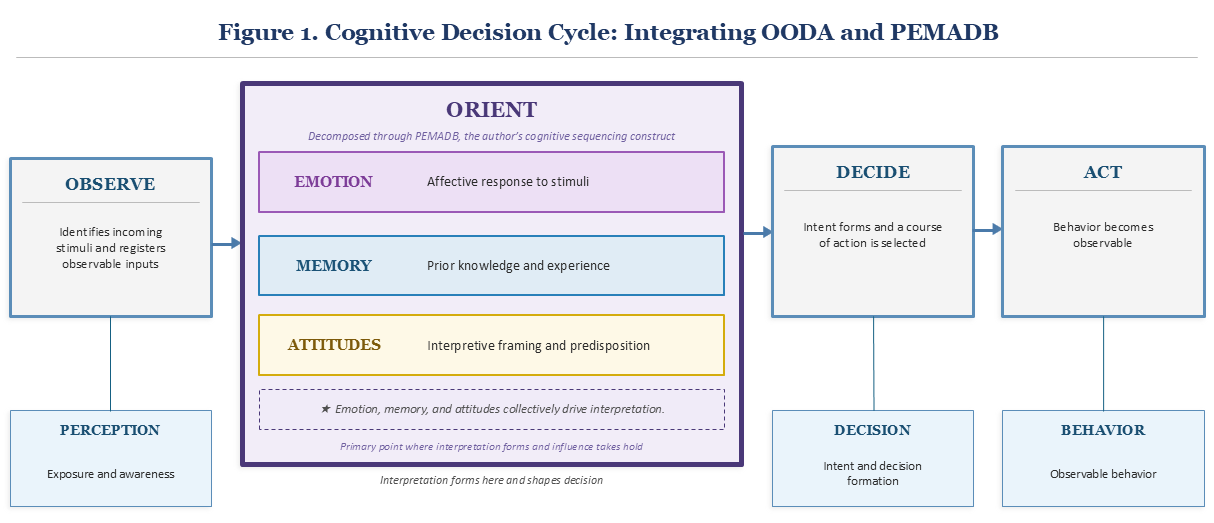
Figure 1 illustrates the cognitive decision cycle created by integrating OODA with PEMADB, the author’s cognitive sequencing construct. It decomposes the Orient phase into sequenced cognitive processes, showing how observation registers as perception and progresses through interpretation before behavior becomes observable.
From Cognitive Processes to Observable Signatures
Assessing invisible cognitive processes requires observable signatures.
As target audiences move through the decision cycle, they produce signals that correspond to different stages of that progression. Early signals reflect exposure and awareness. As interpretation develops, tone, framing, and alignment begin to shift. Later signals suggest movement toward commitment or decision. Eventually, behavior confirms what audiences have already decided.
Organizing this taxonomy of signatures by cognitive phase forms an original contribution of the framework.
Those signals let analysts track interpretation over time. The framework organizes them by phase to show movement through the decision cycle. One pattern holds across cases: behavior changes last, not first.
Non-Traditional Indicators and Warnings (NTIW)
Traditional indicators and warnings remain central to intelligence analysis. They support early warning by identifying changes in activity, posture, and behavior that signal threat or opportunity. Analysts often rely most on indicators tied to observable behavior because those signals are the easiest to validate.
NTIW extends this approach by focusing on earlier phases of the decision cycle. Effective assessment does not require new categories of data; it requires a better way to organize existing observations.
Within ICAF, indicators align with the cognitive cycle. Aligning indicators across cognitive phases, rather than behavioral outcomes, distinguishes the framework from traditional models. Observation indicators capture exposure and awareness. Interpretive indicators reflect how target audiences construct meaning, often through shifts in sentiment or narrative alignment. Intent indicators reveal movement toward a decision. Finally, behavioral indicators confirm what audiences ultimately do.
That alignment changes how analysts interpret signals. Instead of waiting for behavior to confirm a shift, the framework tracks its formation and movement toward action. These elements do not operate independently; they form an interconnected system.
Structuring indicators this way shows how interpretation develops and signals where the actor is heading before action occurs.
The Unified Model: Integrating Influence, Cognition, and Assessment
Taken together, these elements form a single analytical chain. Influence introduces stimuli. Target audiences process those inputs through the decision cycle. Signals emerge from this process. Analysts interpret those signals and translate them into assessments of phase, interpretation, and trajectory.
Each element of the chain stands on its own analytically. The value comes from how analysts connect them. That connection allows analysts to move from observing activity to understanding how it shapes outcomes.
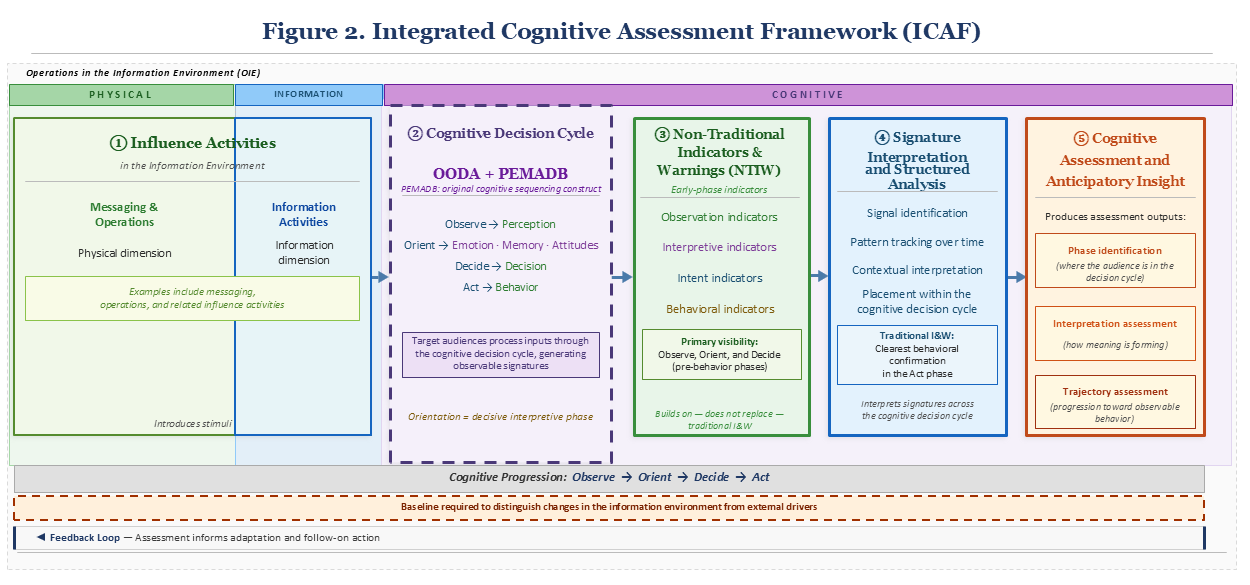
Figure 2 illustrates how influence activities introduced through the physical and informational dimensions generate cognitive processing in the cognitive dimension, and how ICAF organizes observable signatures into structured assessment outputs. The framework supports phase identification, interpretation assessment, and trajectory assessment before observable behavior confirms outcomes.
Signature Interpretation and Structured Analysis
Identifying signals is only the starting point. Analysts create value when they interpret those signals in context.
They begin by identifying relevant signals, then track how those signals change over time. Patterns matter more than isolated events. Analysts then interpret those patterns within context, considering target audience characteristics, competing narratives, and external factors that may shape meaning.
They then place those signals within the cognitive decision cycle. That step changes the analysis by framing signals not only as target audience response but also as indicators of decision progression. Depending on context, a shift in tone indicates early exposure in one case, but emerging intent in another.
This approach does not replace existing analytical practice; it sharpens it. The result shifts the analytical focus from merely describing activity to assessing how interpretation and intent develop.
Cognitive Assessment and Anticipatory Insight
From this process, analysts produce three types of assessment. They determine where target audiences are within the decision cycle, evaluate how interpretation is forming, and assess whether current patterns point toward action.
These assessments rarely provide certainty, but they give analysts earlier insight into how situations are developing. That earlier visibility changes how planners respond. It also creates space for earlier intervention, even when confidence is still forming.
One requirement remains essential: baseline. Without a baseline, analysts struggle to distinguish meaningful change from normal variation. Establishing that baseline is not always simple, but without it, interpretation becomes far less reliable.
Vignette: Interpreting NTIW Across the Cognitive Decision Cycle
Consider a notional scenario in which a state actor signals and conditions the environment for the potential use of force. Actor-generated stimuli surface through messaging, posture, and observable activity. The more meaningful change, however, occurs within the target audience, where cognitive shifts show how those signals are being processed and interpreted.
The scenario begins with increased messaging volume and broader distribution. The actor amplifies narratives emphasizing sovereignty, historical claims, and external threats across multiple channels, creating the observable stimulus. At the same time, the target audience registers increased exposure and awareness without shifting interpretation, marking movement within the Observe (Perception) phase.
The messaging intensifies over time, with themes growing more emotionally consistent and repetitive. While these signals remain visible, the more meaningful change takes shape within the target audience, where sentiment aligns and narratives gain traction. The audience connects messaging to prior beliefs and experiences, driving transition into the Orient (Emotion, Memory, and Attitudes) phase.
The actor’s messaging grows more explicit. Leaders begin articulating positions and narrowing perceived options. These signals suggest intent, but clearer insight comes through the target audience, where expectations converge and discourse reflects recognition of a likely course of action. This shift marks movement into the Decide (Decision) phase.
Only later do observable actions occur. The actor adjusts military posture, increases operational tempo, or signals externally through visible behavior. These actions align with the Act (Behavior) phase and confirm what earlier target audience NTIW had already suggested. By this stage, behavior validates a decision already made.
Across this progression, actor-generated signals introduce stimuli, but shifts within the target audience provide earlier and more reliable indicators of cognitive movement. Structuring NTIW across both sources clarifies how influence shapes interpretation and reveals the actor’s trajectory toward decision and action before behavior becomes observable.
Together, these signals trace a progression from awareness to interpretation to intent and finally to action, enabling assessment of both what occurs and how close an actor stands to executing a chosen course.
Target audience shifts reveal the actor’s trajectory before a decision manifests.
Recommendations
Applying this approach does not require a complete overhaul of existing processes. In the near term, organizations can align existing indicators with the cognitive decision cycle and establish analytical baselines to ensure signals remain consistent and comparable.
In the mid-term, organizations should apply the framework in operational settings. This tests whether phase-aligned indicators improve the assessment of interpretation, intent, and trajectory under real-world conditions.
In the long term, practitioners can refine NTIW sets through repeated use. Analysts improve the precision, standardization, and confidence of cognitive effect assessments. Most of the required data already exists; the difference lies in how analysts organize and interpret it.
Implications for Analysts and Planners
ICAF supports simultaneous assessment of influence effectiveness and progression within the actor’s decision-making process.
Assessments no longer rely solely on behavioral confirmation to understand operational dynamics. They trace how target audiences move through the decision cycle and identify where interpretation begins to take shape.
Across three operational contexts, the core problem persists: current methods confirm effects after the fact rather than informing decisions in progress. In OIE, teams easily measure outputs but struggle to evaluate cognitive effects. In PSYOP, planners measure dissemination and engagement yet often fail to determine how messaging shapes interpretation and intent. Finally, in gray zone environments, influence unfolds gradually and rarely produces clear, immediate indicators of effect.
ICAF addresses this unified problem by structuring how intelligence professionals interpret signals as they emerge.
Aligning indicators to cognitive phases makes this possible. Interpretation and intent become visible as they form, not after behavior confirms them. This approach does not remove uncertainty, but it allows analysts to engage it earlier and more effectively.
Conclusion
Influence shapes decisions before behavior becomes visible. Without a structured way to connect influence, cognition, and observable indicators, operational assessment fails to provide true warning.
ICAF provides a practical method to make those connections. It organizes signals along the cognitive decision cycle and enables analysts to assess interpretation and intent before action confirms them.
Persistent competition favors organizations that interpret signals before competitors act. ICAF gives analysts a practical method to assess cognitive movement early enough to shape decisions rather than merely explain outcomes.