





From Sea Denial to Market Shock: Maritime Swarms and the Weaponization of Global Energy Logistics

Abstract
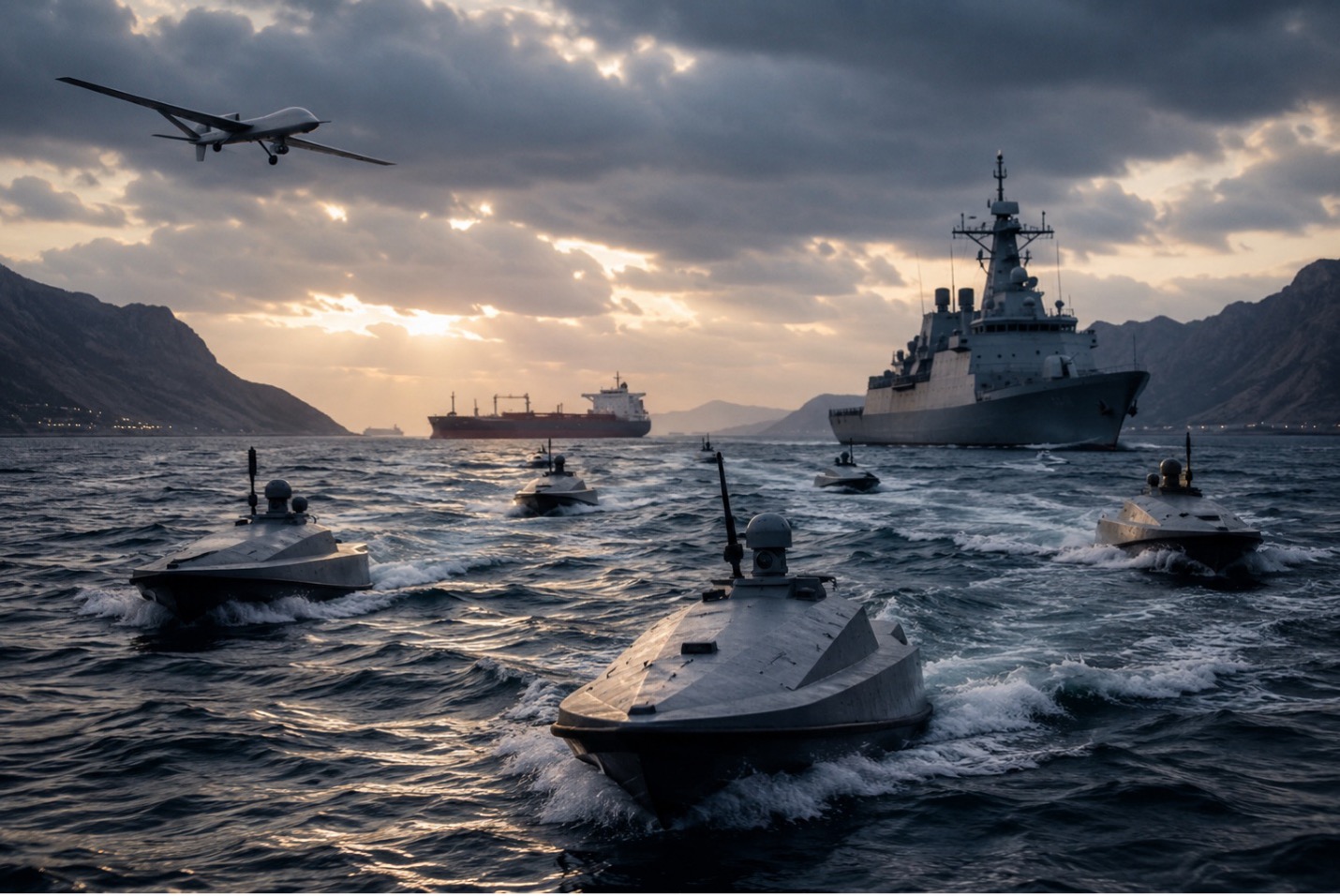
This article examines how maritime swarm tactics enable weak actors to transform global energy chokepoints into strategic battlefields. By leveraging numbers, speed, and dispersion, asymmetric forces—most notably the Islamic Revolutionary Guard Corps Navy (IRGCN)—can overwhelm conventional naval defenses and target vulnerable commercial tankers. These low-cost “mosquito fleets” bypass traditional naval engagements to strike at the global economy’s logistics center of gravity. Through an analysis of the Strait of Hormuz and recent disruptions in the Red Sea, this article demonstrates that swarm warfare imposes disproportionate economic costs, shapes market expectations, and amplifies systemic risk. It argues that these tactics function not only as instruments of sea denial but also as economic coercion targeting global energy supply chains, with implications for convoy adaptation and multinational coordination.
Introduction
Global energy markets depend on uninterrupted maritime transportation. Most internationally traded oil moves by sea, and a significant share of that traffic passes through a small number of narrow chokepoints. These chokepoints compress large volumes of tanker traffic into confined and predictable routes. This dependence on uninterrupted maritime transport creates systemic exposure to even localized disruptions.
Geographic constraints within these chokepoints limit maneuverability and compress reaction time. Such conditions favor asymmetric strategies, with maritime swarm tactics representing the most operationally relevant form in this environment. Small craft, unmanned systems, and missiles can operate effectively in crowded coastal waters, allowing weaker actors to threaten commercial shipping without directly engaging superior naval forces. Large numbers of low-cost platforms can overwhelm defenses, disrupt shipping flows, and generate broader economic consequences. These tactics enable disruption without requiring sustained combat operations, which increases their strategic value. This article argues that maritime swarm tactics allow weaker actors to impose disproportionate economic costs on global energy supply chains. It offers a new interpretation, framing swarm tactics not merely as instruments of sea denial, but as a form of systemic economic coercion targeting global energy logistics.
The Fragility of Global Energy Logistics: Why Chokepoints Matter
Global oil transport depends on a limited number of maritime chokepoints. According to estimates from the U.S. Energy Information Administration, the Strait of Hormuz carries close to 20% of the world’s oil trade. Other critical passages—including the Bab el-Mandeb Strait, the Strait of Malacca, and the Suez Canal—handle an additional 30% of daily flows. It’s alarming to realize that nearly 50% of global seaborne oil passes through a small set of narrow waterways.
Traffic concentration creates predictable shipping patterns. Tankers follow established traffic separation schemes and operate within spaces constrained by limited maneuverability. These conditions simplify tracking and interception for hostile actors operating nearby. These physical constraints do not remain confined to the operational level; they translate directly into systemic economic risk when disruptions occur. Recent disruptions illustrate how quickly localized threats can affect global markets. Houthi attacks in the Red Sea between 2023 and 2026 forced major shipping companies to reroute vessels around the Cape of Good Hope. The longer route added two weeks of transit time and increased fuel consumption. Insurance markets reacted as well. War-risk premiums for ships entering sensitive waters rose sharply, reflecting reassessments by insurers such as those operating within the Lloyd’s Market Association. Even isolated incidents can produce economic consequences that extend far beyond the immediate attack site.
Swarm Warfare: The Strategy of the Weak
Modern naval warfare reflects a broader evolution in naval thought. Classical theories of sea power, particularly those associated with Alfred Thayer Mahan, emphasized decisive fleet engagements and control of sea lines of communication. By contrast, Julian Corbett highlighted the strategic value of sea denial and limited control in constrained environments. Contemporary maritime swarm tactics build on this tradition, now amplified through modern Anti-Access/Area Denial (A2/AD) systems that extend the reach and effectiveness of distributed, low-cost forces.
Swarm warfare provides a practical method for weaker actors to exploit chokepoint vulnerabilities. This strategy relies on four operational characteristics: numbers, speed, dispersion, and simultaneous attack. Instead of seeking a decisive battle, attackers create confusion by presenting multiple threats simultaneously. Defensive systems struggle under these conditions. Radar networks, missile interceptors, and command systems are effective in countering individual threats, but swarm tactics can overwhelm defenses and complicate decision-making.
Recent conflicts demonstrate the effectiveness of this swarm warfare. Ukrainian unmanned surface vessels damaged several Russian warships in the Black Sea through coordinated strikes that bypassed traditional naval defenses. In the Red Sea, Houthis’ drone and missile attacks disrupted commercial transit through the Suez route during peak periods. Container traffic declined as companies shifted vessels to longer routes around Africa. These cases show how inexpensive platforms can produce strategic effects that far exceed their cost.
However, the effectiveness of swarm tactics is not guaranteed. Advances in surveillance, unmanned systems, and data fusion increasingly enable naval forces to detect, track, and engage multiple small targets simultaneously. In sensor-saturated environments, the advantages of dispersion and speed may diminish as defenders improve target discrimination and response times. These developments suggest that swarm warfare remains effective primarily under conditions of congestion, ambiguity, and limited detection windows.
Iran’s Maritime Swarm in Practice
Iran has developed one of the most advanced maritime swarm capabilities among regional powers. Responsibility for this approach falls primarily to the IRGCN, which focuses on littoral warfare in the Persian Gulf and the Strait of Hormuz. The IRGCN relies on a large number of small, inexpensive platforms. Fast-attack craft, missile boats, naval mines, and unmanned systems form the core of this force structure. Analysts frequently describe the organization as a “mosquito fleet” because its effectiveness derives from numbers rather than the capability of individual platforms. Command arrangements reinforce this model. Units operate with decentralized authority and respond rapidly to local conditions. Coastal bases, islands, and dispersed staging areas provide multiple launch points for maritime operations.
Recent deployments highlight the practical application of this doctrine. In February 2026, satellite imagery showed the IRGCN concentrating at least 40 fast-attack vessels near Sirik’s Shahid Seyyed Majid Base in the Strait of Hormuz. The formation operated roughly 14 nautical miles from major tanker routes. Such movements signal readiness while increasing perceived risk for commercial shipping. Iran’s objective focuses on sea denial—the ability to disrupt or restrict an adversary’s use of maritime space— rather than fleet destruction. Limited disruption can influence global markets even without sustained combat operations.
Why Energy Tankers Are Highly Vulnerable Targets
Commercial oil tankers present attractive targets for swarm tactics. Their size creates large radar signatures while their defensive capabilities remain minimal. Most vessels travel at 12-15 knots along fixed shipping lanes, limiting their ability to maneuver in response to fast-moving threats. Crew size also constrains onboard response capacity. Tankers typically operate with civilian crews, making coordinated defense against swarm attacks extremely difficult.
Economic factors amplify the consequences of attacks on commercial shipping. The Iran–Iraq Tanker War in the 1980s demonstrated that limited strikes could trigger sharp increases in insurance premiums. Similar patterns appeared during Red Sea disruptions. Shipping companies often suspend operations in high-risk regions when costs rise above acceptable limits. As a result, even small-scale attacks can disrupt broader trade flows.
Strategic and Economic Consequences
Swarm attacks generate economic effects that extend far beyond the immediate strike. Energy markets react quickly to threats against major chokepoints because a large portion of the global oil supply depends on uninterrupted maritime transport. Even limited disruptions can trigger price volatility and increase uncertainty across shipping and energy markets. According to contemporary reporting, the March 11–12, 2026, attacks on the Marshall Islands-flagged, U.S.-owned Safesea Vishnu and the Malta-flagged tanker Zefyros illustrate this dynamic. News of the strikes affected global oil markets and heightened volatility as traders reassessed the security of Gulf export routes. The incident demonstrated how attacks on a small number of vessels can disrupt physical flows. It also shapes market expectations, amplifies uncertainty, and prompts precautionary behavior among shipping firms and energy importers.
Prolonged disruptions could have even greater consequences. Many Gulf producers rely on maritime exports from a limited number of terminals. If tanker loading operations slow or halt, global supply can quickly tighten. Large import-dependent economies—including China, India, and several European states— would face immediate pressure to secure alternative supplies at higher prices. Ultimately, consumers absorb these effects through increased fuel costs, transportation expenses, and higher prices for goods and services. Inflationary pressures can spread across national economies within a short period.
Insurance markets intensify these pressures. War-risk premiums climb rapidly after attacks near shipping lanes. Some insurers suspend coverage entirely until security conditions stabilize. These financial responses magnify the economic impact of relatively small military actions. Therefore, swarm tactics function as a form of economic coercion. Small and inexpensive platforms can trigger market instability, disrupt energy logistics, and impose costs across the global economy without requiring large conventional forces.
Implications for Naval Strategy and Logistics Security
Naval strategy must adapt to this evolving threat environment. Traditional doctrine emphasized fleet engagements and control of open-ocean space. Recent conflicts indicate that commercial logistics networks are more accessible and strategically valuable targets. Protecting maritime supply chains is now a central operational requirement. Convoy systems may regain importance in high-risk regions. Concentrated escort protection reduces the exposure of individual merchant vessels and allows naval forces to allocate defensive resources more effectively. This approach does not eliminate risk, but it improves resilience against dispersed and fast-moving threats.
Improved maritime domain awareness is equally important. Satellite surveillance, unmanned aerial systems, and surface drones expand monitoring capacity across congested sea lanes. These tools support earlier detection of suspicious activity and enable faster response to emerging threats. Defensive adaptation must also address saturation dynamics. Traditional ship-based defenses are not optimized to counter large numbers of low-cost, fast-moving platforms. Layered defense architectures—combining electronic warfare, directed energy systems, and autonomous interceptors—offer more scalable responses to swarm attacks. International cooperation strengthens these efforts. Multinational patrols in contested regions demonstrate how coalition operations can distribute the burden of securing critical trade routes. Coordinated action improves coverage, enhances information sharing, and reinforces deterrence.
Conclusion
Modern maritime conflict increasingly targets logistics rather than fleets. Global energy supply depends on a small number of maritime chokepoints that concentrate enormous economic value in narrow and predictable waterways. These conditions create opportunities for weaker actors to exploit structural vulnerabilities. Maritime swarm tactics exploit these dynamics by leveraging numbers, speed, and dispersion to overwhelm defenses and disrupt commercial shipping. Iran’s approach, particularly through the IRGCN, illustrates how a state can institutionalize this method of warfare. Vulnerable tankers and sensitive insurance markets amplify the effects of even limited attacks. The result is a strategic environment in which relatively small-scale actions can produce global consequences.
The implications for naval forces are clear. Maritime logistics has become a primary center of gravity in modern conflict. Securing commercial shipping requires sustained attention, advanced surveillance capabilities, and coordinated defensive measures. Protecting logistics networks now carries a strategic importance comparable to traditional naval missions. Sustained disruption of maritime oil transport would extend far beyond temporary price fluctuations. Strategic petroleum reserves can stabilize markets during short-term emergencies, but they cannot replace the continuous flow of large volumes of oil through maritime chokepoints. If attacks on tanker routes persist, supply shortages could exceed the capacity of existing reserves to compensate. Under such conditions, energy security becomes a central strategic concern for major economies. Swarm warfare shows that relatively modest capabilities can threaten those maritime arteries of commerce that sustain the global economy. Naval strategy must adapt accordingly to ensure the resilience and security of maritime supply chains.


