





Persistence Over Power: A Lebanese Model of Maritime Denial

Abstract
This article examines how maritime swarm tactics are reshaping competition in contested littorals and increasing the operational burden on major naval powers. It argues that Lebanon can strengthen maritime security under conditions of asymmetry by adopting a denial-focused swarm strategy built on distributed unmanned systems and sustained presence. Rather than seeking naval parity or escalation dominance, the approach emphasizes endurance, legality, and logistical feasibility to deny adversaries easy maritime success.
Introduction
Maritime chokepoints are increasingly vulnerable to disruption by low-cost, distributed tactics. Recent incidents in the Red Sea and the Strait of Hormuz demonstrate how localized attacks can disrupt global trade flows, raise energy prices, and impose sustained operational demands on major naval powers. These developments reflect a broader shift in maritime competition: control at sea is no longer determined solely by high-end platforms, but by the ability to sustain persistent, distributed presence under pressure.
This shift is most acute in constrained littoral environments, where smaller states face superior naval power but cannot rely on escalation or fleet expansion. Lebanon represents a clear case of this dilemma. It operates under persistent external pressure while seeking to preserve sovereignty and resist coercion without escalation.
The strategic problem is therefore not how Lebanon can defeat stronger maritime actors, but how it can prevent them from achieving their strategic objectives at sea. This article argues that Lebanon can meet this challenge through a denial-focused maritime strategy built on distributed unmanned systems and sustained presence. Rather than seeking parity or dominance, the approach emphasizes endurance, legality, and logistical feasibility to deny adversaries easy success. While grounded in the case of Lebanon, the argument offers broader lessons for maritime strategy in an era of asymmetric, persistent competition.
Lebanon’s Compressed Maritime Environment
Lebanon operates in a uniquely compressed maritime environment where multiple pressures converge. Superior state navies retain escalation dominance near its southern waters, while great-power sensors and naval activity complicate situational awareness in the north. Hybrid networks exploit surveillance gaps and irregular traffic patterns along the entire coastline. At the same time, humanitarian and environmental responsibilities impose continuous non-military demands on limited naval assets. These pressures interact rather than operate independently:
- Search and rescue missions pull patrol craft away from enforcement tasks.
- Maintenance delays reduce availability.
- Predictable patrol patterns create exploitable gaps.
As a result, adversaries and smugglers face low risk when they time activity around known constraints. Lebanon’s intermittent naval presence signals weakness rather than control.
Pursuing naval modernization will not resolve present littoral dynamics.
Fleet expansion exceeds Lebanon’s fiscal capacity and increases its dependence on sustainment chains: fuel, maintenance, spare parts, and trained manpower; all of which are vulnerable to disruption and external constraint. Capital platforms impose high operating costs and limited coverage. A different logic is required—one that emphasizes persistence over concentration and endurance over episodic strength. For Lebanon, this compression is not only material, but also political, as Lebanese naval forces operate under constant scrutiny and legitimacy constraints that shape what effective action can look like in practice. Routine patrol gaps emerge when a single search-and-rescue task or maintenance delay removes a scarce platform from the entire coastal picture.
Distributed Maritime Presence Under Constraint
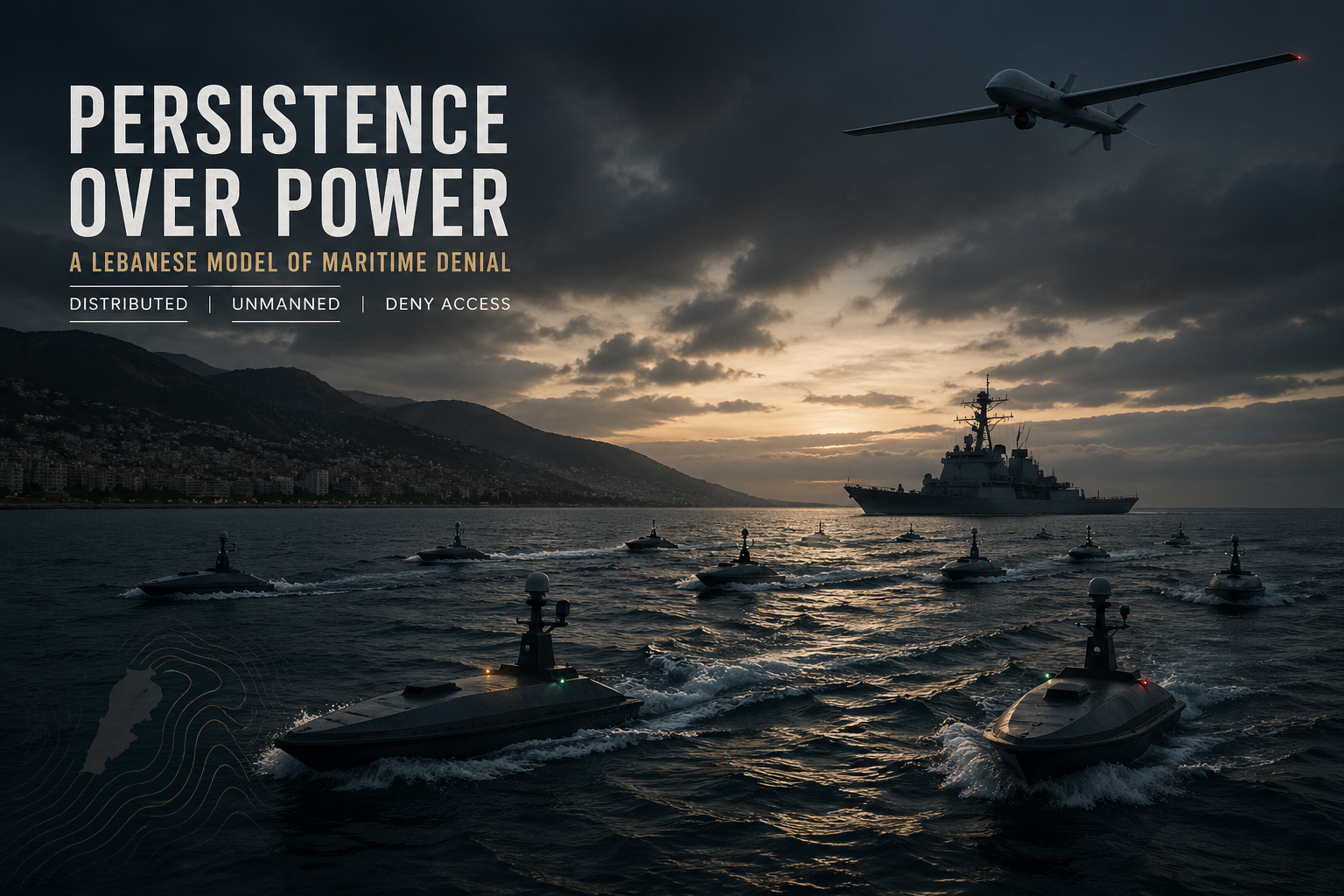
Distributed unmanned systems alter the cost and coverage balance at sea. Small unmanned surface and aerial platforms provide long endurance, wide-area presence, and tolerance for attrition at a fraction of the cost of manned vessels. Their value does not lie in firepower, but in continuity and redundancy. Any loss of individual platforms degrades capacity but does not collapse presence.
This cost structure aligns with Lebanon’s fiscal reality. A single patrol vessel absorbs a disproportionate share of the navy budget, whereas multiple unmanned units can sustain routine coverage across several sectors at comparable or lower cost. Redundancy replaces invulnerability. Availability replaces platform prestige. This shift matters because denial depends on repetition rather than decisive encounters. Recent Black Sea operations illustrate this logic. Ukrainian naval forces sustained maritime denial through repeated, low-cost unmanned surface deployments under constant pressure. These operations illustrate that outcomes in contested littorals are shaped by persistence over time rather than by platform survivability. In practice, this meant that denial was achieved by repeatedly disrupting adversary routines and assumptions about access.
Routine presence, rather than manpower-intensive patrol cycles, defines the operational advantage of distributed swarms.
Small shore-based teams can supervise multiple platforms simultaneously, which allows continuous coverage without proportional increases in crew size. Automation supports navigation and routine monitoring, while human operators retain authority over the classification of contacts, escalation decisions, and enforcement actions. This human-controlled structure preserves legal accountability by ensuring that judgment over use of force, boarding, or interdiction remains with authorized personnel. This manpower model sustains continuous maritime visibility without proportional increases in personnel demand. Comparable operational logic appears in Singapore’s reliance on distributed, routine patrol presence to manage extreme traffic density and geographic compression. There, persistence and visibility shape maritime behavior in one of the world’s most congested littoral environments. This parallel reinforces the claim that denial through repetition functions effectively under conditions of congestion and restraint. While neither case maps neatly onto Lebanon’s political or legal environment, both illustrate how persistence and distributed presence can shape behavior under conditions of congestion and asymmetry.
Unmanned maritime systems are vulnerable to electronic warfare, jamming, or spoofing, particularly in congested littoral environments. This concern reflects the operational realities faced by small states operating near superior naval and electronic capabilities. Such vulnerability does not negate the denial concept but reflects a strategic tradeoff; Lebanon exchanges platform survivability for endurance and presence. Significant effort must therefore focus on mitigating electronic disruption through dispersion, redundancy, low-signature employment, degraded-mode operation, and retained human control. The objective is not to eliminate disruption entirely, but to preserve routine presence despite it. This approach reflects recent operational experience in which electronic contestation has become a persistent feature of littoral competition rather than an exceptional disruption.
Operational Logic and Legal Restraint
A denial-based maritime posture requires more than technology. It requires an operational logic that integrates detection, interference, and enforcement under centralized authority. Success is predicated on three pillars:
- Persistent detection: Continuous observation closes surveillance gaps and removes timing advantages.
- Lawful interference: Shadowing, signaling, and controlled obstruction disrupt routes and schedules without resorting to force. These actions impose operational interference while remaining within legal bounds.
- Human-controlled enforcement: Boarding, arrest, and rescue require judgment and accountability. Automation supports these actions but does not replace them.
These pillars produce a layered denial effect. Adversaries cannot rely on invisibility and cannot assume predictable response patterns. They face continuous uncertainty even when enforcement remains selective.
For Lebanon, legality is not a secondary concern; it is a strategic requirement. International maritime law defines jurisdiction, limits enforcement authority, and imposes duties of assistance. The duty to render assistance at sea overrides all other considerations. Any indication of distress requires immediate response, regardless of the vessel’s activity or nationality. Therefore, a denial posture must be embedded with humanitarian override mechanisms that shift priority from enforcement to rescue when needed. The operations of the European maritime border regimes under Frontex remain politically contested, but they nonetheless demonstrate how persistent monitoring and lawful interference can shape behavior short of continuous interdiction. This experience reinforces the operational reality of non-military maritime overload.
Escalation Management and Political Effects
A maritime swarm strategy reframes Lebanon’s security problem. The question shifts from how to match superior forces to how to deny easy success. This shift aligns strategy with dynamics while preserving political space. Defensive sufficiency does not require dominance but it requires endurance, legality, and restraint. Sustainment, not firepower, determines credibility. When logistics align with institutional limits, denial remains viable under pressure. More broadly, Lebanon’s case offers a lesson for small states in congested littorals. The strategic aim is not maritime dominance, but the preservation of political space for sovereign decision-making under constant external pressure.
Maritime control today depends less on what a navy can destroy and more on what it can continue to do quietly, lawfully, and repeatedly.
While grounded in the case of Lebanon, this framework applies to other small states operating in congested, surveilled littorals under conditions of asymmetry. Similar dynamics confront states that face superior naval power, persistent hybrid pressure, and constrained political space. In such environments, defensive sufficiency through distributed denial may offer a more credible path to maritime control than fleet parity or escalation threats.
Implications for U.S. Maritime Strategy
Maritime swarm tactics are not only a regional concern. The United States depends on uninterrupted maritime trade flows, particularly through energy chokepoints such as the Strait of Hormuz and the Bab el-Mandeb. Disruption in these corridors affects global oil prices, allied economies, and the stability of international markets.
Swarm tactics challenge traditional U.S. naval assumptions. High-end platforms designed for power projection are increasingly vulnerable to low-cost, distributed threats that impose disproportionate economic and operational costs. This dynamic forces the United States to allocate significant resources to protect commercial shipping and maintain freedom of navigation. These threats also expand the burden on U.S. forces. Operations such as convoy protection, maritime security patrols, and crisis response in the Red Sea demonstrate how localized asymmetric tactics can generate sustained operational demand on U.S. naval forces.
Supporting partner nations represents a more sustainable approach. Strengthening the maritime capabilities of small states through distributed surveillance, lawful interdiction, and denial-oriented strategies reduces the need for continuous U.S. intervention. As demonstrated in this article, small-state maritime forces can contribute to regional stability when equipped with scalable and sustainable denial capabilities. Therefore, maritime swarm tactics represent not only a tactical challenge, but also a strategic test of how the United States adapts force design, partner integration, and maritime defense in contested littoral environments.
Conclusion
Lebanon cannot secure its maritime domain through fleet parity or escalation threats. These approaches exceed its capacity and undermine credibility. A distributed maritime swarm offers a realistic alternative grounded in persistence and sustainment. By prioritizing endurance, modularity, and loss tolerance, Lebanon can maintain sovereign presence without provoking escalation. Legal and humanitarian constraints strengthen this posture rather than weaken it. Sustainment transforms material asymmetry into defensive sufficiency. A maritime swarm does not promise victory, but it promises control. In a compressed maritime environment, control is the foundation of sovereignty. This approach reflects a shift from deterrence by punishment toward deterrence by denial under conditions of constraint. Under such conditions, persistence—not power projection—becomes the foundation of sovereignty


