





Ideas Without Rank: Small Wars Journal and the Democratization of Strategic Thought After 9/11
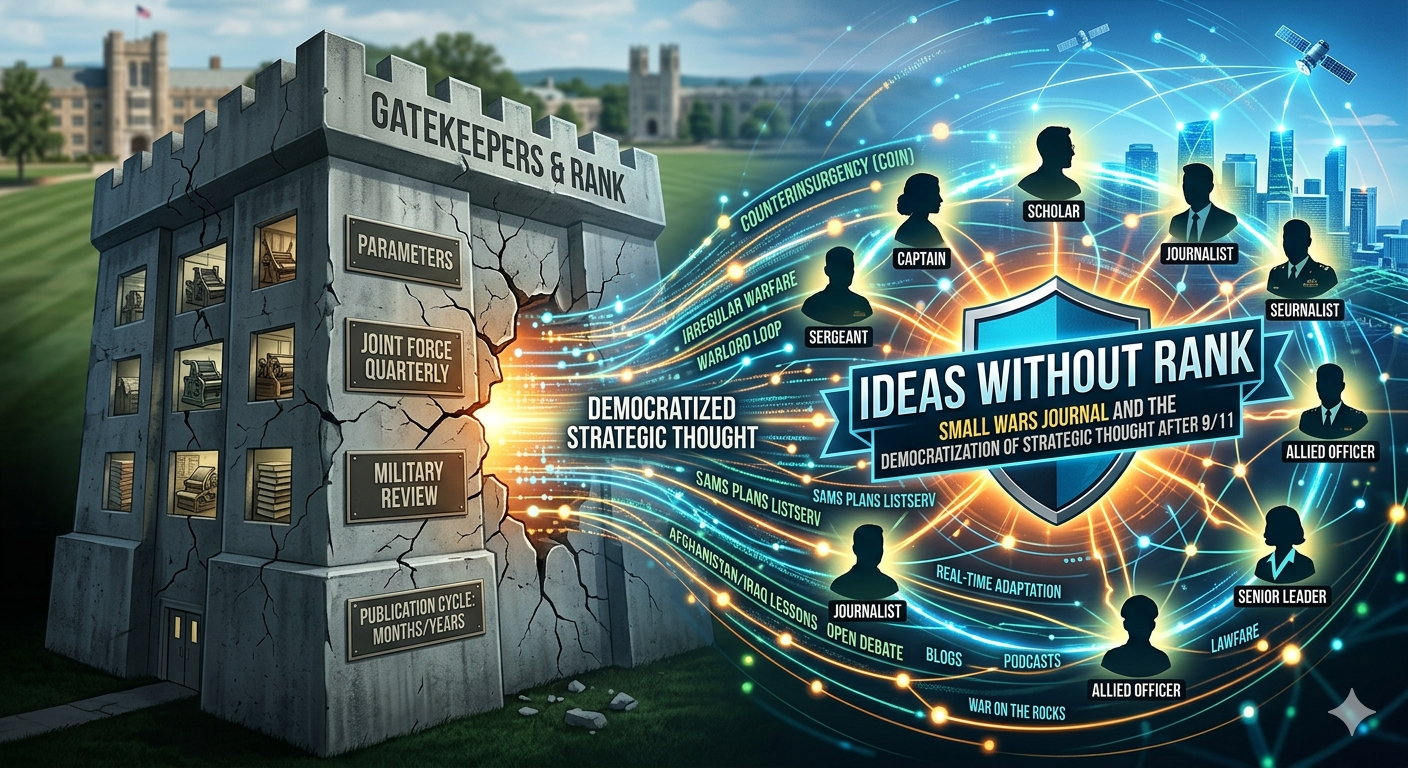

From the Warlord Loop to Small Wars Journal to the Digital Marketplace of Strategic Ideas
The attacks of September 11, 2001, transformed American national security. Entire institutions adapted to confront terrorism, insurgency, irregular warfare, and strategic competition. Less appreciated, however, was another revolution that occurred simultaneously. The way military professionals, scholars, journalists, policymakers, and practitioners discussed war changed fundamentally.
For much of the twentieth century, professional military discourse was deeply hierarchical. Ideas flowed through established institutions, professional journals, military schools, academic publications, and think tanks. Publication timelines were measured in months, sometimes years. Editorial gatekeepers determined which ideas entered the debate. Junior officers rarely engaged directly with senior leaders. Operational lessons often took years to influence doctrine.
Before 9/11, serious national security debate moved through respected venues such as Parameters, Military Review,Proceedings, Joint Force Quarterly, PRISM (now at the Irregular Warfare Center), service journals, and professional military education institutions (most all of which have adapted well in the modern era). Scholars wrote for International Security, Foreign Affairs, Foreign Policy, and academic presses. Think tanks produced reports for Washington policy circles. These institutions mattered. They gave the profession rigor, standards, and legitimacy. But they moved slowly.
The Global War on Terrorism, and specifically wars in Afghanistan and Iraq, did not move slowly.
The profession needed a venue where lessons could be shared in real time, assumptions challenged, and new ideas tested while operations were still underway. It needed a place where a captain in Ramadi, a Special Forces team leader in Kunar, a scholar in Washington, a journalist on the defense beat, and a retired general could engage in the same conversation.
The internet provided the medium.
Small Wars Journal provided the model.
But Small Wars Journal did not appear from nowhere. Its roots reach back into the final decade of the twentieth century, when pioneering military professionals began using early digital networks to connect dispersed communities of thinkers and practitioners. Before blogs, podcasts, Substack, X, LinkedIn, and online journals, there were email distribution lists, discussion groups, and listservs. These early forums foreshadowed the post-9/11 democratization of strategic discourse.
The history of post-9/11 online national security discourse is therefore not only the story of websites. It is the story of a profession moving from gatekeepers to networks.
The Precursors: Warlord, Listservs, and the Early Digital Community
The democratization of national security discourse did not begin with Small Wars Journal. Its roots can be traced to the late twentieth century, when a handful of military professionals began using emerging internet technologies to connect people separated by geography, service, rank, and institution.
One of the most important early examples was the Warlord Loop, established by the late Colonel John Collins. Collins, widely regarded as one of the most respected American military analysts of his generation, created a network that connected officers, scholars, journalists, policymakers, retired military professionals, and independent thinkers. The discussion was (and remains) informal, demanding, and often provocative. Participants exchanged articles, commentary, field observations, historical insights, reading lists, and strategic critiques long before such exchanges became routine in the digital national security world.
The Warlord Loop mattered because it demonstrated the power of distributed professional dialogue. It was a virtual community of practice before the phrase became fashionable. It showed that serious strategic discussion could occur outside formal institutions and beyond the slow timelines of traditional publication.
The late Dave Dilegge was part of that network. The Warlord Loop helped shape his understanding of what a professional digital forum could become. It revealed a demand for rapid exchange, open debate, practitioner insight, and serious discussion unconstrained by rank or bureaucracy. Many of the principles that later defined Small Wars Journal were present in embryonic form in the culture fostered by Collins and the Warlord community.
At roughly the same time, other listservs and email networks were emerging across the military profession. One important example was the School of Advanced Military Studies Plans List, commonly known as the SAMS Plans Listserv. Originally intended to connect SAMS graduates and planners across the force, it became a venue for operational and strategic exchange. Officers shared lessons learned, debated planning concepts, exchanged reading recommendations, and sought advice from peers across the Army and joint force.
The SAMS Plans List reflected a broader shift. Knowledge was beginning to move both horizontally and vertically. Professional learning no longer had to pass only through formal command channels, journals, or schoolhouses. The early digital environment allowed planners, operators, and thinkers to form networks that could learn faster than institutions. This platform eventually evolved to the current listserv, the Army Strategy Loop, managed by Dr. Robert Toguchi, (COL, USA Ret) that continues to provide excellent strategic discourse in 2026.
These early networks were not yet public platforms. They were limited, often informal, and dependent on personal trust. But they were important. They created habits of collaboration, peer exchange, and intellectual candor that would later define the best online national security forums.
They were the bridge between the old world and the new one.
Small Wars Journal and the Birth of a Community of Practice
Small Wars Journal emerged at precisely the right moment.
Founded by Dave Dilegge and Bill Nagle in 2005, Small Wars Journal became far more than a website. It became the central intellectual gathering place for practitioners grappling with the challenges of counterinsurgency, irregular warfare, stability operations, and the wars in Iraq and Afghanistan.
Its innovation was not merely publishing articles online.
Its innovation was creating an open professional community where ideas competed on their merits rather than on the rank, title, or institutional affiliation of the author.
Captains debated colonels. Scholars challenged practitioners. Foreign officers contributed perspectives often absent from American discussions. Active-duty personnel published observations from ongoing operations. Senior leaders gained direct visibility into emerging debates from the field.
The resulting dialogue was often messy, occasionally contentious, and frequently transformative.
Small Wars Journal gave the “counterguerrilla underground” a home. It created a professional marketplace for people who believed the United States needed to relearn old lessons about small wars, political warfare, counterinsurgency, stability operations, unconventional warfare, and the human domain of conflict.
Many of the defining debates of the post-9/11 era found an early home on Small Wars Journal:
- counterinsurgency
- stability operations
- tribal engagement
- population-centric warfare
- hybrid warfare
- political warfare
- irregular warfare
- unconventional warfare
- information operations
- civil-military integration
- the limits of conventional force
- and so much more.
In many cases, discussions on Small Wars Journal preceded formal doctrinal development. Ideas that later appeared in field manuals (i.e., FM 3-24 Counterinsurgency), strategic documents, and professional military education classrooms often appeared first as essays, blog posts, and comment threads among practitioners attempting to understand operational realities.
Small Wars Journal demonstrated a powerful truth. Expertise was far more widely distributed throughout the profession than institutional hierarchies often recognized.
The Democratization of Strategic Thought/Discourse
The most significant contribution of Small Wars Journal may have been the democratization of strategic discourse.
Historically, military institutions relied on hierarchical systems for generating and validating ideas. Such systems remain necessary for command and execution. They are often less effective, however, at fostering innovation.
The digital environment changed this dynamic.
Online platforms lowered barriers to participation and expanded access to professional debate. Officers stationed overseas could engage directly with scholars in Washington. Journalists could interact with military practitioners. Coalition partners could contribute perspectives unavailable within national bureaucracies. Retired officers could stay in the fight intellectually. Junior leaders could test ideas in public before they were sanitized by staff processes.
This democratization did not eliminate expertise.
It broadened the pool from which expertise could emerge.
The result was a more adaptive intellectual ecosystem. Ideas competed more rapidly. Assumptions were challenged more openly. Institutional blind spots became easier to identify.
Most importantly, strategic discourse became less centralized.
Authority increasingly derived from evidence, experience, logic, and persuasion rather than solely from rank or position.
That was a profound change. It made the national security profession more open. It also made it more competitive. Ideas could no longer hide behind title or institution. They had to survive contact with readers who had fought, studied, governed, reported, planned, commanded, and bled.
Timeline of the Post-9/11 Online National Security Ecosystem
The evolution of online national security discourse can be understood as a progression from professional journals to listservs, then to online journals, blogs, institutional platforms, podcasts, newsletters, and social media.
Pre-9/11: Professional Journals and Institutional Publications
Before the rise of online discourse, premier venues included Parameters, Military Review, Proceedings, Joint Force Quarterly, service journals, academic journals, and think tank reports. They provided legitimacy and rigor, but their publication cycles were slow and their access limited.
1990s: The Warlord Loop
COL John Collins’ Warlord Loop showed that serious military and strategic debate could occur through distributed digital networks. It connected diverse professionals and encouraged direct, candid, and rapid exchange. Dave Dilegge’s participation in this network influenced his later development of Small Wars Journal.
1990s: SAMS Plans Listserv
The SAMS Plans Listserv connected graduates and planners across the force. It helped normalize horizontal professional exchange and demonstrated the value of digital communities tied to operational planning and professional military education.
2005: Small Wars Journal
Small Wars Journal became the foundational platform for post-9/11 discussions of small wars, counterinsurgency, irregular warfare, stability operations, and operational lessons from Iraq and Afghanistan. It proved that serious professional debate could flourish outside traditional institutions.
2006-2008: Abu Muqawama
Andrew Exum’s Abu Muqawama became one of the most influential counterinsurgency blogs of the Iraq War era. Less formal than SWJ but operating in the same intellectual space, it demonstrated that blogs could indeed shape serious military thought and policy debate.
2009: The Best Defense
Tom Ricks’ The Best Defense at Foreign Policy brought together military professionals, journalists, and policymakers in the same strategic conversation. It broadened the audience for military debate and brought greater public attention to strategy, leadership, Iraq, Afghanistan, and civil-military relations.
2013: War on the Rocks
War on the Rocks represented the next major evolution. Founded by Ryan Evans, it adopted many of the principles pioneered by SWJ while adding professional editing, broader strategic focus, and greater policy relevance. Its scope expanded beyond Iraq and Afghanistan to great power competition, nuclear deterrence, alliances, defense reform, Asia-Indo-Pacific strategy, cyber conflict, emerging technologies, and statecraft. If Small Wars Journal democratized discourse, War on the Rocks professionalized and scaled it.
2013: The Strategy Bridge
The Strategy Bridge focused on military theory, strategy, and professional military education. It provided an important venue for emerging scholars and junior officers to engage strategy as a discipline rather than merely as a policy slogan.
2014-2015: Modern War Institute
The Modern War Institute at West Point added institutional credibility to practitioner-focused online writing. It linked digital discourse with professional military education while maintaining the accessibility and responsiveness that made online platforms valuable.
2010s: Lawfare
Lawfare expanded the ecosystem beyond warfighting. Its focus on national security law, intelligence, cybersecurity, surveillance, executive authority, and democratic institutions reflected a broader understanding of twenty-first century national security challenges.
2017: Texas National Security Review
Texas National Security Review sought to bridge the divide between academic rigor and policy relevance. It offered a hybrid model that combined scholarly standards with practical application for policymakers and practitioners.
2018-Present: Podcasts, Newsletters, and Social Media
The next phase moved beyond written essays. Podcasts such as the War on the Rocks Podcast, the Lawfare Podcast, and the Irregular Warfare Podcast expanded audiences and accelerated discussion. Substack newsletters, LinkedIn posts, YouTube interviews, and X threads further lowered barriers to participation. The audience grew. The speed increased. The barriers fell. But so did some of the filters.
Note that the timeline is a representative sample of the evolution of the digital ecosystem. There are too many platforms to list, many are still contributing today, and new ones are emerging.
What Changed
The old system privileged institutions.
The new system privileged networks.
This did not destroy expertise. It changed how expertise was discovered. Before 9/11, professional authority often came from rank, title, affiliation, or publication venue. After SWJ, authority could also come from clarity, field experience, evidence, and the ability to persuade a professional audience.
That is the core of the revolution.
It moved the profession from a closed hierarchy of publication to an open network of contestation. It allowed operational insight to move faster. It allowed junior leaders to be heard. It allowed specialists in irregular warfare, special operations, intelligence, law, information, cyber, technology, and strategy to find one another across institutional boundaries.
It also revealed an uncomfortable truth: institutions do not always know where their best ideas reside. Sometimes the best insight comes from the edge. Sometimes it comes from someone outside the approved circle. Sometimes it comes from the person closest to the problem.
Small Wars Journal made that visible.
The Benefits and Risks of Open Discourse
The democratization of discourse produced substantial benefits.
Professional communities became more connected. Innovation accelerated. Junior leaders gained opportunities to contribute. Diverse perspectives improved understanding of complex problems. Ideas no longer needed institutional sponsorship to gain traction.
Yet democratization also introduced risks.
The volume of information increased dramatically. Expertise became harder to distinguish from opinion. Social media rewarded speed over reflection and certainty over nuance. Strategic conversations became increasingly fragmented across multiple platforms. Some discussions became performative. Some became tribal. Some confused visibility with wisdom. Another risk, paradoxically, is that it may now be more difficult to reach policymakers’ attention on certain key issues due to information proliferation.
The challenge today is no longer access to information.
The challenge is finding wisdom inside abundance.
This is the central paradox of the digital age. The profession solved the problem of information scarcity only to confront the problem of information overload.
The answer is not to return to gatekeepers. Nor is it to worship the crowd. The answer isn’t to return to tight hierarchies, but to nurture a culture of intergenerational dialogue and genuine mentorship. The answer is disciplined open discourse. The profession needs rigor without suffocation, openness without chaos, and debate without contempt.
What Small Wars Journal Still Teaches Us
More than two decades after 9/11, the lessons of Small Wars Journal remain relevant.
The future battlefield will be increasingly shaped by artificial intelligence, autonomous systems, cyber operations, space capabilities, cognitive warfare, economic coercion, proxy warfare, irregular warfare, and strategic competition among major powers.
Yet the need for professional dialogue remains unchanged.
Military institutions must continue to cultivate environments where ideas can be challenged, assumptions tested, and innovation encouraged. Hierarchies remain necessary for command. Intellectual progress often depends upon openness.
Small Wars Journal and those that followed demonstrated that professional discourse can be both rigorous and accessible.
It showed that strategic insight is not confined to senior leaders or elite institutions.
It proved that communities of practice can influence doctrine, shape policy, and improve professional understanding.
The lesson reaches back to COL John Collins and the Warlord Loop. It runs through the SAMS Plans Listserv. It finds institutional expression in Dave Dilegge’s Small Wars Journal. It continues through War on the Rocks, Lawfare, the Modern War Institute, The Strategy Bridge, Texas National Security Review, podcasts, newsletters, and social media.
The tools changed.
The requirement did not.
The profession must learn faster than the environment changes.
Conclusion
The history of online national security discourse following 9/11 is, in many respects, the history of the democratization of professional military thought.
Small Wars Journal did not simply create another publication.
It changed the structure of the conversation itself.
The platforms that followed each contributed something important. Abu Muqawama popularized military blogging. The Best Defense connected military professionals and journalists. War on the Rocks broadened and professionalized strategic debate. Lawfare expanded the discussion into law and governance. The Modern War Institute linked discourse to professional military education. The Strategy Bridge and Texas National Security Review connected theory to practice. Podcasts, newsletters, and social media multiplied participation.
But Small Wars Journal came first as the defining post-9/11 platform.
It established the blueprint.
It demonstrated that good ideas could come from anywhere.
In an era defined by rapid technological change, strategic competition, and information abundance, preserving that culture may be one of the most important contributions to national security that any professional community can make.
The question for the profession is simple: if the next war is already being shaped by networks, algorithms, proxies, narratives, and machines, can the national security profession afford to return to slow, hierarchical, closed discourse?
It cannot.
Open professional discourse is not a luxury.
It is a form of readiness.
“Discourse at the speed of relevance. Because there’s nothing small about Small Wars.”



During GWOT, it was always quite interesting to read the articles posted on SWJ. this venue also allowed me to share my ideas, some of which seem to attract attention at levels I didn’t anticipate. Perhaps the most influential article I recall from SWJ was the one from MAJ Jim Gant, “One Tribe at a Time”, in which he advocated for a counterinsurgency strategy that inspired the Village Stability Operations in Afghanistan.
I hope SWJ continues to be a place where members from the US and elsewhere to share ideas and discuss multiple viewpoints. You never know who is reading this stuff.