





Taking Off the Blinders Regarding Special Forces Strategic Utility
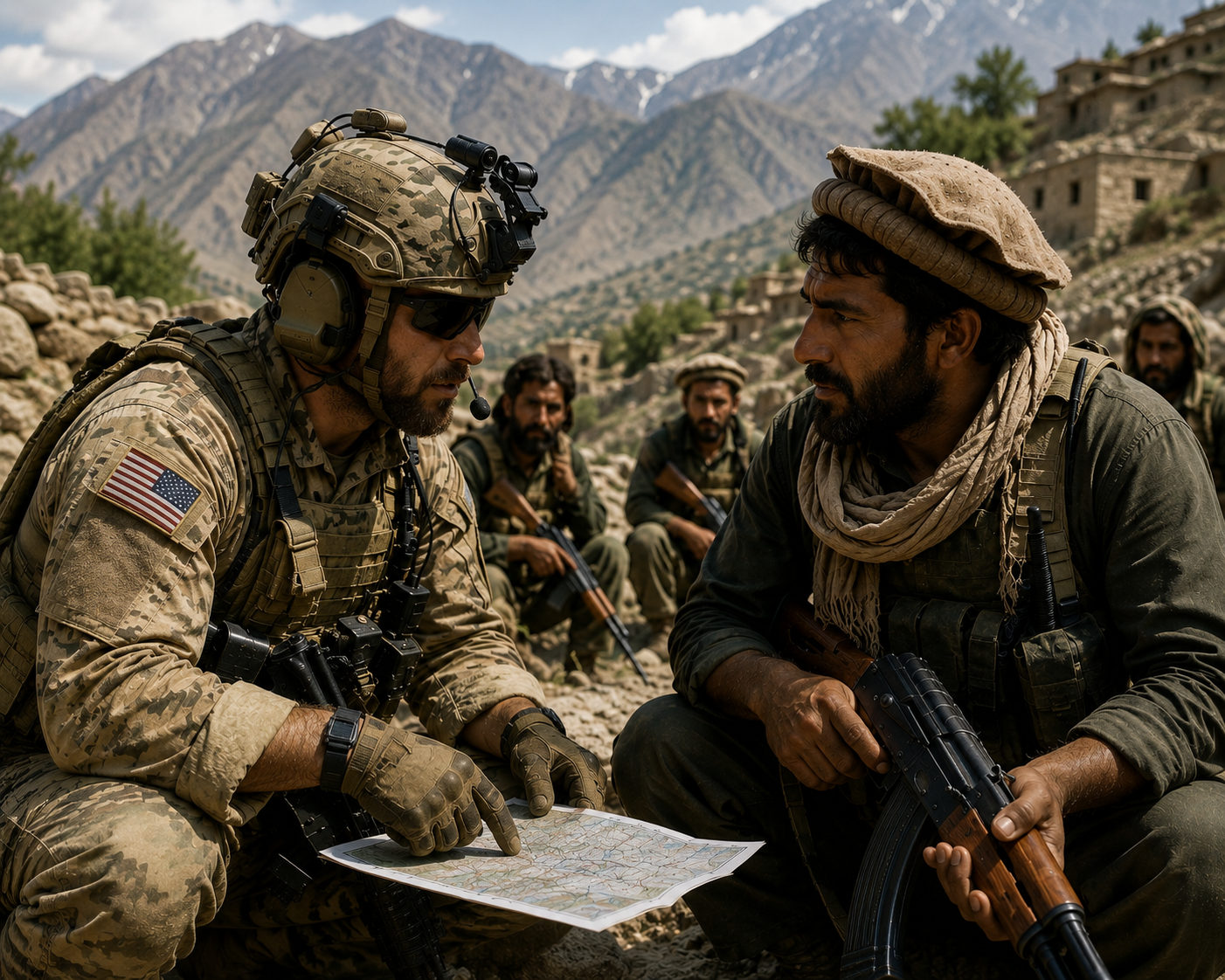

I read Ned Marsh’s two recent articles about the serious challenges Special Forces (SF) face in the current and future operating environments with great interest. Much of what he says seems valid, but not all of what he says. Plus, there are some internal inconsistencies in his argument. Still, his ideas are valuable insights for serious consideration. I will not offer another detailed critique of Marsh’s ideas. That has already been done by others. But properly diagnosing the problem is key for generating effective solutions. My intent is to address the ‘blind spot’ that stands in the way of Special Forces ‘strategic utility,’ a non-trivial point that is rarely addressed.
First, institutional constraints, most of which are defined by the American way of war, and not by technological, doctrinal, or training deficiencies, create a blind spot in the use of SF that undermines their strategic utility. Institutions define and shape how people think and how they must act. Behavior is reinforced by the institution’s incentive structure. As a result, major (versus evolutionary) changes are rarely internally generated. Second, the concept of strategic utility is about how a military unit contributes to the outcome of a war (hot, cold, and political) versus its contribution to the outcome of a battle or engagement, which is a tactical utility.
This blind spot stands in the way of accurately recognizing the problem and ultimately optimizing SF performance. Institutional constraints keep SF linked to and supporting war plans that reflect the American way of war—mass, firepower, and lethality. These constraints limit SF’s contribution. If fact, SF contributions to conventional wars are marginal. In other words, rather than having strategic utility, current institutional constraints generate tactical utility for SF. It is worth noting that during WWII, General Douglas MacArthur did not allow the Office of Strategic Services (OSS) to operate in his theater of operation. General Dwight Eisenhower reluctantly allowed the OSS to deploy in Europe but did so with extreme restrictions that limited their potential. The issue was not the risk associated with small teams operating behind enemy lines. Both MacArthur and Eisenhower accepted risk. The OSS operated outside of the mental comfort zone of conventional military leaders. This was the issue. This WWII legacy endures.
Today’s critiques of SF potential and reform expose this blind spot through recommendations that rest exclusively in keeping SF operations inside the realm of conventional warfare. It condemns thinking about SF usage to inside-the-box thinking which is created and guarded by the institution, which in this case is the Defense Department.
So where does SF’s strategic utility rest? It arguably rests in operating independent of conventional forces and separated from them in time and space. This forum has published articles, many written by Dave Maxwell, about the great 20th century statesman, George Kennan, and his concept of political warfare. Political warfare is the space between war and peace where a country uses all the tools of statecraft at its disposal to advance its national interests while undermining the interests of its enemies. This realm of conflict rests outside the American way of war and as a result it remains unoccupied by U.S. influence. And because of this, the U.S. either underreacts to threats or overmilitarizes policies and actions.
My experience in the arena of national security, which spans almost six decades, tells me that bridging the gap between war and peace is where the potential for achieving strategic utility for SF resides. It is this space, among others, where the U.S. must operate to secure its future. Unfortunately, bridging this gap cannot happen inside the Defense Department. The Department’s institutional DNA is incompatible with operating in the space between war and peace. More importantly, and most relevant to discussions about reform and adaptation, is what must be done to exploit the potential of Special Forces for national purposes? This is the necessary discussion that must take place.
If we are serious about continuously advancing U.S. interests and thwarting the interests of our enemies, an institutional mechanism in the form of an agency, headquarters, or department with bureaucratic power, must be established and resourced to convert existing capabilities into action. This should not require increased resources. But it will necessitate transferring resources from the Department of Defense (DoD), and possibly other agencies and departments, that are not optimally employed today. It is interesting that Ned Marsh recommended transferring SF units to the Joint Special Operations Command (JSOC). He seems to intuitively understand that JSOC exists within a DoD ecosystem that has the capacity to convert capabilities into action. But that JSOC, for all its exquisite capabilities, would use an SF Group in a strategically useful manner is folly because JSOC operates within the realm of the American way of war. U.S. Special Operations Command (SOCOM) has not changed this dynamic, nor is it interested in doing so. Institutional constraints constrain action.
What might strategically useful SF employment potentially look like? Marsh was clear that presence was inconclusive. It does not have to be. Properly employed SF teams to, or adjacent to, high interest areas across the globe, across extended or near-permanent timeframes, can function as global scouts and provide human intelligence, interpreting attitudes, discerning intentions of friends, foes, and neutral actors for the National Command Authorities. Some will argue that in the age of artificial intelligence (AI) and other technologies, this mission is obsolete. I disagree. A traditional world still exists within parts of the modern world where family, tribal, religious, and village networks, etc. still, and will always be important, perhaps decisive for understanding an issue. Trusted personal relationships matter.
Next, SF teams smartly employed can perform as strategic shapers, helping to synchronize host-nation and U.S. interagency activities in support of U.S. objectives. Likewise, SF teams on the ground can measure the effectiveness of policies and actions.
And finally, in this illustrative example, SF can operate as operational combat outposts and shape the battlespace by establishing interoperability parameters with indigenous forces. As part of that mission, they can also strip away an adversary’s capabilities, should conventional forces be required. It is important to remember that access and knowledge about a region and its people are not a given, nor something that is rapidly generated. ‘Presence, patience, and perseverance’ (the 3-P’s) replace ‘move shoot and communicate,’ the enduring tactical infantry mantra.
The 3-P’s can also generate options for decision makers. The April 2026 downing of an American F-15E Strike Eagle over Iran resulted in a massive, and successful, search and rescue operation to recover one of the aircrews. More than 170 aircraft and hundreds of troops, plus CIA participation, were employed. Though successful, the cost of the operation was enormous and required U.S. forces to deliberately destroy several of its own aircraft on the desert floor that could not be recovered. How would the U.S. manage search and rescue operations where many jets were downed over an extended timeframe inside enemy territory? The template used for the recent successful search and recover operation is not practically repeatable. Two historical examples where the 3-P’s could offer repeatable search and rescue operations behind enemy lines are the exploits of Milton Miles in China and the Australian coast watchers in the Soloman Islands during WWII. The return on investment on these low-cost efforts was remarkable. Not only were pilots recovered, but serious damage was done to enemy forces while simultaneously supporting conventional forces.
In 1940, General MacArthur said the following: “The history of failure in war can almost be summed up in two words: ‘Too Late.’ Too late in comprehending the deadly purpose of a potential enemy; too late in realizing the mortal danger; too late in preparedness; too late in uniting all possible forces for resistance; too late in standing with one’s friends…” Although MacArthur did not want the OSS operating in his active war theater, he clearly understood the challenges he had to overcome once war was thrust upon the United States in the Pacific.
The ‘too late’ disaster scenario can arguably be avoided by the strategic employment of U.S. capabilities, SF being the key component. But the current U.S. national security structure lacks the mechanism to anticipate, plan, convert, and manage existing capabilities, short of conventional war, for the national interest. As experts opine on the needed changes to make Special Forces relevant, they must first, and foremost, clearly identify the problem. The solution that follows must keep SF separated from the conventional warfare box and focused on the vast and dangerous space that exists between war and peace. This is the path for ensuring that SF has strategic utility. Solutions within the immovable constraints of the Defense Department will not work.
One final thought – a sister concept of strategic utility is strategic preclusion. Strategic preclusion is the act of introducing military capabilities early so that an adversary cannot gain or consolidate a significant advantage. It is a form of maneuver often leveraging allies, and perhaps others. Properly, employed, Special Forces can strategically preclude attacks against U.S. interests and the interests of our allies by keeping enemies from acquiring or maintaining the capacity to undermine U.S. interests.



This is an excellent and much-needed article. Dr. Rothstein’s insight from nearly six decades in the national security arena is a treasure, and I do not say that lightly. His book, Afghanistan and the Troubled Future of Unconventional Warfare, remains one of the primary readings I assign in my class now that I teach at NPS.
This article is also a more intelligent and much more in-depth discussion of what I was clumsily trying to get at with my own “not WHAT, but WHEN” attempt to frame the problem.
The question is not simply what SF does. SF can raid, advise, train, enable, collect, shape, build, disrupt, and fight. The more important question is when SF is employed and inside what institutional logic. If SF is only brought in after a crisis has already become legible to the conventional force, then much of its real value has already been lost.
The point about tactical utility and strategic utility gets to the heart of this. SF’s strategic value does not come from being a better infantry adjunct, a crisis response tool, or a small-footprint add-on to a conventional war plan. It comes from presence, patience, relationships, local understanding, and access built before the nation suddenly discovers it needs them.
That is also why the discussion about institutional constraints matters so much. The American way of war knows how to convert capability into action once the shooting starts. It is far less comfortable with the long, quiet work required to shape the environment before that point. But that is exactly where SF’s unique value resides.
This article does not just argue that SF still matters. It explains WHY SF matters, WHEN it matters most, and WHY the current institutional structure often prevents the nation from using it properly. That is the discussion we need to be having.