





Visible vs. Valuable: Why Restructuring U.S. Special Forces Won’t Fix a Failure of Perception

Editor’s note: This essay is the second part of the author’s response to Colonel (Ret.) Ned Marsh’s two-part series, “The Last A-Team” and “A New Vision for Special Forces Restructuring.” The author’s first response, “Operationally Detached,” made the structural case and offered decentralization as the solution. This essay tackles the deeper problem beneath the debate: the regiment’s continued inability to recognize the value of the work it is already doing.
“Seeing they see not; and hearing they hear not, neither do they understand.”
— Matthew 13:13
There has always been a romantic fascination with special operations forces (SOF). The idea of secret commandos or Rangers striking from the shadows, surprising the enemy with overwhelming speed, violence of action, and cutting-edge technology, appeals to America’s image of highly trained, elite Soldiers. There is, however, another Soldier who fights from the shadows. This one is perhaps less known and far less understood. His real weapons are a deep understanding of terrain, the relationships built, and the influence developed to motivate and train others to take up the fight. These Soldiers are the U.S. Army Special Forces, the ‘quiet professionals’ whom history and popular culture often overlook.
— Field Manual 3-18, Special Forces Operations (2014)
When I wrote the opening paragraph above into doctrine more than a decade ago, I used the word “overlooked,” but overlooked is the wrong word and too forgiving. To be overlooked is to be missed for lack of attention. Special Forces does not suffer from a lack of attention. It suffers from misperception, which is the harder problem, because misperception arrives wearing the face of a compliment. The romantic picture in that passage, the commando striking from the shadows with speed and violence and cutting-edge gear, was never the Special Forces mission its founders set out to build. It describes the Ranger, or one of the other strike formations within U.S. Special Operations Forces, the formations built to enter a target and be gone before dawn. That image was borrowed and overlaid on the green beret, and the result has been two decades of judging Special Forces for failing to be the force it was never originally designed to be.
That error is worth examining precisely because it does not belong to any one critic. It runs through the institution. Its most recent and controversial expression comes from retired Colonel Ned Marsh, who argues that the SF operational model is obsolete and should be dismantled and rebuilt around a new kind of operator. The argument is serious and merits a serious reply. In the first article in this rebuttal series, Operationally Detached, I argued for decentralization over centralization in the Special Forces operational detachments, to station rather than deploy units to engage in theater operations. This second part addresses the deeper flaw in Colonel Marsh’s thesis: not a failure of analysis, but a failure of perception.
Colonel Marsh’s article has sparked genuine debate within the regiment, and that is its own value. Every generation of Green Berets has asked what Special Forces is for, and answering that question well is part of how the institution stays honest. The following argument takes Colonel Marsh’s central claim seriously and directly challenges it. It is not, and should not be read as, an argument about the man. The regiment’s tradition is to disagree on substance and to leave the ad hominem to others.
In one of his main points in Part 2 of the series, Colonel Marsh claims that the current Special Forces model is broken and of limited value to the joint warfighter, with its organizational and engagement constructs antiquated and built for a world that no longer exists. One of his examples is Ukraine, where he claims Special Forces “are not there.” Yet there is an abundant public record of Special Forces working in and around Ukraine, documented in news archives, congressional testimony, and the units’ own histories. The evidence is in plain view, yet the conclusion drawn from it is that the force is absent and the model has failed. Colonel Marsh is not alone in reaching that conclusion. The same conclusion is voiced in team rooms, staff sections, and senior conferences across the enterprise; he is articulating a pattern, not inventing one. The question this essay takes up is not how one officer reaches that conclusion, but how many in the community can look directly at a public record of their own work and conclude absence from evidence of presence. Explaining how that happens, and what it costs, is the task that follows, because until it is explained, every proposed remedy will be aimed at the wrong target.
The Wrong Lens
The confusion begins with a category error: the basics of a direct-action mission are quietly treated as the grammar of every special operation, and the basics of irregular warfare are then graded against that grammar. The two are not versions of one craft. They are different crafts with different logic. The direct-action fundamentals are to shoot, move, and communicate, and they are visible, measurable, and easy to score on a range or in an after-action review. The fundamentals of the sponsorship mission are to train a partner force to standard, to advise its leaders under conditions outside anyone’s control, to assist it in contact, and to enable it with reach and capability it does not own. Train, advise, assist, and enable (TAAE) is not a lesser version of direct action; it is a separate craft with its own standards, risks, and measures of excellence. The two skill sets share a uniform. They do not share a yardstick.
The decisive difference is where the effect appears. Direct action is performed on the enemy and leaves an immediate, attributable mark: a target serviced, a record with clear authorship. The sponsorship craft is performed through the partner, so its effect appears on the partner’s ledger by design, not on any American one. A year spent making a foreign battalion competent produces a competent foreign battalion, and the entire point is that the capability now belongs to the partner. The better the work, the less it resembles work at all, which is not a defect in the craft but the definition of having done it well. A craft whose success is measured by what the partner can now do will always score zero on a scale built to count what Americans visibly did. Held to the wrong yardstick, the most valuable work the force performs registers as no work at all.
Cognitive Blindness at the Observe-Orient Seam
The mechanism behind that misreading is visible in the framework the force already reverses. Colonel John Boyd’s OODA loop, Observe, Orient, Decide, Act, is taught in every professional military education classroom in the country, and most who teach it invert its central lesson. The loop does not turn on Observe, and it does not turn on Decide. It turns on Orient. Orientation is the lens that takes raw observation and assigns it meaning, and Boyd held that the lens is ground by cultural tradition, prior experience, and the models already carried in the mind. Decision and action follow orientation. When the orientation is wrong, the speed and precision of everything downstream are worthless, because a flawless decision built on a corrupted reading is simply the wrong decision reached faster.
This is the seam where judgment about Special Forces fails. The observables are plentiful and public; the failure is at the joint between Observe and Orient, where the action is seen and then run through a model that has no slot for it, and so is filed as support, as someone else’s work, as nothing of consequence. The claim that Special Forces is absent from Ukraine is not an observation error. It is a misorientation of evidence sitting in full view.
The data pointed in one direction; the lens turned it the other. It is the same mechanism by which the force has spent two decades being judged by the camera, scored on the one kind of action that produces an image and found wanting for the kind that does not.
Cognitive science has named the distortions that grind the lens out of truth, and they are worth knowing, because a bias that can be named is a bias that can be caught. The first is the availability heuristic, the tendency to judge how important or common something is by how easily a vivid example comes to mind. The raid is cinematic, briefed, and printed on every recruiting poster. A year of advising produces no poster at all, so the mind files it as less real and less important, less like the thing Special Forces does, even when it is precisely the thing Special Forces do. Salience is mistaken for significance.
The second is confirmation bias. Once the belief takes hold that raids make a special operator, ambiguous evidence is bent to fit it. The advisor inside a partner headquarters does not register as a counterexample to the belief; he registers as a man who is not doing the real job.
The third is the streetlight effect, named for the man searching for lost keys under the lamppost because the light is better there. The force counts presence, deployments, and targets serviced because those are illuminated well enough to count. The value built inside a partner sits in the dark, uncounted, and the absence of a measurement is then mistaken for the absence of value. The search stays where the light is, and the keys are pronounced gone.
Beneath all three lies a deeper layer, the one the SOF Spectrum framework was built to explain. Drawing on the ecological psychology of James Gibson, the framework holds that perception and action are coupled: an environment is perceived in terms of what the perceiver is equipped to do within it, which means training determines not only capability but sight. A force calibrated almost entirely for direct action does not merely undervalue the work of partnership; it loses the ability to see it. The relational opening, the governance gap, and the influence pathway cease to register as options for action because the perceptual system was never tuned to detect them. This is the most dangerous form of blindness, because it is invisible from the inside. The evidence is not rejected after evaluation; it is filtered out before evaluation begins. It cannot be seen.
Assembled, these layers turn the claim that Special Forces is absent from a reasonable assessment into a textbook orientation failure, and none of it is corrected by reorganizing the force, because a broken lens is not repaired by rearranging the things it points at.
What the Blindness Hides: The Composite Organism
The orientation failure does more than undervalue the force. It conceals the single most important fact about how Special Forces creates value, and that fact has nothing to do with the operational detachment. Almost the entire debate argues about the ODA, how lethal it should be, how technical, how it should be organized or redesigned, and every line of that argument is aimed at the wrong object. The object to be optimized is not the individual operator, or even the detachment, but the composite system created when Special Forces and partner fuse. Mistake one for the other and the wrong thing gets optimized with great care.
The mechanism is straightforward once stated. When a Special Forces element combines with a partner force, the two do not add their capabilities; they fuse into a single operational entity, what might be called a composite organism, in which each fills the gaps in the other’s profile. The Special Forces element supplies enabling capability, reach, resources, and doctrinal depth. The partner supplies local access, legitimacy, language, and a place inside the society that no outside force can manufacture. Alone, each carries gaps that put whole categories of action out of reach: the American element has no native standing and no permanence, while the partner often lacks training, enabling reach, and coalition access. Fused, each closes the other’s gaps, and the resulting entity carries a profile more complete than either parent alone. That completeness of the composite is the entire point.
The effect is more than additive. Closing the gaps in a force’s profile does not merely lengthen a list of capabilities; it opens whole pathways that were closed to both parties, because those pathways depended on capabilities neither held alone. The correct name for this is not a force multiplier, the familiar phrase for adding mass. It is an affordance multiplier: by closing each other’s gaps, the partners open options for action that neither could perceive or pursue alone. The shift is not merely that existing actions become easier; previously unavailable actions become possible. The partner is not merely a recipient of assistance or a proxy acting in another’s place. The partner is the other half of a single composite actor whose completeness is the source of its reach.
This is the fact the restructuring case never confronts, and it is where the headline proposal fails on its own terms. The instinct is to widen the U.S. force’s reach by rebuilding the individual operator into something more lethal, more technical, more survivable, a “neo–Special Forces soldier” grown in a stateside laboratory. That is one lever, and the weaker one. A perfected U.S. Special Forces operator or team that still carries the same gaps still cannot reach what only the partner unlocks; however lethal, they retain the same blind spots and the same missing access. Only the composite closes them. To concentrate every resource on the individual while folding the partnership capability into a strike command that treats it as an occasional enabler is to polish the weaker lever while sawing through the stronger one.
Here the two failures meet. The composite is precisely what the misoriented eye cannot see. An institution trained to look for unilateral American action looks for a single organism doing visible work, while the composite produces its effect through the partner, on the partner’s ledger, in a form that never resembles a unilateral operation. The very structure that creates the value is the structure that hides it from anyone calibrated to see only what Americans do alone. The force is not failing to act. It is succeeding in a way its own institution is not equipped to perceive.
Seeing Is Believing vs. Believing Is Seeing
Marsh writes that the modern environment has “rendered UW as infeasible.” He is partly right, and the part he is right about gives the game away. What has become infeasible is the schoolhouse model of unconventional warfare: the guerrilla column, the auxiliary, the underground, the operator in the mountains raising a partisan army, the Robin Sage template stamped onto the real world. That model might not survive a modern surveillance state. But the template was never the mission; it was always a training abstraction of it, the way the sterile, furniture-less rooms of Range 37 are a training abstraction of close-quarters battle. No one declares CQB infeasible because real buildings do not look like Range 37. To declare unconventional warfare dead because the world does not look like Pineland is the identical error, and it is why the United States can be conducting unconventional warfare right now, in plain sight, while a senior Special Forces officer writes that it cannot be done.
The relevant test is not whether Special Forces has boots on the ground, but whether U.S. activity enabled a resisting partner to affect an adversary from within denied or contested human terrain. And the question is not academic, because by the plain definition, Special Forces is conducting unconventional warfare right now, continuously, in more places than this essay can name, wherever it is enabling a partner to resist a coercive power, whether that partner is resisting today, preparing to resist tomorrow, or building the latent capacity against a day that may never come. The mission Marsh calls infeasible is among the most regularly practiced forms of Special Forces work. Three cases make the pattern visible. Two are unfolding now, in Ukraine and the Philippines. The third reaches back to the regiment’s first operational use in Korea.
Begin with Ukraine, the case Marsh leans on hardest. For years before February 2022, U.S. Army Special Forces and allied partners advised and prepared Ukrainians to resist an occupying power, helping the population build the organization, skills, and mindset for distributed resistance before the tanks crossed the border. Practitioners such as Brian Petit taught and wrote on exactly this work in exactly this period.
The instinct is to file that prewar work as something short of unconventional warfare, a precursor to it, because the shooting had not started. But the doctrine carries no such condition. Unconventional warfare is defined as:
Activities conducted to enable a resistance movement or insurgency to coerce, disrupt, or overthrow a government or occupying power, operating through or with an underground, auxiliary, and guerrilla force in a denied area.
There is no clause requiring that a war is already underway or that an occupier already be in place. The qualifier is purpose, to enable resistance, not timing. Preparing Ukraine to resist was an activity conducted to enable resistance, whether in open war, in competition, or in the quiet years before an invasion anyone can see coming; by plain text, that is UW. The only thing that makes it look like something lesser is the assumption running through the entire debate: that the work must wear wartime clothes to count.
That preparation did not end at the border on invasion day; it became the thing it was built to become. Since Russia seized Crimea in 2014, the 10th Special Forces Group has worked to build Ukraine’s resilience and resistance capability, helping shape the Ukrainian special operations enterprise that now runs the country’s national resistance movement. That movement, organized under Ukrainian SOF and covertly active since 2014, trains and coordinates civilian resistance inside the Russian-occupied territories: sabotage, intelligence collection, subversion, and underground networks operating from Crimea to Luhansk under enemy control. This is not foreign internal defense, and it is not just the training of commandos in a rear area. It is the enabling of organized resistance in denied, occupied territory: unconventional warfare in the present tense.
The judgment that the force was not there confuses location with effect. A missile fired across a border to strike a target is still a strike, and no one calls the mission a failure because the crew never crossed the line. An advisor enabling a resistance network on the far side of that border is doing the mission no less for standing on this side of it.
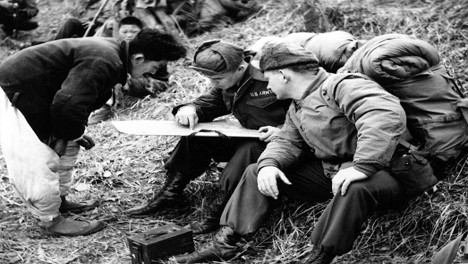
Run the case back further, all the way to the regiment’s first operational use, and the same pattern appears. Between February and September 1953, ninety-nine Special Forces soldiers drawn from the first three Qualification Course classes deployed to Korea, not as detachments but as individual replacements assigned to the 8240th Army Unit. They went to advise the United Nations Partisan Forces operating from offshore islands, raiding into North Korea and the Chinese-held mainland. The 10th Special Forces Group, the regiment’s first formed unit, was simultaneously sent to Germany to wait on an East European uprising that never came. The men who went to Korea instead were the first SF soldiers to do operational unconventional warfare in combat, and two of them, Second Lieutenant Joseph Castro and Captain Douglas Payne, were the first to die doing it.
Measured by boots on the ground inside North Korea, the campaign scores zero. The advisors stood on Paengnyŏng-do and Kangwha-do and the small islands off the coast; the partisans they trained, equipped, and resourced did the work onshore. Measured by effect, the partner forces tied down some two hundred thousand enemy troops along the west coast in 1953 alone. The work was done through the partner, and within the institution it was largely forgotten almost immediately. The advisors were told on out-processing not to speak of the tour, and the lessons learned were never disseminated to the groups that followed. The first combat employment of Special Forces left no image the institution preserved as its own.
The Korean case is not a curiosity. It is the regiment’s origin point. The method on display is the method Special Forces was founded to execute: individuals working through partner forces in territory where no American detachment stood. That the same regiment can now describe partner-enabled action without American boots as “not really there” is the measure of how deeply the seeing failure runs. It runs back to the beginning, and it runs against the regiment’s own founding example.
Measured by boots on the ground inside North Korea, the campaign scores zero. Measured by effect, partner forces tied down two hundred thousand enemy troops along the west coast in 1953.
The third example is the one unfolding now, where the force is executing UW without recognizing it. The Philippines case is also the one that tests whether UW is defined by its function or by its inherited imagery. In 2016 the Permanent Court of Arbitration ruled that China’s nine-dash line has no basis in international law and that the contested waters fall under Philippine sovereignty. China ignored the ruling and continued to advance, through artificial islands, coast-guard rammings, water cannon, and the slow salami-slicing of features inside another nation’s sea. The partner has stated plainly that it will not yield. “The Philippines cannot yield. The Philippines cannot waver,” President Marcos told his congress, to a standing ovation. “The West Philippine Sea is ours.”
Measured against the definition, the activity is unmistakable. Unconventional warfare is the enabling of an irregular partner that resists a coercive power on its own ground. The elements are all present: a legally affirmed sovereign territory, a partner determined to hold it through both regular and irregular forces, a stronger power encroaching and occupying, and the United States enabling that partner to resist. As argued elsewhere, this is unconventional warfare by its own doctrinal definition. It is not called that because it carries none of the expected signature: no land-based guerrilla column, no auxiliary, no underground, nothing resembling Robin Sage. The case may not resemble the inherited imagery of unconventional warfare, but that is precisely the point: the imagery has become less reliable than the definition. The underground, auxiliary, and guerrilla language should be read as a description of resistance functions, not as a rigid visual checklist requiring every case to resemble a mid-twentieth-century partisan campaign. Doctrinal UW is being executed and denied in the same breath because the work does not match the expected picture. Unconventional warfare was not rendered infeasible. One schoolhouse model of it was, and that model was always an abstraction. The mission itself is being conducted today and rendered invisible, which is a different problem with a different cure.
New Eyes, Not New Landscapes
“The real voyage of discovery consists not in seeking new landscapes, but in having new eyes.”
— Marcel Proust
If the problem is seeing, the remedy is not a new structure but a new lens. The diagnosis that “the force has drifted toward the strike” is correct, and the answer is to broaden what the institution values, not to consolidate or change everything that does not conduct raids. This means defining missions such as unconventional warfare by their function, the enabling of a resisting partner, rather than by their visible doctrinal form, so that missions like those in Ukraine and the Philippines become recognizable for what they are. It means measuring success by effect in the human domain rather than short-term effects on storyboards. And it means re-employing the force to maximize engagement rather than reorganizing it, because the capability is not missing; the ability to see it is.
It also means teaching the force to recognize its own orientation biases, which are common, well-known errors in human judgment that can be named and checked. What vivid image is driving this judgment, and what invisible work is discounted because it produced none? What would disprove the belief that this force is irrelevant, and has anyone looked? Is this measuring what matters, or only what is easy to measure? The discipline should be to suspect the lens before blaming the force.
The ground here is not new. LTG Cleveland correctly identified the gap and the trend for the force to gravitate toward the strike a decade ago and changed the force structure to try to close it. The current proposals again reach for structural changes, now dressed in reorganization and new technology. Each time the structure changes, blindness survives because no line-and-block wire diagram has ever taught an institution to value what it cannot see.
None of this is to say the force is fine as it stands. The three cases, Ukraine, Korea, and the Philippines, show unconventional warfare being done where it is not always recognized, but proving the work is real is not the same as claiming it cannot be done better. It can. Marsh is right about one thing above all: the force must keep evolving. The disagreement is over direction. His answer, like many others, is to reorganize and re-engineer the operator around technology. The better answer, argued in the first part of this series, is to evolve in the opposite direction: to double down on engagement, to station Special Forces teams and individual operators forward with the partner, living inside the relationships and the terrain long enough to develop the access networks, built on relationships and trust, that no rotational deployment and no laboratory operator can manufacture. And any of this requires the regiment to recognize its own value first. No external audience will see what the force does not first see in itself: not congressional, not joint, not allied partners.
An analogy lies at the center of the restructuring case and is worth revisiting. The SEALs, Marsh argues, reinvented themselves once by leaving the beach to master the water, and Special Forces should remake themselves in the same way. But the SEALs did not abandon their core; they returned to it. The honest question is not whether Special Forces should reinvent itself, but what its water actually is, and then to return to it with the same clarity the SEALs showed when they went back to the sea. That water is the human domain: the population, the partner, the relationship, the patient, the blue-collar work of making someone else capable of carrying a fight. That is the medium the force was built to move through, and the one no other element can. To restructure away from it is to leave the water altogether.
Which returns the argument to the doctrine it began with and to the two soldiers in the shadows, visible to only one camera. The mission Marsh calls infeasible is being conducted today, and the remedy for a force that cannot see its own best work is not a new force. It is new eyes and the will to push them forward, closer to the partner, where the work is. Visibility was never the measure of value. A coach is not judged by his own performance on the field, but by what his team becomes, what the audience can see. Special Forces have spent decades building teams whose victories were never counted as their own. The force does not need to be rebuilt. It needs to be seen, beginning with how it sees itself.
The views expressed are those of the author and do not reflect the official position of Small Wars Journal, the Naval Postgraduate School, the Department of War, or the United States Government.



Author’s Addendum
Several readers have interpreted this article as an argument against strike capabilities or as a claim that SF no longer conducts effective partnered operations. Neither interpretation reflects the intent of the article.
SF continues to execute partnered operations around the world that produce significant strategic and operational effects. In many ways, these missions represent some of the strongest examples of the value that SF provides to the nation and are a major reason the Regiment has remained relevant across multiple generations of conflict.
The purpose of this article is not to argue that strike capabilities are unnecessary or that partnered operations are inherently superior. A healthy SOF ecosystem requires a full spectrum of capabilities, including both direct and indirect approaches.
Rather, the article asks whether SF’s challenge is not a lack of successful partnered operations, but an inability to fully see and appreciate their value. Strike operations often produce visible and immediate results that are relatively easy to observe, measure, and communicate. Partner-focused activities frequently generate effects that are indirect, cumulative, distributed across time and organizations, and difficult to attribute to any single action, team, or unit.
The article explores whether this difference in visibility creates a bias in how the force understands success and, ultimately, how it values different forms of contribution. In addition to the examples discussed throughout the article, the emphasis on tactical skills, technology-driven solutions, promotions, incentives, command opportunities, and the way SOF is represented in the media is not a problem in itself. Rather, they may reflect a broader tendency to gravitate toward activities whose results are more visible, more immediate, and easier to measure.
The argument is not that strike capabilities are wrong, nor that partnered operations are always preferable. The question is whether the force sometimes struggles to recognize the strategic value of outcomes that are slower, less visible, and achieved largely through partners rather than through direct action. Put differently, the article asks whether there is a difference between what SF says makes it unique and the activities whose value it finds easiest to recognize.
Reasonable people may disagree with this explanation, and there are undoubtedly many factors involved. The article does not claim to provide a definitive answer. Instead, it explores possible reasons for the persistent tension between SF’s stated identity as a partner-centric force and its attraction to more visible and measurable forms of military activity.
If the article succeeds at anything, it is hopefully in encouraging discussion about how SF identifies, assesses, and communicates value. The central question is not whether partnered operations matter. They clearly do. The question is whether the force has developed adequate ways to recognize its importance when the effects are often delayed, indirect, and difficult to measure.
Another note from the article, the term Train, Advise, Assist, Enable (TAAE) is one I created to describe the four tools of the sponsor.
Train gives them a skill they don’t have.
Advise makes them better at a skill they already have.
Assist gives them stuff.
Enable uses our stuff to help them, but doesn’t give it to them.
The term is used more loosely in the article to make a point, but these are the specifics I normally teach in my UW class.