





Special Forces at the Crossroads: Reform Without Self-Destruction
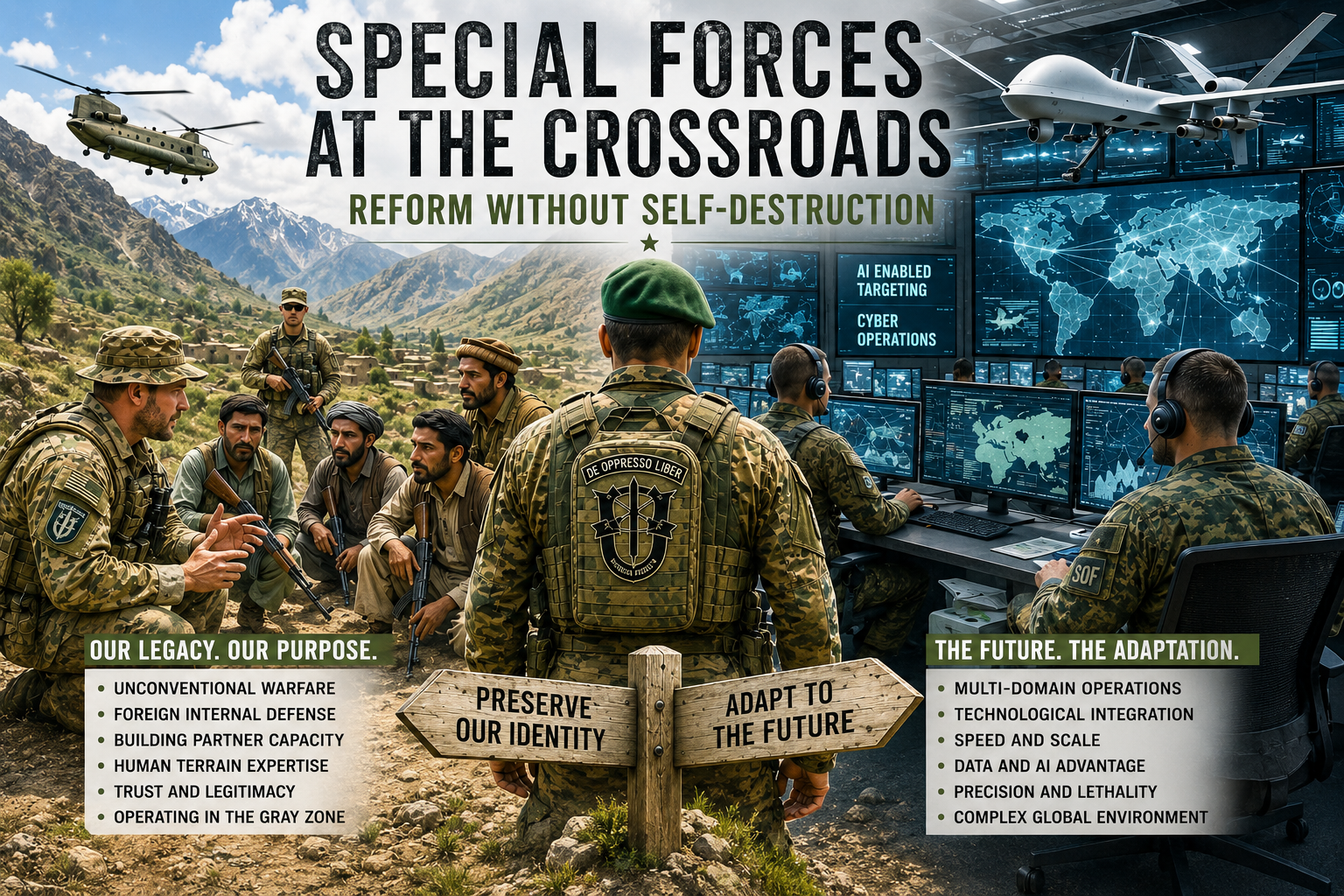

In two recent articles at the Irregular Warfare Initiative—The Last A-Team: Special Forces Aren’t Special Anymore and A New Vision for Special Forces—Ned Marsh has performed a valuable service for the Special Forces Regiment and the broader national security community. He has forced a serious debate about whether U.S. Army Special Forces remains organized trained, equipped, educated, and optimized, for the realities of strategic competition and contested warfare in the Asia-Indo-Pacific, Europe, Africa, Latin America, and the Middle East. His critique is sharp because it addresses real problems. He correctly notes that the contemporary battlefield is saturated with surveillance, drones, biometrics, cyber collection, and electronic warfare. The operational environment has changed faster than many military institutions have adapted. Those realities cannot be dismissed.
But Marsh’s proposed cure risks destroying the very strategic advantages that make Special Forces uniquely valuable to the United States. His argument, at times, mistakes failures of employment, political imagination, and national strategy for failures inherent to Special Forces itself. That distinction matters. Institutions can adapt. Missions can evolve. Strategic relevance can be restored. Yet once deep regional expertise, human networks, and unconventional warfare culture are dismantled, they may not be recoverable in time for the next major conflict or for effective campaigning in support of ongoing political warfare which is what dominates the geostrategic environment today.
Special Forces now stands at a crossroads between adaptation and institutional self-destruction.
The debate should not be framed as a choice between preserving the status quo or burying the beret. The real challenge is how to modernize Special Forces without abandoning the enduring principles that justified its creation and that remain relevant today and in the future.
Marsh Is Right About the Problem
Marsh correctly identifies several uncomfortable truths. The Joint Force often struggles to understand unconventional, irregular, and political warfare. American military culture traditionally privileges decisive battle, large-scale conventional operations, and measurable kinetic effects. Slow shaping operations, resistance preparation, influence activities, and relationship-building frequently appear secondary because their strategic effects emerge over years and months rather than weeks or days.
He is also right that the battlefield has become more lethal for small units operating in denied territory. The assumption that a twelve-man Special Forces Operational Detachment Alpha (SFODA) can infiltrate a highly surveilled authoritarian state with relative freedom belongs to another era. China, Russia, Iran, and north Korea have developed integrated surveillance ecosystems capable of identifying patterns of life, exploiting biometric data, and rapidly targeting exposed networks.
The challenge is preserving what made Special Forces strategically unique while adapting to a changing character of war.
These realities demand adaptation. They demand technological sophistication, signature reduction, cyber integration, distributed operations, and new operational concepts. Special Forces cannot survive intellectually by romanticizing past successes in Southeast Asia, Afghanistan, or Iraq while ignoring the transformation of modern warfare.
Marsh’s greatest contribution is that he forces the Regiment to confront whether it has become too consumed with institutional maintenance, rotational activity, and theater engagement metrics rather than preparing for existential strategic competition that requires integrated campaigning and support to political warfare while preparing to support the Joint Force during large scale combat operations by employing the uniquely relevant capabilities of Special Forces.
That critique deserves to be heard.
The Danger of Technological Determinism
Yet Marsh’s analysis risks overcorrecting by placing too much faith in technological disruption and not enough in enduring political realities.
Wars are ultimately contests of human will, legitimacy, and political organization. Technology changes methods. It rarely changes the fundamental nature of conflict. Surveillance systems can identify individuals. They cannot eliminate grievances, resistance movements, or underground political networks. Drones can destroy vehicles and headquarters. They cannot substitute for trust built over decades among human beings.
The history of warfare repeatedly demonstrates that militaries often confuse changing methods with obsolete principles. Cavalry disappeared as a dominant battlefield arm, but mobility, reconnaissance, and exploitation survived in new forms. Battleships faded, yet maritime power remained central. Likewise, unconventional warfare may require new operational methods, but the strategic requirement for resistance, subversion, political warfare, and indigenous partnerships has not disappeared.
Institutional overcorrection can destroy the very capabilities reform is meant to preserve.
At times, Marsh appears to treat denied-area unconventional warfare as operationally impossible. But history cautions against declaring any form of warfare obsolete simply because contemporary technology complicates it. Occupied populations adapt. Resistance movements evolve. Human beings learn to evade systems. The side that retains political legitimacy and strategic patience often finds ways to survive.
The question is not whether unconventional warfare remains viable. The question is whether the United States retains the political imagination and patience necessary to employ it effectively.
The Human Domain Cannot Be Rebuilt Quickly
Marsh’s proposal risks underestimating what Special Forces actually represents.
Special Forces is not merely a collection of tactical units. It is a repository of regional expertise, language capability, cultural understanding, institutional relationships, and human trust accumulated across generations through continuous campaigning. These networks are not built rapidly. They cannot be regenerated during crisis mobilization.
Sustained campaigning matters because relationships matter. A captain working with Philippine, Thai, Polish, Baltic, or Korean counterparts today may become the trusted strategic interlocutor during crisis or war twenty years later. These relationships create access, legitimacy, and interoperability that no technology can replicate.
Elite organizations do not survive by becoming indistinguishable from conventional forces.
Marsh criticizes theater security cooperation as strategically inconclusive. At times he is correct. Bureaucracies often measure activity rather than strategic effect. But the answer is not abandoning engagement. The answer is employing engagement strategically rather than administratively. This requires sustained campaigning,
Special Forces was never intended merely to conduct raids or advise tactical formations. Its original strategic purpose was psychological warfare and to support political warfare. It existed to prepare resistance, support indigenous networks, enable insurgency against authoritarian rule and hostile occupation, and shape the political environment before conventional war began, and after it concluded.
Ironically, Marsh correctly identifies this historical foundation while simultaneously proposing reforms that may weaken the very institutional ecosystem necessary to sustain it.
The Joint Force Problem
One of Marsh’s most important observations may be unintended. The problem may not primarily be Special Forces. The problem may be the Joint Force and the broader American strategic culture.
If Special Forces is not employed in strategically consequential environments, that may reflect political risk aversion rather than irrelevance. National leaders often hesitate to employ unconventional warfare because it operates in ambiguity, below thresholds of conventional escalation, and outside clean doctrinal frameworks.
The United States has become increasingly uncomfortable with long-term political warfare despite facing adversaries who embrace it fully. China conducts unrestricted warfare and employs psychological, legal, economic, cyber, and political influence campaigns continuously. Russia integrates information warfare, proxies, sabotage, and political destabilization. Iran sustains proxy networks across the Middle East. north Korea employs cyber warfare, coercion, and illicit transnational networks persistently.
Against such adversaries, dismantling America’s premier political warfare support and unconventional warfare force would be strategically ironic.
The issue is not whether Special Forces retains utility. The issue is whether American national security leadership understands how to employ unconventional warfare as part of integrated and competitive statecraft.
Reform Without Revolution
Special Forces does require reform. It must modernize aggressively. Signature management, cyber integration, artificial intelligence support, autonomous systems, distributed communications, employment of space assets, and denied-area survivability all require urgent attention. Selection and assessment standards should become even more rigorous. Regional expertise and language mastery should deepen substantially. The Regiment must become intellectually sharper and technologically more adaptive.
But reform should strengthen Special Forces’ strategic foundations rather than abandon them.
The future Green Beret should remain a master of resistance organization, indigenous partnership, strategic influence, and support to political warfare. Technology should enhance those missions, not replace them. The Regiment should become smaller where necessary, more selective where appropriate, and more specialized where required. Yet it must retain its human-centric character.
The greatest danger is not that Special Forces changes too little. The greatest danger is that it forgets what made it strategically valuable in the first place.
Conclusion
Ned Marsh is correct that Special Forces faces a moment of reckoning. The battlefield has changed. Bureaucratic inertia is dangerous. Institutional self-congratulation can become fatal. Those warnings should not be ignored.
But revolutions inside military institutions often destroy enduring capabilities while chasing temporary fashions. The United States should be cautious before dismantling decades of unconventional warfare expertise in pursuit of operational concepts that remain largely theoretical.
Using Richard Neustadt and Ernest May’s Thinking in Time framework, the central lesson is clear: policymakers and military leaders must distinguish between changing methods and enduring strategic purposes. The methods of unconventional warfare will evolve. The strategic requirement for support to political warfare, resistance preparation, indigenous partnership, and human networks will endure.
The Green Beret’s future should not be built on nostalgia. But neither should it be sacrificed to technological determinism masquerading as strategic inevitability.



Strong article and an important contribution to the current debate. Dave captures something many discussions miss: the distinction between adapting methods and abandoning strategic purpose.
SF absolutely needs modernization for contested and highly surveilled environments, but the answer cannot be to discard the human-centric foundations that made the Regiment strategically relevant in the first place. Technology may change the character of UW and political warfare, but it does not eliminate the enduring need for trusted human networks, indigenous partnerships, regional expertise, and resistance support.
Perhaps the deeper issue Dave raises is not whether SF remains relevant, but whether the broader national security establishment still understands how to employ unconventional warfare strategically?