





“No One’s Coming to Do it for Us:” Innovation at African Lion 2026
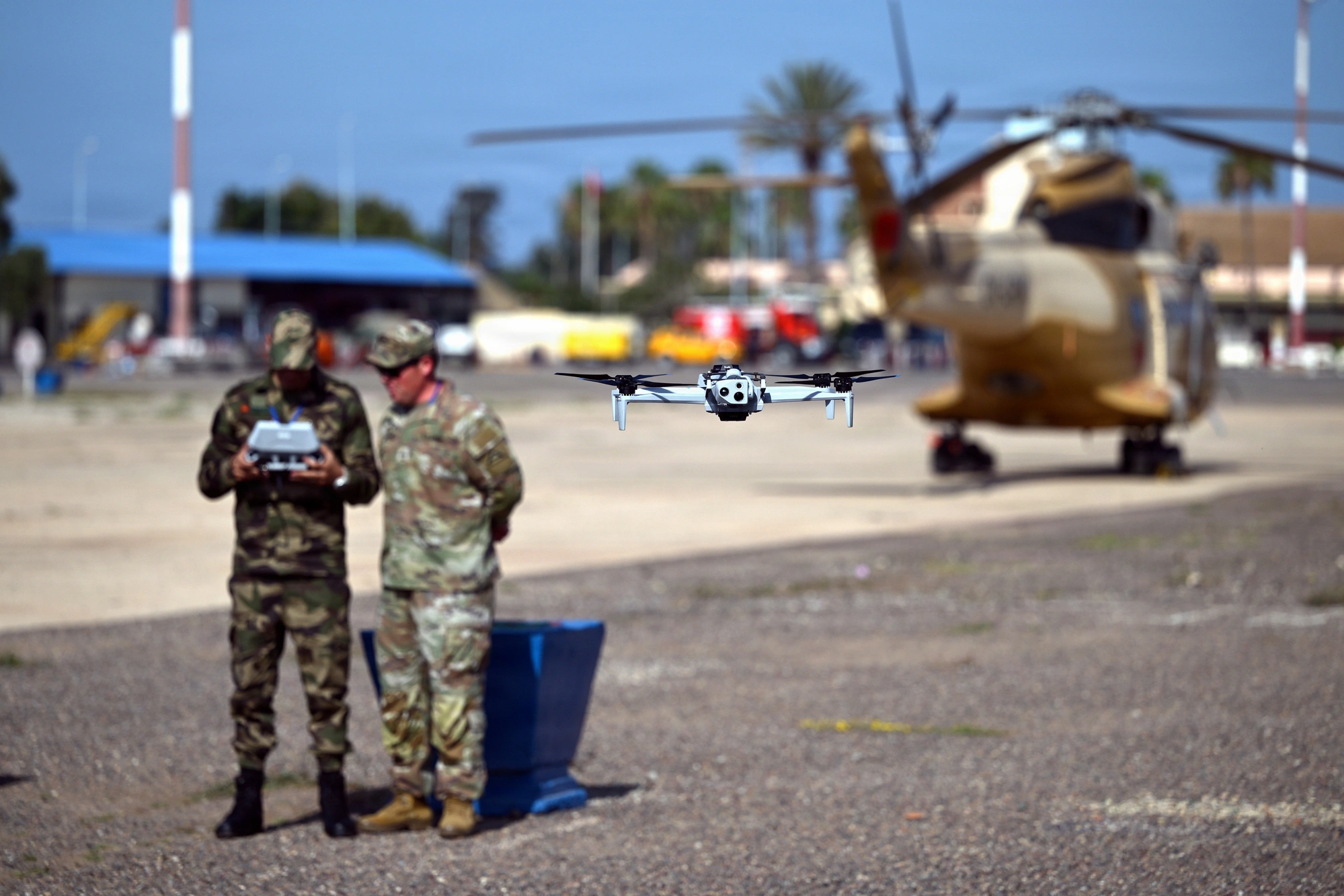

Vice News embedded with African Lion 26 in Morocco’s Tantan desert to produce the video, “Autonomous Warfare Has Arrived | African Lion 2026 Exclusive with Gen. Anderson & Lt. Gasparri.”
The annual U.S.-led multinational exercise has traditionally focused on conventional military cooperation. This year, AI and autonomous systems dominated the agenda.
Working from a tent with commercial components, First Lieutenant Vincent Gasparri and his team have spent eighteen months building, testing, and deploying one-way attack FPV drones, autonomous ground vehicles, and counter-UAS systems. In particular, they:
- blew up eleven targets in a single day using a commercially available arming solution fitted to Army-supplied energetics,
- built their own FPV platforms as live targets to test Smart Shooter-equipped M4s, and
- adapted a heavy-lift Italian delivery drone—designed for mail runs in the Alps—into a 200-pound payload resupply and munitions platform.
“No one’s coming to do it for us. We own our warfighting tasks and we own the protection of this brigade.”
The policy environment has changed enough to let them run. What once required fifteen separate approvals across fifteen different systems has been dramatically streamlined. That institutional shift may matter as much as the technology itself.
Who will figure it out first?
General Davin Anderson, commander of U.S. Africa Command, points out that the technology itself isn’t surprising, it’s the speed of its maturation that caught everyone off guard. In the early 20th century, he says, everyone knew what airplanes, submarines, and machine guns were. Nobody knew how to combine them. The Wehrmacht figured it out first. The question today is who figures out the combination first—and whether the U.S. military can learn fast enough from Ukraine and Iran to stay ahead of that curve.
“The fallacy is that you can stop the world, figure out the way ahead, and then restart the technology…. Our adversaries aren’t waiting.”
Ukraine and Iran dominate the discussion.
- Ukraine as World War I, static with grinding attrition and precision at short range.
- Iran as World War II, with waves of cheap one-way munitions.
Both have stress-tested American assumptions about what a peer or near-peer threat actually looks like in practice.
On autonomy and AI
The U.S. military remains committed to human-on-the-loop or human-in-the-loop frameworks. Both men defend it as a principled position rather than a constraint. The harder problem Anderson identifies is processing scale: thousands of targeting packages, generated and assessed in seconds, at a volume no human cognitive architecture can handle alone.
Things to think about
Three threads run underneath the spectacle of autonomous vehicles and FPV strikes.
The innovation driving this transformation is happening at the tactical level—literally a lieutenant in a tent, not a program office—which says something uncomfortable about where formal acquisition still sits relative to the threat.
Second, the energy problem is the next hard constraint. Batteries die, liquid fuel is heavy, and computational power in austere environments is finite. The drone revolution runs on energy, and moving energy forward remains a World War II-era logistics problem that gets worse with every autonomous system added to the force. Gasparri’s interest in small modular reactors is a direct response to an operational gap the exercise exposed.
Finally, Anderson’s careful distinction between human-in-the-loop and human-on-the-loop deserves more scrutiny. As targeting cycles compress from hours to seconds and swarm operations require processing at scales beyond human cognition, the human-on-the-loop model starts to look less like a principled position and more like a placeholder. That was not said out loud in the video. But the math they describe implicitly highlights this tension.
While you’re here…
Read Crispin Burke’s 2025 take on smart drone strategy for the U.S. Army: “Small Drones, Big Limits: A Smarter Drone Strategy.”

