





Book Review | The Weaponisation of Everything: A Field Guide to the New Way of War
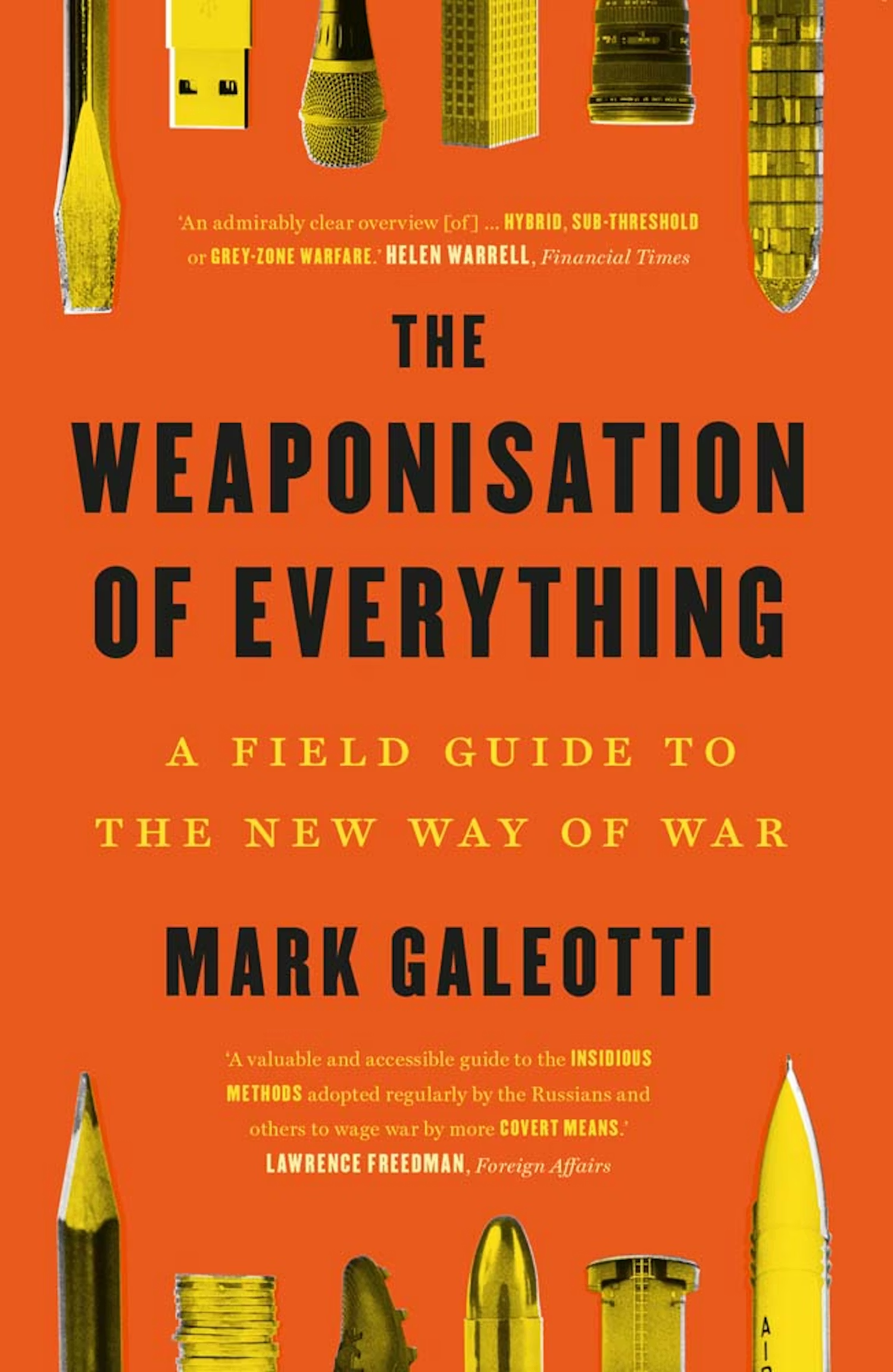

The Weaponisation of Everything: A Field Guide to the New Way of War. By Mark Galeotti. Yale University Press, 2023. ISBN: 978-0300270419. Pp. iv, 239. $18.00 at time of review.
Mark Galeotti’s The Weaponisation of Everything offers a wide-ranging and accessible tour of modern conflict’s expanding frontiers. Galeotti argues that the conventional image of war (declared, bounded, fought between uniformed soldiers on recognizable battlefields) has become the exception rather than the rule. States are increasingly turning the instruments of civilian life into weapons: business and sanctions, criminal proxies, legal procedures, information ecosystems, and culture. While this shift is commonly treated as a revolutionary development driven by Russia’s hybrid adventurism, Galeotti’s central and most provocative claim is that it is nothing of the sort. The techniques may be more sophisticated and the environment more interconnected, but the underlying logic of subverting, demoralizing, and outmaneuvering an adversary without resorting to full-scale military force is as old as statecraft itself.
Galeotti brings formidable credentials to the subject. A senior research fellow at the Royal United Services Institute (RUSI) and one of Britain’s foremost experts on Russian security policy and organized crime, he has spent decades studying the shadowy border between peace and conflict. His previous books, including The Vory: Russia’s Super Mafia (2018) and We Need to Talk About Putin (2019), established him as a writer capable of translating complex security subjects for a broad audience without sacrificing analytical rigor. He is also, with characteristic self-deprecation, the man who accidentally created one of the most misleading concepts in contemporary security studies. The so-called “Gerasimov Doctrine” was a term he coined lightly as a journalistic label, only to watch it take on a life of its own as a supposed blueprint for Russian strategic genius. His willingness to own and interrogate this error gives the book an unusual quality of intellectual honesty.
The book unfolds in four thematic parts, framed by a dramatic introduction and a forward-looking conclusion. After opening with a detailed and unsettling hypothetical scenario depicting a multi-layered Chinese attack on Japan’s power grid, Galeotti devotes the first part to the traditional military domain, arguing that conventional war has become too expensive, too politically costly, and too legally constrained to remain the primary instrument of statecraft. Part Two examines business, financial coercion, and crime as strategic tools. Part Three turns to the weaponization of everyday life: law, information, and culture. The final section looks toward a future of permanent, low-intensity competition in which the line between war and peace may dissolve entirely. The structure is fast-moving and loosely chronological in its historical sweep, drawing on examples from Renaissance Venice to Cold War proxy conflicts to Russia’s seizure of Crimea in 2014.
The book’s greatest strength lies in its historical depth and its willingness to push back against conventional wisdom. Galeotti is at his most incisive when dismantling the mythology surrounding hybrid warfare as a new phenomenon. His survey of Renaissance Italian city-states (which fought one another through mercenaries, information manipulation, financial coercion, and dynastic intrigue long before anyone coined the term “gray zone conflict”) is not merely intellectual window dressing. It serves the serious analytical purpose of demonstrating that the current fascination with non-kinetic conflict reflects continuity more than rupture. When he quotes the Florentine humanist Coluccio Salutati’s opponent, conceding that Salutati’s letters and speeches did more damage than a thousand cavalry, the parallel to modern information warfare is direct and persuasive. Similarly, his treatment of the declining utility of traditional warfare (the spiraling costs of modern military hardware, the political sensitivity around casualties in even semi-authoritarian states, and the constraining power of international law) provides essential context for why states are increasingly reaching for other instruments. The anecdote of a US ally using a multi-million-dollar Patriot missile to shoot down a $300 commercial drone makes this economic logic vivid in a single image.
Beyond its historical sweep, Galeotti also makes several sharp conceptual contributions. His concept of “soldiering-plus” (the expanding role of armed forces as multi-function tools deployed in counter-piracy, pandemic relief, disaster response, and soft-power projection) captures a genuine transformation in how military power is operationalized without descending into alarmism. Likewise, his treatment of criminal proxies and “gig geopolitics” (the outsourcing of coercive tasks to mercenaries, organized crime groups, and ideologically motivated volunteers) illuminates the deliberate blurring of state and non-state actors that has been central to Russian, Chinese, and Iranian strategy. His account of the Crimea annexation, in which criminal gangs from rival Sevastopol factions were persuaded by the FSB to work together as a screen for regular Russian special forces, is well-documented and precise.
Galeotti is also refreshingly balanced in a field prone to either alarmism or complacency. Where other analysts have portrayed these instruments as a uniquely malign Russian or Chinese invention, he insists, with some force, that liberal democracies are equally capable of deploying them, and may need to become more willing to do so. His discussion of Bellingcat’s citizen-journalism exposure of Russia’s role in downing MH17 serves as the book’s clearest example of the opposite argument: the same democratization of information and connectivity that enables disinformation campaigns can also be used to hold powerful states accountable. He concludes, with measured optimism, that while the emerging era of permanent low-intensity conflict is uncomfortable, it is arguably less catastrophic than the alternative of industrial-scale state-to-state warfare, and that “nothing, after all, is more powerful when weaponized than intellect and imagination.”
The book has its limitations. Published in 2022 and written before Russia’s full-scale invasion of Ukraine, some of its arguments are challenged by later events. Galeotti’s take on the declining utility of conventional war was almost immediately complicated by Putin’s decision to launch a grinding, territorial conflict resulting in hundreds of thousands of casualties, making Russian hybrid operations look less like a sophisticated strategic choice and more like a substitute for military capacity Russia was ultimately unwilling to sustain. A more systematic comparative framework examining how China and Iran have drawn different lessons from Russia’s hybrid experiments would also have strengthened the book’s forward-looking chapters.
Ultimately, The Weaponisation of Everything is a valuable and entertaining field guide for scholars, policymakers, and practitioners alike. Policymakers and practitioners working on resilience, strategic communication, and hybrid threats will find in Galeotti an unusually clear-eyed analyst of the environment they are navigating. Military professionals, and special operations forces in particular, will recognize in his analysis the complex, ambiguous terrain they operate in daily, where the boundaries between war, crime, diplomacy, and commerce have all but disappeared. And general readers confronted daily with the language of “weaponized” migration, information, and trade will find here a serious and surprisingly hopeful argument that understanding these instruments is the first step toward countering them. As Galeotti concludes, invoking Dante’s journey through Hell toward Paradise, there is no need to abandon all hope. War is no longer something that happens elsewhere, to others, in uniform. It is, increasingly, all around us.


