





The “Like” Liaison: On Social Media and Diplomacy

Introduction
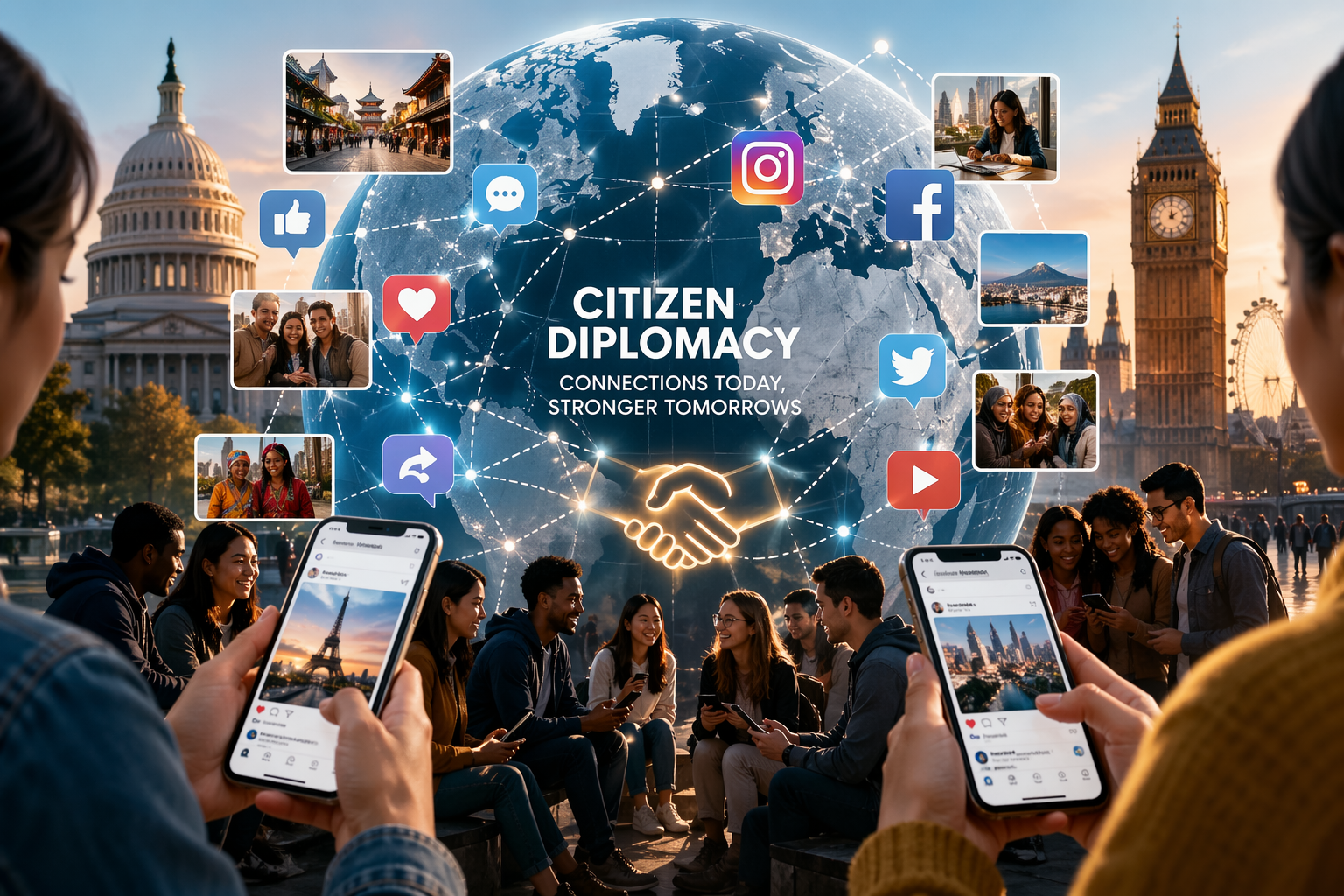
The internet and digital domain are becoming increasingly a larger part of both governance and civilian life. Specifically, social media has played a role in enhancing the magnitude in which private citizens of nations can independently connect with one another. Previously, the practice of citizen-diplomacy, defined as private citizens engaging with one another to influence international relations, was limited to in-person contact. The introduction of the internet has made social media an arena that can facilitate the practice of citizen-diplomacy and make it a common, and even frequent, interaction.
Citizen-diplomacy underscores the fabric of formalized diplomatic relationships between states. While alliances and other legitimate agreements between states provide the structure of various economic, military, and political relationships, social media operates in parallel crafting informal networks and online communities. These interactions of likes, comments, shares, and follows, while often overlooked, shape perceptions and impact narratives that contribute to the climate of broader state relationships.
While scrolling on social media, internet users can view a day-in-the-life of someone living in London, a recap of someone else’s research in Cape Town, walk with someone exploring Tokyo, or any other number of life events. In this way, the digital domain is elevated from the surface area of a phone to a medium through which individuals are exposed to different cultures and life experiences. The cumulative impact of constant exposure to citizens from other states can reinforce a deepened understanding between different groups. Further, as users begin to intentionally interact with international content and join digital international groups, they can function as citizen-diplomats and contribute to shaping how different societies understand each other. What appears to be insignificant online engagement actually has the propensity to redefine public sentiment and influence the conditions under which diplomacy operates at a formalized level.
Social Media as a Diplomatic Tool
Social media has become a valuable asset in a diplomatic tool kit. It can be used in a formalized manner. For example, many diplomats maintain social media accounts that allow them to share information with citizens of their home country, with citizens of their host country, and with the greater public.
In this way social media can facilitate soft power, promote transparency and engagement, and enhance strengthened international relations. Research shows that Americans are receiving the majority of their news via social media consumption. Various American diplomats leverage Instagram, Facebook, and Twitter accounts to post updates on their diplomatic engagements and endeavors. They use their social media accounts to show them visiting significant landmarks, meeting with officials from their host country, and engaging with the public. This builds positive rapport between the U.S. and other countries. This also illustrates the U.S.’s participation within the international community. In this way, social media becomes a force for goodwill and reinforces America’s interests abroad.
Impact of International Exposure on Citizens
As users scroll their feed, they have the potential to be passively exposed to content from international users. These moments, while not random, do not always have to be intentional, as international exposure has become a natural incident because of the existing globalized networks that connect people from around the world together.
These instances are not random because of how social media algorithms are designed to show users posts based on what they interact with. Essentially, different forms of engagement – from likes, comments, saves, and reshares – are assigned a value that is then multiplied by the probability you do indeed initiate that engagement. The higher the value, the more likely the post is going to be shown to the user. The social media “like” becomes an individual’s personal liaison to the world. What an individual “likes” on social media becomes the type of content they are repeatedly fed.
Through cumulative online foreign exposures, users can view the daily routines, story time videos, and personal experiences of someone living on a completely different continent. The impact this connection has is significant because it transforms what is foreign to something familiar. Repeated exposure to different national contexts reduces the perceived distance between those in different societies and contributes to an understanding of another way of life.
Potential for Social Media To Misinform
Further discussions of social media algorithms have found that they can create echo-chambers for users. When a user repeatedly likes the same types of content, the algorithm pushes posts similar to the user’s preferences, rather than showing them different content. As a result, research shows that social media has the propensity to be both connective tissue between different countries as well as an instrument for isolation.
Additionally, social media can be a platform for weaponized narratives and misinformation to spread. The low barrier to entry makes it so anyone can post content online, regardless of it being truthful or accurate. This creates an environment where false or misleading information is circulated and can gain even more traction if caught in algorithmic amplification. This problem is then compounded when adversarial actors act in parallel with one another, like Russia and China, who launch influence campaigns on social media to manipulate how they are perceived. At times, their independent messaging became interconnected and were amplified by one another. As seen in the COVID-19 crisis and the Russo-Ukrainian war, their overlapping narratives sought to improve their favorability online, as well as, spread confusion and distrust around competing narratives that were spreading truthful information. Studies found that those who were vulnerable to Russian propaganda and had aligned themselves with Russia in the Ukrainian war, were also in support of misinformation on COVID-19. The linkage between the two demonstrates how exposure on social media to one faulty perspective can enhance an individual’s receptivity to others, and create entire frameworks of opinions based on skewed information. In the context of diplomacy, these misinformation campaigns can complicate a diplomat’s efforts and make it difficult to advance the U.S.’s agenda over the volume of its enemies.
While algorithmic and informational concerns should be met with valid redress, they do not negate social media’s potential to be a cross-cultural bridge. Rather than labelling social media as inherently harmful, it is important to recognize it as a platform whose impact is defined by the intent of those wielding it, as well as by norms and institutional safeguards that are created for oversight. Of course, the U.S.’s adversaries can use social media, along with any other tool, for malign interference, but that does not justify an abandonment of social media for diplomatic gains. Rather, it emphasizes the need for democratic states to collaborate and construct norms around digital behavior. Strategic cooperation that is actively engaged with the social media space can formulate coordinated responses to misinformation and normalize being honest online. Further, social media sites can work in tandem with democratic states to manually flag misinformation and reduce the perception profits and increase the reputational costs of influence campaigns. Examples of this can be seen in how companies like Meta have worked with academia and law enforcement to remove misinformation for their platforms. This way the algorithm does not have the final say on what gets promoted and its negative effects can be neutralized through the oversight of norms and strategic coordination between states and social media corporations.
Ultimately, the imperfect ecosystem that is social media, retains its ability to foster citizen-diplomacy. The “like” and other interactions can become consequential when it can trigger algorithmic circulation and the alignment of truthful content with receptive viewers. Though not a formal negotiation tactic, the accumulation of engagement that increases exposure to truthful international content, when supported by truthful democratic coordination, can collectively shape how citizens receive truthful information and accurately perceive the nations around them.
From Exposure to Participation
What starts as observation can develop into participation. The diplomatic value of social media lies in embedding global awareness into an individual’s everyday life. Through logging on to watch a favorite vlogger’s “get ready with me” video, users in one country can comment on the post of someone who lives on the opposite side of the world and build cross-cultural dialogue in the comment section. Users can repost content that resonates with them, further amplifying a post’s global reach. When passive exposure grows into genuine affinity, that person’s perception of the international world is positively impacted. This shift marks a transformation in users observing the world to engage with it. When this occurs at scale for millions of social media users, social media becomes a powerful diplomatic force capable of influencing cultural understanding and the broader international landscape.
This participation can also become coordinated. Online communities and groups that are unified under an idea, shared interest, or belief, can bring together a diverse group of individuals into a single digital space. Examples of these kinds of groups with international membership look like the Marriage and Relationship Counseling Group, which is the largest Facebook group globally, at a staggering 7.6 million members. Interaction with these groups is powerful because it highlights issues that transcend borders and unite people, such as needing marital support. This elevation from viewer to active participant, is actual users becoming citizen-diplomats. How they interact online in these groups is shaping how the other users view not only them, but their country. Studies have shown that when members of different groups, in this case countries, interact in such a way where their status is equal and goals are aligned, their perception of one another is improved. Setting aside oppressive political regimes who limit their citizen’s access to free internet usage, social media is a territory where traditional borders between states can be thinned and genuine connection and understanding between different citizens can be built.
Conclusion
Whether these groups are for learning a language, playing video games, or just making friends, through initial passive exposure via scrolling, users can transition to becoming active participants within global communities and contribute to the social dimension of wider geopolitical dynamics. Citizen-diplomacy is centered around the idea that ordinary people can have an impact on international relations through interacting with foreign peoples and building mutual understanding.
Social media has become a domain where citizen-diplomacy can thrive and happen at an unprecedented scale. Casual exposure to international users can evolve to intentional and meaningful interactions between citizens of different nations and ultimately have the ability to be a force for good in shaping how people perceive different groups of citizens. The public sentiment generated online, underscores formalized diplomatic relationships and overall contributes to a stronger international system. In this way, the most subtle form of engagement, the “like”, becomes the liaison between different people that shapes how they view, interact with, and understand the world around them.


